Paper II — Q8
(a) Define biodiversity. Explain the various ex situ and in situ methods of conserving biodiversity. (20 marks) (b) What are…
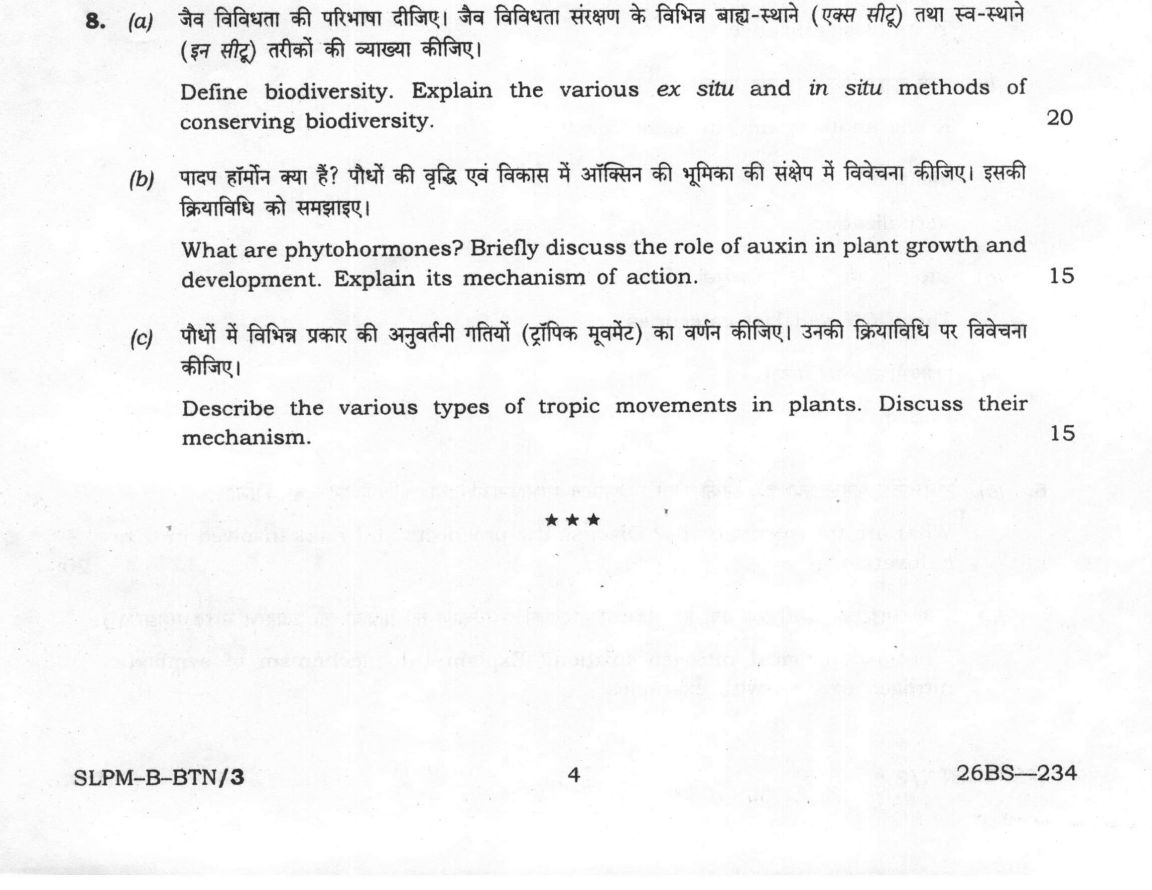
Define biodiversity. Explain the various ex situ and in situ methods of conserving biodiversity. 20 marks
What are phytohormones? Briefly discuss the role of auxin in plant growth and development. Explain its mechanism of action. 15 marks
Describe the various types of tropic movements in plants. Discuss their mechanism. 15 marks
हिंदी में प्रश्न पढ़ें
जैव विविधता की परिभाषा दीजिए। जैव विविधता संरक्षण के विभिन्न बाह्य-स्थाने (एक्स सिटु) तथा स्व-स्थाने (इन सिटु) तरीकों की व्याख्या कीजिए। (20 अंक)
पादप हार्मोन क्या हैं? पौधों की वृद्धि एवं विकास में ऑक्सिन की भूमिका की संक्षेप में विवेचना कीजिए। इसकी क्रियाविधि को समझाइए। (15 अंक)
पौधों में विभिन्न प्रकार की अनुवर्ती गतियों (ट्रॉपिक मूवमेंट) का वर्णन कीजिए। उनकी क्रियाविधि पर विवेचना कीजिए। (15 अंक)
Model answer
Written by UPSC Answer Check against this question's marking rubric, to the expected length. UPSC does not publish answers for Mains — this is one way to score well, not an official key.
Biodiversity and Conservation Strategies
Biodiversity represents the totality of genes, species, and ecosystems across the hierarchical organization of biological systems. It comprises genetic diversity (allelic variation within populations), species diversity (richness and evenness within a community), and ecosystem diversity (structural and functional habitat variations).
In situ conservation preserves organisms within their natural habitats, allowing evolutionary processes to continue unhindered. This is operationalized through a protected area network comprising National Parks (e.g., Kaziranga), Wildlife Sanctuaries, and Biosphere Reserves (e.g., Nilgiri Biosphere Reserve), supplemented by species-focused schemes like Project Tiger. It also encompasses community-conserved traditional landscapes, such as sacred groves in the Western Ghats and Meghalaya, and legally designated Community Reserves, safeguarding ecosystem integrity alongside endemic germplasm.
Ex situ conservation maintains threatened taxa outside their natural biophysical environments under managed conditions to prevent imminent extinction. This includes living collections in botanical gardens (such as the Royal Botanic Gardens, Kew, and AJC Bose Indian Botanic Garden) and zoological parks. Advanced germplasm conservation involves field gene banks for recalcitrant species, in vitro tissue culture, and long-term seed banks. High-tech cryopreservation at minus 196 degrees Celsius in liquid nitrogen—executed by institutions like the National Bureau of Plant Genetic Resources (NBPGR) and Foundation for Revitalisation of Local Health Traditions (FRLHT)—ensures long-term genomic stability for wild relatives of crops and endangered medicinal flora.
Phytohormones: Auxin Function and Molecular Action
Phytohormones are low-molecular-weight organic signal molecules biosynthesized by plants in minute concentrations (micromolar or lower) that regulate growth, differentiation, and environmental responses, distinguishing them from inorganic nutrients and energy-yielding metabolites.
Auxin, primarily Indole-3-Acetic Acid (IAA), along with related native compounds (e.g., Indole-3-Butyric Acid or IBA) and synthetic analogues (1-Naphthaleneacetic acid or NAA, 2,4-Dichlorophenoxyacetic acid or 2,4-D), orchestrates several developmental programs. It sustains apical dominance by suppressing axillary bud outgrowth, directs vascular differentiation into xylem and phloem elements, induces adventitious and lateral root initiation (IBA/NAA applications), stimulates parthenocarpic fruit set, and drives cellular expansion.
The mechanism of auxin action combines biophysical elongation and transcriptional reprogramming. Directional intercellular movement is regulated by Polar Auxin Transport (PAT), mediated by PIN-FORMED (PIN) efflux carriers. According to the Acid Growth Hypothesis, auxin rapidly stimulates plasma membrane proton-ATPases, pumping protons into the apoplast. The resulting wall acidification activates expansins and endoglucanases, which disrupt hydrogen bonds between xyloglucan and cellulose microfibrils, allowing turgor-driven cell expansion. At the molecular level, auxin enters the nucleus and acts as a molecular glue binding to the TIR1/AFB F-box receptor of the SCF-ubiquitin ligase complex. This binding facilitates the polyubiquitination and 26S proteasome-mediated degradation of Aux/IAA transcriptional repressors, thereby derepressing Auxin Response Factors (ARFs) to activate the transcription of primary auxin-responsive genes.
Tropic Movements and Mechanisms in Plants
Tropic movements are directional, irreversible growth responses wherein the direction of movement depends strictly on the vector of an environmental stimulus. These include phototropism (light vector), gravitropism (gravitational field), thigmotropism (tactile contact, seen in tendril coiling around supports), chemotropism (unidirectional chemical gradients, such as pollen tube elongation toward the ovular micropyle mediated by calcium and chemocyanin signals), and hydrotropism (moisture gradients).
Mechanistically, tropisms operate through asymmetric cellular elongation explained by the Cholodny-Went model. In phototropism, unilateral blue light activates phototropin photoreceptors (phot1 and phot2), causing their autophosphorylation. This triggers lateral repositioning of PIN3 and PIN7 efflux proteins toward the shaded side of the shoot apex, driving lateral auxin migration. The elevated auxin on the shaded flank promotes greater proton efflux and microfibril loosening, resulting in faster elongation than the lit flank and producing positive curvature toward light.
In gravitropism, physical perception occurs in root columella and shoot endodermis cells via sedimenting amyloplasts, known as the starch-statolith hypothesis. Statolith sedimentation onto the lower endoplasmic reticulum generates downstream cytosolic calcium fluxes and relocates PIN proteins to the lower membrane face. In roots, the resulting high auxin concentration on the lower side inhibits cell elongation (due to supra-optimal sensitivity), while the upper flank continues expanding, causing downward root curvature (positive gravitropism). In thigmotropism, mechanosensitive calcium channels trigger transient calcium spikes and cytoskeletal microfilament reorganization, slowing growth at the contact interface while accelerating outer flank expansion to drive tendril coiling.
Way Forward
Integrating our molecular understanding of plant tropisms, hormonal signaling networks, and physiological plasticity provides critical foundational insights for refining ex situ propagation protocols and optimizing micropropagation systems, ultimately strengthening biodiversity conservation strategies against climate-induced stresses.
What "Explain" is asking you to do
Make the working of something clear — what sets it off, what follows from what, and what it produces. Explain is the Commission's mechanism word: it dominates the technical papers and the “explain why” stems, where the marks sit in the causal chain and not in the label.
Structure that answers it
State what it is → the initiating condition → the chain of cause, step by step → an instance where it plays out → what the chain produces
Where marks are lost
Describing what something looks like instead of why it works that way. Naming the stages without linking them reads as description too.
How this answer will be evaluated
Approach
Framework: UPSC Botany Paper 2. (a) explain: definition/context > points in order > small example > short close | (b) explain: definition/context > points in order > small example > short close | (c) describe: define > structure or process in order > labelled diagram > significance Full marks: Comprehensive coverage of all sub-parts with precise mechanisms, specific examples, and clear distinction between concepts.
Key points expected
- Precise definition of biodiversity (genetic, species, ecosystem)
- In situ methods: National Parks, Sanctuaries, Biosphere Reserves
- Ex situ methods: Botanical gardens, Seed banks, Tissue culture
- Comparison or distinction between in situ and ex situ
- Definition of phytohormones (plant growth regulators)
- Role of auxin: Apical dominance, phototropism, cell elongation
- Mechanism: Acid growth hypothesis (H+ pump activation)
- Mechanism: Auxin transport (polar transport)
Evaluation rubric
Each sub-part is marked on its own, against the marks and word limit printed on the paper.
- (a) Definition of biodiversity and detailed explanation of in situ and ex situ conservation methods. 20 marks
explain— definition/context → points in order → small example → short close
Must cover
- Precise definition of biodiversity (genetic, species, ecosystem)
- In situ methods: National Parks, Sanctuaries, Biosphere Reserves
- Ex situ methods: Botanical gardens, Seed banks, Tissue culture
- Comparison or distinction between in situ and ex situ
Loses marks
- Confusing in situ and ex situ definitions
- Listing methods without explaining their function
- Ignoring the definition of biodiversity
Earns more
- Mention of specific Indian examples (e.g., Kaziranga, ICAR)
- Reference to IUCN Red List or CITES
- Mention of gene banks or cryopreservation
Extra mark
- Reference to specific legislation (Wildlife Protection Act)
- Mention of a specific endangered species (e.g., *Rafflesia arnoldii*)
- (b) Definition of phytohormones, role of auxin in growth, and its mechanism of action. 15 marks
explain— definition/context → points in order → small example → short close
Must cover
- Definition of phytohormones (plant growth regulators)
- Role of auxin: Apical dominance, phototropism, cell elongation
- Mechanism: Acid growth hypothesis (H+ pump activation)
- Mechanism: Auxin transport (polar transport)
Loses marks
- Confusing auxin with gibberellin functions
- Vague description of mechanism (no mention of pH or transport)
- Failing to define phytohormones
Earns more
- Mention of IAA (Indole-3-acetic acid) as primary auxin
- Reference to auxin receptors (TIR1/AFB)
- Mention of cytokinin antagonism
Extra mark
- Mention of synthetic auxins (2,4-D) in agriculture
- Reference to specific gene expression changes (e.g., *SAUR* genes)
- (c) Description of various types of tropic movements and their mechanisms. 15 marks
describe— define → structure or process in order → labelled diagram → significance
Must cover
- Definition of tropism (directional growth response)
- Types: Phototropism, Geotropism (Gravitropism), Hydrotropism
- Mechanism: Differential growth (auxin redistribution)
- Mechanism: Statolith hypothesis for gravitropism
Loses marks
- Confusing tropism with nastic movements (seismonasty)
- Listing types without explaining the mechanism
- Failing to mention directional stimulus
Earns more
- Distinction between positive and negative tropism
- Mention of thigmotropism (contact response)
- Reference to auxin transport in phototropism
Extra mark
- Mention of specific experimental evidence (e.g., Darwin's canary grass)
- Reference to specific statoliths (amyloplasts)
Practice this exact question
Write your answer and it is marked point by point against the model answer above — what you covered, what you missed, what you got wrong.
Evaluate my answer →More from Botany 2025 Paper II
- Q5 Write short notes on the following in about 150 words each: (a) Tests of significance (10…
- Q6 (a) What are transgenic crops? Discuss the prospects and risks involved in their cultivat…
- Q7 (a) What are the different gene transfer methods in plants? Give a brief account of direc…
- Q8 (a) Define biodiversity. Explain the various ex situ and in situ methods of conserving bi…