Paper II — Q5
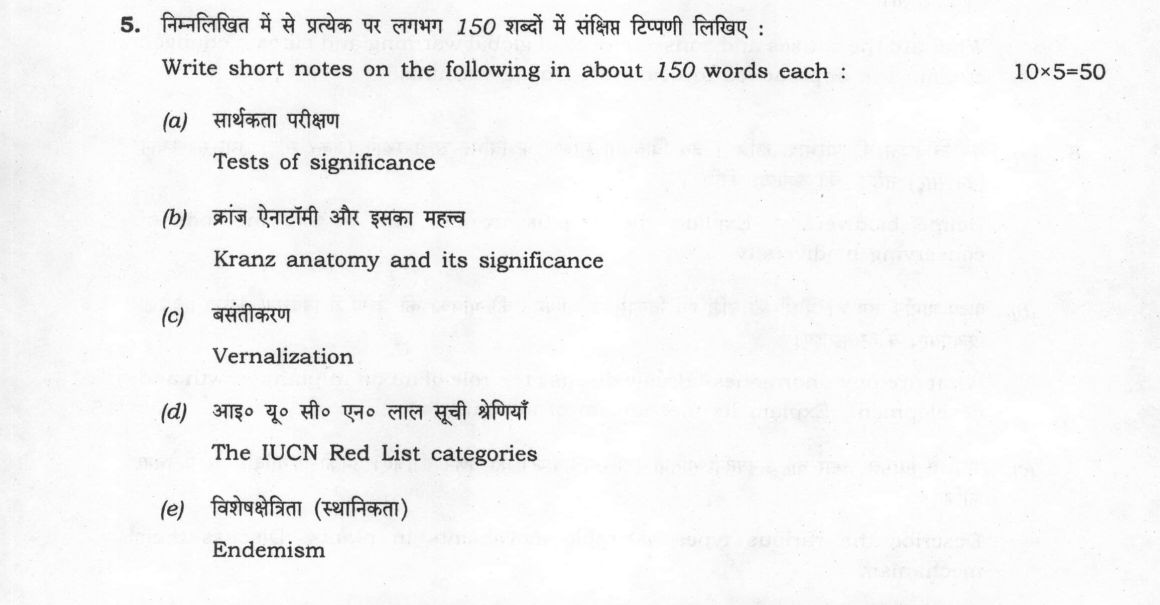
Write short notes on the following in about 150 words each: (a) Tests of significance (10 marks) (b) Kranz anatomy and its…
Write short notes on the following in about 150 words each:
Tests of significance 10 marks
Kranz anatomy and its significance 10 marks
Vernalization 10 marks
The IUCN Red List categories 10 marks
Endemism 10 marks
हिंदी में प्रश्न पढ़ें
निम्नलिखित में से प्रत्येक पर लगभग 150 शब्दों में संक्षिप्त टिप्पणी लिखिए :
सार्थकता परीक्षण (10 अंक)
क्रांज ऐनाटॉमी और इसका महत्व (10 अंक)
वसंतीकरण (10 अंक)
आई० यू० सी० एन० लाल सूची श्रेणियाँ (10 अंक)
विशेषक्षेत्रिता (स्थानिकता) (10 अंक)
Model answer
Written by UPSC Answer Check against this question's marking rubric, to the 150-word length. UPSC does not publish answers for Mains — this is one way to score well, not an official key.
Tests of Significance Statistical tests of significance determine whether observed differences or associations in biological data are likely due to chance or reflect true population parameters. The core framework involves the null hypothesis (H₀), which posits no significant difference or effect, and the alternative hypothesis (H₁), which suggests a significant difference exists. Three primary tests are utilized in botanical research. The t-test compares the means of two independent groups, such as plant height in treated versus control samples, relying on degrees of freedom to determine the critical value. The chi-square (χ²) test assesses goodness of fit, determining if observed genetic ratios match expected Mendelian ratios, or tests independence between categorical variables like flower color and pollinator type. The F-test, central to Analysis of Variance (ANOVA), evaluates differences among three or more means by comparing between-group variance to within-group variance. A result is deemed statistically significant if the p-value is less than 0.05, indicating a less than 5% probability that the null hypothesis is true.
Kranz Anatomy and its Significance Kranz anatomy is a specialized leaf structure characterized by two concentric layers of cells surrounding the vascular bundles. The inner layer consists of large, thick-walled bundle sheath cells containing numerous chloroplasts, often lacking grana (centric chloroplasts), while the outer mesophyll cells possess granal chloroplasts. This arrangement is the structural basis for C4 photosynthesis. In C4 plants, atmospheric CO₂ is first converted to bicarbonate (HCO₃⁻) by carbonic anhydrase in the mesophyll. Phosphoenolpyruvate carboxylase (PEP carboxylase) then fixes this bicarbonate into oxaloacetate, a four-carbon compound. This compound is transported to the bundle sheath cells, where it is decarboxylated to release high concentrations of CO₂ for the Calvin cycle. This spatial separation of initial carbon fixation and the Calvin cycle greatly minimizes photorespiration, although it does not completely suppress it under all conditions. This mechanism enhances photosynthetic efficiency in hot, dry environments. Prominent examples include maize, sugarcane, and sorghum, which exhibit higher water-use efficiency and growth rates compared to C3 plants under similar stress conditions.
Vernalization Vernalization is the physiological process by which exposure to prolonged low temperatures (typically 0–10°C) induces the transition from vegetative growth to flowering in certain plants. This phenomenon was first observed by Gustav Gassner in 1918, who noted that winter wheat required a cold period to flower. T. D. Lysenko later popularized the concept and termed it vernalization in 1928, linking it to his broader theories on thermoinduction. The process is critical for biennial and perennial plants, ensuring they flower only in spring after winter dormancy, thereby avoiding frost damage. The underlying mechanism involves epigenetic changes, particularly the suppression of the FLC (FLOWERING LOCUS C) gene, which acts as a repressor of flowering. While the "vernalin" hormone hypothesis was proposed historically, current understanding emphasizes chromatin remodeling and RNA interference. Vernalization is reversible; if plants are exposed to high temperatures after vernalization but before flowering, the effect can be lost, a process known as devernalization. This principle is applied in agriculture, such as in the cultivation of winter wheat and cabbage, where controlled cold treatments can synchronize flowering or induce bolting in brassicas.
The IUCN Red List Categories The IUCN Red List of Threatened Species is the global standard for assessing conservation status, using specific quantitative criteria to categorize species based on their risk of extinction. The categories range from the most severe to the least concern. Extinct (EX) species have no remaining individuals. Extinct in the Wild (EW) species survive only in captivity or as naturalized populations outside their historical range. Critically Endangered (CR) species face an extremely high risk of extinction in the wild, often due to rapid population decline or restricted range. Endangered (EN) species face a very high risk, while Vulnerable (VU) species face a high risk. Near Threatened (NT) species are likely to become threatened in the near future. Least Concern (LC) species are widespread and abundant. These classifications are determined by criteria including population size, geographic range (Extent of Occurrence and Area of Occupancy), population decline rates, and probability of extinction within specific time frames. The Red List serves as a vital tool for prioritizing conservation efforts and informing policy decisions globally.
Endemism Endemism refers to the ecological state of a species being unique to a defined geographic location, such as an island, country, or specific habitat, and found nowhere else on Earth. It is a key indicator of biodiversity hotspots and evolutionary isolation. Endemism is broadly classified into two types. Neo-endemism describes species that have recently evolved and have a narrow geographic range, often resulting from recent speciation events or isolation. Paleo-endemism refers to relict species that were once widespread but have become restricted to small areas due to environmental changes or competition. In India, endemism is particularly high in the Western Ghats and the Himalayas. For instance, Nepenthes khasiana, a pitcher plant, is endemic to the Khasi Hills in Meghalaya. Similarly, the Sal tree (Shorea robusta) is largely endemic to the Indian subcontinent. Conservation of endemic species is critical because their restricted ranges make them highly vulnerable to habitat loss, climate change, and invasive species. Protecting these unique taxa is essential for preserving global genetic diversity and ecosystem integrity.
What "Write short notes" is asking you to do
Five or six self-contained answers, marked separately, typically 10 marks and about 150 words each. Each note must carry its own definition, its two or three defining features and a line on why it matters; a common introduction or conclusion across the notes earns nothing.
Structure that answers it
Per note: one-line definition or identification → two or three features, mechanisms or named examples → one line of significance or Indian application
Where marks are lost
Writing the first two notes at essay length and rationing the rest. Each note is marked on its own, so marks surrendered on a compressed or unattempted note cannot be won back by the long ones.
How this answer will be evaluated
Approach
Framework: Botany Paper 2: Define > Structure/Process > Diagram > Significance. (a) write short notes: define > 3-4 key features > one example > one-line significance | (b) write short notes: define > 3-4 key features > one example > one-line significance | (c) write short notes: define > 3-4 key features > one example > one-line significance | (d) write short notes: define > 3-4 key features > one example > one-line significance | (e) write short notes: define > 3-4 key features > one example > one-line significance Full marks: Precise definitions, correct terminology (e.g., FLC, IUCN acronyms), and clear logical flow.
Key points expected
- Define null hypothesis (H0) and alternative hypothesis (H1)
- Explain the role of the p-value and significance level (α)
- Mention specific tests (e.g., t-test, chi-square, ANOVA)
- State the biological interpretation of a significant result
- Describe the concentric arrangement of mesophyll and bundle sheath cells
- Identify the location of Rubisco in bundle sheath cells
- Explain the spatial separation of C3 and C4 cycles
- State the advantage regarding photorespiration
Evaluation rubric
Each sub-part is marked on its own, against the marks and word limit printed on the paper.
- (a) Define statistical significance and outline the hypothesis testing procedure. · 150 words
write short notes— define → 3-4 key features → one example → one-line significance
Must cover
- Define null hypothesis (H0) and alternative hypothesis (H1)
- Explain the role of the p-value and significance level (α)
- Mention specific tests (e.g., t-test, chi-square, ANOVA)
- State the biological interpretation of a significant result
Loses marks
- Confusing statistical significance with biological importance
- Failing to define the null hypothesis
Earns more
- Mention Type I and Type II errors
- Reference specific software or manual calculation method
Extra mark
- Provide a specific example of a test used in a plant study
- (b) Describe the anatomical arrangement of Kranz structure and its role in C4 photosynthesis. · 150 words
write short notes— define → 3-4 key features → one example → one-line significance
Must cover
- Describe the concentric arrangement of mesophyll and bundle sheath cells
- Identify the location of Rubisco in bundle sheath cells
- Explain the spatial separation of C3 and C4 cycles
- State the advantage regarding photorespiration
Loses marks
- Describing C3 anatomy instead of C4
- Failing to link anatomy to the C4 cycle
Earns more
- Mention the presence of large chloroplasts in bundle sheath cells
- Name a specific C4 crop (e.g., *Zea mays*, *Sorghum bicolor*)
Extra mark
- Include a labelled diagram of the Kranz anatomy
- (c) Define vernalization and explain the physiological mechanism of cold-induced flowering. · 150 words
write short notes— define → 3-4 key features → one example → one-line significance
Must cover
- Define vernalization as a requirement for prolonged cold
- Explain the role of the *FLC* gene (repression of flowering)
- Mention the role of gibberellins (GA) in promoting flowering
- Distinguish between obligate and facultative vernalization
Loses marks
- Confusing vernalization with photoperiodism
- Failing to mention the genetic mechanism (FLC)
Earns more
- Mention the *FT* (Flowering Locus T) gene
- Name a specific biennial plant (e.g., *Brassica napus*)
Extra mark
- Mention the concept of 'vernalins' (historical term)
- (d) List and define the categories of the IUCN Red List of Threatened Species. · 150 words
write short notes— define → 3-4 key features → one example → one-line significance
Must cover
- List the main categories (EX, EW, CR, EN, VU, NT, LC, DD)
- Define 'Critically Endangered' (CR) and 'Endangered' (EN)
- Define 'Least Concern' (LC) and 'Data Deficient' (DD)
- Mention the criteria used (population decline, range, etc.)
Loses marks
- Listing categories in the wrong order of threat
- Failing to define the acronyms
Earns more
- Mention the 'Near Threatened' (NT) category
- Reference the IUCN Red List as a global standard
Extra mark
- Name a specific species in a threatened category (e.g., *Panthera tigris*)
- (e) Define endemism and discuss its significance in biogeography and conservation. · 150 words
write short notes— define → 3-4 key features → one example → one-line significance
Must cover
- Define endemism as restriction to a specific geographic area
- Distinguish between micro-endemism and macro-endemism
- Explain the link between endemism and island biogeography
- State the conservation priority of endemic species
Loses marks
- Confusing endemism with rarity
- Failing to mention the geographic restriction
Earns more
- Mention 'biodiversity hotspots' as areas of high endemism
- Name a specific endemic plant (e.g., *Rafflesia arnoldii*)
Extra mark
- Mention the concept of 'relict' species
Practice this exact question
Write your answer and it is marked point by point against the model answer above — what you covered, what you missed, what you got wrong.
Evaluate my answer →More from Botany 2025 Paper II
- Q2 (a) What are the different methods of DNA sequencing? Elaborate the shotgun sequencing me…
- Q3 (a) Elucidate the molecular basis of sex determination in plants. Explain the role of hom…
- Q4 (a) What is organic evolution? Discuss in detail the indirect evidences of organic evolut…
- Q5 Write short notes on the following in about 150 words each: (a) Tests of significance (10…
- Q6 (a) What are transgenic crops? Discuss the prospects and risks involved in their cultivat…
- Q7 (a) What are the different gene transfer methods in plants? Give a brief account of direc…
- Q8 (a) Define biodiversity. Explain the various ex situ and in situ methods of conserving bi…