Paper II — Q3
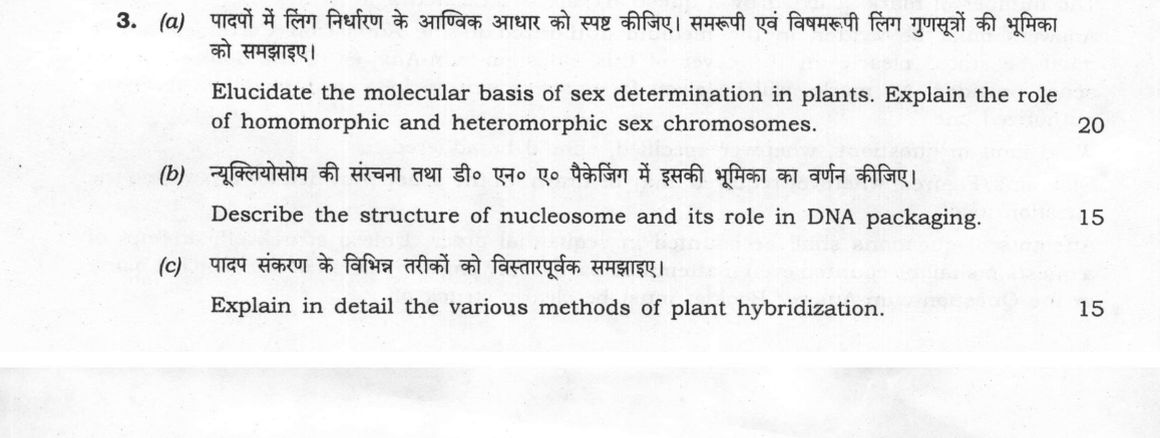
(a) Elucidate the molecular basis of sex determination in plants. Explain the role of homomorphic and heteromorphic sex…
Elucidate the molecular basis of sex determination in plants. Explain the role of homomorphic and heteromorphic sex chromosomes. 20 marks
Describe the structure of nucleosome and its role in DNA packaging. 15 marks
Explain in detail the various methods of plant hybridization. 15 marks
हिंदी में प्रश्न पढ़ें
पादपों में लिंग निर्धारण के आण्विक आधार को स्पष्ट कीजिए। समरूपी एवं विषमरूपी लिंग गुणसूत्रों की भूमिका को समझाइए। (20 अंक)
न्यूक्लियोसोम की संरचना तथा डी० एन० ए० पैकेजिंग में इसकी भूमिका का वर्णन कीजिए। (15 अंक)
पादप संकरण के विभिन्न तरीकों को विस्तारपूर्वक समझाइए। (15 अंक)
Model answer
Written by UPSC Answer Check against this question's marking rubric, to the expected length. UPSC does not publish answers for Mains — this is one way to score well, not an official key.
Sex Determination and Chromatin Architecture in Plant Breeding
Sex determination in plants is genetically controlled, ranging from environmental triggers to complex chromosomal systems. Understanding these mechanisms, alongside the structural basis of DNA packaging, is fundamental for exploiting hybrid vigor in crop improvement.
Molecular Basis of Sex Determination The molecular basis of sex determination involves specific loci that dictate floral organ development. In dioecious species, the S-locus (Sex-determining locus) on the sex chromosomes contains master regulatory genes. For instance, in Silene latifolia (pink mallow), the Y chromosome carries a dominant MADS-box gene that suppresses pistil development, while the X chromosome retains the default female pathway. Epigenetic regulation, such as DNA methylation and histone modification, often silences these genes in the heterogametic sex, ensuring unisexual flower formation.
Sex chromosomes are classified based on morphology. Heteromorphic sex chromosomes are morphologically distinct, such as the XY system in Silene latifolia and Rumex (dock), where the Y chromosome is significantly smaller and heterochromatic due to degeneration. This degeneration results from the loss of recombination, leading to an accumulation of transposable elements and gene decay. In contrast, Homomorphic sex chromosomes are cryptic and morphologically identical, as seen in Papaya (Carica papaya) and Asparagus. Here, sex determination is controlled by small, specific genetic differences rather than large chromosomal structural changes. While haplodiploidy is a sex-determination mechanism in some animals, it is not the primary model for plant sex determination; instead, plants rely on XX/XY or ZW/ZZ systems. The ZW/ZZ system, found in some ferns and gymnosperms, features a heterogametic female (ZW) and homogametic male (ZZ).
Nucleosome Structure and DNA Packaging The nucleosome is the fundamental unit of chromatin. It consists of a histone octamer, formed by two copies each of H2A, H2B, H3, and H4, around which 147 base pairs of DNA are wrapped in 1.65 left-handed superhelical turns. The nucleosome is connected to the next by linker DNA (10–80 bp). Histone H1, the linker histone, binds to the dyad axis of the nucleosome and the entry/exit points of the DNA, forming the chromatosome.
The assembly of nucleosomes and linker DNA creates the primary 11-nm "beads-on-a-string" fiber. This structure exists without the involvement of H1. H1 facilitates the folding of this 11-nm fiber into the higher-order 30-nm fiber by promoting interactions between adjacent nucleosomes. This hierarchical packaging compacts the genome, fitting meters of DNA into the micron-scale nucleus. Crucially, chromatin remodeling complexes alter nucleosome positioning, regulating gene expression by making promoters accessible or inaccessible to transcription factors, thereby linking DNA structure to functional regulation.
Methods of Plant Hybridization Hybridization involves the controlled crossing of two genetically distinct parents to produce heterozygous offspring. The methods vary based on the crop's pollination biology.
For self-pollinated crops like wheat and rice, emasculation is required to prevent self-fertilization. In wheat, the anthers are removed before anthesis, and the flower is bagged to prevent foreign pollen contamination. Hand pollination is then performed with pollen from the desired male parent. In rice, emasculation is difficult due to the small flower size; therefore, gamma irradiation or chemical treatments are sometimes used to induce male sterility, facilitating cross-pollination.
For cross-pollinated crops like maize, emasculation is not needed. The tassels (male inflorescences) of the female parent are removed, and the ear is bagged. Pollen from the selected male parent is applied to the silks. Cotton (Gossypium hirsutum), although predominantly self-pollinated, can be crossed by emasculating the flower buds before anthesis, a technique essential for developing interspecific hybrids like Gossypium hirsutum × G. barbadense.
Somatic hybridization offers a route for distant crosses where sexual hybridization fails. Protoplasts (cells without cell walls) from two different species are fused using polyethylene glycol (PEG) or electrofusion. The resulting hybrid cells are cultured to regenerate plants. However, somatic hybrids are often sterile or aneuploid, requiring further genetic manipulation or chromosome elimination to achieve stability.
Conclusion The elucidation of sex-determining genes and nucleosome dynamics provides the theoretical framework for modern breeding. By understanding the molecular controls of sex and chromatin accessibility, breeders can design precise hybridization protocols. Integrating these insights with techniques like emasculation and somatic fusion allows for the creation of superior varieties, enhancing yield and stress resistance in Indian agriculture.
What "Elucidate" is asking you to do
Make a stated proposition plain and then prove it with instances. Elucidate stems almost always carry a claim or a named concept, and very often the words “with examples” or “with suitable diagrams” — the illustration is part of the directive, not decoration.
Structure that answers it
Plain-language statement of what the proposition means → the part that is obscure, resolved → first illustration → second illustration → why the proposition holds
Where marks are lost
Adding terminology; elucidate rewards removing it. The commoner loss is a clean explanation with no example, when the stem asked for examples.
How this answer will be evaluated
Approach
Framework: Botany Paper 2: Define > Structure/Process > Labelled Diagram > Significance. (a) explain: definition/context > points in order > small example > short close | (b) describe: define > structure or process in order > labelled diagram > significance | (c) explain: definition/context > points in order > small example > short close Full marks: Precise molecular/structural details, labelled diagrams, specific species examples, and clear significance.
Key points expected
- Molecular basis of sex determination (e.g., MADS-box genes, S-locus)
- Role of homomorphic sex chromosomes (e.g., XX/XY in *Silene latifolia*)
- Role of heteromorphic sex chromosomes (e.g., ZW in *Asparagus officinalis*)
- Labelled diagram of sex chromosome pairing or gene pathway
- Structure of nucleosome (histone octamer, linker DNA)
- Role in DNA packaging (10nm fiber, 30nm fiber)
- Labelled diagram of the nucleosome core particle
- Significance in chromatin compaction
Evaluation rubric
Each sub-part is marked on its own, against the marks and word limit printed on the paper.
- (a) Molecular mechanisms of sex determination and the specific roles of homomorphic vs heteromorphic chromosomes. 20 marks
explain— definition/context → points in order → small example → short close
Must cover
- Molecular basis of sex determination (e.g., MADS-box genes, S-locus)
- Role of homomorphic sex chromosomes (e.g., XX/XY in *Silene latifolia*)
- Role of heteromorphic sex chromosomes (e.g., ZW in *Asparagus officinalis*)
- Labelled diagram of sex chromosome pairing or gene pathway
Loses marks
- Confusing plant sex determination with animal (SRY) mechanisms
- Unlabelled diagrams of chromosomes
- Failing to distinguish homomorphic from heteromorphic roles
Earns more
- Mention of *Papaver* or *Cucumis* as specific examples
- Explanation of dosage compensation or X-inactivation
- Link to sex determination in dioecious crops
Extra mark
- Reference to recent biotech application in sex control
- Mention of specific gene names like *MADS1* or *SRY*
- (b) Structural components of the nucleosome and its specific function in DNA packaging. 15 marks
describe— define → structure or process in order → labelled diagram → significance
Must cover
- Structure of nucleosome (histone octamer, linker DNA)
- Role in DNA packaging (10nm fiber, 30nm fiber)
- Labelled diagram of the nucleosome core particle
- Significance in chromatin compaction
Loses marks
- Unlabelled diagrams of nucleosomes
- Confusing nucleosome with chromatin fiber
- Omitting the role of linker DNA
Earns more
- Mention of histone variants (H1, H2A.Z)
- Explanation of 'beads on a string' model
- Link to gene regulation via chromatin remodeling
Extra mark
- Reference to specific histone modifications (acetylation)
- Mention of nucleosome positioning in *Arabidopsis*
- (c) Detailed description of the various methods used in plant hybridization. 15 marks
explain— definition/context → points in order → small example → short close
Must cover
- Definition of plant hybridization
- Methods: Emasculation, Bagging, Pollination
- Labelled diagram of the hybridization process
- Significance in crop improvement
Loses marks
- Unlabelled diagrams of hybridization steps
- Confusing hybridization with polyploidy
- Failing to explain the purpose of bagging
Earns more
- Mention of specific crops (e.g., *Zea mays*, *Gossypium*)
- Explanation of emasculation timing (pre-anthesis)
- Link to biotechnology (e.g., marker-assisted selection)
Extra mark
- Reference to specific cultivars (e.g., 'Hybrid Vigor' in maize)
- Mention of recent biotech application in hybrid seed production
Practice this exact question
Write your answer and it is marked point by point against the model answer above — what you covered, what you missed, what you got wrong.
Evaluate my answer →More from Botany 2025 Paper II
- Q1 Write short notes on the following in about 150 words each: (a) Nuclear pore complex (10…
- Q2 (a) What are the different methods of DNA sequencing? Elaborate the shotgun sequencing me…
- Q3 (a) Elucidate the molecular basis of sex determination in plants. Explain the role of hom…
- Q4 (a) What is organic evolution? Discuss in detail the indirect evidences of organic evolut…
- Q5 Write short notes on the following in about 150 words each: (a) Tests of significance (10…
- Q6 (a) What are transgenic crops? Discuss the prospects and risks involved in their cultivat…