Paper II — Q6
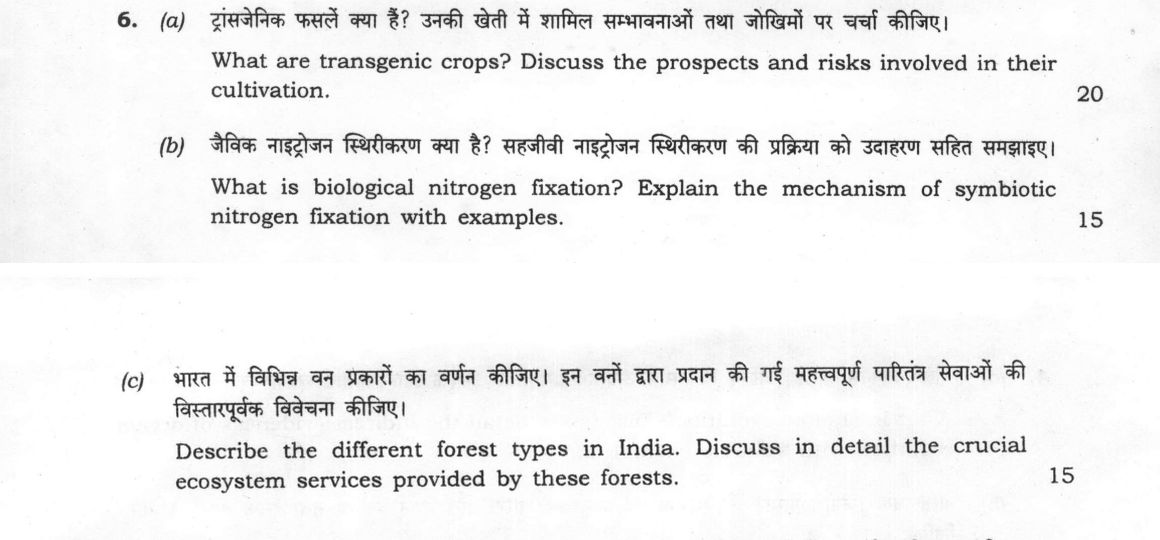
(a) What are transgenic crops? Discuss the prospects and risks involved in their cultivation. (20 marks) (b) What is biological…
What are transgenic crops? Discuss the prospects and risks involved in their cultivation. 20 marks
What is biological nitrogen fixation? Explain the mechanism of symbiotic nitrogen fixation with examples. 15 marks
Describe the different forest types in India. Discuss in detail the crucial ecosystem services provided by these forests. 15 marks
हिंदी में प्रश्न पढ़ें
ट्रांसजेनिक फसलें क्या हैं? उनकी खेती में शामिल संभावनाओं तथा जोखिमों पर चर्चा कीजिए। (20 अंक)
जैविक नाइट्रोजन स्थिरीकरण क्या है? सहजीवी नाइट्रोजन स्थिरीकरण की प्रक्रिया को उदाहरण सहित समझाइए। (15 अंक)
भारत में विभिन्न वन प्रकारों का वर्णन कीजिए। इन वनों द्वारा प्रदान की गई महत्वपूर्ण पारितंत्र सेवाओं की विस्तारपूर्वक विवेचना कीजिए। (15 अंक)
Model answer
Written by UPSC Answer Check against this question's marking rubric, to the expected length. UPSC does not publish answers for Mains — this is one way to score well, not an official key.
Transgenic Crops: Prospects and Risks
Transgenic crops are genetically modified organisms developed through recombinant DNA (rDNA) technology, wherein genes from unrelated species are stably integrated into a plant genome, distinct from cisgenesis which transfers genes within sexually compatible species.
Their cultivation offers significant prospects for agricultural sustainability and food security:
- Pest and disease resistance: Transgenics expressing Bacillus thuringiensis endotoxins (Cry proteins), such as Bt cotton and Bt brinjal, significantly reduce chemical insecticide reliance.
- Yield stability and biofortification: Enhancements like Golden Rice (engineered with phytoene synthase to synthesize β-carotene) address micronutrient deficiencies (hidden hunger).
- Herbicide tolerance and abiotic stress resilience: Introduction of drought-, submergence-, and salinity-tolerant genes stabilizes productivity under accelerating climate fluctuations.
However, ecological and socioeconomic risks warrant scrutiny:
- Gene flow: Outcrossing via pollen transfer to wild relatives risks creating herbicide-resistant "superweeds".
- Resistance evolution: Secondary pest outbreaks and resistance development, evidenced by Pink Bollworm (Pectinophora gossypiella) overcoming Cry1Ac/Cry2Ab toxins in Indian Bt cotton belts.
- Biosafety and health concerns: Potential allergenicity of novel proteins and non-target toxicity toward beneficial entomofauna, including pollinators.
- Socioeconomic dependence: Intellectual property rights (IPR) enforcement and hybrid-seed monopolies exacerbate farmer financial vulnerability.
In India, commercialization requires statutory biosafety clearances from the Genetic Engineering Appraisal Committee (GEAC) under the Environment (Protection) Act, 1986, adhering to international commitments under the Cartagena Protocol on Biosafety and the Nagoya Protocol on Access and Benefit-Sharing.
Biological Nitrogen Fixation: Mechanism and Examples
Biological Nitrogen Fixation (BNF) is the microbially mediated reduction of atmospheric dinitrogen (N₂) into biologically usable ammonia (NH₃), circumventing the energy-intensive industrial Haber-Bosch process.
The symbiotic mechanism comprises precise molecular cross-talk and biochemical pathways:
- Molecular signaling: Legume roots secrete flavonoids, inducing bacterial nod genes to produce lipochitooligosaccharide Nod factors.
- Infection and organogenesis: Nod factors induce root hair curling and an infection thread via invagination. Bacteria penetrate the cortical cells, triggering cell division and nodule organogenesis.
- Bacteroid differentiation: Bacteria enter host cytoplasm, encapsulated by a peribacteroid membrane, differentiating into bacteroids.
- Nitrogenase function and O₂ regulation: The enzyme complex—consisting of the Fe-protein (dinitrogenase reductase) and the Mo-Fe protein (dinitrogenase), transcribed via nif gene clusters—catalyzes N₂ + 8H⁺ + 8e⁻ + 16ATP → 2NH₃ + H₂ + 16ADP + 16Pᵢ. Because nitrogenase is irreversibly inactivated by oxygen, leghaemoglobin functions as an oxygen scavenger, maintaining microaerophilic conditions.
- Ammonia assimilation: Synthesized NH₃ is rapidly assimilated into amino acids via the Glutamine Synthetase–Glutamate Synthase (GS-GOGAT) pathway to avoid toxicity.
Key symbiotic associations include:
- Rhizobium with legumes like Glycine max (soybean) and Cajanus cajan (pigeon pea).
- Frankia (actinomycete) with non-legumes like Casuarina and Alnus.
- Anabaena azollae (cyanobacterium) in symbiotic association with the aquatic fern Azolla.
Forest Types and Ecosystem Services in India
Under the Champion and Seth (1968) classification, Indian forests are categorized into major groups: Tropical Wet Evergreen (Western Ghats, Northeast), Semi-Evergreen, Tropical Moist Deciduous (dominant across central-eastern tracts), Tropical Dry Deciduous, Subtropical/Thorn (arid northwest), Littoral and Swamp (Sundarbans mangroves), Montane Sub-tropical/Temperate, and Alpine meadows (Himalayan belt).
These forests render indispensable ecosystem services:
- Carbon sequestration: Western Ghats and northeastern forests serve as primary terrestrial carbon sinks, mitigating global warming.
- Hydrological and watershed regulation: Himalayan and Central Indian catchment forests stabilize streamflow, regulate groundwater recharge, and prevent siltation.
- Biodiversity preservation: Harboring endemic germplasm within global biodiversity hotspots, providing natural pollination buffers for adjacent agricultural landscapes.
- Soil conservation: Canopy cover and root networks prevent topsoil erosion, mitigating landslides in fragile montane topographies.
- Socioeconomic and cultural sustenance: Provisioning of non-timber forest products (NTFPs) sustains tribal livelihoods, alongside the preservation of sacred groves.
Way Forward
A sustainable agricultural future requires harmonizing ecological conservation with biotechnological advancements. Integrating transgenic research—such as engineering non-legumes for endosymbiotic nitrogen fixation—reduces synthetic fertilizer dependency. Concurrently, strengthening governance under the National Forest Policy (evolving from 1952 to the 1988 ecological paradigm) and the National Action Plan on Climate Change (NAPCC) will protect natural sinks, ensuring climate-resilient agro-ecosystems.
What "Discuss" is asking you to do
Lay the issue out from more than one side — how it arose, what is claimed for it, what is held against it, and where it now stands. UPSC attaches discuss to broad topics with several live dimensions, so coverage of the dimensions earns more than the strength of your opinion.
Structure that answers it
Set the issue up → the case as it is made → the case against → the dimension both sides leave out → where the balance now lies
Where marks are lost
Listing facts with no thread between them, or arguing one side throughout and calling it a discussion.
How this answer will be evaluated
Approach
Framework: UPSC Botany Paper 2. (a) discuss: intro > 3-4 dimensions > example > balanced close | (b) explain: definition/context > points in order > small example > short close | (c) describe: define > structure or process in order > labelled diagram > significance Full marks: Comprehensive coverage of all sub-parts with specific examples, binomials, and balanced analysis.
Key points expected
- Precise definition of transgenic crops (GMOs)
- Prospects: pest resistance (e.g., Bt cotton), herbicide tolerance
- Risks: gene flow to wild relatives, biodiversity loss
- Risks: socio-economic issues (seed cost, corporate control)
- Definition of biological nitrogen fixation (N2 to NH3)
- Role of Rhizobium and legume root nodules
- Mechanism: Nodulation, nitrogenase enzyme, leghemoglobin
- Example: *Rhizobium* in *Pisum sativum* or *Medicago sativa*
Evaluation rubric
Each sub-part is marked on its own, against the marks and word limit printed on the paper.
- (a) Definition of transgenic crops, followed by a balanced analysis of their cultivation prospects and risks. 20 marks
discuss— intro → 3-4 dimensions → example → balanced close
Must cover
- Precise definition of transgenic crops (GMOs)
- Prospects: pest resistance (e.g., Bt cotton), herbicide tolerance
- Risks: gene flow to wild relatives, biodiversity loss
- Risks: socio-economic issues (seed cost, corporate control)
Loses marks
- Confusing transgenic with hybrid or conventional breeding
- Ignoring the 'risks' aspect of the command word
Earns more
- Mention of specific cultivars (e.g., Bt brinjal, Golden Rice)
- Reference to regulatory bodies (GEAC, India)
Extra mark
- Recent biotech application (e.g., virus-resistant papaya)
- Specific statistic on yield increase or pesticide reduction
- (b) Definition of biological nitrogen fixation and a stepwise mechanism of the symbiotic process with examples. 15 marks
explain— definition/context → points in order → small example → short close
Must cover
- Definition of biological nitrogen fixation (N2 to NH3)
- Role of Rhizobium and legume root nodules
- Mechanism: Nodulation, nitrogenase enzyme, leghemoglobin
- Example: *Rhizobium* in *Pisum sativum* or *Medicago sativa*
Loses marks
- Omitting the role of leghemoglobin in oxygen protection
- Using common names instead of binomials for bacteria/plants
Earns more
- Mention of energy requirement (ATP) for the process
- Distinction between symbiotic and non-symbiotic fixation
Extra mark
- Diagram of root nodule structure
- Mention of specific nitrogenase subunits (Fe-protein, Mo-protein)
- (c) Classification of Indian forest types and a detailed discussion of their ecosystem services. 15 marks
describe— define → structure or process in order → labelled diagram → significance
Must cover
- Classification: Tropical Evergreen, Tropical Deciduous, Montane, etc.
- Ecosystem service: Water regulation and watershed protection
- Ecosystem service: Carbon sequestration and climate regulation
- Ecosystem service: Biodiversity conservation and genetic resources
Loses marks
- Listing forest types without describing their characteristics
- Failing to link services to the specific forest types mentioned
Earns more
- Mention of specific forest types (e.g., Tropical Thorn, Mangroves)
- Linking services to specific regions (e.g., Western Ghats)
Extra mark
- Reference to specific conservation acts (Forest Conservation Act)
- Mention of specific endemic species in a forest type
Practice this exact question
Write your answer and it is marked point by point against the model answer above — what you covered, what you missed, what you got wrong.
Evaluate my answer →More from Botany 2025 Paper II
- Q3 (a) Elucidate the molecular basis of sex determination in plants. Explain the role of hom…
- Q4 (a) What is organic evolution? Discuss in detail the indirect evidences of organic evolut…
- Q5 Write short notes on the following in about 150 words each: (a) Tests of significance (10…
- Q6 (a) What are transgenic crops? Discuss the prospects and risks involved in their cultivat…
- Q7 (a) What are the different gene transfer methods in plants? Give a brief account of direc…
- Q8 (a) Define biodiversity. Explain the various ex situ and in situ methods of conserving bi…