Paper II — Q2
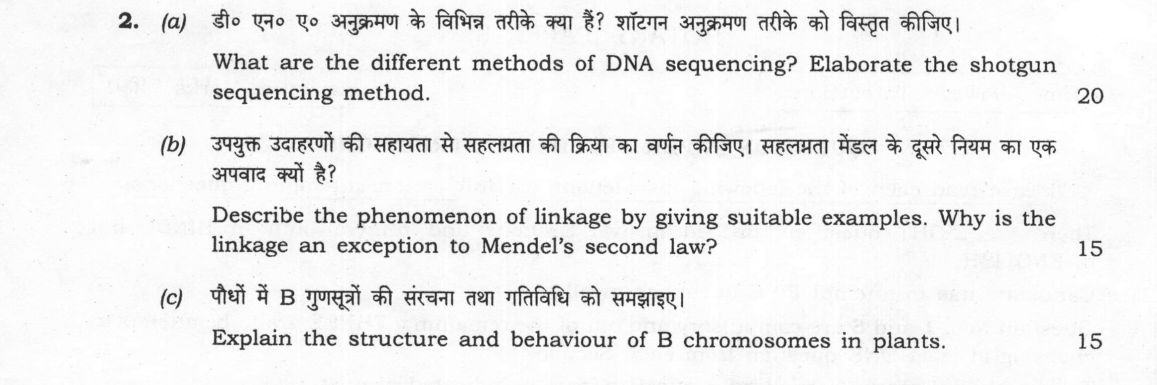
(a) What are the different methods of DNA sequencing? Elaborate the shotgun sequencing method. (20 marks) (b) Describe the…
What are the different methods of DNA sequencing? Elaborate the shotgun sequencing method. 20 marks
Describe the phenomenon of linkage by giving suitable examples. Why is the linkage an exception to Mendel's second law? 15 marks
Explain the structure and behaviour of B chromosomes in plants. 15 marks
हिंदी में प्रश्न पढ़ें
डी० एन० ए० अनुक्रमण के विभिन्न तरीके क्या हैं? शॉटगन अनुक्रमण तरीके को विस्तृत कीजिए। (20 अंक)
उपयुक्त उदाहरणों की सहायता से सहलग्नता की क्रिया का वर्णन कीजिए। सहलग्नता मेंडल के दूसरे नियम का एक अपवाद क्यों है? (15 अंक)
पौधों में B गुणसूत्रों की संरचना तथा गतिविधि को समझाइए। (15 अंक)
Model answer
Written by UPSC Answer Check against this question's marking rubric, to the expected length. UPSC does not publish answers for Mains — this is one way to score well, not an official key.
Methods of DNA Sequencing and Shotgun Assembly
The advent of high-throughput technologies has revolutionized genomics, enabling the rapid determination of nucleotide sequences. DNA sequencing methods are broadly classified into first, second, and third generations. First-generation sequencing, represented by Sanger’s dideoxy method, relies on chain termination using ddNTPs and capillary electrophoresis, offering high accuracy but low throughput. Second-generation or Next-Generation Sequencing (NGS), such as Illumina’s sequencing by synthesis and Ion Torrent’s semiconductor-based detection, produces massive parallel reads with high speed but shorter read lengths. Third-generation methods, including PacBio’s Single Molecule Real-Time (SMRT) sequencing and Oxford Nanopore Technologies, sequence individual DNA molecules in real-time, generating long reads that facilitate the resolution of complex genomic regions.
Shotgun Sequencing Shotgun sequencing is a strategy for determining the sequence of long DNA molecules by breaking them into random fragments, sequencing them, and reassembling the data computationally. The workflow involves:
- Random Fragmentation: Genomic DNA is sheared into random fragments of defined size (e.g., 3–5 kb for BAC libraries or shorter for NGS).
- Library Preparation: These fragments are ligated into cloning vectors (like BACs or plasmids) or adapters for NGS platforms.
- Sequencing: The clones or fragments are sequenced from both ends (paired-end) to generate overlapping reads.
- Computational Assembly: Algorithms identify overlaps between reads to construct contigs, which are then ordered into scaffolds using paired-end information. This de novo approach contrasts with hierarchical (clone-by-clone) sequencing, which relies on physical maps. While hierarchical sequencing is more accurate for large genomes, shotgun sequencing is faster and cost-effective. In India, while institutions like NIPGR and IARI contribute significantly to functional genomics, major de novo assemblies of crops like chickpea and pigeonpea were led by international consortia involving ICRISAT, highlighting the collaborative nature of global genomics.
Linkage and Mendel’s Second Law Linkage is the tendency of genes located on the same chromosome to be inherited together. It was first observed by Bateson and Punnett in Lathyrus odoratus (sweet pea), where the 9:3:3:1 dihybrid ratio was not obtained; instead, parental combinations were more frequent than recombinants. Thomas Hunt Morgan’s work on Drosophila further established that genes are arranged linearly on chromosomes, forming linkage groups.
Linkage is an exception to Mendel’s Second Law (Independent Assortment) because Mendel’s law assumes that alleles of different genes segregate independently during gamete formation. However, genes on the same chromosome are physically linked and do not assort independently unless separated by crossing over. The degree of linkage is measured by recombination frequency (RF), where 1% RF equals 1 map unit (centimorgan). Complete linkage occurs when no crossing over happens, while incomplete linkage results from recombination. Thus, linkage demonstrates that independent assortment is not universal but depends on chromosomal location.
B Chromosomes in Plants B chromosomes, or supernumerary chromosomes, are extra chromosomes that are not essential for viability or fertility. Structurally, they are typically smaller than A chromosomes, highly heterochromatic, and possess functional centromeres, although their centromeric repeats may differ from A chromosomes. They often contain repetitive DNA sequences and lack many functional genes found on A chromosomes. B chromosomes are found in various plants, including maize (Zea mays), rye (Secale cereale), and Coix species.
The behavior of B chromosomes is characterized by non-Mendelian inheritance and accumulation. A key mechanism is "drive," where B chromosomes are transmitted to offspring at a rate higher than 50%. In many plants, this drive occurs during the second pollen mitosis. Here, nondisjunction of B chromatids ensures that both B chromatids are preferentially transmitted to one of the two sperm nuclei. This B-containing sperm nucleus then has a competitive advantage in fertilizing the egg cell, leading to an increase in B chromosome frequency in the population. B chromosomes can also interfere with A chromosome pairing during meiosis, potentially causing sterility or phenotypic changes. As selfish genetic elements, B chromosomes provide insights into genome evolution and the dynamics of chromosomal instability in plant populations.
Conclusion Understanding sequencing methodologies, linkage, and B chromosome dynamics is crucial for modern plant breeding. Shotgun sequencing accelerates genome characterization, while knowledge of linkage aids in marker-assisted selection. Furthermore, recognizing B chromosomes as selfish elements helps in managing genetic variability and improving crop stability.
What "Elaborate" is asking you to do
Give the full detailed account the question has compressed into a line — every dimension of it, with specifics. Elaborate rewards completeness and detail rather than clarification or argument: the examiner is checking whether you can fill out a topic without being told what its parts are.
Structure that answers it
State the proposition → first dimension in detail → second dimension in detail → the part the statement leaves implicit → the consolidated picture
Where marks are lost
Repeating the statement at greater length instead of adding substance. Elaborate also punishes narrowness: omitting a whole dimension costs more here than anywhere else in this family.
How this answer will be evaluated
Approach
Framework: UPSC Botany Paper 2. (a) describe: define > structure or process in order > labelled diagram > significance | (b) describe: define > structure or process in order > labelled diagram > significance | (c) explain: definition/context > points in order > small example > short close Full marks: Precise definitions, named species, clear diagrams, and logical flow.
Key points expected
- List Sanger, Maxam-Gilbert, and Next-Gen methods
- Define shotgun sequencing as random fragmentation
- Explain assembly of overlapping reads (contigs)
- Mention use of BACs for large genomes
- Define linkage as co-inheritance of alleles
- Cite *Drosophila* (Bridges) or *Nicotiana* (Bateson) example
- Explain physical proximity on same chromosome
- Contrast with Mendel's Law of Independent Assortment
Evaluation rubric
Each sub-part is marked on its own, against the marks and word limit printed on the paper.
- (a) List DNA sequencing methods and detail the shotgun sequencing process. 20 marks
describe— define → structure or process in order → labelled diagram → significance
Must cover
- List Sanger, Maxam-Gilbert, and Next-Gen methods
- Define shotgun sequencing as random fragmentation
- Explain assembly of overlapping reads (contigs)
- Mention use of BACs for large genomes
Loses marks
- Confusing shotgun with whole-genome shotgun
- Omitting the assembly step
- Unlabelled diagrams
Earns more
- Labelled diagram of shotgun assembly
- Mention of *E. coli* or *Drosophila* as first sequenced
- Comparison of read lengths (Sanger vs NGS)
- Mention of 'shotgun' term origin
Extra mark
- Mention of Human Genome Project application
- Reference to specific software (e.g., Phrap)
- (b) Define linkage with examples and explain its conflict with Mendel's second law. 15 marks
describe— define → structure or process in order → labelled diagram → significance
Must cover
- Define linkage as co-inheritance of alleles
- Cite *Drosophila* (Bridges) or *Nicotiana* (Bateson) example
- Explain physical proximity on same chromosome
- Contrast with Mendel's Law of Independent Assortment
Loses marks
- Confusing linkage with epistasis
- Failing to mention Mendel's second law explicitly
- Vague examples without species names
Earns more
- Diagram of linked vs unlinked genes
- Mention of recombination frequency
- Reference to 'coupling' and 'repulsion' phases
- Mention of Morgan's work
Extra mark
- Mention of specific gene loci (e.g., *vg*, *pr*)
- Reference to genetic mapping
- (c) Describe the structure and meiotic behavior of B chromosomes in plants. 15 marks
explain— definition/context → points in order → small example → short close
Must cover
- Define B chromosomes as supernumerary elements
- Describe structure (smaller, heterochromatic)
- Explain lagging behavior during meiosis
- Mention non-Mendelian inheritance pattern
Loses marks
- Confusing B chromosomes with A chromosomes
- Failing to explain 'lagging' behavior
- Unlabelled diagrams
Earns more
- Diagram of B chromosome lagging
- Mention of *Oryza sativa* or *Triticum* examples
- Discussion of 'selfish' DNA nature
- Mention of B chromosome effects on fertility
Extra mark
- Reference to specific B chromosome names (e.g., B1, B2)
- Mention of molecular markers for B chromosomes
Practice this exact question
Write your answer and it is marked point by point against the model answer above — what you covered, what you missed, what you got wrong.
Evaluate my answer →More from Botany 2025 Paper II
- Q1 Write short notes on the following in about 150 words each: (a) Nuclear pore complex (10…
- Q2 (a) What are the different methods of DNA sequencing? Elaborate the shotgun sequencing me…
- Q3 (a) Elucidate the molecular basis of sex determination in plants. Explain the role of hom…
- Q4 (a) What is organic evolution? Discuss in detail the indirect evidences of organic evolut…
- Q5 Write short notes on the following in about 150 words each: (a) Tests of significance (10…