Paper II — Q7
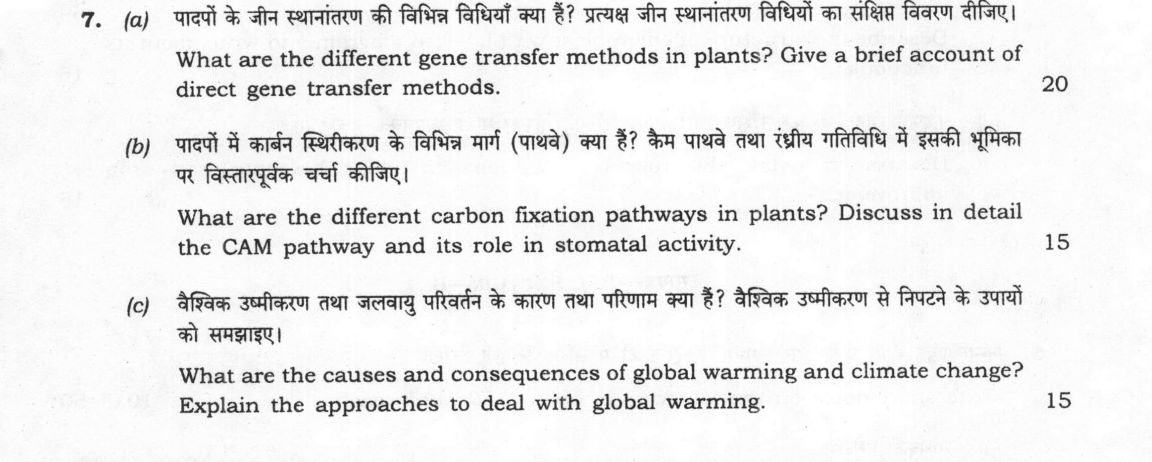
(a) What are the different gene transfer methods in plants? Give a brief account of direct gene transfer methods. (20 marks) (b)…
What are the different gene transfer methods in plants? Give a brief account of direct gene transfer methods. 20 marks
What are the different carbon fixation pathways in plants? Discuss in detail the CAM pathway and its role in stomatal activity. 15 marks
What are the causes and consequences of global warming and climate change? Explain the approaches to deal with global warming. 15 marks
हिंदी में प्रश्न पढ़ें
पादपों के जीन स्थानांतरण की विभिन्न विधियाँ क्या हैं? प्रत्यक्ष जीन स्थानांतरण विधियों का संक्षिप्त विवरण दीजिए। (20 अंक)
पादपों में कार्बन स्थिरीकरण के विभिन्न मार्ग (पाथवे) क्या हैं? कैम पाथवे तथा रंध्रीय गतिविधि में इसकी भूमिका पर विस्तारपूर्वक चर्चा कीजिए। (15 अंक)
वैश्विक उष्मीकरण तथा जलवायु परिवर्तन के कारण तथा परिणाम क्या हैं? वैश्विक उष्मीकरण से निपटने के उपायों को समझाइए। (15 अंक)
Model answer
Written by UPSC Answer Check against this question's marking rubric, to the expected length. UPSC does not publish answers for Mains — this is one way to score well, not an official key.
Gene Transfer, Carbon Fixation, and Climate Change
Plant biotechnology, photosynthetic efficiency, and global climate dynamics are interconnected themes defining modern agricultural science. Understanding genetic engineering mechanisms, alternative carbon fixation pathways, and climate mitigation strategies is crucial for developing resilient food systems.
Part (a): Gene Transfer Methods in Plants
Gene transfer in plants is classified into indirect (vector-mediated) and direct methods. Indirect methods utilize biological vectors to introduce foreign DNA. The most prominent is *Agrobacterium tumefaciens*-mediated transformation, where the Ti-plasmid’s T-DNA integrates into the plant genome. Another significant indirect method involves plant virus vectors, which exploit viral replication machinery to deliver transgenes, particularly useful for transient expression in research.
Direct methods bypass vectors, delivering DNA physically or chemically. Biolistics (Gene Gun): This method uses a high-pressure helium pulse to accelerate gold or tungsten particles coated with DNA into plant cells. It is versatile for recalcitrant species but causes significant tissue damage and low transformation efficiency due to multi-copy integration. Electroporation: An electric field creates transient pores in the plasma membrane, allowing DNA uptake. It is effective for protoplasts but limited by cell viability issues and the need for cell culture for regeneration. Microinjection: A fine glass needle directly injects DNA into the nucleus of large cells, such as zygotes or embryos. While precise, it is labor-intensive and has low throughput, restricting its use to specific model organisms. PEG-mediated Transformation: Polyethylene glycol (PEG) induces membrane fusion between protoplasts and DNA-coated liposomes or directly facilitates DNA uptake through osmotic stress. It is cost-effective but often results in low regeneration rates. Silicon Carbide Whiskers: These microscopic fibers pierce the cell wall and membrane, carrying DNA into the cytoplasm. It is a low-cost alternative to biolistics but suffers from similar tissue damage issues.
Part (b): Carbon Fixation Pathways and CAM
Plants utilize three main carbon fixation pathways: C3, C4, and CAM. C3 plants fix CO2 directly via RuBisCO, while C4 plants spatially separate initial fixation (mesophyll) and Calvin cycle (bundle sheath) to minimize photorespiration. CAM (Crassulacean Acid Metabolism) plants, adapted to arid environments, temporally separate these processes.
In CAM plants, stomata open at night to minimize water loss. CO2 is fixed by PEP carboxylase into oxaloacetate, which is reduced to malate and stored in vacuoles. During the day, stomata close. Malate is transported to the mitochondria, where NAD-malic enzyme decarboxylates it to release CO2 and pyruvate. The CO2 is then refixed by RuBisCO in the Calvin cycle within the chloroplasts. Some CAM plants use PEP carboxykinase, which converts oxaloacetate (derived from malate) to PEP and CO2 in the cytosol. This temporal separation allows CAM plants to maintain high water-use efficiency, crucial for survival in deserts.
Part (c): Global Warming: Causes, Consequences, and Approaches
Global warming is driven by anthropogenic greenhouse gas (GHG) emissions, primarily from fossil fuel combustion, deforestation, and industrial agriculture. These emissions enhance the greenhouse effect, trapping heat in the atmosphere.
The consequences are severe: rising sea levels threaten coastal communities, ocean acidification disrupts marine ecosystems, and extreme weather events increase agricultural volatility. Biodiversity loss and crop yield declines pose food security risks.
Mitigation approaches include transitioning to renewable energy, enhancing carbon sinks through afforestation, and adopting sustainable agricultural practices. Adaptation strategies focus on developing climate-resilient crop varieties through biotechnology and improving water management. In India, the National Action Plan on Climate Change (NAPCC) and the National Determination Contributions (NDCs) under the Paris Agreement outline targets for reducing emissions intensity and expanding renewable energy capacity.
Conclusion
Integrating advanced gene transfer techniques with an understanding of efficient carbon fixation pathways like CAM offers a pathway to develop climate-resilient crops. By combining biotechnological innovation with robust climate mitigation and adaptation strategies, nations can secure food systems against the escalating challenges of global warming.
What "Explain" is asking you to do
Make the working of something clear — what sets it off, what follows from what, and what it produces. Explain is the Commission's mechanism word: it dominates the technical papers and the “explain why” stems, where the marks sit in the causal chain and not in the label.
Structure that answers it
State what it is → the initiating condition → the chain of cause, step by step → an instance where it plays out → what the chain produces
Where marks are lost
Describing what something looks like instead of why it works that way. Naming the stages without linking them reads as description too.
How this answer will be evaluated
Approach
Framework: UPSC Botany Paper 2. (a) describe: define > structure or process in order > labelled diagram > significance | (b) discuss: intro > 3-4 dimensions > example > balanced close | (c) analyse: intro > causes > effects > stakeholders/linkages > way forward Full marks: Comprehensive, accurate, with labelled diagrams and specific examples.
Key points expected
- List direct and indirect gene transfer methods
- Detail Agrobacterium-mediated transformation process
- Explain biolistics (gene gun) mechanism
- Include labelled diagram of a direct method
- List C3, C4, and CAM pathways
- Explain CAM pathway stepwise (night/day)
- Describe role of stomatal activity in CAM
- Include labelled diagram of CAM cycle
Evaluation rubric
Each sub-part is marked on its own, against the marks and word limit printed on the paper.
- (a) Enumerate plant gene transfer methods and detail direct methods. 20 marks
describe— define → structure or process in order → labelled diagram → significance
Must cover
- List direct and indirect gene transfer methods
- Detail Agrobacterium-mediated transformation process
- Explain biolistics (gene gun) mechanism
- Include labelled diagram of a direct method
Loses marks
- Unlabelled diagrams
- Confusing direct and indirect methods
- Lack of specific technical terminology
Earns more
- Mention electroporation or microinjection
- Reference specific crop examples (e.g., Bt cotton)
- Compare efficiency of direct vs indirect methods
Extra mark
- Mention recent CRISPR/Cas9 application
- Reference specific cultivar or species
- (b) List carbon fixation pathways and detail CAM pathway and stomata. 15 marks
discuss— intro → 3-4 dimensions → example → balanced close
Must cover
- List C3, C4, and CAM pathways
- Explain CAM pathway stepwise (night/day)
- Describe role of stomatal activity in CAM
- Include labelled diagram of CAM cycle
Loses marks
- Confusing C4 and CAM mechanisms
- Unlabelled diagrams
- Failing to link stomata to CAM
Earns more
- Mention specific CAM plant examples (e.g., *Opuntia*)
- Compare CAM with C4 pathway
- Explain ecological significance of CAM
Extra mark
- Mention specific enzyme names (PEP carboxylase)
- Reference recent research on CAM induction
- (c) Analyse causes, consequences, and approaches to global warming. 15 marks
analyse— intro → causes → effects → stakeholders/linkages → way forward
Must cover
- Identify causes of global warming
- Explain consequences of climate change
- Detail approaches to deal with global warming
- Link to agricultural or ecological impacts
Loses marks
- Vague or general statements
- Failing to link causes to consequences
- Lack of specific examples or data
Earns more
- Mention specific greenhouse gases (CO2, CH4)
- Reference specific mitigation strategies (renewable energy)
- Discuss adaptation measures in agriculture
Extra mark
- Mention specific international agreements (Paris Agreement)
- Reference specific climate data or trends
Practice this exact question
Write your answer and it is marked point by point against the model answer above — what you covered, what you missed, what you got wrong.
Evaluate my answer →More from Botany 2025 Paper II
- Q4 (a) What is organic evolution? Discuss in detail the indirect evidences of organic evolut…
- Q5 Write short notes on the following in about 150 words each: (a) Tests of significance (10…
- Q6 (a) What are transgenic crops? Discuss the prospects and risks involved in their cultivat…
- Q7 (a) What are the different gene transfer methods in plants? Give a brief account of direc…
- Q8 (a) Define biodiversity. Explain the various ex situ and in situ methods of conserving bi…