Paper II — Q1
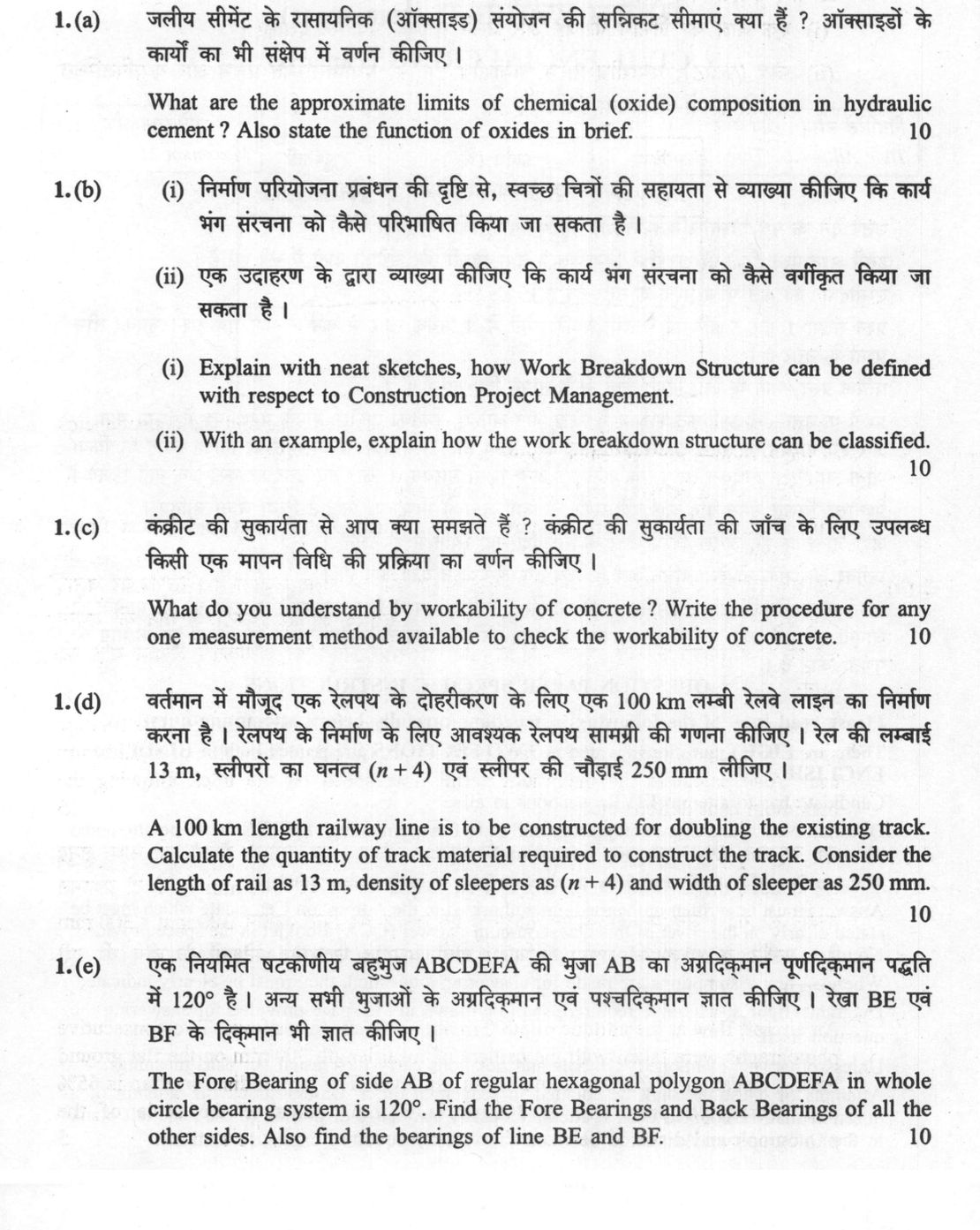
(a) What are the approximate limits of chemical (oxide) composition in hydraulic cement ? Also state the function of oxides in…
What are the approximate limits of chemical (oxide) composition in hydraulic cement ? Also state the function of oxides in brief. 10 marks
Explain with neat sketches, how Work Breakdown Structure can be defined with respect to Construction Project Management.
With an example, explain how the work breakdown structure can be classified. 10 marks
What do you understand by workability of concrete ? Write the procedure for any one measurement method available to check the workability of concrete. 10 marks
A 100 km length railway line is to be constructed for doubling the existing track. Calculate the quantity of track material required to construct the track. Consider the length of rail as 13 m, density of sleepers as (n + 4) and width of sleeper as 250 mm. 10 marks
The Fore Bearing of side AB of regular hexagonal polygon ABCDEFA in whole circle bearing system is 120°. Find the Fore Bearings and Back Bearings of all the other sides. Also find the bearings of line BE and BF. 10 marks
हिंदी में प्रश्न पढ़ें
जलीय सीमेंट के रासायनिक (ऑक्साइड) संयोजन की सन्निकट सीमाएं क्या हैं ? ऑक्साइडों के कार्यों का भी संक्षेप में वर्णन कीजिए। (10 अंक)
निर्माण परियोजना प्रबंधन की दृष्टि से, स्वच्छ चित्रों की सहायता से व्याख्या कीजिए कि कार्य भंग संरचना को कैसे परिभाषित किया जा सकता है।
एक उदाहरण के द्वारा व्याख्या कीजिए कि कार्य भंग संरचना को कैसे वर्गीकृत किया जा सकता है। (10 अंक)
कंक्रीट की सुकार्यता से आप क्या समझते हैं ? कंक्रीट की सुकार्यता की जाँच के लिए उपलब्ध किसी एक मापन विधि की प्रक्रिया का वर्णन कीजिए। (10 अंक)
वर्तमान में मौजूद एक रेलपथ के दोहरीकरण के लिए एक 100 km लम्बी रेलवे लाइन का निर्माण करना है। रेलपथ के निर्माण के लिए आवश्यक रेलपथ सामग्री की गणना कीजिए। रेल की लम्बाई 13 m, स्लीपरों का घनत्व (n + 4) एवं स्लीपर की चौड़ाई 250 mm लीजिए। (10 अंक)
एक नियमित षट्कोणीय बहुभुज ABCDEFA की भुजा AB का अग्रदिक्मान पूर्णदिक्मान पद्धति में 120° है। अन्य सभी भुजाओं के अग्रदिक्मान एवं पश्चदिक्मान ज्ञात कीजिए। रेखा BE एवं BF के दिक्मान भी ज्ञात कीजिए। (10 अंक)
Model answer
Written by UPSC Answer Check against this question's marking rubric, to the expected length. UPSC does not publish answers for Mains — this is one way to score well, not an official key.
Cement composition. Hydraulic cement is essentially a calcined silicate-aluminate mixture. The approximate oxide limits are CaO 60–67%, SiO₂ 17–25%, Al₂O₃ 3–8%, Fe₂O₃ 0.5–6%, MgO <2% and SO₃ <3%. CaO is the principal oxide; it combines with water and silica to form calcium silicate hydrate (C-S-H) and calcium hydroxide, which give strength. SiO₂ provides the silica for C3S and C2S, controlling long-term strength. Al₂O₃ forms C3A, giving quick setting and early heat. Fe₂O₃ forms C4AF, gives brown colour and acts as a flux, lowering clinkering temperature. MgO, if excessive, causes delayed expansion, while SO₃, usually as gypsum, retards setting and prevents flash set.
Work Breakdown Structure. A WBS is a hierarchical decomposition of the total project scope into deliverable-oriented components, ending in work packages small enough to estimate, schedule, assign and control. The decomposition continues until each work package has a single responsible engineer, a defined budget, a duration and measurable outputs. The causal mechanism is that a large construction project is too complex to manage as a single task; by splitting it into deliverables, each level clarifies what is to be produced, who is responsible, and how cost and time will be measured. A neat sketch would show Level 1: Project; Level 2: major deliverables such as Planning, Design, Construction, Commissioning; Level 3: work packages such as foundation, superstructure, track, electrical; Level 4: activities such as excavation, concreting, testing. The WBS is not a sequence diagram; it is a scope tree, and the 100% rule requires that it include all project work without overlap.
Classification of WBS. WBS can be classified by phase, system, geography or organisation. The same project can be re-cut for different management purposes, but the total scope must remain unchanged. In a metro rail project, a phase-based WBS may have Planning, Design, Construction and Commissioning. The construction level can then be split by system: civil structures, track, electrical, signalling and rolling stock; by geography: station 1, station 2, tunnel section; or by organisation: civil contractor, electrical contractor, systems contractor. For example, a Delhi Metro corridor WBS might be: 1 Planning, 2 Design, 3 Construction, 4 Commissioning; under 3 Construction: 3.1 Civil, 3.2 Track, 3.3 Electrical, 3.4 Signalling. This classification makes responsibility and procurement clear.
Workability. Workability is the ease with which fresh concrete can be mixed, transported, placed, compacted and finished without segregation or bleeding. It is not a property of the concrete alone; it depends on water-cement ratio, aggregate gradation, particle shape, temperature and admixtures. A common check is the slump test. The procedure is: clean and oil the standard slump cone of 300 mm height, 100 mm top diameter and 200 mm base diameter; place it on a flat plate. Fill the cone in three equal layers, each about 100 mm deep, and tamp each layer 25 times with the 16 mm tamping rod. Strike off the top, lift the cone vertically in 5–10 seconds, and allow the concrete to subside. Measure the height of the slump mass; the difference from 300 mm is the slump. A higher slump indicates greater workability, but excessive slump may cause segregation, so the value must be matched to the element and compaction method. The test is quick and field-friendly, which is why it is used before placing concrete.
Track material quantity. For 100 km of doubling work, the new track has two 100 km rails. Number of 13 m rails = 2×100,000/13 = 15,384.6, i.e. about 15,385 rails (15,386 if each line is rounded up to 7,693 pieces). Joints are not equal to rails: each line has one fewer joint than pieces, so joints = 2×7,692 = 15,384. Hence fish plates = 2×15,384 = 30,768 and fish bolts = 4×15,384 = 61,536. Sleeper density is taken from the (n+4) notation as the usual BG spacing of 0.6 m (n=6), i.e. 1.667 sleepers/m; for the 100 km doubling estimate the sleeper count is 100,000/0.6×2 ≈ 333,333. Fastenings are taken as four per sleeper, about 13.33 lakh. Ballast cannot be fixed exactly from the data because depth and formation width are not given; taking the supplied 250 mm sleeper width as the ballast depth for the estimate and the standard BG formation width as 4.2 m, gross ballast = 100,000×4.2×0.25 = 105,000 m³, i.e. about 1,00,000 m³. If a 300 mm depth is adopted, the estimate rises to 1.26×10⁵ m³, so the order is 10⁵ m³. These quantities are approximate because rail wastage, joint protection and ballast compaction are not specified.
Bearings. For a regular hexagon, interior angle = 120°, so the bearing changes by 60° from side to side. The 60° increment follows because the exterior angle of a regular hexagon is 360/6 = 60°. With FB of AB = 120°, the fore bearings are BC = 180°, CD = 240°, DE = 300°, EF = 0° (360°), FA = 60°. Back bearings are obtained by adding or subtracting 180°: AB = 300°, BC = 0°/360°, CD = 60°, DE = 120°, EF = 180°, FA = 240°. To find diagonals, place A at origin and side length 1. Coordinates: B(0.866, -0.5), E(-0.866, -1.5), F(-0.866, -0.5). BE vector is (-1.732, -1.0), i.e. 60° west of south, so bearing = 240°. BF vector is (-1.732, 0), due west, so bearing = 270°. In practice, these results are used for procurement, scheduling and setting-out.
What "Explain" is asking you to do
Make the working of something clear — what sets it off, what follows from what, and what it produces. Explain is the Commission's mechanism word: it dominates the technical papers and the “explain why” stems, where the marks sit in the causal chain and not in the label.
Structure that answers it
State what it is → the initiating condition → the chain of cause, step by step → an instance where it plays out → what the chain produces
Where marks are lost
Describing what something looks like instead of why it works that way. Naming the stages without linking them reads as description too.
How this answer will be evaluated
Approach
(a) enumerate: list the items in order > one line each > no commentary | (b(i)) explain: definition/context > points in order > small example > short close | (b(ii)) explain: definition/context > points in order > small example > short close | (c) describe: define > structure or process in order > labelled diagram > significance | (d) calculate: given > formula > substitution > result with units > interpretation | (e) calculate: given > formula > substitution > result with units > interpretation Full marks: All parts answered with correct method, units, and sketches where required.
Key points expected
- Limits for SiO2, Al2O3, Fe2O3, CaO
- Function of each major oxide
- Mention of minor oxides (MgO, SO3)
- Definition of WBS in construction context
- Neat sketch of hierarchical decomposition
- Explanation of deliverable-oriented structure
- Classification by phase (Design, Exec, etc.)
- Classification by discipline (Civil, Mech, etc.)
Evaluation rubric
Each sub-part is marked on its own, against the marks and word limit printed on the paper.
- (a) List oxide composition limits and their functions in hydraulic cement. 10 marks
enumerate— list the items in order → one line each → no commentary
Must cover
- Limits for SiO2, Al2O3, Fe2O3, CaO
- Function of each major oxide
- Mention of minor oxides (MgO, SO3)
Loses marks
- Omitting the function of oxides
- Confusing cement types (OPC vs PPC)
Earns more
- Reference to IS 269 or IS 8112
- Mention of C3S/C2S/C3A/C4AF phases
Extra mark
- Specific numerical limits for IS 269 Grade 53
- (b(i)) Define Work Breakdown Structure (WBS) with sketches.
explain— definition/context → points in order → small example → short close
Must cover
- Definition of WBS in construction context
- Neat sketch of hierarchical decomposition
- Explanation of deliverable-oriented structure
Loses marks
- No sketch provided
- Confusing WBS with Gantt chart
Earns more
- Mention of 100% rule
- Link to project scope
Extra mark
- Example of a specific construction project WBS
- (b(ii)) Classify WBS using a specific example.
explain— definition/context → points in order → small example → short close
Must cover
- Classification by phase (Design, Exec, etc.)
- Classification by discipline (Civil, Mech, etc.)
- Concrete example of classification
Loses marks
- No example provided
- Vague classification without structure
Earns more
- Comparison of phase vs discipline approach
- Mention of hybrid WBS
Extra mark
- Detailed breakdown of a specific building type
- (c) Define workability and describe a measurement method. 10 marks
describe— define → structure or process in order → labelled diagram → significance
Must cover
- Definition of workability (ease of handling)
- Procedure for one method (Slump/Vee-Bee)
- Steps of the chosen test method
Loses marks
- No specific test procedure described
- Confusing workability with strength
Earns more
- Mention of IS 1199 (Slump) or IS 10241 (Vee-Bee)
- Factors affecting workability
Extra mark
- Comparison of different workability tests
- (d) Calculate track material quantity for 100 km line. 10 marks
calculate— given → formula → substitution → result with units → interpretation
Must cover
- Number of rails calculation (100km/13m)
- Number of sleepers calculation (n+4 density)
- Total quantity of material
Loses marks
- Incorrect sleeper density application
- Missing units in final answer
Earns more
- Assumption of 'n' value (e.g., 1000m)
- Unit consistency in calculations
Extra mark
- Calculation of ballast quantity
- (e) Find bearings of hexagon sides and diagonals. 10 marks
calculate— given → formula → substitution → result with units → interpretation
Must cover
- Fore/Back bearings of all sides (BC, CD, etc.)
- Calculation of diagonal BE bearing
- Calculation of diagonal BF bearing
Loses marks
- Incorrect interior angle assumption
- Confusing Fore and Back bearings
Earns more
- Use of interior angle 120° for hexagon
- Correct WCB conversion (180° rule)
Extra mark
- Sketch of the hexagon with bearings
Practice this exact question
Write your answer and it is marked point by point against the model answer above — what you covered, what you missed, what you got wrong.
Evaluate my answer →More from Civil Engineering 2023 Paper II
- Q1 (a) What are the approximate limits of chemical (oxide) composition in hydraulic cement ?…
- Q2 (a) For a project consisting of several activities, the allotted time and the dependencie…
- Q3 (a) (i) Explain any two traffic surveys carried out to decide the geometric design featur…
- Q4 (a) A machine was purchased for ₹4,50,000 on 1st January 2001 and erection and installati…