Paper II — Q6
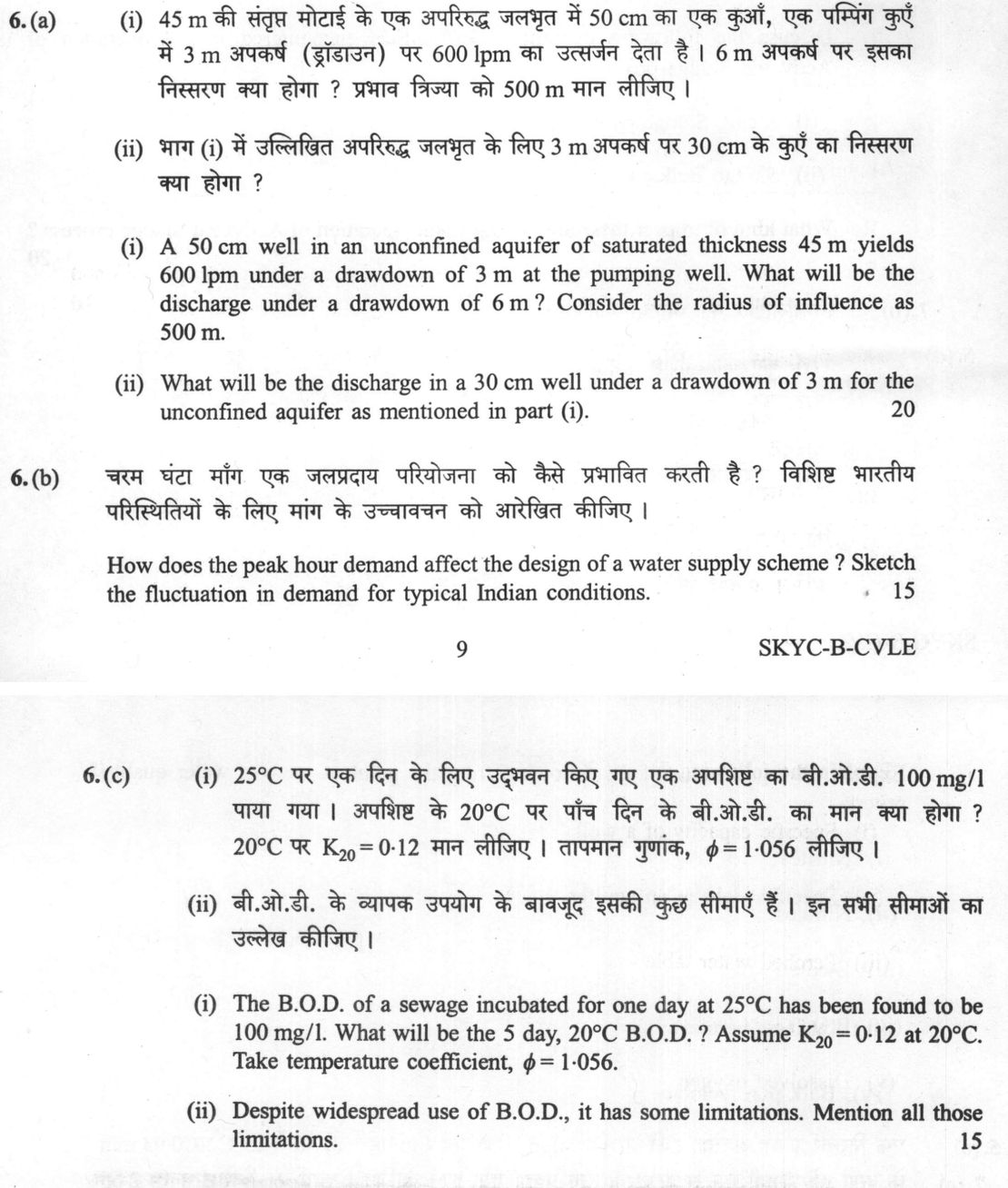
(a) (i) A 50 cm well in an unconfined aquifer of saturated thickness 45 m yields 600 lpm under a drawdown of 3 m at the pumping…
A 50 cm well in an unconfined aquifer of saturated thickness 45 m yields 600 lpm under a drawdown of 3 m at the pumping well. What will be the discharge under a drawdown of 6 m ? Consider the radius of influence as 500 m. (ii) What will be the discharge in a 30 cm well under a drawdown of 3 m for the unconfined aquifer as mentioned in part (i). 20 marks
How does the peak hour demand affect the design of a water supply scheme ? Sketch the fluctuation in demand for typical Indian conditions. 15 marks
The B.O.D. of a sewage incubated for one day at 25°C has been found to be 100 mg/l. What will be the 5 day, 20°C B.O.D. ? Assume K₂₀ = 0·12 at 20°C. Take temperature coefficient, φ = 1·056. (ii) Despite widespread use of B.O.D., it has some limitations. Mention all those limitations. 15 marks
हिंदी में प्रश्न पढ़ें
45 m की संतृप्त मोटाई के एक अपरिरुद्ध जलभृत में 50 cm का एक कुआँ, एक पम्पिंग कुएँ में 3 m अपकर्ष (ड्रॉडाउन) पर 600 lpm का उत्सर्जन देता है । 6 m अपकर्ष पर इसका निस्सरण क्या होगा ? प्रभाव त्रिज्या को 500 m मान लीजिए । (ii) भाग (i) में उल्लिखित अपरिरुद्ध जलभृत के लिए 3 m अपकर्ष पर 30 cm के कुएँ का निस्सरण क्या होगा ? 20 marks
चरम घंटा माँग एक जलप्रदाय परियोजना को कैसे प्रभावित करती है ? विशिष्ट भारतीय परिस्थितियों के लिए माँग के उच्चावचन को आरेखित कीजिए । 15 marks
25°C पर एक दिन के लिए उद्भवन किए गए एक अपशिष्ट का बी.ओ.डी. 100 mg/l पाया गया । अपशिष्ट के 20°C पर पाँच दिन के बी.ओ.डी. का मान क्या होगा ? 20°C पर K₂₀ = 0·12 मान लीजिए । तापमान गुणांक, φ = 1·056 लीजिए । (ii) बी.ओ.डी. के व्यापक उपयोग के बावजूद इसकी कुछ सीमाएँ हैं । इन सभी सीमाओं का उल्लेख कीजिए । 15 marks
Model answer
Written by UPSC Answer Check against this question's marking rubric, to the expected length. UPSC does not publish answers for Mains — this is one way to score well, not an official key.
(a) (i) For steady radial flow to a well in an unconfined aquifer, use the Dupuit–Thiem equation: Q = π K (H² − h_w²) / ln(R / r_w) Valid for a homogeneous, isotropic, unconfined aquifer, fully penetrating well, no recharge, and steady flow.
Take the 50 cm well as diameter, so r_w = 0.25 m. H = 45 m, s₁ = 3 m, h₁ = 45 − 3 = 42 m, R = 500 m. Q₁ = 600 lpm = 600 × 1.44 = 864 m³/day.
K = Q₁ ln(R / r_w) / [π (H² − h₁²)] K = 864 ln(500 / 0.25) / [π (45² − 42²)] K = 864 ln(2000) / (π × 261) = 8.00917 m/day.
For s₂ = 6 m, h₂ = 45 − 6 = 39 m. Same well and R: Q₂ / Q₁ = (H² − h₂²) / (H² − h₁²) Q₂ / Q₁ = (45² − 39²) / (45² − 42²) Q₂ / Q₁ = (2025 − 1521) / (2025 − 1764) Q₂ / Q₁ = 504 / 261 = 56 / 29.
Q₂ = 600 × 56 / 29 = 33600 / 29 = 1158.62 lpm. Q₂ ≈ 1158.62 lpm = 1668.41 m³/day.
(a) (ii) For a 30 cm well, r_w = 0.15 m. Drawdown s = 3 m, so H² − h² = 261 m². Using the same K and R: Q₃₀ / Q₅₀ = ln(R / 0.25) / ln(R / 0.15) Q₃₀ / Q₅₀ = ln(500 / 0.25) / ln(500 / 0.15) Q₃₀ / Q₅₀ = ln(2000) / ln(10000 / 3) Q₃₀ / Q₅₀ = 7.60090246 / 8.11172808 = 0.93702629.
Q₃₀ = 600 × 0.93702629 = 562.22 lpm. Q₃₀ ≈ 562.22 lpm = 809.59 m³/day.
(b) Peak hour demand is the maximum water required in any one hour of the maximum-demand day. It affects the design of a water supply scheme because the distribution system must carry this high flow while maintaining adequate residual pressure.
- Distribution mains, service connections, valves, meters, and booster pumps are sized for peak hourly flow, plus fire demand where applicable.
- Pipe diameters and hydraulic gradients are checked at peak flow; otherwise head loss becomes excessive and pressure at tail ends falls.
- Service reservoirs and clear water reservoirs provide balancing storage. Their capacity depends on the cumulative surplus and deficit between inflow and hourly demand; a higher peak increases the required balancing storage.
- Pumping mains and pumps may be designed for peak hourly flow if direct pumping is used. If a reservoir is provided, pumps may run at a steadier rate and the reservoir absorbs the peaks.
- Source works and treatment units are generally designed for maximum daily demand, while peak hour mainly governs distribution and storage.
- Typical Indian peak factor is about 2 to 3 times the average daily demand, and may exceed 3 for small towns, summer days, or festivals. Minimum hourly demand may fall to 0.3–0.6 times average.
`` Demand (× average daily) 3.0 | ╭╮ 2.5 | ╱ ╲ ╭╮ 2.0 | ╱ ╲ ╱ ╲ 1.5 | ╱ ╲ ╱ ╲ 1.0 | ╭╯ ╰──╯ ╰╮ 0.5 | ╭╯ ╰╮ 0.0 +------------------------------- hours 0 4 8 12 16 20 24 ``
The sketch shows two daily peaks: a morning peak about 7–10 h and an evening peak about 17–21 h, with minimum demand at night. This pattern is typical of Indian conditions.
(c) (i) Use first-order BOD kinetics with base-10 rate constant: BOD_t = L₀ [1 − 10^(−K_T t)]
Temperature correction: K_T = K₂₀ φ^(T−20)
Given K₂₀ = 0.12 day⁻¹, φ = 1.056, T = 25°C. K₂₅ = 0.12 × 1.056^(25−20) = 0.12 × 1.056⁵ K₂₅ = 0.12 × 1.313165883 = 0.157579906 day⁻¹.
At 25°C, 1-day BOD = 100 mg/l: 100 = L₀ [1 − 10^(−0.157579906 × 1)] 10^(−0.157579906) = 0.69569694 1 − 0.69569694 = 0.30430306 L₀ = 100 / 0.30430306 = 328.62 mg/l.
For 5-day, 20°C BOD: BOD₅,₂₀ = L₀ [1 − 10^(−K₂₀ × 5)] BOD₅,₂₀ = 328.62 [1 − 10^(−0.12 × 5)] 10^(−0.6) = 0.251188643 1 − 10^(−0.6) = 0.748811357 BOD₅,₂₀ = 328.62 × 0.748811357 = 246.07 mg/l.
BOD₅,₂₀ ≈ 246.07 mg/l. Assuming same ultimate BOD and no nitrification.
(c) (ii) Limitations of BOD:
- Measures only biodegradable organic matter; ignores inorganic, volatile, refractory, and non-biodegradable organics.
- Gives oxygen consumed by microorganisms, not total organic carbon or all pollutants.
- Standard 5-day BOD is not ultimate BOD; it represents only a fraction of total carbonaceous demand.
- Nitrogenous oxygen demand can interfere; unless nitrification is inhibited, BOD may include ammonia oxidation and overestimate carbonaceous BOD.
- Test is slow, requiring 5 days; unsuitable for real-time or online process control.
- Results depend on seeding, dilution, temperature, pH, nutrients, dissolved oxygen, and incubation conditions.
- Toxic substances, chlorine, heavy metals, and extreme pH inhibit microorganisms, giving falsely low BOD.
- Poor reproducibility and precision; requires skilled analyst and careful dilution.
- For industrial wastes with variable composition or toxic/refractory organics, BOD correlates poorly with treatability.
- Does not distinguish settleable, colloidal, and dissolved biodegradable matter.
- Saline, radioactive, or biologically inhibitory wastes may require special adaptation.
- COD, TOC, or oxygen uptake rate may be needed as supplementary tests.
What "Solve" is asking you to do
Choose the method, then carry it through to a final answer. Identifying what kind of problem this is and why that method applies is the first thing marked; a correct figure arrived at invisibly earns almost nothing.
Structure that answers it
Given data and what is required → method chosen, with the reason it applies → set-up (equation, circuit, free body, trial balance) → working, step by step → answer with units and any condition of validity
Where marks are lost
Doing the middle steps mentally and writing only the result. In mathematics papers, a further loss comes from giving a decimal where the exact value in surds or fractions was wanted, or from skipping the justification a part explicitly asks for.
How this answer will be evaluated
Approach
Framework: Hydrogeology and Water Quality Analysis. (a(i)) calculate: given > formula > substitution > result with units > interpretation | (a(ii)) calculate: given > formula > substitution > result with units > interpretation | (b) explain: definition/context > points in order > small example > short close | (c(i)) calculate: given > formula > substitution > result with units > interpretation | (c(ii)) enumerate: list the items in order > one line each > no commentary Full marks: Correct application of Dupuit-Thiem and BOD kinetics with clear sketches and unit consistency.
Key points expected
- State Dupuit-Thiem equation for unconfined flow
- Identify given parameters (H, h, r, R)
- Calculate hydraulic conductivity K from first case
- Substitute K to find Q for 6m drawdown
- Use K value derived in part (i)
- Adjust well radius (r) to 0.15m
- Apply Dupuit-Thiem equation for new r
- Define peak hour demand and its relation to average demand
Evaluation rubric
Each sub-part is marked on its own, against the marks and word limit printed on the paper.
- (a(i)) Determine discharge for 6m drawdown in unconfined aquifer.
calculate— given → formula → substitution → result with units → interpretation
Must cover
- State Dupuit-Thiem equation for unconfined flow
- Identify given parameters (H, h, r, R)
- Calculate hydraulic conductivity K from first case
- Substitute K to find Q for 6m drawdown
Loses marks
- Using confined aquifer formula (Theis)
- Omitting the K calculation step
Earns more
- Explicitly state assumption of steady-state flow
- Show unit conversion for lpm to m³/s
Extra mark
- Mention radius of influence (R) as 500m
- (a(ii)) Determine discharge for 30cm well with 3m drawdown.
calculate— given → formula → substitution → result with units → interpretation
Must cover
- Use K value derived in part (i)
- Adjust well radius (r) to 0.15m
- Apply Dupuit-Thiem equation for new r
Loses marks
- Recalculating K unnecessarily
- Using 50cm radius for the 30cm well
Earns more
- Note that discharge is independent of well radius in this model
Extra mark
- Mention well loss coefficient if applicable
- (b) Explain impact of peak hour demand on design and sketch fluctuation. 15 marks
explain— definition/context → points in order → small example → short close
Must cover
- Define peak hour demand and its relation to average demand
- Explain sizing of pipes, pumps, and storage based on peak
- Provide a labelled sketch of 24-hour demand curve
- Identify typical peak times for Indian conditions (morning/evening)
Loses marks
- Sketch without time axis or labels
- Ignoring the 'Indian conditions' context
Earns more
- Mention peak hour factor (PHF) calculation
- Discuss impact on reservoir capacity
Extra mark
- Reference specific IS code for water supply design
- (c(i)) Calculate 5-day BOD at 20°C from 1-day BOD at 25°C.
calculate— given → formula → substitution → result with units → interpretation
Must cover
- State first-order BOD reaction formula (L - L_t)
- Adjust rate constant K for temperature using phi
- Calculate ultimate BOD (L) from 1-day data
- Compute 5-day BOD at 20°C
Loses marks
- Using K25 directly without correction
- Confusing base 10 and natural log in BOD formula
Earns more
- Show step-by-step temperature correction of K
- Use natural log (ln) correctly in formula
Extra mark
- Mention standard incubation temperature is 20°C
- (c(ii)) List limitations of BOD as a water quality parameter.
enumerate— list the items in order → one line each → no commentary
Must cover
- Mention time required for test (5 days)
- Excludes nitrification oxygen demand
- Does not account for toxic substances
- Cannot measure oxygen demand of non-biodegradable organics
Loses marks
- Listing advantages instead of limitations
- Vague statements like 'it is not accurate'
Earns more
- Mention interference from chlorination
- Note that it is a biological, not chemical, measure
Extra mark
- Compare with COD as a faster alternative
Practice this exact question
Write your answer and it is marked point by point against the model answer above — what you covered, what you missed, what you got wrong.
Evaluate my answer →More from Civil Engineering 2023 Paper II
- Q3 (a) (i) Explain any two traffic surveys carried out to decide the geometric design featur…
- Q4 (a) A machine was purchased for ₹4,50,000 on 1st January 2001 and erection and installati…
- Q5 (a) A 6-hour unit hydrograph has the following ordinates : If φ index is 0·3 cm/hr and ba…
- Q6 (a) (i) A 50 cm well in an unconfined aquifer of saturated thickness 45 m yields 600 lpm…
- Q7 (a) Discuss the following operational difficulties encountered in the operation of Activa…
- Q8 (a) (i) Design a trapezoidal concrete lined channel to carry a discharge of 300 m³/s at a…