Paper II — Q8
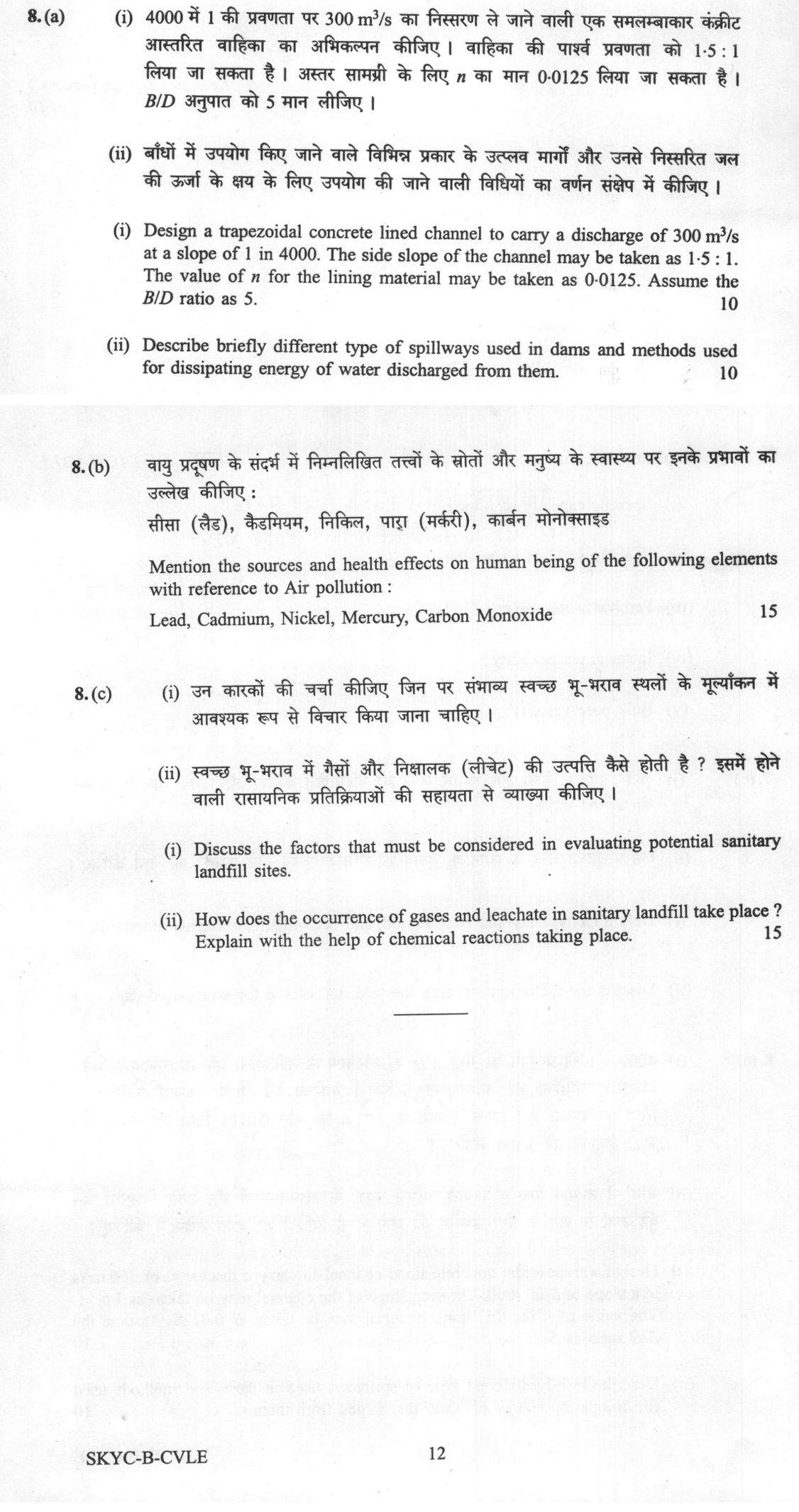
(a) (i) Design a trapezoidal concrete lined channel to carry a discharge of 300 m³/s at a slope of 1 in 4000. The side slope of…
Design a trapezoidal concrete lined channel to carry a discharge of 300 m³/s at a slope of 1 in 4000. The side slope of the channel may be taken as 1·5 : 1. The value of n for the lining material may be taken as 0·0125. Assume the B/D ratio as 5. 10 marks
Describe briefly different type of spillways used in dams and methods used for dissipating energy of water discharged from them. 10 marks
Mention the sources and health effects on human being of the following elements with reference to Air pollution : Lead, Cadmium, Nickel, Mercury, Carbon Monoxide 15
Discuss the factors that must be considered in evaluating potential sanitary landfill sites.
How does the occurrence of gases and leachate in sanitary landfill take place ? Explain with the help of chemical reactions taking place. 15 marks
हिंदी में प्रश्न पढ़ें
4000 में 1 की प्रवणता पर 300 m³/s का निस्सरण ले जाने वाली एक समलम्बाकार कंक्रीट आस्तरित वाहिका का अभिकल्पन कीजिए । वाहिका की पार्श्व प्रवणता को 1·5 : 1 लिया जा सकता है । अस्तर सामग्री के लिए n का मान 0·0125 लिया जा सकता है । B/D अनुपात को 5 मान लीजिए । 10
बांधों में उपयोग किए जाने वाले विभिन्न प्रकार के उत्लव मार्गों और उनसे निस्सरित जल की ऊर्जा के क्षय के लिए उपयोग की जाने वाली विधियों का वर्णन संक्षेप में कीजिए । 10
वायु प्रदूषण के संदर्भ में निम्नलिखित तत्त्वों के स्रोतों और मनुष्य के स्वास्थ्य पर इनके प्रभावों का उल्लेख कीजिए : सीसा (लैड), कैडमियम, निकेल, पारा (मर्करी), कार्बन मोनोक्साइड 15
उन कारकों की चर्चा कीजिए जिन पर संभाव्य स्वच्छ भू-भराव स्थलों के मूल्यांकन में आवश्यक रूप से विचार किया जाना चाहिए ।
स्वच्छ भू-भराव में गैसों और निषालक (लीचेट) की उत्पत्ति कैसे होती है ? इसमें होने वाली रासायनिक प्रतिक्रियाओं की सहायता से व्याख्या कीजिए । 15
Model answer
Written by UPSC Answer Check against this question's marking rubric, to the expected length. UPSC does not publish answers for Mains — this is one way to score well, not an official key.
(a)(i) Given: Q = 300 m³/s, S = 1/4000 = 0.00025, n = 0.0125, side slope z = 1.5, B/D = 5, so B = 5D.
For a trapezoidal channel:
- Area A = BD + zD² = 5D² + 1.5D² = 6.5D²
- Perimeter P = B + 2D√(1 + z²) = 5D + 2D√(3.25) = (5 + √13)D
- Hydraulic radius R = A/P = 6.5D²/[(5 + √13)D] = 13D/[2(5 + √13)] = 0.755326D
Using Manning’s equation: Q = (1/n) A R^(2/3) S^(1/2)
300 = (1/0.0125)(6.5D²)[13D/(2(5 + √13))]^(2/3)(1/4000)^(1/2)
Solving: D^(8/3) = 43.994 D = 43.994^(3/8) = 4.133 m
Then:
- Bottom width B = 5D = 20.665 m
- Area A = 6.5(4.133)² = 111.034 m²
- Velocity V = Q/A = 300/111.034 = 2.702 m/s
- Normal top width = B + 2zD = 20.665 + 3(4.133) = 33.064 m
- Freeboard = 0.75 m
- Total depth = 4.133 + 0.75 = 4.883 m
- Designed top width = 20.665 + 3(4.883) = 35.314 m
Final section: trapezoidal concrete lined channel with bottom width 20.665 m, normal depth 4.133 m, total depth 4.883 m, side slopes 1.5H : 1V, freeboard 0.75 m, velocity 2.702 m/s, normal top width 33.064 m.
(a)(ii) Spillway types:
- Service spillway: handles normal flood discharges.
- Emergency/auxiliary spillway: used when service spillway capacity is exceeded; fuse-plug spillways are a variant.
- Ogee/overflow spillway: shaped concrete crest for gravity dams, designed for atmospheric pressure.
- Chute/trough spillway: inclined open channel carrying flow from crest to downstream.
- Side-channel spillway: flow enters along the side and is led to a chute or tunnel; suitable for narrow valleys.
- Shaft/glory-hole spillway: vertical shaft with circular crest, often called morning-glory spillway.
- Siphon spillway: curved conduit that primes automatically; used for small dams.
- Labyrinth/piano-key spillway: zigzag crest gives long effective length at low head.
- Stepped spillway: steps dissipate energy along the chute, common in RCC dams.
Energy dissipation methods:
- Hydraulic jump stilling basin: USBR I–IV types with chute blocks, baffle blocks, end sill; suitable for medium and high heads.
- Bucket-type dissipators: roller bucket for low Froude number; trajectory/ski-jump bucket throws jet into downstream plunge pool.
- Impact/baffled apron: for low heads and small discharges.
- Plunge pool/stilling well: jet plunges into pool, energy lost by turbulence.
- Stepped spillways, riprap protection, end sills, and downstream bed protection supplement dissipation.
(b) Sources and health effects:
- Lead: Sources: leaded petrol, smelters, battery recycling, paints, pipes, industrial emissions. Health effects: neurotoxicity, reduced IQ in children, anaemia, kidney damage, hypertension, reproductive effects.
- Cadmium: Sources: Ni-Cd batteries, electroplating, pigments, plastics, smelting, incineration. Health effects: kidney tubular damage, bone disease like itai-itai, lung cancer, emphysema.
- Nickel: Sources: stainless steel/alloys, electroplating, coins, fuel oil combustion, tobacco smoke. Health effects: dermatitis, respiratory irritation, asthma, sinusitis, nasal and lung cancer.
- Mercury: Sources: coal combustion, chlor-alkali plants, gold mining, smelters, waste incineration. Health effects: neurotoxicity, Minamata disease, kidney damage, developmental defects; methylmercury bioaccumulates in fish.
- Carbon monoxide: Sources: incomplete combustion of fuels, vehicles, furnaces, tobacco smoke. Health effects: binds haemoglobin as carboxyhaemoglobin, causing tissue hypoxia, headache, dizziness, cardiac stress, unconsciousness and death.
(c)(i) Factors for evaluating potential sanitary landfill sites:
- Land area, volume capacity and expected life.
- Haul distance and access roads.
- Topography, slope, drainage and floodplain avoidance.
- Soil type, permeability, depth to groundwater and aquifer vulnerability.
- Distance from surface water, wells, springs and wetlands.
- Geological stability, seismic risk and mining subsidence.
- Availability of cover material.
- Climate, rainfall and leachate generation potential.
- Proximity to residential areas, airports, sensitive ecosystems and cultural sites.
- Land-use zoning, public acceptance, cost, utilities and closure/post-closure management.
(c)(ii) Leachate forms when rainwater, waste moisture, and sometimes groundwater percolate through solid waste. Decomposition releases soluble organic and inorganic matter, giving high BOD, COD, TDS, chloride, ammonia, and heavy metals. Leachate moves by gravity and concentration gradient; its strength changes with landfill phase.
Gas forms mainly by anaerobic decomposition. Initially aerobic reaction occurs: Organic matter + O₂ → CO₂ + H₂O + heat.
Then hydrolysis: (C₆H₁₀O₅)n + nH₂O → n C₆H₁₂O₆
Acidogenesis: C₆H₁₂O₆ + 2 H₂O → 2 CH₃COOH + 2 CO₂ + 4 H₂
Acetogenesis: CH₃CH₂COOH + 2 H₂O → CH₃COOH + 3 H₂ + CO₂
Methanogenesis: CH₃COOH → CH₄ + CO₂ CO₂ + 4 H₂ → CH₄ + 2 H₂O
Landfill gas is roughly 50–60% CH₄, 40–50% CO₂, with traces of H₂S, NH₃ and VOCs. If unvented, it migrates and may cause odour, explosion risk, and vegetation damage.
What "Design" is asking you to do
Produce a specification that meets the given brief and demonstrate that it does. In civil and electrical papers the design is incomplete until it is expressed in buildable numbers — diameter, spacing, section, component value — and checked back against every limit stated.
Structure that answers it
Requirements and permissible values listed → code clause or design basis adopted → proportioning calculations → the specification in final dimensions → check against each requirement → sketch
Where marks are lost
Stopping at a required area or a required value without converting it into the bar size, spacing or component actually provided. The provided-against-required comparison and the serviceability or stability check are separately marked and routinely left out.
How this answer will be evaluated
Approach
(a(i)) calculate: given > formula > substitution > result with units > interpretation | (a(ii)) describe: define > structure or process in order > labelled diagram > significance | (b) highlight: name the salient points > one line of substance each > close | (c(i)) discuss: intro > 3-4 dimensions > example > balanced close | (c(ii)) explain: definition/context > points in order > small example > short close Full marks: Precise calculations with checks; comprehensive coverage of all pollutants; detailed chemical equations for landfill processes.
Key points expected
- State Manning's equation and given parameters (Q, S, n, m, B/D)
- Substitute B=5D into area and wetted perimeter formulas
- Solve for D and calculate B
- Verify discharge Q using calculated dimensions
- List major spillway types (Ogee, Chute, Side, Siphon)
- Explain energy dissipation methods (Hydraulic jump, Aerators)
- Link specific spillway types to their energy dissipation needs
- Cover all five elements: Lead, Cadmium, Nickel, Mercury, CO
Evaluation rubric
Each sub-part is marked on its own, against the marks and word limit printed on the paper.
- (a(i)) Determine channel dimensions (B, D) for a trapezoidal concrete channel. 10 marks
calculate— given → formula → substitution → result with units → interpretation
Must cover
- State Manning's equation and given parameters (Q, S, n, m, B/D)
- Substitute B=5D into area and wetted perimeter formulas
- Solve for D and calculate B
- Verify discharge Q using calculated dimensions
Loses marks
- Omitting the final discharge check
- Incorrect substitution of side slope m
Earns more
- Explicit calculation of hydraulic radius R
- Unit consistency check (m³/s)
Extra mark
- Sketch of trapezoidal section with dimensions
- (a(ii)) Outline types of dam spillways and energy dissipation methods. 10 marks
describe— define → structure or process in order → labelled diagram → significance
Must cover
- List major spillway types (Ogee, Chute, Side, Siphon)
- Explain energy dissipation methods (Hydraulic jump, Aerators)
- Link specific spillway types to their energy dissipation needs
Loses marks
- Listing types without explaining energy dissipation
- Confusing spillway types with dam types
Earns more
- Mentioning specific structures like stilling basins
- Reference to high-velocity flow management
Extra mark
- Labelled diagram of a specific spillway type
- (b) Identify sources and health effects of five specific air pollutants. 15 marks
highlight— name the salient points → one line of substance each → close
Must cover
- Cover all five elements: Lead, Cadmium, Nickel, Mercury, CO
- Identify specific industrial or natural sources for each
- State specific physiological health effects for each
- Distinguish between acute and chronic effects where relevant
Loses marks
- Missing any of the five specified elements
- Vague health effects (e.g., 'bad for health')
Earns more
- Mentioning specific diseases (e.g., Itai-itai for Cd)
- Reference to bioaccumulation for heavy metals
Extra mark
- Table format for comparison
- (c(i)) List and explain factors for evaluating sanitary landfill sites.
discuss— intro → 3-4 dimensions → example → balanced close
Must cover
- Geological and hydrogeological factors (permeability, water table)
- Topographical and climatic factors (slope, rainfall)
- Socio-economic factors (distance to habitation, land cost)
- Environmental impact assessment considerations
Loses marks
- Ignoring hydrogeological factors
- Listing factors without explanation
Earns more
- Mentioning specific soil types (clay vs sand)
- Reference to leachate migration potential
Extra mark
- Reference to specific environmental regulations
- (c(ii)) Explain the formation of landfill gas and leachate via chemical reactions.
explain— definition/context → points in order → small example → short close
Must cover
- Describe the stages of waste decomposition (aerobic to anaerobic)
- Provide chemical equations for methane and CO2 production
- Explain leachate formation via water percolation and leaching
- Link gas composition to the age of the landfill
Loses marks
- Omitting chemical equations
- Confusing leachate with general wastewater
Earns more
- Mentioning specific byproducts (H2S, NH3)
- Discussion of pH changes in leachate
Extra mark
- Diagram of the landfill gas collection system
Practice this exact question
Write your answer and it is marked point by point against the model answer above — what you covered, what you missed, what you got wrong.
Evaluate my answer →More from Civil Engineering 2023 Paper II
- Q5 (a) A 6-hour unit hydrograph has the following ordinates : If φ index is 0·3 cm/hr and ba…
- Q6 (a) (i) A 50 cm well in an unconfined aquifer of saturated thickness 45 m yields 600 lpm…
- Q7 (a) Discuss the following operational difficulties encountered in the operation of Activa…
- Q8 (a) (i) Design a trapezoidal concrete lined channel to carry a discharge of 300 m³/s at a…