Paper II — Q4
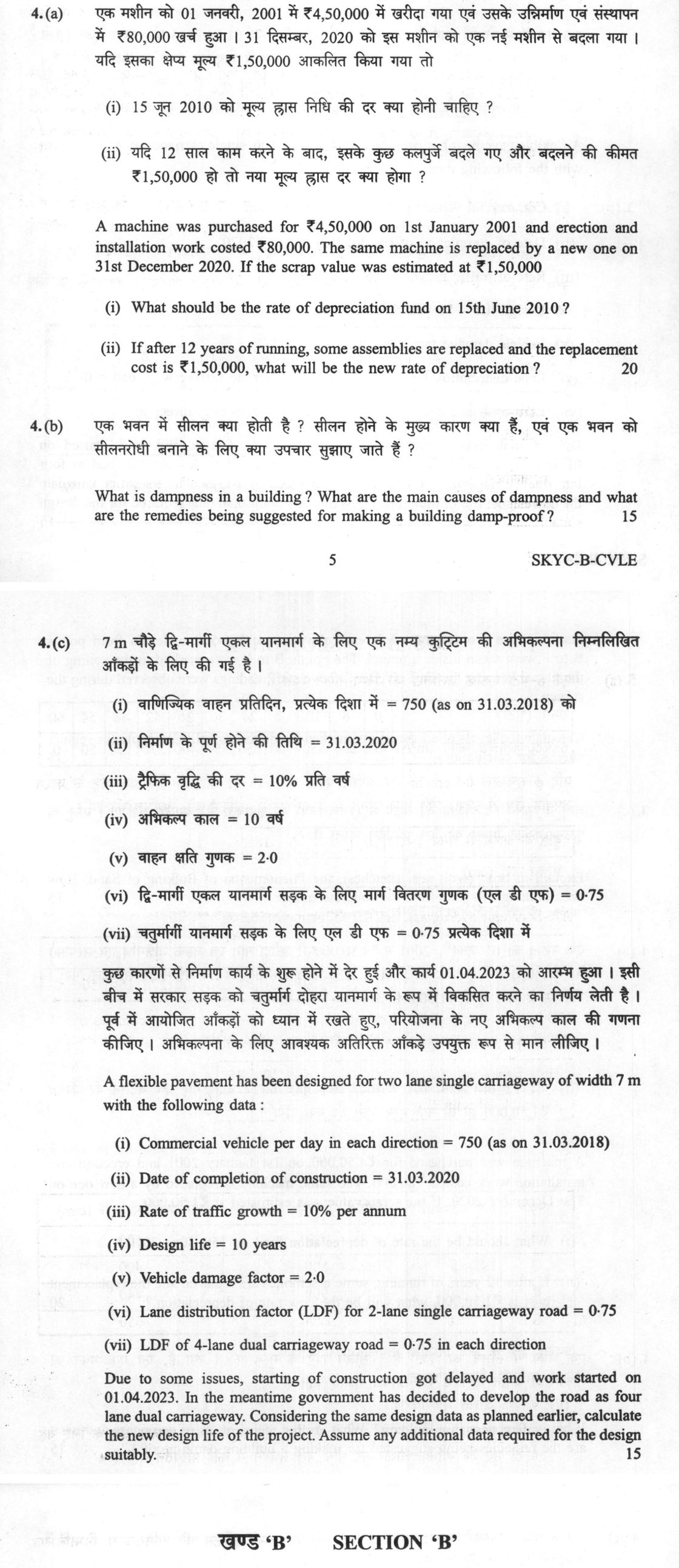
(a) A machine was purchased for ₹4,50,000 on 1st January 2001 and erection and installation work costed ₹80,000. The same machine…
A machine was purchased for ₹4,50,000 on 1st January 2001 and erection and installation work costed ₹80,000. The same machine is replaced by a new one on 31st December 2020. If the scrap value was estimated at ₹1,50,000
What should be the rate of depreciation fund on 15th June 2010 ?
If after 12 years of running, some assemblies are replaced and the replacement cost is ₹1,50,000, what will be the new rate of depreciation ? 20 marks
What is dampness in a building ? What are the main causes of dampness and what are the remedies being suggested for making a building damp-proof ? 15 marks
A flexible pavement has been designed for two lane single carriageway of width 7 m with the following data :
Commercial vehicle per day in each direction = 750 (as on 31.03.2018)
Date of completion of construction = 31.03.2020
Rate of traffic growth = 10% per annum
Design life = 10 years
Vehicle damage factor = 2·0
Lane distribution factor (LDF) for 2-lane single carriageway road = 0·75
LDF of 4-lane dual carriageway road = 0·75 in each direction
Due to some issues, starting of construction got delayed and work started on 01.04.2023. In the meantime government has decided to develop the road as four lane dual carriageway. Considering the same design data as planned earlier, calculate the new design life of the project. Assume any additional data required for the design suitably. 15 marks
हिंदी में प्रश्न पढ़ें
एक मशीन को 01 जनवरी, 2001 में ₹4,50,000 में खरीदा गया एवं उसके उत्थापन एवं संस्थापन में ₹80,000 खर्च हुआ । 31 दिसम्बर, 2020 को इस मशीन को एक नई मशीन से बदला गया । यदि इसका शेष मूल्य ₹1,50,000 आकलित किया गया तो
15 जून 2010 को मूल्य ह्रास निधि की दर क्या होनी चाहिए ?
यदि 12 साल काम करने के बाद, इसके कुछ कलपुर्जे बदले गए और बदलने की कीमत ₹1,50,000 हो तो नया मूल्य ह्रास दर क्या होगा ? (20 अंक)
एक भवन में सीलन क्या होती है ? सीलन होने के मुख्य कारण क्या हैं, एवं एक भवन को सीलनरोधी बनाने के लिए क्या उपचार सुझाए जाते हैं ? (15 अंक)
7 m चौड़े द्वि-मार्गी एकल यानमार्ग के लिए एक नम्य कुंटिटम की अभिकल्पना निम्नलिखित आंकड़ों के लिए की गई है ।
वाणिज्यिक वाहन प्रतिदिन, प्रत्येक दिशा में = 750 (as on 31.03.2018) को
निर्माण के पूर्ण होने की तिथि = 31.03.2020
ट्रैफिक वृद्धि की दर = 10% प्रति वर्ष
अभिकल्प काल = 10 वर्ष
वाहन क्षति गुणक = 2·0
द्वि-मार्गी एकल यानमार्ग सड़क के लिए मार्ग वितरण गुणक (एल डी एफ) = 0·75
चतुर्मार्गी यानमार्ग सड़क के लिए एल डी एफ = 0·75 प्रत्येक दिशा में
कुछ कारणों से निर्माण कार्य के शुरू होने में देर हुई और कार्य 01.04.2023 को आरम्भ हुआ । इसी बीच में सरकार सड़क को चतुर्मार्गी दोहरा यानमार्ग के रूप में विकसित करने का निर्णय लेती है । पूर्व में आयोजित आंकड़ों को ध्यान में रखते हुए, परियोजना के नए अभिकल्प काल की गणना कीजिए । अभिकल्पना के लिए आवश्यक अतिरिक्त आंकड़े उपयुक्त रूप से मान लीजिए । (15 अंक)
Model answer
Written by UPSC Answer Check against this question's marking rubric, to the expected length. UPSC does not publish answers for Mains — this is one way to score well, not an official key.
(a) Total cost C = ₹4,50,000 + ₹80,000 = ₹5,30,000. Life n = 1 January 2001 to 31 December 2020 = 20 years. Scrap value S = ₹1,50,000. Using straight-line depreciation: Annual depreciation D = (C − S)/n = (5,30,000 − 1,50,000)/20 = ₹19,000 per year. Rate of depreciation = (D/C) × 100 = (19,000/5,30,000) × 100 = 3·5849% ≈ 3·585% per annum.
(i) On 15 June 2010, elapsed period from 1 January 2001 = 9 years + 5 months 15 days = 9·4583 years. Depreciation fund accumulated = D × elapsed time = 19,000 × 9·4583 = ₹1,79,708·33 ≈ ₹1,79,708. Thus the annual rate is 3·585% per annum, and the depreciation fund accumulated on 15 June 2010 is ₹1,79,708 approx.
(ii) After 12 years, book value = C − 12D = 5,30,000 − 12 × 19,000 = ₹3,02,000. Replacement cost added = ₹1,50,000. New capital cost = 3,02,000 + 1,50,000 = ₹4,52,000. Remaining life = 20 − 12 = 8 years. New annual depreciation = (4,52,000 − 1,50,000)/8 = ₹37,750. New rate of depreciation = (37,750/4,52,000) × 100 = 8·3518% ≈ 8·35% per annum.
(b) Dampness in a building is the undesirable presence of moisture in walls, floors, roofs or other components. It causes plaster decay, efflorescence, mould, timber rot, corrosion of reinforcement and unhealthy indoor conditions.
Main causes:
- Rising damp by capillary action from ground due to absent or defective DPC, porous materials or high water table.
- Penetrating damp by rain through porous walls, cracks, defective flashing, sills, roof leakage, faulty gutters and downpipes.
- Condensation due to warm moist indoor air meeting cold surfaces, poor ventilation, cooking, bathing and temperature difference.
- Leakage from plumbing, sanitary fittings, water tanks and drains.
- Construction defects such as inadequate DPC, unfilled joints, poor mortar, bad quality materials and faulty roof slopes.
- Hygroscopic salts in bricks and mortar attracting moisture.
- Defective site drainage and wet adjoining ground.
Remedies:
- Provide continuous DPC at plinth, roof, parapet and sills using bitumen, polythene, cement concrete or lead.
- Use cavity walls, damp-proof membranes and water-repellent external coatings such as silicone, cement paint or bituminous treatment.
- Ensure proper roof slope, flashing, waterproofing and repair of cracks, gutters and downpipes.
- Provide surface drains, French drains, subsoil drains and slope ground away from the building.
- Improve ventilation and use exhaust fans or dehumidifiers to prevent condensation.
- Remove affected plaster, replaster with waterproof mortar and treat soluble salts.
- For existing dampness, use chemical DPC by silicone injection, electro-osmotic damp proofing or pressure grouting.
- Maintain plumbing and drainage regularly to stop leaks.
(c) Given: r = 10% = 0·10, VDF = 2·0, LDF for 2-lane single carriageway = 0·75, design life n₀ = 10 years. Traffic count on 31·03·2018 = 750 CV/day in each direction.
For the original two-lane single carriageway, two-way traffic at completion on 31·03·2020: A₂₀₂₀ = 2 × 750 × (1·10)² = 1815 CV/day. Using IRC cumulative standard axle formula: N = 365 × A × VDF × LDF × [((1+r)ⁿ − 1)/r] N₀ = 365 × 1815 × 2·0 × 0·75 × [((1·10)¹⁰ − 1)/0·10] = 365 × 1815 × 1·5 × 15·9374246 = 15,837,218 standard axles ≈ 15·837 MSA.
Assume the construction period remains 2 years, as indicated by the original completion date. New work starts on 01·04·2023, so new completion is 31·03·2025. Traffic in each direction at new completion: A₂₀₂₅ = 750 × (1·10)⁷ = 1461·538 CV/day. For four-lane dual carriageway, LDF = 0·75 in each direction. Let new design life be n years. Equate new per-carriageway design traffic to the originally planned design traffic: 365 × 1461·538 × 2·0 × 0·75 × [((1·10)ⁿ − 1)/0·10] = 15,837,218 800,191·96 × [((1·10)ⁿ − 1)/0·10] = 15,837,218 ((1·10)ⁿ − 1)/0·10 = 19·7918 (1·10)ⁿ = 2·97918 n = ln(2·97918)/ln(1·10) = 1·09165/0·09531 = 11·45 years.
Thus the new design life is 11·45 years ≈ 11 years 5·5 months. In practice, it may be adopted as 11·5 years or 12 years depending on rounding policy.
What "Calculate" is asking you to do
Apply the standard formula or schedule to data the question has already supplied — a table of readings, cost records, a balance sheet — and produce the number. The method is rarely in doubt; the marks sit in the named intermediate quantities, each of which has to appear as a labelled line.
Structure that answers it
Data as given → formula or standard treatment, named → substitution → each intermediate, labelled → result with units
Where marks are lost
Omitting an intermediate the marking scheme pays for separately, or rounding at an intermediate line so the final figure drifts. In commerce and accountancy, any figure in a statement that no numbered working note supports is treated as unearned.
How this answer will be evaluated
Approach
Framework: null. (a) calculate: given > formula > substitution > result with units > interpretation | (b) explain: definition/context > points in order > small example > short close | (c) calculate: given > formula > substitution > result with units > interpretation Full marks: Accurate calculations with clear steps, correct application of codes, and well-structured explanations.
Key points expected
- Calculate total cost (₹4,50,000 + ₹80,000)
- Apply sinking fund formula for 2001-2020 period
- Adjust book value for ₹1,50,000 replacement cost
- Recalculate rate for remaining life (2013-2020)
- Define dampness in building context
- List at least 3 main causes (e.g., capillary action)
- Suggest specific remedies (e.g., DPC, waterproofing)
- Explain the mechanism of one remedy
Evaluation rubric
Each sub-part is marked on its own, against the marks and word limit printed on the paper.
- (a) Determine depreciation rate for fund method and new rate after replacement. 20 marks
calculate— given → formula → substitution → result with units → interpretation
Must cover
- Calculate total cost (₹4,50,000 + ₹80,000)
- Apply sinking fund formula for 2001-2020 period
- Adjust book value for ₹1,50,000 replacement cost
- Recalculate rate for remaining life (2013-2020)
Loses marks
- Ignoring installation cost in initial value
- Using straight-line method for part (i)
Earns more
- Explicitly state scrap value deduction
- Show formula for sinking fund rate
- Distinguish between straight line and fund method
Extra mark
- Reference to IS: 15380 or accounting standards
- (b) Define dampness, list causes, and suggest damp-proofing remedies. 15 marks
explain— definition/context → points in order → small example → short close
Must cover
- Define dampness in building context
- List at least 3 main causes (e.g., capillary action)
- Suggest specific remedies (e.g., DPC, waterproofing)
- Explain the mechanism of one remedy
Loses marks
- Confusing dampness with seepage
- Listing causes without corresponding remedies
Earns more
- Mention rising damp vs penetrating damp
- Reference to IS: 2645 or IS: 15380
- Sketch of DPC placement
Extra mark
- Mention specific chemical names for damp-proofing
- (c) Calculate new design life for 4-lane dual carriageway. 15 marks
calculate— given → formula → substitution → result with units → interpretation
Must cover
- Calculate cumulative traffic for original 2-lane design
- Adjust traffic for 4-lane configuration (LDF change)
- Account for construction delay (2020 to 2023)
- Solve for new design life using traffic growth rate
Loses marks
- Ignoring the 3-year construction delay
- Using 2-lane LDF for 4-lane calculation
Earns more
- Show step-by-step traffic accumulation
- Explicitly state assumption for additional data
- Use correct LDF for 4-lane road (0.75)
Extra mark
- Reference to IRC: 82 or IRC: 37
Practice this exact question
Write your answer and it is marked point by point against the model answer above — what you covered, what you missed, what you got wrong.
Evaluate my answer →More from Civil Engineering 2023 Paper II
- Q1 (a) What are the approximate limits of chemical (oxide) composition in hydraulic cement ?…
- Q2 (a) For a project consisting of several activities, the allotted time and the dependencie…
- Q3 (a) (i) Explain any two traffic surveys carried out to decide the geometric design featur…
- Q4 (a) A machine was purchased for ₹4,50,000 on 1st January 2001 and erection and installati…
- Q5 (a) A 6-hour unit hydrograph has the following ordinates : If φ index is 0·3 cm/hr and ba…
- Q6 (a) (i) A 50 cm well in an unconfined aquifer of saturated thickness 45 m yields 600 lpm…
- Q7 (a) Discuss the following operational difficulties encountered in the operation of Activa…