Paper II — Q7
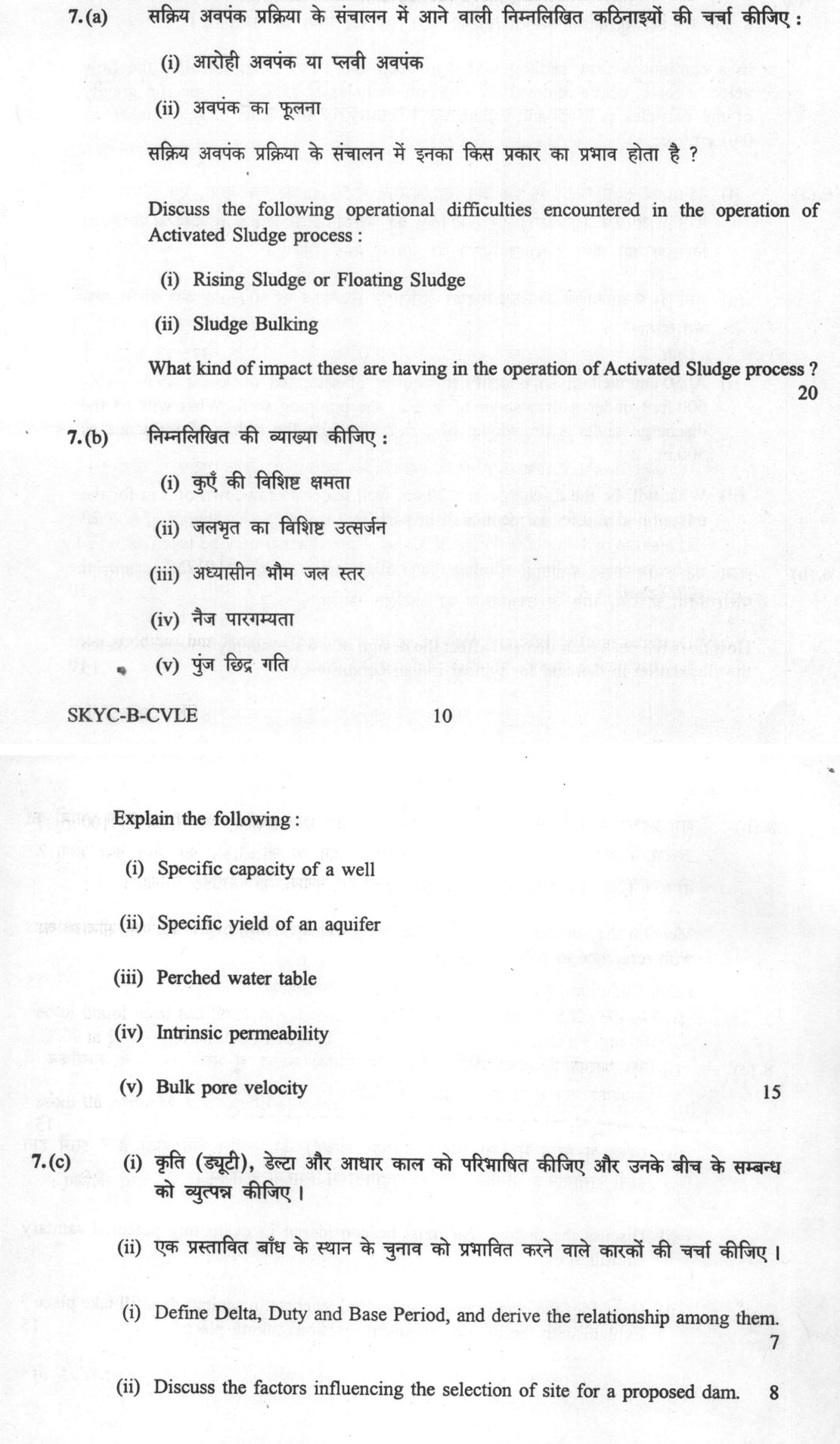
(a) Discuss the following operational difficulties encountered in the operation of Activated Sludge process : (i) Rising Sludge…
Discuss the following operational difficulties encountered in the operation of Activated Sludge process : Rising Sludge or Floating Sludge
Sludge Bulking What kind of impact these are having in the operation of Activated Sludge process ? 20 marks
Explain the following : Specific capacity of a well
Specific yield of an aquifer
Perched water table
Intrinsic permeability
Bulk pore velocity 15
Define Delta, Duty and Base Period, and derive the relationship among them. 7 marks
Discuss the factors influencing the selection of site for a proposed dam. 8 marks
हिंदी में प्रश्न पढ़ें
सक्रिय अवपंक प्रक्रिया के संचालन में आने वाली निम्नलिखित कठिनाइयों की चर्चा कीजिए : आरोही अवपंक या प्लवी अवपंक
अवपंक का फूलना सक्रिय अवपंक प्रक्रिया के संचालन में इनका किस प्रकार का प्रभाव होता है ? 20 marks
निम्नलिखित की व्याख्या कीजिए : कुएँ की विशिष्ट क्षमता
जलभृत का विशिष्ट उत्सर्जन
अध्यासीन भौम जल स्तर
नैज पारगम्यता
पुंज छिद्र गति 15
कृति (ड्यूटी), डेल्टा और आधार काल को परिभाषित कीजिए और उनके बीच के सम्बन्ध को व्युत्पन्न कीजिए । 7
एक प्रस्तावित बांध के स्थान के चुनाव को प्रभावित करने वाले कारकों की चर्चा कीजिए । 8
Model answer
Written by UPSC Answer Check against this question's marking rubric, to the expected length. UPSC does not publish answers for Mains — this is one way to score well, not an official key.
The activated sludge process depends on stable floc formation, adequate oxygen transfer and controlled sludge age; when these fail, the plant loses settling and effluent quality. In Indian STPs, variable influent strength and limited clarifier space make these failures common.
Rising or floating sludge. In the final clarifier, sludge may rise or float as a loose, dark, odorous layer. The main cause is denitrification in the clarifier under anoxic/facultative conditions: nitrate-rich mixed liquor is reduced to nitrogen gas, and N2 bubbles adhere to flocs, lowering their density. It is common in nitrifying plants where return sludge carries high nitrate. It is favoured by high nitrate, low DO, low temperature, high sludge age and long clarifier detention. It is identified by poor settleability, rising sludge and abnormal or high sludge volume index. Impact is loss of clarifier capacity, short-circuiting, high TSS and BOD in effluent, reduced return sludge quality and operational instability. Remedies include increasing sludge wasting to reduce sludge age and nitrate, reducing MLSS, improving aeration/DO, reducing return sludge nitrate, and, where needed, adding denitrification control or clarifier modifications.
Sludge bulking. Bulking is failure of flocs to settle, usually due to excessive filamentous bacteria such as Sphaerotilus natans and Thiothrix competing with floc-formers. It is promoted by low DO, high or fluctuating F/M ratio, organic shock, low pH, nutrient deficiency and toxic loads. SVI above about 150 mL/g is an indicator. Impact is poor sludge blanket, carry-over of solids, high effluent TSS/BOD, reduced plant capacity, increased sludge handling and difficulty meeting discharge standards. Both reduce clarifier solids residence time and increase downstream load. Control includes maintaining DO, adjusting F/M and sludge age, chlorination or selective oxidation, adding selector basins, nutrient balancing and avoiding toxic shocks.
Hydrogeological terms. Specific capacity of a well is the discharge obtained per unit drawdown, Q/s, usually m³/day/m; it indicates well efficiency. Specific yield of an aquifer is the volume of water drained by gravity per unit volume of aquifer, Sy = ΔV/(Δh A), dimensionless. A perched water table is a local saturated zone above the regional water table, separated by an aquitard or low-permeability layer. Intrinsic permeability is a property of the porous medium, k, with units m², independent of the fluid. Bulk pore velocity, or actual interstitial velocity, is v = K i / n, where K is hydraulic conductivity, i hydraulic gradient and n porosity; it is the true velocity of water through pores. They guide well yield, aquifer storage and contaminant travel estimates.
Irrigation water requirement. Delta (Δ) is the depth of water required by a crop over its base period. Duty (D) is the area irrigated per unit discharge, expressed in hectares per cumec, i.e. 1 m³/s throughout the base period. Base period (B) is the total duration of irrigation. If a discharge Q m³/s irrigates area A ha for B days, total volume is Q×86400×B m³. Since 1 ha-cm = 100 m³, Δ cm = (Q×86400×B)/(100 A). As D = A/Q, Δ = 8.64 B/D. It shows higher duty or shorter base period lowers delta.
Dam site selection. A suitable site should have a narrow gorge with a wide upstream valley for storage, sound foundation rock with low seepage, adequate catchment and reliable inflow, low sediment load, proximity to demand centres, stable geology and low seismic risk, and acceptable environmental and social impacts. Geotechnical investigation, flood routing, cost-benefit and clearances also matter. In India, sites such as Tehri and Sardar Sarovar show that geological soundness, reservoir submergence, rehabilitation and environmental clearance are decisive. Thus, operational sludge problems, aquifer behaviour and irrigation/dam planning all require matching design assumptions with field conditions; remedies, monitoring and site-specific assessment are essential for reliable performance.
What "Discuss" is asking you to do
Lay the issue out from more than one side — how it arose, what is claimed for it, what is held against it, and where it now stands. UPSC attaches discuss to broad topics with several live dimensions, so coverage of the dimensions earns more than the strength of your opinion.
Structure that answers it
Set the issue up → the case as it is made → the case against → the dimension both sides leave out → where the balance now lies
Where marks are lost
Listing facts with no thread between them, or arguing one side throughout and calling it a discussion.
How this answer will be evaluated
Approach
Framework: null. (a) discuss: intro > 3-4 dimensions > example > balanced close | (b) explain: definition/context > points in order > small example > short close | (c(i)) derive: given > assumptions > stepwise derivation > result > check | (c(ii)) discuss: intro > 3-4 dimensions > example > balanced close Full marks: Comprehensive definitions, correct derivations, and detailed discussion of impacts and factors.
Key points expected
- Define rising sludge and sludge bulking
- Identify causes (e.g., denitrification, filamentous bacteria)
- Explain impact on settling and effluent quality
- Mention corrective measures (e.g., chlorination, DO control)
- Define specific capacity (Q/s) and specific yield
- Explain perched water table and intrinsic permeability
- Define bulk pore velocity (seepage velocity)
- Distinguish between hydraulic and intrinsic permeability
Evaluation rubric
Each sub-part is marked on its own, against the marks and word limit printed on the paper.
- (a) Analyze causes and operational impacts of rising sludge and sludge bulking. 20 marks
discuss— intro → 3-4 dimensions → example → balanced close
Must cover
- Define rising sludge and sludge bulking
- Identify causes (e.g., denitrification, filamentous bacteria)
- Explain impact on settling and effluent quality
- Mention corrective measures (e.g., chlorination, DO control)
Loses marks
- Confusing rising sludge with bulking
- Omitting the impact on secondary clarifier performance
Earns more
- Distinguish between filamentous and non-filamentous bulking
- Reference SVI (Sludge Volume Index) as a diagnostic tool
Extra mark
- Sketch of aeration tank showing sludge blanket issues
- (b) Define five specific groundwater and aquifer terminology terms. 15 marks
explain— definition/context → points in order → small example → short close
Must cover
- Define specific capacity (Q/s) and specific yield
- Explain perched water table and intrinsic permeability
- Define bulk pore velocity (seepage velocity)
- Distinguish between hydraulic and intrinsic permeability
Loses marks
- Confusing specific yield with porosity
- Defining bulk velocity as Darcy velocity
Earns more
- Provide the formula for specific capacity (Q/s)
- Mention units for specific yield (dimensionless)
Extra mark
- Diagram illustrating a perched aquifer
- (c(i)) Define Delta, Duty, and Base Period and derive their relationship. 7 marks
derive— given → assumptions → stepwise derivation → result → check
Must cover
- Define Delta (total depth of water required)
- Define Duty (area irrigated per unit discharge)
- Define Base Period (total irrigation duration)
- Derive the formula Delta = 8.64 B / D
Loses marks
- Writing the formula without derivation
- Incorrect unit conversion factor (8.64)
Earns more
- Show the step-by-step unit conversion in the derivation
- State the units for Delta (m), B (days), D (ha/cumec)
Extra mark
- Example calculation using the derived formula
- (c(ii)) List and explain factors for selecting a dam site. 8 marks
discuss— intro → 3-4 dimensions → example → balanced close
Must cover
- Geological factors (foundation stability, rock type)
- Topographical factors (valley shape, reservoir capacity)
- Hydrological factors (catchment area, flood discharge)
- Economic and social factors (land acquisition, cost)
Loses marks
- Listing factors without explaining their influence
- Ignoring the geological stability of the foundation
Earns more
- Mention seismic considerations for the site
- Discuss the impact of sedimentation on reservoir life
Extra mark
- Reference to a specific dam site selection case study
Practice this exact question
Write your answer and it is marked point by point against the model answer above — what you covered, what you missed, what you got wrong.
Evaluate my answer →More from Civil Engineering 2023 Paper II
- Q4 (a) A machine was purchased for ₹4,50,000 on 1st January 2001 and erection and installati…
- Q5 (a) A 6-hour unit hydrograph has the following ordinates : If φ index is 0·3 cm/hr and ba…
- Q6 (a) (i) A 50 cm well in an unconfined aquifer of saturated thickness 45 m yields 600 lpm…
- Q7 (a) Discuss the following operational difficulties encountered in the operation of Activa…
- Q8 (a) (i) Design a trapezoidal concrete lined channel to carry a discharge of 300 m³/s at a…