Paper II — Q5
(a) A 6-hour unit hydrograph has the following ordinates : If φ index is 0·3 cm/hr and base flow is 25 m³/s, determine the…
A 6-hour unit hydrograph has the following ordinates : If φ index is 0·3 cm/hr and base flow is 25 m³/s, determine the ordinates of resulting hydrograph of flow in the catchment due to the storm given below : 10 marks
The annual precipitation and evaporation from each of the sub-areas P, Q, R and S are given below for a catchment. Calculate the following for catchment : (i) Annual average precipitation (ii) Annual average evaporation (iii) Annual runoff coefficients for the sub-areas and for the total catchment taken as a whole assuming no change in the ground water storage on an annual basis. 10 marks
Route the above flood hydrograph through a river reach : The value of x and K in the Muskingham equation have been identified as 0·25 and 8 hr. The initial outflow discharge from the reach is 10 m³/s. 10 marks
Explain the significance of the following from the point of view of water quality criteria : (i) Nitrites (ii) Nitrates (iii) E-coli (iv) B.O.D. (v) Dissolved oxygen 10 marks
In a continuous flow settling tank 4 m deep and 80 m long, calculate the flow velocity for effective removal of 0.03 mm particles at 25°C. The specific gravity of the particles is 2.65 and kinematic viscosity (v) for water may be taken as 0.01 cm²/sec. 10 marks
हिंदी में प्रश्न पढ़ें
एक 6-घंटा एकांक जललेख की निम्नलिखित कोटियाँ हैं । यदि φ सूचकांक 0·3 cm/hr एवं आधार प्रवाह 25 m³/s है, तो नीचे दिए गए वृष्टि के कारण अपवाह क्षेत्र में उत्पन्न होने वाले प्रवाह के जललेख की कोटियों को निर्धारित कीजिए । 10 marks
एक अपवाह क्षेत्र के सभी उपक्षेत्रों P, Q, R एवं S के वार्षिक वृष्टिपात और वाष्पीकरण नीचे दिए गए हैं । अपवाह क्षेत्र के लिए निम्नलिखित की गणना कीजिए : (i) वार्षिक औसत वृष्टिपात (ii) वार्षिक औसत वाष्पीकरण (iii) वार्षिक अपवाह गुणांक, सभी उपक्षेत्रों के लिए और संपूर्ण सकल अपवाह क्षेत्र के लिए यह मानते हुए कि वार्षिक आधार पर भौम जल संचयन में कोई परिवर्तन नहीं है । 10 marks
नदी के एक खंड के लिए निम्नलिखित बाढ़ जलालेख का मार्गणिमगम कीजिए । मस्किंघम समीकरण में प्रयुक्त होने वाले x एवं K का मान 0·25 एवं 8 घंटे हैं । नदी खंड से होने वाला प्रारंभिक बहिर्वाह निस्सरण 10 m³/s है । 10 marks
जल की गुणवत्ता की कसौटी की दृष्टि से निम्नलिखित की सार्थकता की व्याख्या कीजिए : (i) नाइट्राइट (ii) नाइट्रेट (iii) ई-कोलाई (iv) बी.ओ.डी. (v) घुलीत ऑक्सीजन 10 marks
एक निरंतर प्रवाह अवसाद टंकी जो कि 80 m लंबी एवं 4 m गहरी है, उसमें 25°C पर 0.03 mm के कणों को प्रभावी रूप से हटाने के लिए प्रवाह गति ज्ञात कीजिए । कणों का विशिष्ट घनत्व 2.65 है और जल की शुद्धगतिक श्यानता (v) को 0.01 cm²/sec लिया जा सकता है । 10 marks
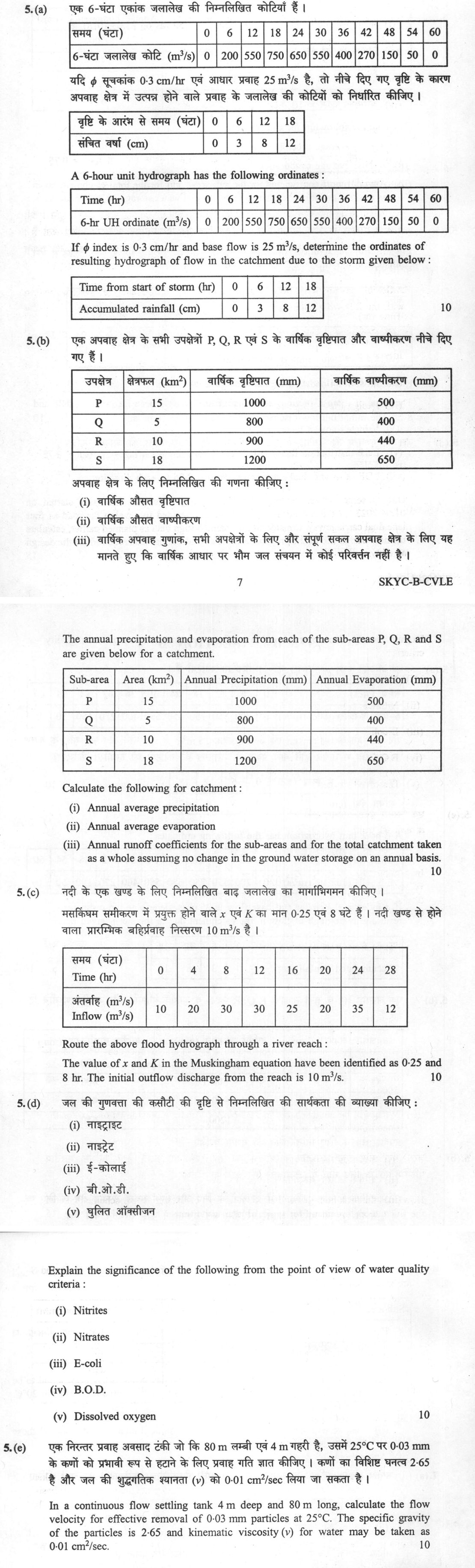
The figure this question refers to, in words
The question paper is a scan and the diagram did not survive as text. This is the figure as read from the original page — every component, value and label — so the question can be worked from the text below.
(a) Table 2: Storm data. Row 1 (Time from start of storm (hr)): 0, 6, 12, 18. Row 2 (Accumulated rainfall (cm)): 0, 3, 8, 12.
(b) Table with columns: Sub-area, Area (km2), Annual Precipitation (mm), Annual Evaporation (mm). Rows: P, 15, 1000, 500; Q, 5, 800, 400; R, 10, 900, 440; S, 18, 1200, 650.
(c) Table with two rows. Row 1 (Time (hr)): 0, 4, 8, 12, 16, 20, 24, 28. Row 2 (Inflow (m3/s)): 10, 20, 30, 30, 25, 20, 35, 12.
What "Calculate" is asking you to do
Apply the standard formula or schedule to data the question has already supplied — a table of readings, cost records, a balance sheet — and produce the number. The method is rarely in doubt; the marks sit in the named intermediate quantities, each of which has to appear as a labelled line.
Structure that answers it
Data as given → formula or standard treatment, named → substitution → each intermediate, labelled → result with units
Where marks are lost
Omitting an intermediate the marking scheme pays for separately, or rounding at an intermediate line so the final figure drifts. In commerce and accountancy, any figure in a statement that no numbered working note supports is treated as unearned.
How this answer will be evaluated
Approach
(a) calculate: given > formula > substitution > result with units > interpretation | (b) calculate: given > formula > substitution > result with units > interpretation | (c) calculate: given > formula > substitution > result with units > interpretation | (d) explain: definition/context > points in order > small example > short close | (e) calculate: given > formula > substitution > result with units > interpretation Full marks: All parts solved with correct methods, clear steps, and proper units.
Key points expected
- Convert accumulated rainfall to incremental rainfall
- Calculate effective rainfall using phi index
- Scale UH ordinates by effective rainfall depth
- Add base flow to direct runoff ordinates
- Calculate area-weighted average precipitation
- Calculate area-weighted average evaporation
- Compute runoff coefficient for each sub-area
- Compute total catchment runoff coefficient
Evaluation rubric
Each sub-part is marked on its own, against the marks and word limit printed on the paper.
- (a) Ordinates of the resulting hydrograph for the given storm. 10 marks
calculate— given → formula → substitution → result with units → interpretation
Must cover
- Convert accumulated rainfall to incremental rainfall
- Calculate effective rainfall using phi index
- Scale UH ordinates by effective rainfall depth
- Add base flow to direct runoff ordinates
Loses marks
- Using total rainfall instead of effective rainfall
- Omitting base flow addition
Earns more
- Tabular presentation of rainfall and runoff
- Explicit calculation of effective rainfall depth
Extra mark
- Sketch of the resulting hydrograph
- (b) Average precipitation, evaporation, and runoff coefficients. 10 marks
calculate— given → formula → substitution → result with units → interpretation
Must cover
- Calculate area-weighted average precipitation
- Calculate area-weighted average evaporation
- Compute runoff coefficient for each sub-area
- Compute total catchment runoff coefficient
Loses marks
- Simple arithmetic mean instead of area-weighted
- Confusing runoff with evaporation
Earns more
- Use of Thiesen polygon or area-weighted method
- Clear tabulation of sub-area data
Extra mark
- Sketch of catchment sub-areas
- (c) Outflow hydrograph routed through river reach. 10 marks
calculate— given → formula → substitution → result with units → interpretation
Must cover
- Apply Muskingum equation with given x and K
- Calculate outflow for each time step
- Use initial outflow as starting condition
- Present outflow ordinates in a table
Loses marks
- Using wrong Muskingum coefficients
- Skipping intermediate time steps
Earns more
- Step-by-step calculation for each time interval
- Verification of mass balance
Extra mark
- Graphical representation of inflow and outflow
- (d) Significance of water quality parameters. 10 marks
explain— definition/context → points in order → small example → short close
Must cover
- Define each parameter (Nitrites, Nitrates, E-coli, BOD, DO)
- Explain health or environmental significance
- Link parameters to water quality criteria
- Provide context for each parameter
Loses marks
- Defining parameters without explaining significance
- Confusing nitrites with nitrates
Earns more
- Reference to standard water quality limits
- Explanation of interrelationships between parameters
Extra mark
- Table summarizing parameters and their significance
- (e) Flow velocity for effective particle removal. 10 marks
calculate— given → formula → substitution → result with units → interpretation
Must cover
- Calculate settling velocity using Stokes' law
- Determine overflow rate for the settling tank
- Ensure flow velocity does not exceed settling velocity
- State assumptions about particle behavior
Loses marks
- Using wrong formula for settling velocity
- Ignoring tank dimensions in calculation
Earns more
- Correct application of Stokes' law
- Clear calculation of tank dimensions and flow rate
Extra mark
- Discussion of factors affecting settling efficiency
Model answer coming soon
Every evaluation on this site is marked against a verified model answer. This question's answer is still being written; evaluation opens the moment it lands.
More from Civil Engineering 2023 Paper II
- Q2 (a) For a project consisting of several activities, the allotted time and the dependencie…
- Q3 (a) (i) Explain any two traffic surveys carried out to decide the geometric design featur…
- Q4 (a) A machine was purchased for ₹4,50,000 on 1st January 2001 and erection and installati…
- Q5 (a) A 6-hour unit hydrograph has the following ordinates : If φ index is 0·3 cm/hr and ba…
- Q6 (a) (i) A 50 cm well in an unconfined aquifer of saturated thickness 45 m yields 600 lpm…
- Q7 (a) Discuss the following operational difficulties encountered in the operation of Activa…
- Q8 (a) (i) Design a trapezoidal concrete lined channel to carry a discharge of 300 m³/s at a…