Paper II — Q3
(a) (i) Explain any two traffic surveys carried out to decide the geometric design features of a road. (5 marks) (ii) The…
Explain any two traffic surveys carried out to decide the geometric design features of a road. 5 marks
The relationship between speed and density for a given section of road was found to be v = 100 – 1·2 k, where v is speed in kmph and k is the density in vehicles per km. Calculate the speed and density in which maximum flow could occur. Also draw the speed-density, speed-flow and flow-density diagrams indicating critical values. 15 marks
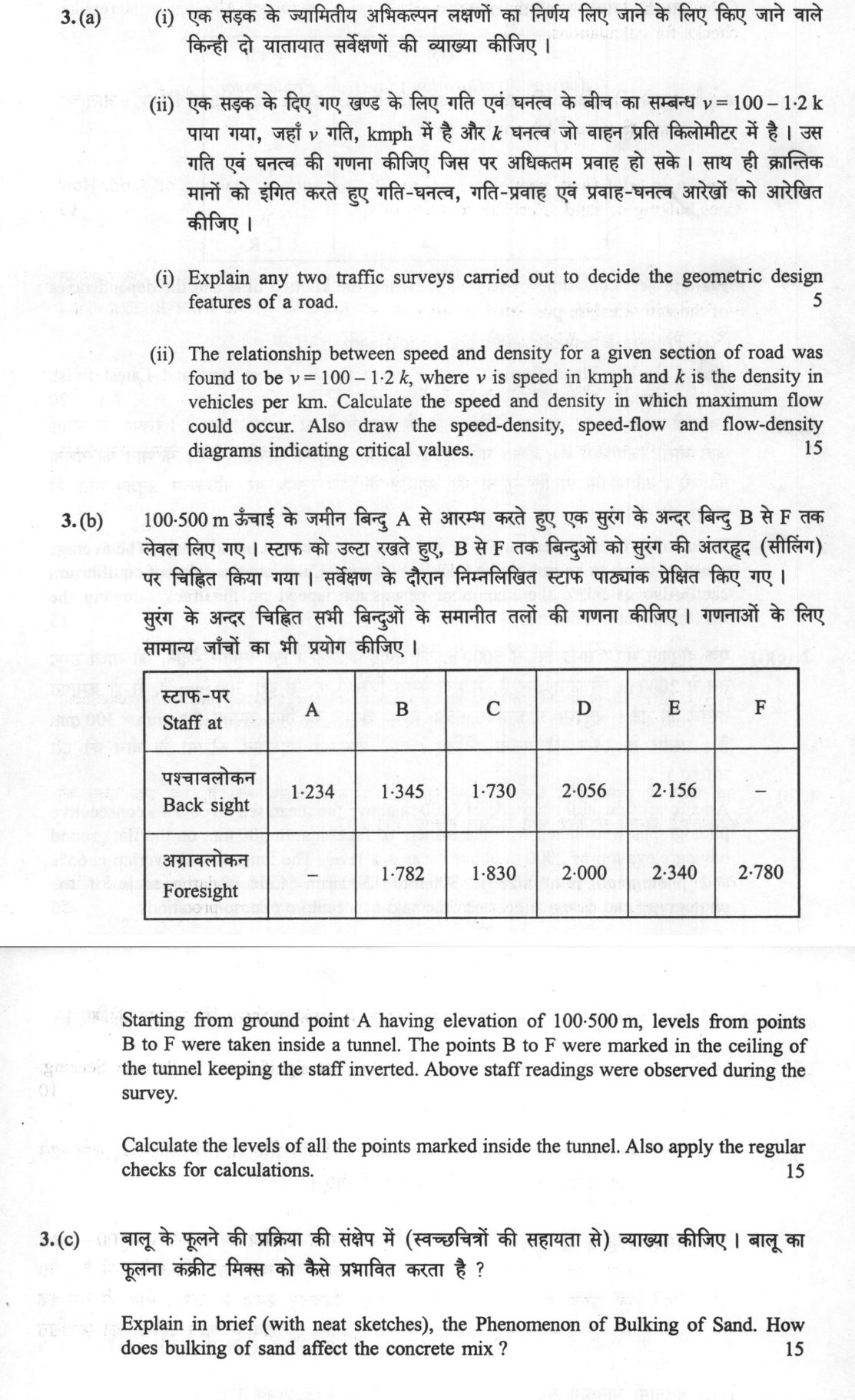
Starting from ground point A having elevation of 100·500 m, levels from points B to F were taken inside a tunnel. The points B to F were marked in the ceiling of the tunnel keeping the staff inverted. Above staff readings were observed during the survey.
Calculate the levels of all the points marked inside the tunnel. Also apply the regular checks for calculations. 15 marks
Explain in brief (with neat sketches), the Phenomenon of Bulking of Sand. How does bulking of sand affect the concrete mix ? 15 marks
हिंदी में प्रश्न पढ़ें
एक सड़क के ज्यामितीय अभिकल्पन लक्षणों का निर्णय लिए जाने के लिए किए जाने वाले किन्हीं दो यातायात सर्वेक्षणों की व्याख्या कीजिए । (5 अंक)
एक सड़क के दिए गए खंड के लिए गति एवं घनत्व के बीच का सम्बन्ध v = 100 – 1·2 k पाया गया, जहाँ v गति, kmph में है और k घनत्व जो वाहन प्रति किलोमीटर में है । उस गति एवं घनत्व की गणना कीजिए जिस पर अधिकतम प्रवाह हो सके । साथ ही क्रांतिक मानों को दर्शित करते हुए गति-घनत्व, गति-प्रवाह एवं प्रवाह-घनत्व आरेखों को आरेखित कीजिए । (15 अंक)
100·500 m ऊँचाई के जमीन बिन्दु A से आरम्भ करते हुए एक सुरंग के अन्दर बिन्दु B से F तक लेवल लिए गए । स्टाफ को उल्टा रखते हुए, B से F तक बिन्दुओं को सुरंग की अन्तःछद (सीलिंग) पर चिह्नित किया गया । सर्वेक्षण के दौरान निम्नलिखित स्टाफ पाठ्यांक प्रेक्षित किए गए ।
सुरंग के अन्दर चिह्नित सभी बिन्दुओं के समानीत तलों की गणना कीजिए । गणनाओं के लिए सामान्य जाँचों का भी प्रयोग कीजिए । (15 अंक)
बालू के फूलने की प्रक्रिया की संक्षेप में (स्वच्छित्रों की सहायता से) व्याख्या कीजिए । बालू का फूलना कंक्रीट मिक्स को कैसे प्रभावित करता है ? (15 अंक)
The figure this question refers to, in words
The question paper is a scan and the diagram did not survive as text. This is the figure as read from the original page — every component, value and label — so the question can be worked from the text below.
(b) Table with 3 rows and 7 columns. Header row: 'Staff at', 'A', 'B', 'C', 'D', 'E', 'F'. Second row: 'Back sight', '1.234', '1.345', '1.730', '2.056', '2.156', '-'. Third row: 'Foresight', '-', '1.782', '1.830', '2.000', '2.340', '2.780'.
Model answer
Written by UPSC Answer Check against this question's marking rubric, to the expected length. UPSC does not publish answers for Mains — this is one way to score well, not an official key.
(a)(i)
- Traffic volume survey: counts vehicles over a period, classified by type, direction, speed, lane occupancy and turning movements. It gives design volume, peak hour factor, average speed, lane demand and junction volumes. These values are used to fix number of lanes, lane width, acceleration and deceleration lanes, junction layout, and pavement capacity.
- Speed survey: measures spot speeds, running speeds, 85th percentile speed, and speed distribution at a section. It fixes design speed, horizontal and vertical curve radii, sight distance, superelevation, cross slope, and alignment features.
(a)(ii) Given v = 100 – 1·2 k, v in km/h, k in veh/km. Since 1·2 = 6/5, v = 100 – (6/5)k. This is a Greenshields linear speed-density relation for steady, uniform traffic on the section. Flow q = v k = k(100 – (6/5)k) = 100k – (6/5)k² veh/h. For maximum flow, differentiate q with respect to k and set derivative zero: dq/dk = 100 – (12/5)k = 0 k = 100/(12/5) = 125/3 veh/km. The second derivative d²q/dk² = –12/5 < 0, so this is a maximum. Then v = 100 – (6/5)(125/3) = 50 km/h. q(max) = 50 × 125/3 = 6250/3 veh/h. Free-flow speed = 100 km/h at k = 0; jam density = 100/(6/5) = 250/3 veh/km at v = 0. Critical values are half free-flow speed and half jam density. The critical density is the density at maximum flow, and the critical speed is the speed at that density. Diagrams to draw:
- Speed-density: axes k horizontal, v vertical; straight line from (0, 100) to (250/3, 0); mark critical point (125/3, 50).
- Flow-density: axes k horizontal, q vertical; parabola q = 100k – (6/5)k², zero at k = 0 and 250/3, vertex at (125/3, 6250/3).
- Speed-flow: axes v horizontal, q vertical; from k = (100 – v)/(6/5), q = v(250/3 – (5/6)v), zero at v = 0 and 100, vertex at (50, 6250/3).
(b) Point A is on ground, so its staff reading is normal. Points B to F are on the ceiling, so their staff readings are inverted and are taken as negative. The height of instrument is the elevation of the line of sight. All readings are in metres to three decimals. A: RL = 100·500 m; BS = +1·234 m; HI = 100·500 + 1·234 = 101·734 m. B: FS = –1·782 m; RL = 101·734 – (–1·782) = 103·516 m; BS = –1·345 m; HI = 103·516 – 1·345 = 102·171 m. C: FS = –1·830 m; RL = 102·171 + 1·830 = 104·001 m; BS = –1·730 m; HI = 104·001 – 1·730 = 102·271 m. D: FS = –2·000 m; RL = 102·271 + 2·000 = 104·271 m; BS = –2·056 m; HI = 104·271 – 2·056 = 102·215 m. E: FS = –2·340 m; RL = 102·215 + 2·340 = 104·555 m; BS = –2·156 m; HI = 104·555 – 2·156 = 102·399 m. F: FS = –2·780 m; RL = 102·399 + 2·780 = 105·179 m. Regular checks: Number of BS = number of FS = 5. ΣBS = 1·234 – 1·345 – 1·730 – 2·056 – 2·156 = –6·053 m. ΣFS = –1·782 – 1·830 – 2·000 – 2·340 – 2·780 = –10·732 m. ΣBS – ΣFS = 4·679 m. RL(F) – RL(A) = 105·179 – 100·500 = 4·679 m. Check satisfied. Final levels: B = 103·516 m, C = 104·001 m, D = 104·271 m, E = 104·555 m, F = 105·179 m.
(c) Bulking of sand is the increase in bulk volume of sand when a small amount of water is present. In dry sand, particles are in contact and voids are air-filled. When damp, a thin water film forms on each particle; surface tension creates menisci between particles, pushing them apart and trapping air. This increases the total volume occupied by the same mass of sand. At saturation, voids are filled with water and the volume returns to the dry volume. Bulking is most pronounced for fine sand because its large surface area holds more water film. Sketches:
- Draw three containers: dry sand with particles touching and air voids; damp sand with water films and larger voids, higher level; saturated sand with water filling voids, level back to dry level.
- Draw a curve of bulking percentage against moisture content: starts at 0 for dry sand, rises to a maximum of about 30–40% for fine sand, 20–25% for medium sand, and 10–15% for coarse sand at about 5–10% moisture, then falls to 0 at saturation. Effect on concrete mix:
- If sand is measured by volume, bulking makes a bucket or pan contain less solid sand and more air/water than intended. The concrete will have lower sand content, more voids, and its workability/consistency will be affected; strength and durability may fall.
- Moist sand also carries water; if mixing water is not reduced, the water-cement ratio increases, causing shrinkage, permeability, and strength loss.
- Therefore sand should be weighed, or its measured volume should be corrected by the bulking percentage, and the moisture content should be accounted for in the water addition.
What "Solve" is asking you to do
Choose the method, then carry it through to a final answer. Identifying what kind of problem this is and why that method applies is the first thing marked; a correct figure arrived at invisibly earns almost nothing.
Structure that answers it
Given data and what is required → method chosen, with the reason it applies → set-up (equation, circuit, free body, trial balance) → working, step by step → answer with units and any condition of validity
Where marks are lost
Doing the middle steps mentally and writing only the result. In mathematics papers, a further loss comes from giving a decimal where the exact value in surds or fractions was wanted, or from skipping the justification a part explicitly asks for.
How this answer will be evaluated
Approach
(a(i)) explain: definition/context > points in order > small example > short close | (a(ii)) calculate: given > formula > substitution > result with units > interpretation | (b) calculate: given > formula > substitution > result with units > interpretation | (c) explain: definition/context > points in order > small example > short close Full marks: Complete method with all checks, diagrams, and code references.
Key points expected
- Name two specific traffic surveys
- Link each survey to a design feature
- Describe data collected in each survey
- Explain how data determines design parameters
- Derive flow equation q = 100k - 1.2k²
- Calculate critical density k = 41.67 veh/km
- Calculate critical speed v = 50 kmph
- Draw speed-density, speed-flow, flow-density diagrams
Evaluation rubric
Each sub-part is marked on its own, against the marks and word limit printed on the paper.
- (a(i)) Description of two traffic surveys for geometric design. 5 marks
explain— definition/context → points in order → small example → short close
Must cover
- Name two specific traffic surveys
- Link each survey to a design feature
- Describe data collected in each survey
- Explain how data determines design parameters
Loses marks
- Listing surveys without design link
- Vague description of data collection
Earns more
- Mention specific design parameters (e.g., lane width)
- Reference relevant IS code for design
Extra mark
- Mention specific IS code number
- (a(ii)) Calculation of critical speed/density and three diagrams. 15 marks
calculate— given → formula → substitution → result with units → interpretation
Must cover
- Derive flow equation q = 100k - 1.2k²
- Calculate critical density k = 41.67 veh/km
- Calculate critical speed v = 50 kmph
- Draw speed-density, speed-flow, flow-density diagrams
Loses marks
- Missing any of the three diagrams
- Incorrect differentiation of flow equation
Earns more
- Label critical values on all diagrams
- Show differentiation steps for max flow
- Calculate maximum flow value q = 2083 veh/hr
Extra mark
- Mention Greenberg or Greenshields model
- (b) Calculation of tunnel ceiling levels with checks. 15 marks
calculate— given → formula → substitution → result with units → interpretation
Must cover
- Apply inverted staff rule (subtract readings)
- Calculate HI and RL for points B to F
- Perform arithmetic check (Sum BS - Sum FS)
- Verify check equals Last RL - First RL
Loses marks
- Adding inverted staff readings instead of subtracting
- Missing arithmetic check calculation
Earns more
- Show step-by-step HI calculation
- Explicitly state inverted staff convention
- Present results in a clear table
Extra mark
- Mention specific surveying code for tunnels
- (c) Explanation of sand bulking and its effect on concrete. 15 marks
explain— definition/context → points in order → small example → short close
Must cover
- Define bulking of sand phenomenon
- Explain cause (water film/air voids)
- Describe effect on concrete mix volume
- Provide neat sketch of bulking mechanism
Loses marks
- No sketch or diagram provided
- Failing to link bulking to mix design
Earns more
- Mention typical bulking percentage (20-30%)
- Explain correction method in batching
- Show before/after volume comparison sketch
Extra mark
- Mention specific IS code for sand testing
Practice this exact question
Write your answer and it is marked point by point against the model answer above — what you covered, what you missed, what you got wrong.
Evaluate my answer →More from Civil Engineering 2023 Paper II
- Q1 (a) What are the approximate limits of chemical (oxide) composition in hydraulic cement ?…
- Q2 (a) For a project consisting of several activities, the allotted time and the dependencie…
- Q3 (a) (i) Explain any two traffic surveys carried out to decide the geometric design featur…
- Q4 (a) A machine was purchased for ₹4,50,000 on 1st January 2001 and erection and installati…
- Q5 (a) A 6-hour unit hydrograph has the following ordinates : If φ index is 0·3 cm/hr and ba…
- Q6 (a) (i) A 50 cm well in an unconfined aquifer of saturated thickness 45 m yields 600 lpm…