Paper I — Q2
(a) A cantilever beam ABC as shown in the above figure is having a total span of 2·0 m. The maximum safe allowable bending stress…
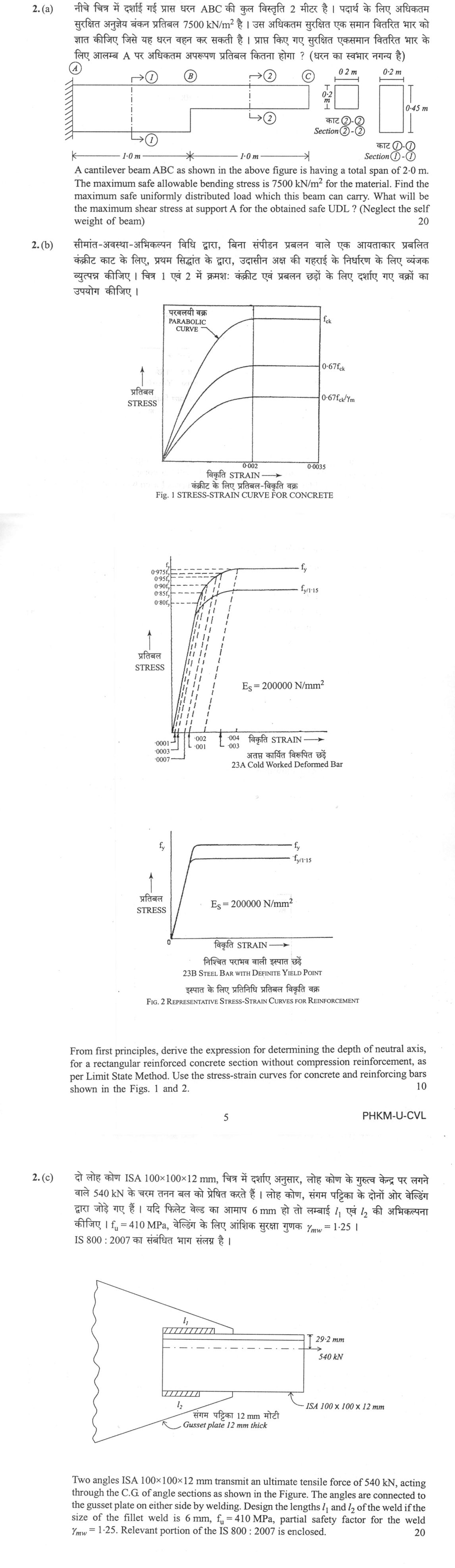
A cantilever beam ABC as shown in the above figure is having a total span of 2·0 m. The maximum safe allowable bending stress is 7500 kN/m² for the material. Find the maximum safe uniformly distributed load which this beam can carry. What will be the maximum shear stress at support A for the obtained safe UDL ? (Neglect the self weight of beam) 20 marks
From first principles, derive the expression for determining the depth of neutral axis, for a rectangular reinforced concrete section without compression reinforcement, as per Limit State Method. Use the stress-strain curves for concrete and reinforcing bars shown in the Figs. 1 and 2. 10 marks
Two angles ISA 100×100×12 mm transmit an ultimate tensile force of 540 kN, acting through the C.G. of angle sections as shown in the Figure. The angles are connected to the gusset plate on either side by welding. Design the lengths l₁ and l₂ of the weld if the size of the fillet weld is 6 mm, fᵤ = 410 MPa, partial safety factor for the weld γₘw = 1·25. Relevant portion of the IS 800 : 2007 is enclosed. 20 marks
हिंदी में प्रश्न पढ़ें
नीचे चित्र में दर्शाई गई प्रास धरन ABC की कुल विस्तृति 2 मीटर है । पदार्थ के लिए अधिकतम सुरक्षित अनुजेय बंकन प्रतिबल 7500 kN/m² है । उस अधिकतम सुरक्षित एक समान वितरित भार को ज्ञात कीजिए जिसे यह धरन वहन कर सकती है । प्राप्त किए गए सुरक्षित एकसमान वितरित भार के लिए आलम्ब A पर अधिकतम अपरूपण प्रतिबल कितना होगा ? (धरन का स्वभार नगण्य है) (20 अंक)
सीमान्त-अवस्था-अभिकल्पन विधि द्वारा, बिना संपीडन प्रबलन वाले एक आयताकार प्रबलित कंक्रीट काट के लिए, प्रथम सिद्धान्त के द्वारा, उदासीन अक्ष की गहराई के निर्धारण के लिए व्यंजक व्युत्पन्न कीजिए । चित्र 1 एवं 2 में क्रमशः: कंक्रीट एवं प्रबलन छड़ों के लिए दर्शाए गए वक्रों का उपयोग कीजिए । (10 अंक)
दो लोह कोण ISA 100×100×12 mm, चित्र में दर्शाए अनुसार, लोह कोण के गुरुत्व केन्द्र पर लगने वाले 540 kN के चरम तनन बल को प्रेषित करते हैं। लोह कोण, संगम पट्टिका के दोनों ओर वेल्डिंग द्वारा जोड़े गए हैं। यदि फिलेट वेल्ड का आमाप 6 mm हो तो लम्बाई l₁ एवं l₂ की अभिकल्पना कीजिए। fᵤ = 410 MPa, वेल्डिंग के लिए आंशिक सुरक्षा गुणक γₘw = 1·25। IS 800 : 2007 का संबंधित भाग संलग्न है। (20 अंक)
The figure this question refers to, in words
The question paper is a scan and the diagram did not survive as text. This is the figure as read from the original page — every component, value and label — so the question can be worked from the text below.
(a) Diagram of a stepped cantilever beam ABC fixed at support A on the left and free at tip C on the right. The top surface of the beam is continuous and horizontal. Segment AB has a length of 1.0 m, and segment BC has a length of 1.0 m, making the total span 2.0 m. The beam has two different rectangular cross-sections: Section 1-1 (along segment AB) is a rectangle with a width of 0.2 m and an overall depth of 0.45 m; Section 2-2 (along segment BC) is a rectangle with a width of 0.2 m and an overall depth of 0.2 m. The bottom face of the beam steps up at point B.
(b) Graph titled 'Fig. 1 STRESS-STRAIN CURVE FOR CONCRETE' with STRESS on the vertical axis and STRAIN on the horizontal axis. On the horizontal axis, strain values 0, 0.002, and 0.0035 are marked. Three curves are shown, each starting from the origin (0, 0) as a parabolic curve up to a strain of 0.002, and then continuing horizontally as a straight line up to an ultimate strain of 0.0035 where they terminate vertically: (1) an upper curve with a plateau stress of fck, (2) an intermediate curve with a plateau stress of 0.67 fck, and (3) a lower design curve with a plateau stress of 0.67 fck / gamma_m.
(c) A horizontal angle section labeled 'ISA 100 x 100 x 12 mm' is connected to a 'Gusset plate 12 mm thick' on the left. The top horizontal edge of the angle is welded to the gusset plate over a length labeled 'l_1' (indicated with hatching). The bottom horizontal edge of the angle is welded over a length labeled 'l_2' (indicated with hatching). A horizontal dashed line indicates the center of gravity (C.G.) line of the angle section, positioned at a vertical distance of 29.2 mm from the top edge. A tensile force of 540 kN acts horizontally to the right along this C.G. line.
Model answer
Written by UPSC Answer Check against this question's marking rubric, to the expected length. UPSC does not publish answers for Mains — this is one way to score well, not an official key.
(a) Let w be the safe uniformly distributed load in kN/m. For a cantilever, maximum moment occurs at the fixed support A, and in segment BC the maximum moment occurs at B.
For section AB: b = 0.20 m, d = 0.45 m. Z₁ = b d²/6 = 0.20 × 0.45²/6 = 0.00675 m³. M_A = w × 2²/2 = 2w kN·m. σ_A = M_A/Z₁ = 2w/0.00675 = 296.30w kN/m². σ_A ≤ 7500 ⇒ w ≤ 7500/296.30 = 25.31 kN/m.
For section BC: b = 0.20 m, d = 0.20 m. Z₂ = 0.20 × 0.20²/6 = 0.001333 m³. M_B = w × 1²/2 = 0.5w kN·m. σ_B = 0.5w/0.001333 = 375w kN/m². σ_B ≤ 7500 ⇒ w ≤ 7500/375 = 20 kN/m.
Hence the safe UDL is governed by section BC: w = 20 kN/m.
Shear force at support A: V_A = w × 2 = 20 × 2 = 40 kN. For a rectangular section, maximum shear stress is τₘₐₓ = 3V/(2bd) = 3 × 40/(2 × 0.20 × 0.45) = 120/0.18 = 666.67 kN/m². τₘₐₓ at A = 666.67 kN/m² = 0.667 N/mm².
(b) Let b = width of rectangular section, d = effective depth, xᵤ = depth of neutral axis from extreme compression fibre, Aₛₜ = area of tension steel, f_cₖ = characteristic concrete strength, and fᵧ = yield strength of steel.
From Fig. 1, the design stress-strain curve for concrete has ultimate strain ε_cᵤ = 0.0035. The design peak stress is f_d = 0.67 f_cₖ/γₘ = 0.67 f_cₖ/1.5 = 0.446 f_cₖ.
Assume plane sections remain plane, so strain varies linearly. The concrete compressive force is C = b ∫₀^xᵤ f(ε) dy, with ε = ε_cᵤ y/xᵤ. Thus C = (b xᵤ/ε_cᵤ) ∫₀^ε_cᵤ f(ε) dε.
Using the stress-strain curve: parabolic from 0 to 0.002, then constant to 0.0035. ∫₀^0.0035 f(ε) dε = (2/3)(0.002)f_d + (0.0035 − 0.002)f_d = 0.002833 f_d.
Therefore, C = b xᵤ (0.002833/0.0035) f_d = 0.8095 f_d b xᵤ = 0.8095 × 0.446 f_cₖ b xᵤ ≈ 0.36 f_cₖ b xᵤ.
From Fig. 2, the design tensile stress in steel at ultimate limit state is f_s = fᵧ/γₛ = fᵧ/1.15 = 0.87 fᵧ, provided the steel strain exceeds the yield strain. Hence T = 0.87 fᵧ Aₛₜ.
For equilibrium, C = T: 0.36 f_cₖ b xᵤ = 0.87 fᵧ Aₛₜ. Thus xᵤ = 0.87 fᵧ Aₛₜ/(0.36 f_cₖ b). In non-dimensional form, xᵤ/d = 0.87 fᵧ Aₛₜ/(0.36 f_cₖ b d). If pₜ = 100Aₛₜ/(bd), then xᵤ/d = 0.87 fᵧ pₜ/(36 f_cₖ).
This is valid for a singly reinforced rectangular section with tension steel only, when the section is under-reinforced and xᵤ ≤ xᵤ,ₘₐₓ.
(c) Two angles share the total ultimate tensile force, so load per angle is P = 540/2 = 270 kN.
For one angle, the C.G. lies 29.2 mm from the top weld and 100 − 29.2 = 70.8 mm from the bottom weld. Let F₁ and F₂ be the forces carried by the top and bottom welds. For the resultant to pass through the C.G., F₂ × 100/(F₁ + F₂) = 29.2. Hence F₁ = 0.708P = 0.708 × 270 = 191.16 kN, F₂ = 0.292P = 0.292 × 270 = 78.84 kN.
Design strength of fillet weld: f_wd = fᵤ/(√3 γₘw) = 410/(√3 × 1.25) = 189.37 N/mm². Effective throat thickness of 6 mm fillet weld: tₜ = 0.7 × 6 = 4.2 mm. Weld capacity per mm length: q = tₜ f_wd = 4.2 × 189.37 = 795.35 N/mm = 0.795 kN/mm.
Required effective lengths: l₁ₑ = F₁/q = 191.16/0.795 = 240.35 mm. l₂ₑ = F₂/q = 78.84/0.795 = 99.13 mm.
Allow 2s = 12 mm for end craters. Hence overall lengths: l₁ = 240.35 + 12 = 252.35 mm ≈ 255 mm. l₂ = 99.13 + 12 = 111.13 mm ≈ 115 mm.
Minimum weld length = max(4s, 40 mm) = 40 mm, so both are acceptable.
Adopt l₁ = 255 mm and l₂ = 115 mm.
What "Solve" is asking you to do
Choose the method, then carry it through to a final answer. Identifying what kind of problem this is and why that method applies is the first thing marked; a correct figure arrived at invisibly earns almost nothing.
Structure that answers it
Given data and what is required → method chosen, with the reason it applies → set-up (equation, circuit, free body, trial balance) → working, step by step → answer with units and any condition of validity
Where marks are lost
Doing the middle steps mentally and writing only the result. In mathematics papers, a further loss comes from giving a decimal where the exact value in surds or fractions was wanted, or from skipping the justification a part explicitly asks for.
How this answer will be evaluated
Approach
Framework: Limit State Design (IS 800:2007). (a) calculate: given > formula > substitution > result with units > interpretation | (b) derive: given > assumptions > stepwise derivation > result > check | (c) calculate: given > formula > substitution > result with units > interpretation Full marks: Complete method with all checks, labelled diagrams, and code references.
Key points expected
- Calculate section modulus for both segments
- Determine max bending moment at support A
- Calculate safe UDL using allowable stress
- Compute max shear stress at support A
- State equilibrium of forces (C = T)
- Use parabolic-rectangular stress block for concrete
- Apply strain compatibility at neutral axis
- Derive final expression for xu/d
Evaluation rubric
Each sub-part is marked on its own, against the marks and word limit printed on the paper.
- (a) Maximum safe UDL and maximum shear stress at support A. 20 marks
calculate— given → formula → substitution → result with units → interpretation
Must cover
- Calculate section modulus for both segments
- Determine max bending moment at support A
- Calculate safe UDL using allowable stress
- Compute max shear stress at support A
Loses marks
- Ignoring the stepped section change
- Using wrong section modulus for critical section
- Final value without design check
Earns more
- Draw SFD and BMD diagrams
- Show shear stress distribution formula
- Verify shear stress against allowable limit
Extra mark
- Labelled sketch of beam with dimensions
- Explicit statement of assumptions
- (b) Expression for neutral axis depth in singly reinforced RC section. 10 marks
derive— given → assumptions → stepwise derivation → result → check
Must cover
- State equilibrium of forces (C = T)
- Use parabolic-rectangular stress block for concrete
- Apply strain compatibility at neutral axis
- Derive final expression for xu/d
Loses marks
- Skipping strain compatibility step
- Using wrong stress block parameters
- No final expression for xu/d
Earns more
- Reference to IS 456:2000 clause
- Show stress-strain curve assumptions
- Define all variables used
Extra mark
- Neat labelled stress block diagram
- Mention of partial safety factors
- (c) Design lengths l1 and l2 of fillet welds for ISA angles. 20 marks
calculate— given → formula → substitution → result with units → interpretation
Must cover
- Calculate weld strength per unit length
- Determine force distribution based on CG
- Calculate l1 and l2 using equilibrium
- Check weld lengths against minimum requirements
Loses marks
- Ignoring CG location in force split
- Using wrong weld strength formula
- No check on minimum weld length
Earns more
- Show free body diagram of angle
- State IS 800:2007 clause for weld design
- Verify total weld length adequacy
Extra mark
- Labelled sketch of weld arrangement
- Mention of partial safety factor γmw
Practice this exact question
Write your answer and it is marked point by point against the model answer above — what you covered, what you missed, what you got wrong.
Evaluate my answer →More from Civil Engineering 2024 Paper I
- Q1 (a) A cantilever beam ABCD, as shown in the above figure, is carrying a uniformly distrib…
- Q2 (a) A cantilever beam ABC as shown in the above figure is having a total span of 2·0 m. T…
- Q3 (a) A box culvert ABCD is shown in the above figure. By using member fixed end moments gi…
- Q4 (a) A prestressed concrete T-beam having the cross-section of flange 1500 mm wide and 200…
- Q5 (a) A 125 mm diameter vertical cylinder rotates concentrically inside a fixed cylinder of…