Paper I — Q4
(a) A prestressed concrete T-beam having the cross-section of flange 1500 mm wide and 200 mm thick, rib of 300 mm wide and 1200…
A prestressed concrete T-beam having the cross-section of flange 1500 mm wide and 200 mm thick, rib of 300 mm wide and 1200 mm deep. The beam carries a live load of 20 kN/m apart from its dead load, over a simply supported span of 18 m. The beam is prestressed with a straight cable having constant eccentricity 'e'. Assume the losses of prestress as 16%. Determine the initial prestressing force 'Pᵢ' and its eccentricity 'e', if the permissible net stresses are equal to zero and 5 MPa respectively at top and bottom fibres of the beam. The unit weight of concrete is 25 kN/m³. 20 marks
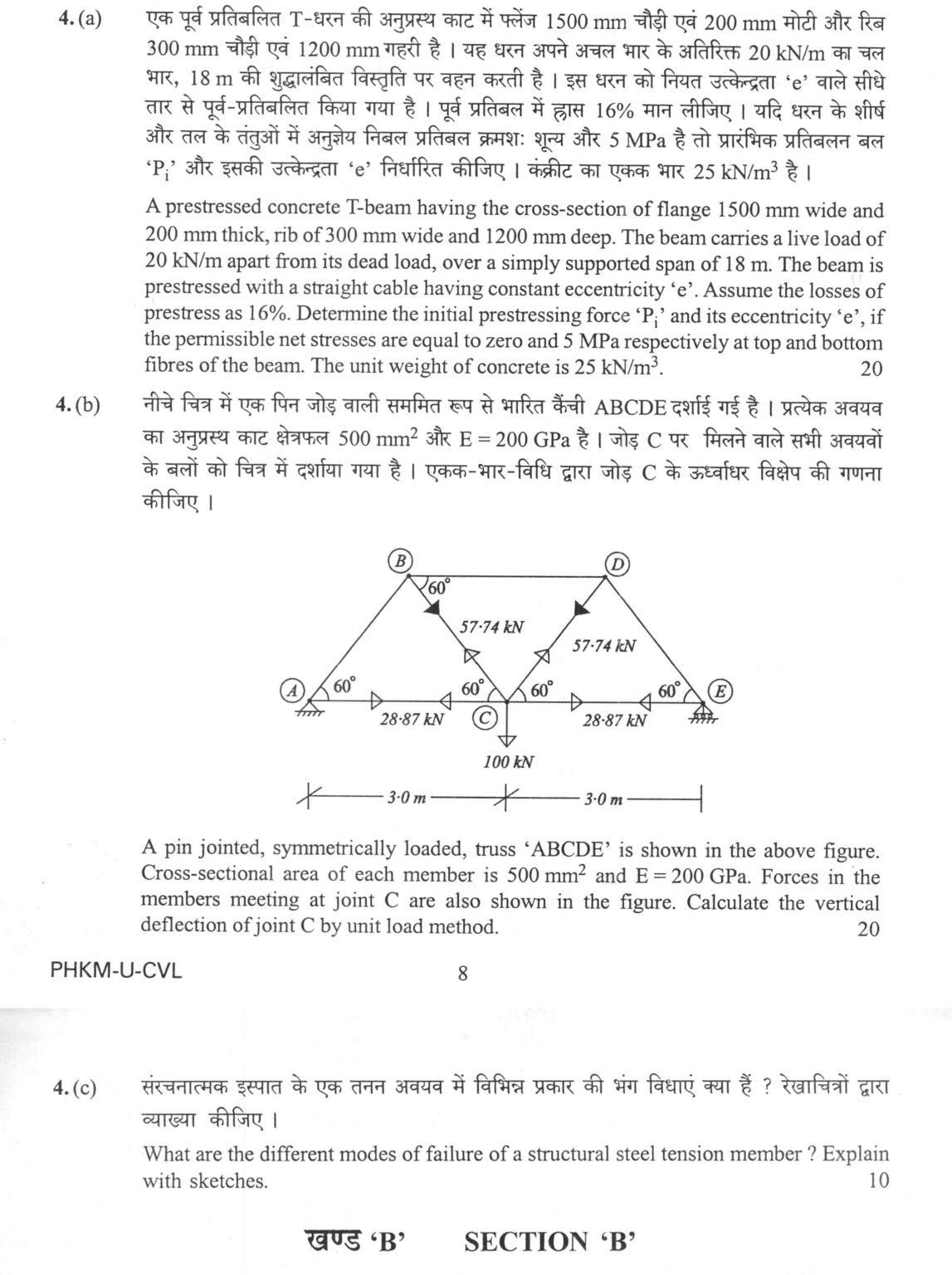
A pin jointed, symmetrically loaded, truss 'ABCDE' is shown in the above figure. Cross-sectional area of each member is 500 mm² and E = 200 GPa. Forces in the members meeting at joint C are also shown in the figure. Calculate the vertical deflection of joint C by unit load method. 20 marks
What are the different modes of failure of a structural steel tension member ? Explain with sketches. 10 marks
हिंदी में प्रश्न पढ़ें
एक पूर्व प्रतिबलित T-धरन की अनुप्रस्थ काट में फ्लेंज 1500 mm चौड़ी एवं 200 mm मोटी और रिब 300 mm चौड़ी एवं 1200 mm गहरी है। यह धरन अपने अचल भार के अतिरिक्त 20 kN/m का चल भार, 18 m की शुद्धालम्बित विस्तृति पर वहन करती है। इस धरन को नियत उत्केन्द्रता 'e' वाले सीधे तार से पूर्व-प्रतिबलित किया गया है। पूर्व प्रतिबल में ह्रास 16% मान लीजिए। यदि धरन के शीर्ष और तल के तंतुओं में अनुज्ञेय निवल प्रतिबल क्रमशः: शून्य और 5 MPa है तो प्रारंभिक प्रतिबलन बल 'Pᵢ' और इसकी उत्केन्द्रता 'e' निर्धारित कीजिए। कंक्रीट का एकक भार 25 kN/m³ है। 20 marks
नीचे चित्र में एक पिन जोड़ वाली सममित रूप से भारित कैंची ABCDE दर्शाई गई है। प्रत्येक अवयव का अनुप्रस्थ काट क्षेत्रफल 500 mm² और E = 200 GPa है। जोड़ C पर मिलने वाले सभी अवयवों के बलों को चित्र में दर्शाया गया है। एकक-भार-विधि द्वारा जोड़ C के उद्वर्धर विस्थाप की गणना कीजिए। 20 marks
संरचनात्मक इस्पात के एक तनन अवयव में विभिन्न प्रकार की भंग विधाएं क्या हैं ? रेखाचित्रों द्वारा व्याख्या कीजिए । 10 marks
The figure this question refers to, in words
The question paper is a scan and the diagram did not survive as text. This is the figure as read from the original page — every component, value and label — so the question can be worked from the text below.
(b) A symmetric pin-jointed truss labeled ABCDE consisting of three equilateral triangles (ABC, BCD, and CDE) with 60-degree angles. The bottom chord lies on a horizontal line with joints A, C, and E, where joint A is a pin/hinged support and joint E is also supported. The horizontal distance from A to C is 3.0 m, and from C to E is 3.0 m (total span 6.0 m). The top chord connects joints B and D horizontally. Members include AB, BC, CD, DE, BD, AC, and CE. A downward vertical point load of 100 kN is applied at joint C. Internal member forces for all four members meeting at joint C are shown acting away from joint C: a force of 28.87 kN directed to the left along member AC; a force of 28.87 kN directed to the right along member CE; a force of 57.74 kN directed up-and-left along member BC; and a force of 57.74 kN directed up-and-right along member CD. The angles indicated are 60 degrees at angle BAC, angle ABC, angle BCA, angle DCE, and angle DEC.
Model answer
Written by UPSC Answer Check against this question's marking rubric, to the expected length. UPSC does not publish answers for Mains — this is one way to score well, not an official key.
(a) Use compression positive. Effective prestress after 16% loss is Pₑ = 0.84 Pᵢ. Taking overall depth = 1200 mm, web depth below flange = 1000 mm.
A = 1500×200 + 300×1000 = 600000 mm² Centroid from bottom: ȳ = (1500×200×1100 + 300×1000×500)/(600000) = 800 mm I = 80×10⁹ mm⁴ Z_t = I/400 = 200×10⁶ mm³, Z_b = I/800 = 100×10⁶ mm³.
Self weight = 0.60×25 = 15 kN/m. Total load w = 15 + 20 = 35 kN/m. M = wL²/8 = 35×18²/8 = 1417.5 kN·m = 1.4175×10⁹ N·mm. M/Z_t = 7.0875 MPa, M/Z_b = 14.175 MPa.
For the physically admissible prestressed concrete stress condition, take bottom fibre stress zero and top fibre stress 5 MPa compression. σ_t = Pₑ/A − Pₑe/Z_t + M/Z_t = 5 σ_b = Pₑ/A + Pₑe/Z_b − M/Z_b = 0
Thus, Pₑ(1/A − e/Z_t) = 5 − 7.0875 = −2.0875 Pₑ(1/A + e/Z_b) = 14.175
Solving: e(14.175/Z_t − 2.0875/Z_b) = 16.2625/A e(14.175×5×10⁻⁹ − 2.0875×10⁻⁸) = 16.2625/600000 e = 542.08 mm
Pₑ = 14.175/(1/600000 + 542.08/100×10⁶) Pₑ = 2.00×10⁶ N = 2000 kN
Pᵢ = Pₑ/0.84 = 2000/0.84 = 2380.95 kN
Final: Pᵢ = 2380.95 kN, e = 542.08 mm below centroid. If the top/bottom order is read literally as top = 0 and bottom = 5 MPa, then e = 1750.8 mm, which lies outside the section; hence the above is the admissible design interpretation.
(b) All members have L = 3 m = 3000 mm. A = 500 mm², E = 200 GPa = 200000 N/mm². AE = 500×200000 = 1.0×10⁸ N.
From the given joint C forces: F_AC = F_CE = 28.87 kN tension F_BC = F_CD = 57.74 kN tension
By joint equilibrium: At A, R_A = 50 kN, so F_AB = −57.74 kN. At B, F_BD = −57.74 kN. At E, F_DE = −57.74 kN.
Thus five members AB, BC, CD, DE, BD carry 57.74 kN, and two members AC, CE carry 28.87 kN.
Unit load method: apply 1 kN downward at C. Since the structure is linear, uᵢ = Fᵢ/100.
δ_C = Σ Fᵢ uᵢ L/(AE)
For one 57.74 kN member: (57.74×10³)(0.5774)(3000)/(1.0×10⁸) = 1.000 mm
For one 28.87 kN member: (28.87×10³)(0.2887)(3000)/(1.0×10⁸) = 0.250 mm
Therefore, δ_C = 5×1.000 + 2×0.250 = 5.50 mm
Final: vertical deflection of joint C = 5.50 mm downward.
(c) Different modes of failure of a structural steel tension member:
- Gross yielding: The whole gross cross-section reaches yield stress f_y and elongates excessively. It is ductile and checked by T = A_g f_y/γ_m0. Sketch: a tension rod uniformly elongating.
- Net-section rupture: Tension member fractures at the critical net section through bolt holes or welds. Checked by T = 0.9 A_n f_u/γ_m1. Sketch: a plate with holes; crack runs across the bolt-hole line.
- Block shear failure: A block of material tears out by shear on one plane and tension on a perpendicular plane. Capacity is the smaller of shear yield + tensile rupture and shear rupture + tensile yield. Sketch: a rectangular block pulled out near the end connection.
- Fatigue failure: Under repeated or cyclic loading, a crack starts at a stress concentration such as a hole or weld and propagates until rupture. Sketch: small crack at a bolt hole under cyclic tension.
- Shear lag effect: Not a separate failure mode, but it reduces the effective net area in angles, channels or tees connected through part of their section, causing premature rupture near the connection. For pin-connected members, rupture may occur through the pin hole or by tear-out.
What "Solve" is asking you to do
Choose the method, then carry it through to a final answer. Identifying what kind of problem this is and why that method applies is the first thing marked; a correct figure arrived at invisibly earns almost nothing.
Structure that answers it
Given data and what is required → method chosen, with the reason it applies → set-up (equation, circuit, free body, trial balance) → working, step by step → answer with units and any condition of validity
Where marks are lost
Doing the middle steps mentally and writing only the result. In mathematics papers, a further loss comes from giving a decimal where the exact value in surds or fractions was wanted, or from skipping the justification a part explicitly asks for.
How this answer will be evaluated
Approach
Framework: Civil Engineering Paper 1: Given > Assumptions > Design/Analysis > Result/Check. (a) calculate: given > formula > substitution > result with units > interpretation | (b) calculate: given > formula > substitution > result with units > interpretation | (c) explain: definition/context > points in order > small example > short close Full marks: Complete working with correct units, code references, and neat sketches; all assumptions stated.
Key points expected
- Calculate section properties (A, Zt, Zb) for T-beam
- Compute dead load and maximum bending moment
- Apply stress limits (0 MPa top, 5 MPa bottom) to form equations
- Solve for Pi and e, accounting for 16% prestress loss
- Identify member forces (N) from given diagram
- Apply unit load at C to find virtual forces (n)
- Calculate member lengths based on geometry (3.0m, 60°)
- Sum (N*n*L)/AE to find total deflection
Evaluation rubric
Each sub-part is marked on its own, against the marks and word limit printed on the paper.
- (a) Determine initial prestressing force Pi and eccentricity e for the T-beam. 20 marks
calculate— given → formula → substitution → result with units → interpretation
Must cover
- Calculate section properties (A, Zt, Zb) for T-beam
- Compute dead load and maximum bending moment
- Apply stress limits (0 MPa top, 5 MPa bottom) to form equations
- Solve for Pi and e, accounting for 16% prestress loss
Loses marks
- Ignoring prestress losses in final calculation
- Using incorrect section modulus for T-beam
- Missing units in intermediate steps
Earns more
- Explicitly state unit weight of concrete (25 kN/m³)
- Show free body diagram or section sketch
- Verify final stresses against permissible limits
Extra mark
- Reference IS 1343 code clauses for prestressed concrete
- (b) Calculate vertical deflection of joint C using unit load method. 20 marks
calculate— given → formula → substitution → result with units → interpretation
Must cover
- Identify member forces (N) from given diagram
- Apply unit load at C to find virtual forces (n)
- Calculate member lengths based on geometry (3.0m, 60°)
- Sum (N*n*L)/AE to find total deflection
Loses marks
- Incorrect virtual force analysis at joint C
- Using wrong member lengths for diagonal members
- Forgetting to convert units (mm to m, GPa to MPa)
Earns more
- Tabulate N, n, L, and N*n*L for each member
- Correctly resolve forces at 60° angles
- State E and A values clearly before substitution
Extra mark
- Check for symmetry to reduce calculation steps
- (c) Explain different modes of failure of structural steel tension members. 10 marks
explain— definition/context → points in order → small example → short close
Must cover
- Identify failure in gross section (yielding)
- Identify failure in net section (rupture)
- Provide sketches for each failure mode
- Mention block shear failure if applicable
Loses marks
- Confusing tension failure with compression buckling
- Missing sketches as explicitly requested
- Vague description without specific failure mechanisms
Earns more
- Distinguish between ductile and brittle failure
- Reference IS 800 code for design strengths
- Show stress distribution diagrams
Extra mark
- Mention specific failure patterns for bolted connections
Practice this exact question
Write your answer and it is marked point by point against the model answer above — what you covered, what you missed, what you got wrong.
Evaluate my answer →More from Civil Engineering 2024 Paper I
- Q1 (a) A cantilever beam ABCD, as shown in the above figure, is carrying a uniformly distrib…
- Q2 (a) A cantilever beam ABC as shown in the above figure is having a total span of 2·0 m. T…
- Q3 (a) A box culvert ABCD is shown in the above figure. By using member fixed end moments gi…
- Q4 (a) A prestressed concrete T-beam having the cross-section of flange 1500 mm wide and 200…
- Q5 (a) A 125 mm diameter vertical cylinder rotates concentrically inside a fixed cylinder of…
- Q6 (a) The resistance force F of a ship is a function of its length L, velocity V, accelerat…
- Q7 (a) A canal is to be excavated through a soil with c = 20 kN/m², φ = 20°, e = 0·80 and G…