Paper I — Q7
(a) A canal is to be excavated through a soil with c = 20 kN/m², φ = 20°, e = 0·80 and G = 2·70. The side slope is 1 in 1. The…
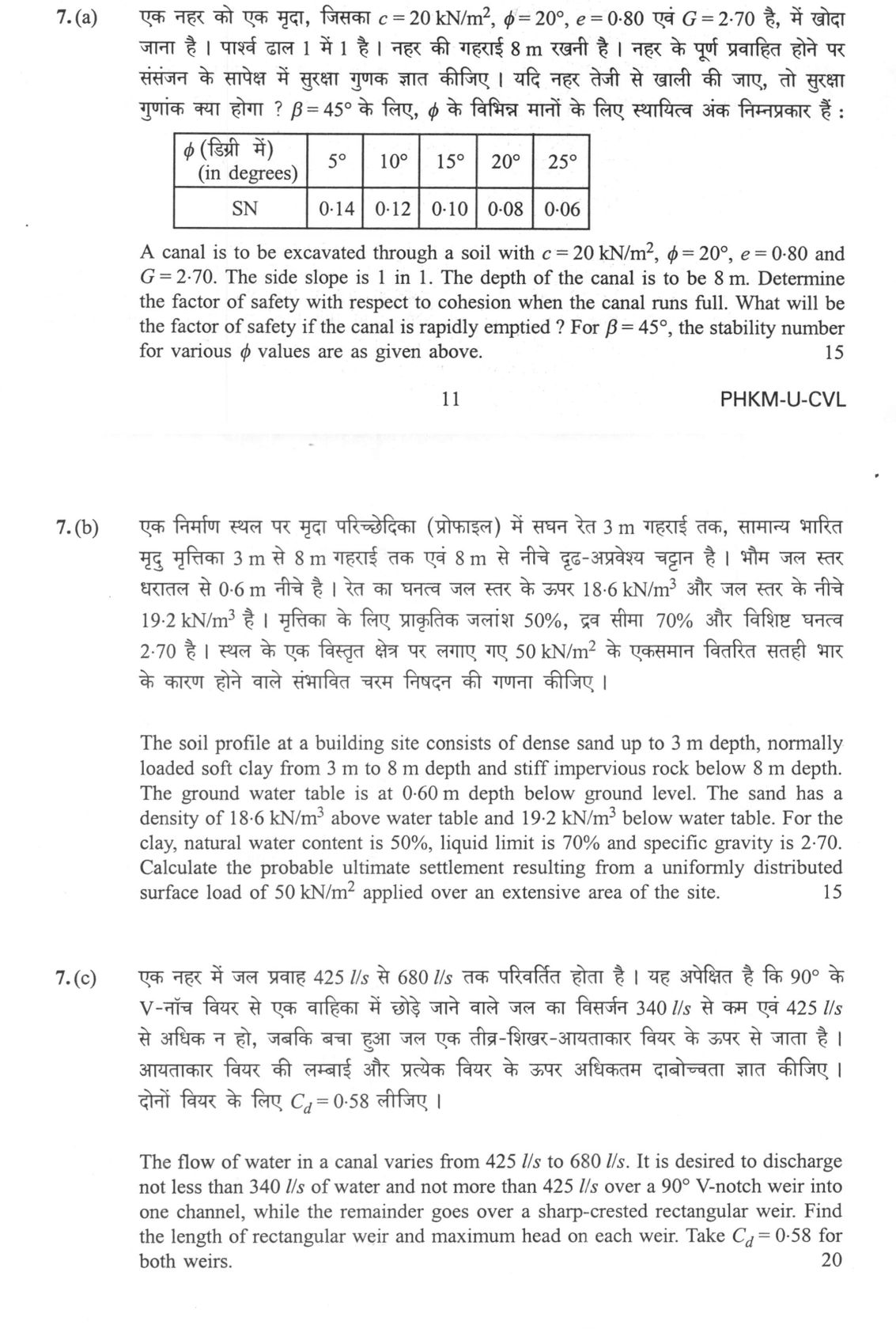
A canal is to be excavated through a soil with c = 20 kN/m², φ = 20°, e = 0·80 and G = 2·70. The side slope is 1 in 1. The depth of the canal is to be 8 m. Determine the factor of safety with respect to cohesion when the canal runs full. What will be the factor of safety if the canal is rapidly emptied ? For β = 45°, the stability number for various φ values are as given above. 15 marks
The soil profile at a building site consists of dense sand up to 3 m depth, normally loaded soft clay from 3 m to 8 m depth and stiff impervious rock below 8 m depth. The ground water table is at 0·60 m depth below ground level. The sand has a density of 18·6 kN/m³ above water table and 19·2 kN/m³ below water table. For the clay, natural water content is 50%, liquid limit is 70% and specific gravity is 2·70. Calculate the probable ultimate settlement resulting from a uniformly distributed surface load of 50 kN/m² applied over an extensive area of the site. 15 marks
The flow of water in a canal varies from 425 l/s to 680 l/s. It is desired to discharge not less than 340 l/s of water and not more than 425 l/s over a 90° V-notch weir into one channel, while the remainder goes over a sharp-crested rectangular weir. Find the length of rectangular weir and maximum head on each weir. Take C_d = 0·58 for both weirs. 20 marks
हिंदी में प्रश्न पढ़ें
एक नहर को एक मृदा, जिसका c = 20 kN/m², φ = 20°, e = 0·80 एवं G = 2·70 है, में खोदा जाना है। पार्श्व ढाल 1 में 1 है। नहर की गहराई 8 m रखनी है। नहर के पूर्ण प्रवाहित होने पर संसजन के सापेक्ष में सुरक्षा गुणक ज्ञात कीजिए। यदि नहर तेजी से खाली की जाए, तो सुरक्षा गुणांक क्या होगा ? β = 45° के लिए, φ के विभिन्न मानों के लिए स्थायित्व अंक निम्नप्रकार हैं :
φ (डिग्री में) (in degrees) 5° 10° 15° 20° 25°
SN 0·14 0·12 0·10 0·08 0·06 15 marks
एक निर्माण स्थल पर मृदा परिछेदिका (प्रोफाइल) में सघन रेत 3 m गहराई तक, सामान्य भारित मृद् मृतिका 3 m से 8 m गहराई तक एवं 8 m से नीचे दृढ़-अप्रवेश्य चट्टान है। भौम जल स्तर धरातल से 0·6 m नीचे है। रेत का घनत्व जल स्तर के ऊपर 18·6 kN/m³ और जल स्तर के नीचे 19·2 kN/m³ है। मृतिका के लिए प्राकृतिक जलांश 50%, द्रव सीमा 70% और विशिष्ट घनत्व 2·70 है। स्थल के एक विस्तृत क्षेत्र पर लगाए गए 50 kN/m² के एकसमान वितरित सतही भार के कारण होने वाले संभावित चरम निपदन की गणना कीजिए। 15 marks
एक नहर में जल प्रवाह 425 l/s से 680 l/s तक परिवर्तित होता है। यह अपेक्षित है कि 90° के V-नोच वियर से एक वाहिका में छोड़े जाने वाले जल का विसर्जन 340 l/s से कम एवं 425 l/s से अधिक न हो, जबकि बचा हुआ जल एक तीक्ष्ण-शिखर-आयताकार वियर के ऊपर से जाता है। आयताकार वियर की लंबाई और प्रत्येक वियर के ऊपर अधिकतम दाबोच्चता ज्ञात कीजिए। दोनों वियर के लिए C_d = 0·58 लीजिए। 20 marks
The figure this question refers to, in words
The question paper is a scan and the diagram did not survive as text. This is the figure as read from the original page — every component, value and label — so the question can be worked from the text below.
(a) Table with two rows and six columns. The first row contains the header 'phi (in degrees)' followed by values: 5, 10, 15, 20, 25. The second row contains the header 'SN' followed by values: 0.14, 0.12, 0.10, 0.08, 0.06.
What "Solve" is asking you to do
Choose the method, then carry it through to a final answer. Identifying what kind of problem this is and why that method applies is the first thing marked; a correct figure arrived at invisibly earns almost nothing.
Structure that answers it
Given data and what is required → method chosen, with the reason it applies → set-up (equation, circuit, free body, trial balance) → working, step by step → answer with units and any condition of validity
Where marks are lost
Doing the middle steps mentally and writing only the result. In mathematics papers, a further loss comes from giving a decimal where the exact value in surds or fractions was wanted, or from skipping the justification a part explicitly asks for.
How this answer will be evaluated
Approach
Framework: Geotechnical Engineering Analysis. (a) calculate: given > formula > substitution > result with units > interpretation | (b) calculate: given > formula > substitution > result with units > interpretation | (c) calculate: given > formula > substitution > result with units > interpretation Full marks: All steps shown with correct formulas, units, and final values with checks.
Key points expected
- Compute saturated and submerged unit weights from G and e
- Apply FOS formula for full canal using saturated weight
- Apply FOS formula for rapid emptying using submerged weight
- Substitute SN=0.08 for φ=20° and β=45° from table
- Determine clay void ratio from water content and G
- Calculate initial effective stress at mid-clay depth
- Compute final effective stress including 50 kN/m² load
- Apply one-dimensional consolidation settlement formula
Evaluation rubric
Each sub-part is marked on its own, against the marks and word limit printed on the paper.
- (a) Factor of safety for full and rapidly emptied canal conditions. 15 marks
calculate— given → formula → substitution → result with units → interpretation
Must cover
- Compute saturated and submerged unit weights from G and e
- Apply FOS formula for full canal using saturated weight
- Apply FOS formula for rapid emptying using submerged weight
- Substitute SN=0.08 for φ=20° and β=45° from table
Loses marks
- Using dry unit weight for full canal condition
- Ignoring the change in effective stress for rapid emptying
Earns more
- Explicitly state the stability number formula used
- Show calculation of γ_sat and γ_sub
Extra mark
- Sketch of canal cross-section with water levels
- (b) Probable ultimate settlement of the soft clay layer. 15 marks
calculate— given → formula → substitution → result with units → interpretation
Must cover
- Determine clay void ratio from water content and G
- Calculate initial effective stress at mid-clay depth
- Compute final effective stress including 50 kN/m² load
- Apply one-dimensional consolidation settlement formula
Loses marks
- Ignoring the water table depth in stress calculation
- Using total stress instead of effective stress
Earns more
- Correct calculation of submerged unit weight for sand
- Explicit statement of compression index assumption
Extra mark
- Sketch of soil profile with water table and stresses
- (c) Length of rectangular weir and maximum head on each weir. 20 marks
calculate— given → formula → substitution → result with units → interpretation
Must cover
- Use V-notch formula to find head for 425 l/s flow
- Calculate flow over rectangular weir for max canal flow
- Solve for rectangular weir length using Cd=0.58
- Determine maximum head on rectangular weir
Loses marks
- Using wrong discharge formula for V-notch weir
- Ignoring the minimum flow constraint for V-notch
Earns more
- Correct conversion of flow rates to m³/s
- Clear separation of V-notch and rectangular weir calculations
Extra mark
- Sketch of weir arrangement with flow directions
Model answer coming soon
Every evaluation on this site is marked against a verified model answer. This question's answer is still being written; evaluation opens the moment it lands.
More from Civil Engineering 2024 Paper I
- Q4 (a) A prestressed concrete T-beam having the cross-section of flange 1500 mm wide and 200…
- Q5 (a) A 125 mm diameter vertical cylinder rotates concentrically inside a fixed cylinder of…
- Q6 (a) The resistance force F of a ship is a function of its length L, velocity V, accelerat…
- Q7 (a) A canal is to be excavated through a soil with c = 20 kN/m², φ = 20°, e = 0·80 and G…
- Q8 (a) A retaining wall 8 m high, with a smooth vertical back is pushed against a soil mass…