Paper I — Q5
(a) A 125 mm diameter vertical cylinder rotates concentrically inside a fixed cylinder of diameter 130 mm. Both cylinders are 325…
A 125 mm diameter vertical cylinder rotates concentrically inside a fixed cylinder of diameter 130 mm. Both cylinders are 325 mm long. Find the dynamic viscosity of the liquid that fills the space between the cylinders, if a torque of 0·92 Nm is required to maintain a speed of 70 r.p.m. 10 marks
Calculate the friction drag on a flat plate 15 cm wide and 45 cm long placed longitudinally in a stream of oil of relative density 0·925 and kinematic viscosity 0·9 stoke, flowing with a free stream velocity of 6 m/s. Also find the thickness of the boundary layer and shear stress at the trailing edge. Take density of water 1000 kg/m³. 10 marks
A large tank as shown in the above figure has a vertical pipe 70 cm long and 2 cm in diameter. The tank contains an oil of density 920 kg/m³ and viscosity 1·5 poise. Find the discharge through the pipe when the height of the oil level of the tank is 0·80 m above the pipe inlet. 10 marks
A field density test was conducted by core-cutter method and the following data was obtained: Weight of empty core-cutter = 23 N Weight of soil and core-cutter = 50 N Dimensions of the core-cutter dia = 90 mm and height = 180 mm Weight of wet sample for moisture determination = 55×10⁻² N Weight of oven dry sample = 52×10⁻² N Specific gravity of soil grains = 2·70 Determine its dry density, void ratio and degree of saturation. 10 marks
Two plate load tests were conducted at a site – one with a 300 mm square plate and other with a 600 mm square test plate. For a settlement of 25 mm the loads were found to be 21·6 kN and 64·8 kN respectively in the two tests. Determine the allowable bearing pressure of the sand and the load which a square footing 1·5 m×1·5 m can carry with the settlement not exceeding 25 mm. 10 marks
हिंदी में प्रश्न पढ़ें
एक 125 mm व्यास का उद्वाधर बेलन, एक 130 mm व्यास के आबद्ध बेलन के अन्दर संकेन्द्र: घूमता है । दोनों बेलनों की लम्बाई 325 mm है । यदि 70 r.p.m की गति बनाए रखने के लिए 0·92 Nm बल आघूर्ण की आवश्यकता होती है, तो बेलनों के बीच की जगह में भरे हुए द्रव की गतिक श्यानता ज्ञात कीजिए । (10 अंक)
आपेक्षिक घनत्व 0·925 और शुद्ध गतिक श्यानता 0·9 स्टोक वाले एक तेल की धारा, जो एक 6 m/s के स्वतंत्र धारा वेग से प्रवाहित है, में 15 cm चौड़ी और 45 cm लम्बी, अनुदैर्ध्यवत रखी गई, एक चपटी पट्टिका पर घर्षण विकर्ष की गणना कीजिए । सीमान्त परत की मोटाई और अनुगामी किनार पर अपरूपण प्रतिबल भी ज्ञात कीजिए । जल का घनत्व 1000 kg/m³ लीजिए । (10 अंक)
नीचे चित्र में दर्शाई गई एक विशाल टंकी में 70 cm लम्बा और 2 cm व्यास का एक उद्वाधर पाइप लगा है । टंकी में, 920 kg/m³ घनत्व एवं 1·5 पायस वाला तेल है । जब टंकी में तेल सतह की ऊँचाई, पाइप के अन्तर्गम से 0·80 m ऊपर हो तो पाइप में से निस्सरण को ज्ञात कीजिए । (10 अंक)
कोर कटर (कोर कटर) विधि द्वारा एक क्षेत्र घनत्व परीक्षण किया गया जिससे निम्नलिखित आंकड़े प्राप्त हुए : खाली कोर कटर का वजन = 23 N मृदा एवं कोर कटर का वजन = 50 N कोर कटर की विमाएं : व्यास = 90 mm एवं ऊँचाई = 180 mm जलाश निर्धारण के लिए नम-नमूने का वजन = 55×10⁻² N भट्टी में सुखाए गए नमूने का वजन = 52×10⁻² N मृदा कणों का विशिष्ट घनत्व = 2·70 इसके लिए शुष्कघनत्व, रिक्ति अनुपात, एवं संतृप्ति की मात्रा ज्ञात कीजिए । (10 अंक)
एक स्थल पर दो पट्टिका-भार-परीक्षण किए गए एक 300 mm की वर्गाकार पट्टिका से एवं दूसरा 600 mm की वर्गाकार परीक्षण पट्टिका से । इन दो परीक्षणों में 25 mm निष्पदन के लिए बलों का मान क्रमशः 21·6 kN एवं 64·8 kN प्राप्त हुआ । रेत के लिए अनुज्ञेय-धारक-दाब; और निष्पदन के 25 mm से अधिक नहीं होने की स्थिति में एक 1·5 m×1·5 m की वर्गाकार पाद द्वारा वहन किए जाने वाले भार को निर्धारित कीजिए । (10 अंक)
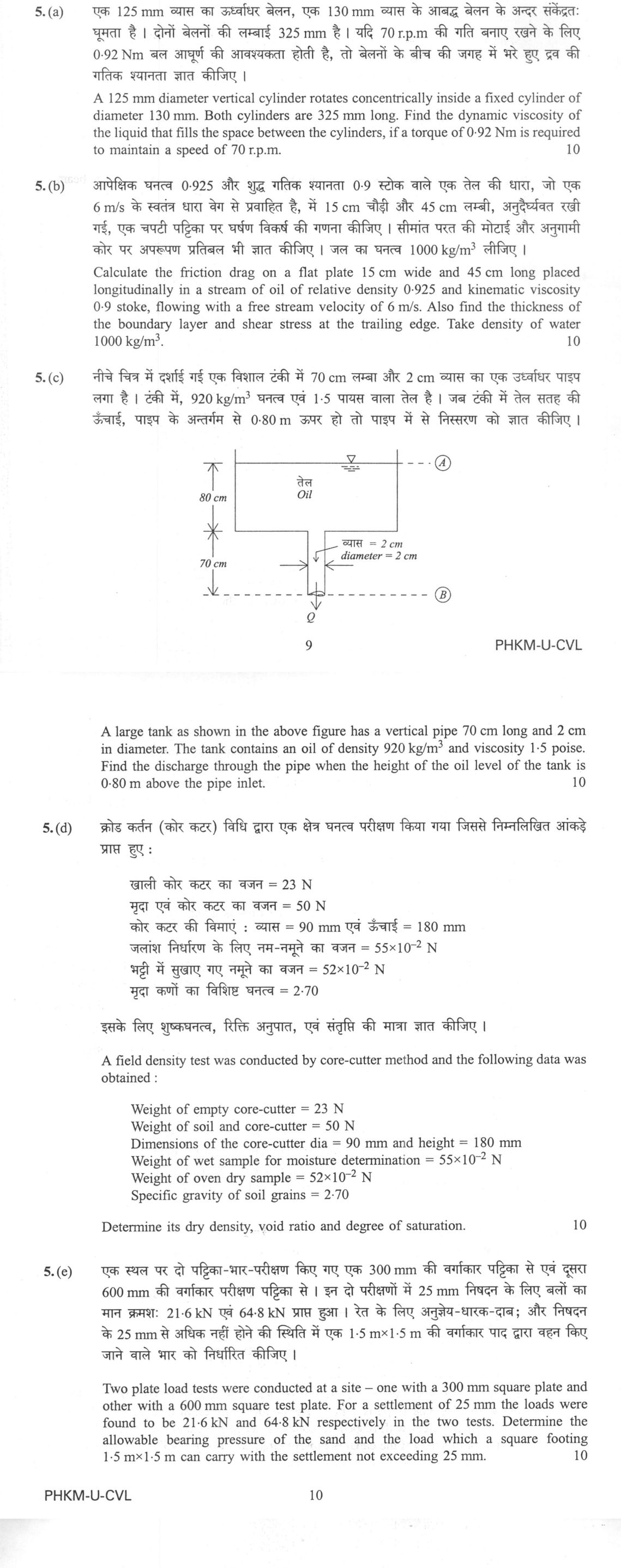
The figure this question refers to, in words
The question paper is a scan and the diagram did not survive as text. This is the figure as read from the original page — every component, value and label — so the question can be worked from the text below.
(c) A large open tank containing oil ('तेल / Oil') with a vertical discharge pipe attached to its bottom. The liquid surface in the tank is marked with a liquid level symbol and a dashed horizontal reference line to label (A). The depth of the oil from the free surface (A) to the bottom of the tank (inlet of the vertical pipe) is 80 cm. A vertical pipe extends downwards from the bottom of the tank with a length of 70 cm to its discharge exit, which is aligned with a dashed horizontal reference line to label (B). The pipe is labeled with 'diameter = 2 cm' ('व्यास = 2 cm'). An arrow pointing downwards from the exit of the pipe is labeled 'Q'.
Model answer
Written by UPSC Answer Check against this question's marking rubric, to the expected length. UPSC does not publish answers for Mains — this is one way to score well, not an official key.
(a) For steady laminar Couette flow between concentric cylinders, use the exact solution. The velocity profile is u_θ = Ar + B/r. With inner radius R1 rotating at ω and outer radius R2 fixed, the torque magnitude is T = μ (4π L ω R1² R2²) / (R2² − R1²).
Given: R1 = 125/2 mm = 0.0625 m, R2 = 130/2 mm = 0.065 m, L = 325 mm = 0.325 m, N = 70 r.p.m., T = 0.92 Nm. ω = 2πN/60 = 2π×70/60 = 7π/3 rad/s.
R2² − R1² = 0.065² − 0.0625² = 0.004225 − 0.00390625 = 0.00031875 m². R1² R2² = 0.0625² × 0.065² = 0.00390625 × 0.004225 = 0.00001650390625 m⁴.
Thus μ = T (R2² − R1²) / (4π L ω R1² R2²) = 0.92 × 0.00031875 / [4π × 0.325 × (7π/3) × 0.00001650390625] = 0.00029325 / 0.000494090645 = 0.5935 Pa·s.
μ = 0.5935 Pa·s = 5.94 poise.
Condition: steady, laminar, Newtonian liquid; end effects neglected. The usual thin-gap approximation gives μ ≈ 0.629 Pa·s; the exact annular-curvature value above is the rigorous one.
(b) Relative density = 0.925, so ρ = 925 kg/m³. ν = 0.9 stoke = 0.9 cm²/s = 9×10⁻⁵ m²/s. μ = ρν = 925 × 9×10⁻⁵ = 0.08325 Pa·s.
L = 45 cm = 0.45 m, b = 15 cm = 0.15 m, U = 6 m/s. Re_L = UL/ν = 6 × 0.45 / (9×10⁻⁵) = 30000 < 5×10⁵, so the boundary layer is laminar over the whole plate.
Average skin-friction coefficient for one side: C_f = 1.328 / √Re_L = 1.328 / √30000 = 0.007667.
Dynamic pressure = (1/2)ρU² = 0.5 × 925 × 36 = 16650 Pa. Area of one side = bL = 0.15 × 0.45 = 0.0675 m².
Drag on one side: F₁ = C_f × dynamic pressure × area = 0.007667 × 16650 × 0.0675 = 8.62 N.
Total drag on both sides: F = 2F₁ = 17.24 N.
Boundary-layer thickness at trailing edge: δ = 5L / √Re_L = 5 × 0.45 / √30000 = 0.01299 m = 12.99 mm.
Shear stress at trailing edge: τ_w = 0.332 ρU² / √Re_L = 0.332 × 925 × 36 / √30000 = 63.8 Pa.
Total drag = 17.24 N (one side = 8.62 N); δ_trailing = 12.99 mm; τ_trailing = 63.8 Pa.
Condition: smooth flat plate, zero pressure gradient, laminar boundary layer.
(c) Given: d = 2 cm = 0.02 m, L = 70 cm = 0.70 m, ρ = 920 kg/m³, μ = 1.5 poise = 0.15 Pa·s.
The oil surface is 0.80 m above the pipe inlet and the pipe exit is 0.70 m below the inlet, so total head: H = 0.80 + 0.70 = 1.50 m.
Assume laminar flow and use Hagen–Poiseuille equation: Q = π ρ g d⁴ H / (128 μ L).
d⁴ = (0.02)⁴ = 1.6×10⁻⁷ m⁴.
Q = π × 920 × 9.81 × 1.50 × 1.6×10⁻⁷ / (128 × 0.15 × 0.70) = 6.805×10⁻³ / 13.44 = 5.063×10⁻⁴ m³/s = 0.506 L/s.
Velocity: V = Q / (πd²/4) = 5.063×10⁻⁴ / (π × 0.02²/4) = 1.611 m/s.
Reynolds number: Re = ρVd/μ = 920 × 1.611 × 0.02 / 0.15 = 197.7 < 2000, so laminar assumption is valid.
Q = 5.06×10⁻⁴ m³/s = 0.506 L/s.
Condition: fully developed laminar pipe flow, minor losses and exit kinetic-energy head neglected. If exit kinetic-energy head is included, Q ≈ 4.68×10⁻⁴ m³/s.
(d) Weight of wet soil in core cutter = 50 − 23 = 27 N.
Volume of core cutter: V = (π/4)d²h = (π/4) × (0.09)² × 0.18 = 1.145×10⁻³ m³.
Wet unit weight: γ = 27 / (1.145×10⁻³) = 23579 N/m³ = 23.58 kN/m³.
Moisture content: w = (0.55 − 0.52) / 0.52 = 0.03 / 0.52 = 0.05769 = 5.769%.
Dry unit weight: γ_d = γ / (1 + w) = 23.58 / 1.05769 = 22.29 kN/m³.
Dry density: ρ_d = γ_d / g = 22.29 / 9.81 = 2.272×10³ kg/m³ = 2.272 g/cm³.
Void ratio: e = G_s γ_w / γ_d − 1, with γ_w = 9.81 kN/m³, G_s = 2.70. e = (2.70 × 9.81) / 22.29 − 1 = 26.487 / 22.29 − 1 = 1.188 − 1 = 0.188.
Degree of saturation: S = w G_s / e = (0.05769 × 2.70) / 0.188 = 0.1558 / 0.188 = 0.828 = 82.8%.
γ_d = 22.29 kN/m³; e = 0.188; S = 82.8%.
(e) For the 300 mm plate: B₁ = 0.30 m, A₁ = 0.30² = 0.09 m². q₁ = 21.6 / 0.09 = 240 kN/m².
For the 600 mm plate: B₂ = 0.60 m, A₂ = 0.60² = 0.36 m². q₂ = 64.8 / 0.36 = 180 kN/m².
For sand, at a fixed settlement, the plate-load-test relation gives qB / (B + 0.3) = constant.
Check: q₁B₁ / (B₁ + 0.3) = 240 × 0.30 / (0.30 + 0.30) = 120 kN/m². q₂B₂ / (B₂ + 0.3) = 180 × 0.60 / (0.60 + 0.30) = 120 kN/m².
Thus constant C = 120 kN/m².
For footing B_f = 1.5 m, at the same settlement 25 mm: q_f × 1.5 / (1.5 + 0.3) = 120 q_f = 120 × 1.8 / 1.5 = 144 kN/m².
Area of footing = 1.5 × 1.5 = 2.25 m².
Load Q = q_f × A = 144 × 2.25 = 324 kN.
Allowable bearing pressure = 144 kN/m² = 144 kPa; safe load = 324 kN.
What "Calculate" is asking you to do
Apply the standard formula or schedule to data the question has already supplied — a table of readings, cost records, a balance sheet — and produce the number. The method is rarely in doubt; the marks sit in the named intermediate quantities, each of which has to appear as a labelled line.
Structure that answers it
Data as given → formula or standard treatment, named → substitution → each intermediate, labelled → result with units
Where marks are lost
Omitting an intermediate the marking scheme pays for separately, or rounding at an intermediate line so the final figure drifts. In commerce and accountancy, any figure in a statement that no numbered working note supports is treated as unearned.
How this answer will be evaluated
Approach
(a) calculate: given > formula > substitution > result with units > interpretation | (b) calculate: given > formula > substitution > result with units > interpretation | (c) calculate: given > formula > substitution > result with units > interpretation | (d) calculate: given > formula > substitution > result with units > interpretation | (e) calculate: given > formula > substitution > result with units > interpretation Full marks: All parts solved with correct formulas, units, and clear steps.
Key points expected
- Convert rpm to angular velocity (rad/s)
- Calculate radial clearance (R2 - R1)
- Apply Newton's law of viscosity for shear stress
- Relate torque to shear force and radius
- Calculate Reynolds number to determine flow regime
- Select appropriate drag coefficient formula (laminar/turbulent)
- Compute boundary layer thickness (δ) at L
- Calculate shear stress (τ) at the trailing edge
Evaluation rubric
Each sub-part is marked on its own, against the marks and word limit printed on the paper.
- (a) Dynamic viscosity of the liquid filling the annular space. 10 marks
calculate— given → formula → substitution → result with units → interpretation
Must cover
- Convert rpm to angular velocity (rad/s)
- Calculate radial clearance (R2 - R1)
- Apply Newton's law of viscosity for shear stress
- Relate torque to shear force and radius
Loses marks
- Using diameter instead of radius in torque equation
- Ignoring unit conversion for length or time
Earns more
- Explicit calculation of surface area
- Unit consistency check (Pa.s or N.s/m²)
Extra mark
- Sketch of concentric cylinders with dimensions
- (b) Friction drag, boundary layer thickness, and shear stress at trailing edge. 10 marks
calculate— given → formula → substitution → result with units → interpretation
Must cover
- Calculate Reynolds number to determine flow regime
- Select appropriate drag coefficient formula (laminar/turbulent)
- Compute boundary layer thickness (δ) at L
- Calculate shear stress (τ) at the trailing edge
Loses marks
- Using wrong formula for Reynolds number
- Confusing kinematic and dynamic viscosity
Earns more
- Explicit calculation of dynamic viscosity (μ)
- Verification of flow regime (Laminar/Turbulent)
Extra mark
- Sketch of boundary layer profile
- (c) Discharge through the vertical pipe. 10 marks
calculate— given → formula → substitution → result with units → interpretation
Must cover
- Calculate total head (h) from diagram
- Apply Darcy-Weisbach equation for head loss
- Solve for velocity (v) or discharge (Q)
- Convert viscosity units (Poise to SI)
Loses marks
- Ignoring the 70 cm pipe length in head loss
- Using wrong diameter in area calculation
Earns more
- Explicit calculation of pipe area
- Check for laminar flow assumption
Extra mark
- Sketch of energy grade line
- (d) Dry density, void ratio, and degree of saturation. 10 marks
calculate— given → formula → substitution → result with units → interpretation
Must cover
- Calculate volume of core cutter
- Determine water content (w) from weights
- Calculate dry density (ρd)
- Use phase diagram relations for e and S
Loses marks
- Confusing wet and dry weights
- Incorrect volume calculation from dimensions
Earns more
- Explicit calculation of wet and dry weights
- Use of standard soil mechanics formulas
Extra mark
- Sketch of soil phase diagram
- (e) Allowable bearing pressure and load for 1.5m footing. 10 marks
calculate— given → formula → substitution → result with units → interpretation
Must cover
- Calculate bearing pressure for both plates
- Use Terzaghi's or Skempton's settlement formula
- Determine allowable bearing pressure (qall)
- Calculate load for 1.5m x 1.5m footing
Loses marks
- Ignoring the difference in plate sizes
- Using wrong formula for settlement
Earns more
- Explicit calculation of plate areas
- Correct application of settlement ratio
Extra mark
- Sketch of plate load test setup
Practice this exact question
Write your answer and it is marked point by point against the model answer above — what you covered, what you missed, what you got wrong.
Evaluate my answer →More from Civil Engineering 2024 Paper I
- Q2 (a) A cantilever beam ABC as shown in the above figure is having a total span of 2·0 m. T…
- Q3 (a) A box culvert ABCD is shown in the above figure. By using member fixed end moments gi…
- Q4 (a) A prestressed concrete T-beam having the cross-section of flange 1500 mm wide and 200…
- Q5 (a) A 125 mm diameter vertical cylinder rotates concentrically inside a fixed cylinder of…
- Q6 (a) The resistance force F of a ship is a function of its length L, velocity V, accelerat…
- Q7 (a) A canal is to be excavated through a soil with c = 20 kN/m², φ = 20°, e = 0·80 and G…
- Q8 (a) A retaining wall 8 m high, with a smooth vertical back is pushed against a soil mass…