Paper I — Q3
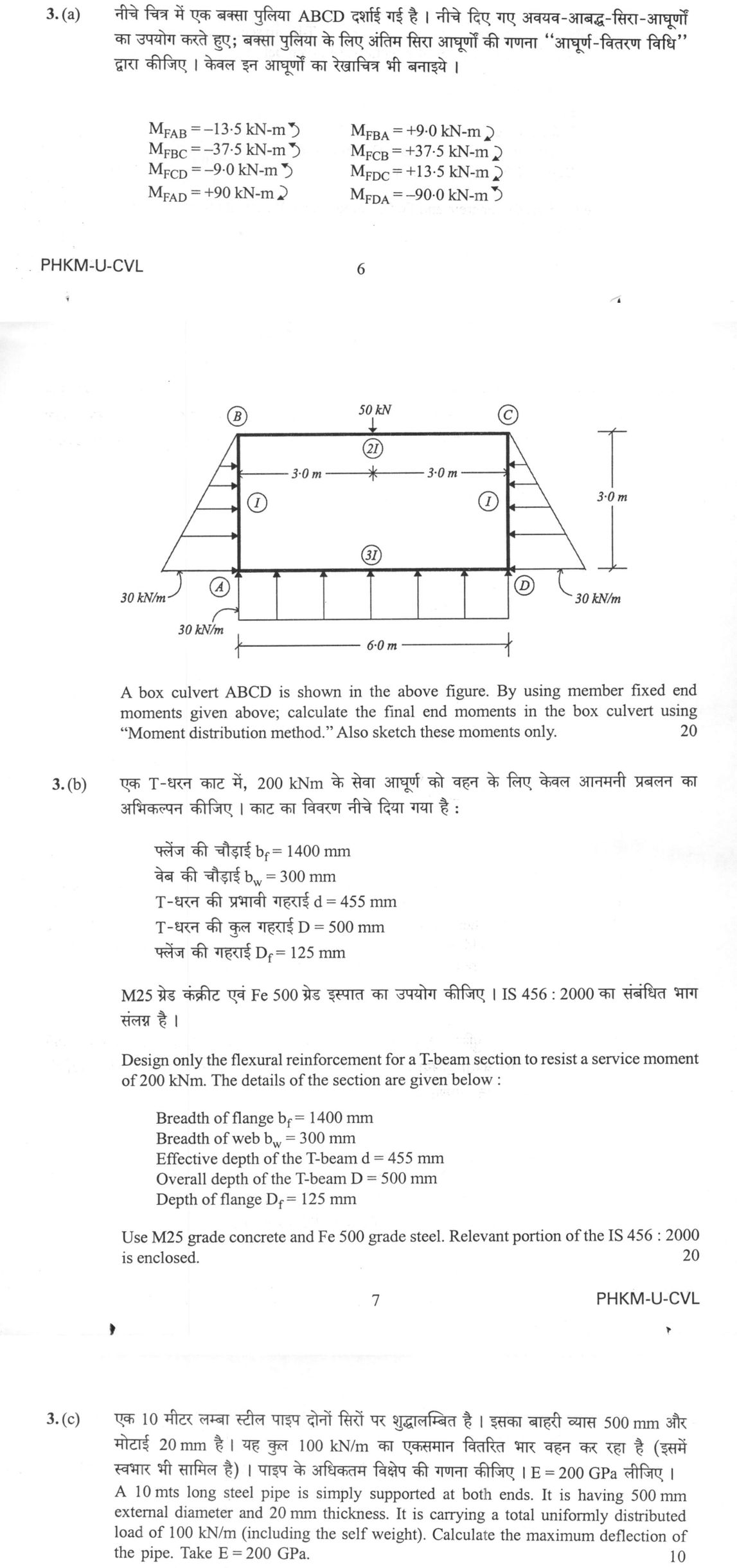
(a) A box culvert ABCD is shown in the above figure. By using member fixed end moments given above; calculate the final end…
A box culvert ABCD is shown in the above figure. By using member fixed end moments given above; calculate the final end moments in the box culvert using "Moment distribution method." Also sketch these moments only. 20 marks
Design only the flexural reinforcement for a T-beam section to resist a service moment of 200 kNm. The details of the section are given below: Breadth of flange b_f = 1400 mm Breadth of web b_w = 300 mm Effective depth of the T-beam d = 455 mm Overall depth of the T-beam D = 500 mm Depth of flange D_f = 125 mm Use M25 grade concrete and Fe 500 grade steel. Relevant portion of the IS 456 : 2000 is enclosed. 20 marks
A 10 mts long steel pipe is simply supported at both ends. It is having 500 mm external diameter and 20 mm thickness. It is carrying a total uniformly distributed load of 100 kN/m (including the self weight). Calculate the maximum deflection of the pipe. Take E = 200 GPa. 10 marks
हिंदी में प्रश्न पढ़ें
नीचे चित्र में एक बक्सा पुलिया ABCD दर्शाई गई है। नीचे दिए गए अवयव-आबद्ध-सिरा-आघूर्णों का उपयोग करते हुए; बक्सा पुलिया के लिए अंतिम सिरा आघूर्णों की गणना "आघूर्ण-वितरण विधि" द्वारा कीजिए। केवल इन आघूर्णों का रेखाचित्र भी बनाइये। M_FAB = –13·5 kN-m M_FBC = –37·5 kN-m M_FCD = –9·0 kN-m M_FAD = +90 kN-m M_FBA = +9·0 kN-m M_FCB = +37·5 kN-m M_FDC = +13·5 kN-m M_FDA = –90·0 kN-m 20 marks
एक T-धरन काट में, 200 kNm के सेवा आघूर्ण को वहन के लिए केवल आनमनी प्रबलन का अभिकल्पन कीजिए । काट का विवरण नीचे दिया गया है : प्लेंज की चौड़ाई b_f = 1400 mm वेब की चौड़ाई b_w = 300 mm T-धरन की प्रभावी गहराई d = 455 mm T-धरन की कुल गहराई D = 500 mm प्लेंज की गहराई D_f = 125 mm M25 ग्रेड कंक्रीट एवं Fe 500 ग्रेड इस्पात का उपयोग कीजिए । IS 456 : 2000 का संबंधित भाग संलग्न है । 20 marks
एक 10 मीटर लम्बा स्टील पाइप दोनों सिरों पर शुद्धालम्बित है। इसका बाहरी व्यास 500 mm और मोटाई 20 mm है। यह कुल 100 kN/m का एकसमान वितरित भार वहन कर रहा है (इसमें स्वभार भी सामिल है)। पाइप के अधिकतम विस्थाप की गणना कीजिए। E = 200 GPa लीजिए। 10 marks
The figure this question refers to, in words
The question paper is a scan and the diagram did not survive as text. This is the figure as read from the original page — every component, value and label — so the question can be worked from the text below.
(a) A rectangular box culvert frame ABCD with a width of 6.0 m and a height of 3.0 m. The corners are labeled A (bottom-left), B (top-left), C (top-right), and D (bottom-right). The top horizontal member BC has a moment of inertia of 2I and carries a central point load of 50 kN acting downwards. The bottom horizontal member AD has a moment of inertia of 3I and carries a uniformly distributed load of 30 kN/m acting upwards. The left vertical member AB has a moment of inertia of I and carries a triangular distributed load acting inwards (to the right), with the maximum intensity at the bottom (A) and zero at the top (B). The right vertical member CD has a moment of inertia of I and carries a triangular distributed load acting inwards (to the left), with the maximum intensity at the bottom (D) and zero at the top (C). The maximum intensity of the triangular loads on the vertical members is labeled as 30 kN/m.
What "Calculate" is asking you to do
Apply the standard formula or schedule to data the question has already supplied — a table of readings, cost records, a balance sheet — and produce the number. The method is rarely in doubt; the marks sit in the named intermediate quantities, each of which has to appear as a labelled line.
Structure that answers it
Data as given → formula or standard treatment, named → substitution → each intermediate, labelled → result with units
Where marks are lost
Omitting an intermediate the marking scheme pays for separately, or rounding at an intermediate line so the final figure drifts. In commerce and accountancy, any figure in a statement that no numbered working note supports is treated as unearned.
How this answer will be evaluated
Approach
Framework: null. (a) calculate: given > formula > substitution > result with units > interpretation | (b) calculate: given > formula > substitution > result with units > interpretation | (c) calculate: given > formula > substitution > result with units > interpretation Full marks: Complete working with correct formulas, units, and checks; neat sketches; all parts fully addressed.
Key points expected
- Calculate stiffness factors (K) for all members
- Determine distribution factors (DF) at joints B, C, D
- Perform moment distribution iterations to equilibrium
- Sketch final bending moment diagram
- Check if section acts as rectangular or T-beam
- Calculate required area of steel (As) using IS 456
- Select bar diameter and number of bars
- Verify minimum and maximum reinforcement limits
Evaluation rubric
Each sub-part is marked on its own, against the marks and word limit printed on the paper.
- (a) Final end moments for box culvert ABCD using Moment Distribution Method. 20 marks
calculate— given → formula → substitution → result with units → interpretation
Must cover
- Calculate stiffness factors (K) for all members
- Determine distribution factors (DF) at joints B, C, D
- Perform moment distribution iterations to equilibrium
- Sketch final bending moment diagram
Loses marks
- Omitting carry-over moments in distribution
- Incorrect calculation of distribution factors
- Final moments without a sketch
Earns more
- Correctly identifies fixed end moments (FEM) from data
- Shows carry-over moments (COM) in calculation table
- Checks joint equilibrium (sum of moments = 0)
Extra mark
- Neatly labelled moment diagram with values
- Explicit statement of sign convention used
- (b) Flexural reinforcement design for T-beam section. 20 marks
calculate— given → formula → substitution → result with units → interpretation
Must cover
- Check if section acts as rectangular or T-beam
- Calculate required area of steel (As) using IS 456
- Select bar diameter and number of bars
- Verify minimum and maximum reinforcement limits
Loses marks
- Ignoring flange contribution in moment capacity
- Using wrong grade of steel or concrete
- Final bar count without checking spacing
Earns more
- Correct calculation of neutral axis depth (xu)
- Use of correct stress block parameters for M25/Fe500
- Check for under-reinforced section
Extra mark
- Sketch of T-beam section with reinforcement
- Explicit citation of IS 456:2000 clauses
- (c) Maximum deflection of a simply supported steel pipe. 10 marks
calculate— given → formula → substitution → result with units → interpretation
Must cover
- Calculate moment of inertia (I) of hollow section
- Apply deflection formula for UDL on simply supported beam
- Substitute values with correct units (N, mm, GPa)
- State final deflection in mm
Loses marks
- Incorrect moment of inertia calculation
- Unit mismatch in final calculation
- Using wrong deflection formula for support conditions
Earns more
- Correct calculation of I = π/64 (D⁴ - d⁴)
- Consistent unit conversion (kN to N, m to mm)
- Identification of maximum deflection location (mid-span)
Extra mark
- Check of deflection against span/deflection limits
- Neat presentation of formula and substitution
Model answer coming soon
Every evaluation on this site is marked against a verified model answer. This question's answer is still being written; evaluation opens the moment it lands.
More from Civil Engineering 2024 Paper I
- Q1 (a) A cantilever beam ABCD, as shown in the above figure, is carrying a uniformly distrib…
- Q2 (a) A cantilever beam ABC as shown in the above figure is having a total span of 2·0 m. T…
- Q3 (a) A box culvert ABCD is shown in the above figure. By using member fixed end moments gi…
- Q4 (a) A prestressed concrete T-beam having the cross-section of flange 1500 mm wide and 200…
- Q5 (a) A 125 mm diameter vertical cylinder rotates concentrically inside a fixed cylinder of…
- Q6 (a) The resistance force F of a ship is a function of its length L, velocity V, accelerat…