Paper I — Q6
(a) The resistance force F of a ship is a function of its length L, velocity V, acceleration due to gravity g and fluid…
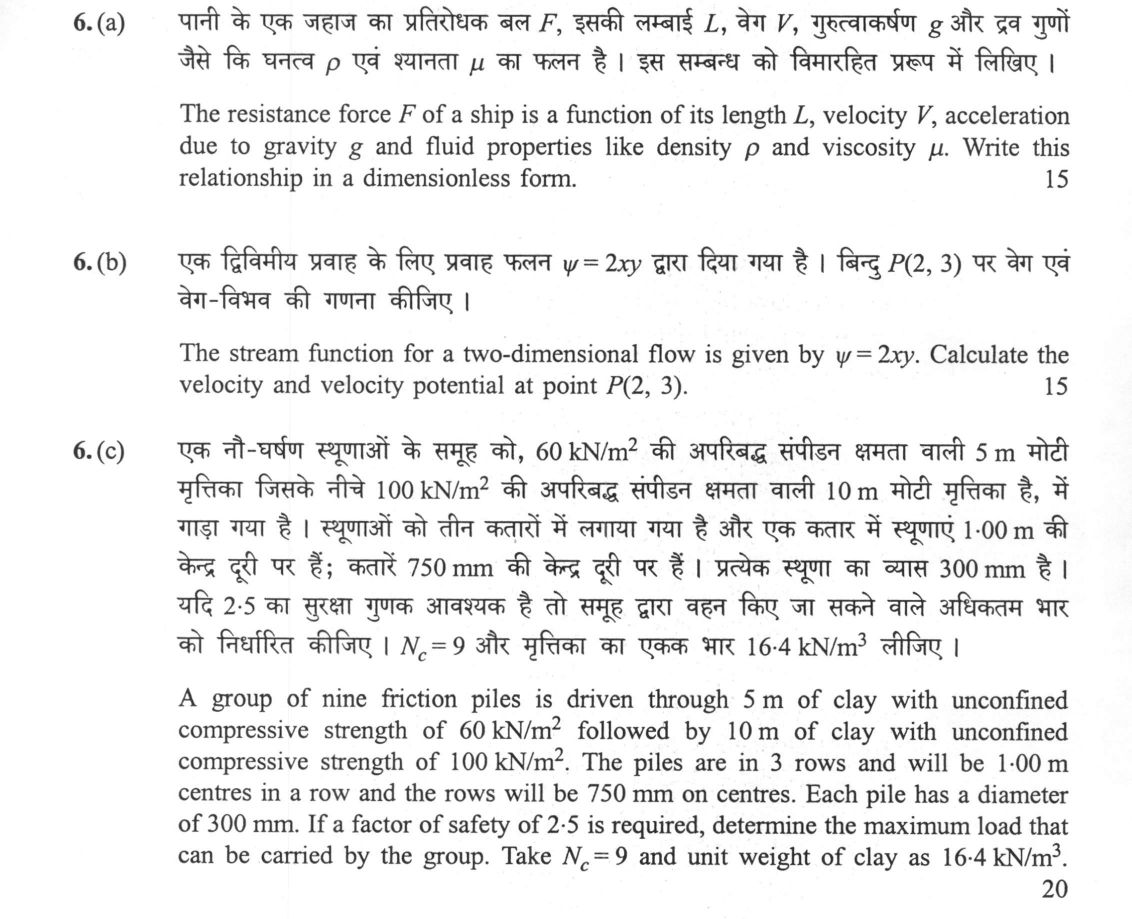
The resistance force F of a ship is a function of its length L, velocity V, acceleration due to gravity g and fluid properties like density ρ and viscosity μ. Write this relationship in a dimensionless form. 15 marks
The stream function for a two-dimensional flow is given by ψ = 2xy. Calculate the velocity and velocity potential at point P(2, 3). 15 marks
A group of nine friction piles is driven through 5 m of clay with unconfined compressive strength of 60 kN/m² followed by 10 m of clay with unconfined compressive strength of 100 kN/m². The piles are in 3 rows and will be 1·00 m centres in a row and the rows will be 750 mm on centres. Each pile has a diameter of 300 mm. If a factor of safety of 2·5 is required, determine the maximum load that can be carried by the group. Take Nc = 9 and unit weight of clay as 16·4 kN/m³. 20 marks
हिंदी में प्रश्न पढ़ें
पानी के एक जहाज का प्रतिरोधक बल F, इसकी लम्बाई L, वेग V, गुरुत्वाकर्षण g और द्रव गुणों जैसे कि घनत्व ρ एवं श्यानता μ का फलन है। इस सम्बन्ध को विमारहित प्ररूप में लिखिए। (15 अंक)
एक द्विविमीय प्रवाह के लिए प्रवाह फलन ψ = 2xy द्वारा दिया गया है। बिन्दु P(2, 3) पर वेग एवं वेग-विभव की गणना कीजिए। (15 अंक)
एक नौ-घर्षण स्तम्भों के समूह को, 60 kN/m² की अपरिबद्ध संपीडन क्षमता वाली 5 m मोटी मृत्तिका जिसके नीचे 100 kN/m² की अपरिबद्ध संपीडन क्षमता वाली 10 m मोटी मृत्तिका है, में गाड़ा गया है। स्तम्भों को तीन कतारों में लगाया गया है और एक कतार में स्तम्भ 1·00 m की केन्द्र दूरी पर हैं; कतारें 750 mm की केन्द्र दूरी पर हैं। प्रत्येक स्तम्भ का व्यास 300 mm है। यदि 2·5 का सुरक्षा गुणक आवश्यक है तो समूह द्वारा वहन किए जा सकने वाले अधिकतम भार को निर्धारित कीजिए। Nc = 9 और मृत्तिका का एकक भार 16·4 kN/m³ लीजिए। (20 अंक)
Model answer
Written by UPSC Answer Check against this question's marking rubric, to the expected length. UPSC does not publish answers for Mains — this is one way to score well, not an official key.
(a) By the Buckingham Pi theorem, the variables are F, L, V, g, ρ and μ, so n = 6. Their dimensions are: F = MLT⁻², L = L, V = LT⁻¹, g = LT⁻², ρ = ML⁻³, μ = ML⁻¹T⁻¹. With three basic dimensions M, L, T, the number of independent Π terms is n − m = 6 − 3 = 3.
Choose ρ, V and L as repeating variables. Then: Π₁ = F ρᵃ Vᵇ Lᶜ. Equating powers gives a = −1, b = −2, c = −2, so Π₁ = F/(ρ V² L²).
Π₂ = g ρᵃ Vᵇ Lᶜ. Equating powers gives a = 0, b = −2, c = 1, so Π₂ = gL/V² = 1/Fr², where Fr = V/√(gL).
Π₃ = μ ρᵃ Vᵇ Lᶜ. Equating powers gives a = −1, b = −1, c = −1, so Π₃ = μ/(ρ V L) = 1/Re, where Re = ρVL/μ.
Therefore the dimensionless relationship is: F/(ρ V² L²) = f(gL/V², μ/(ρVL)) or, equivalently, F/(ρ V² L²) = f(V/√(gL), ρVL/μ). This is valid for geometrically similar ships. Complete similarity requires equal Froude and Reynolds numbers; if viscous effects are negligible, the function reduces to the Froude-number form.
(b) For a two-dimensional flow, using the standard convention u = ∂ψ/∂y, v = −∂ψ/∂x. Given ψ = 2xy: u = ∂(2xy)/∂y = 2x, v = −∂(2xy)/∂x = −2y.
At P(2, 3): u = 2(2) = 4 m/s, v = −2(3) = −6 m/s. Thus V = 4i − 6j m/s.
Magnitude: |V| = √(4² + (−6)²) = √52 = 2√13 m/s ≈ 7·21 m/s.
Check irrotationality: ω_z = ∂v/∂x − ∂u/∂y = 0 − 0 = 0. Hence a velocity potential φ exists.
Using u = ∂φ/∂x and v = ∂φ/∂y: ∂φ/∂x = 2x ⇒ φ = x² + f(y). Then ∂φ/∂y = f′(y) = −2y ⇒ f(y) = −y² + C. So φ = x² − y² + C.
At P(2, 3), taking C = 0: φ = 2² − 3² = 4 − 9 = −5 m²/s. Thus velocity potential at P = −5 m²/s (apart from an arbitrary constant).
(c) Unconfined compressive strength qu = 2c_u, so: Layer 1: c_u1 = 60/2 = 30 kN/m². Layer 2: c_u2 = 100/2 = 50 kN/m².
Pile diameter d = 0·30 m. Since the piles are friction piles, end bearing of an individual pile is neglected. The perimeter of one pile is p = πd = 0·30π m.
Individual pile capacity Skin friction in layer 1: Q_s1 = c_u1 p L1 = 30 × 0·30π × 5 = 45π kN ≈ 141·37 kN.
Skin friction in layer 2: Q_s2 = c_u2 p L2 = 50 × 0·30π × 10 = 150π kN ≈ 471·24 kN.
Ultimate capacity of one friction pile: Q_u1 = 45π + 150π = 195π kN ≈ 612·61 kN.
For 9 piles: Q_ug,individual = 9 × 195π = 1755π kN ≈ 5513·50 kN.
Safe load by individual action: Q_safe,individual = 5513·50/2·5 = 2205·40 kN.
Block failure check The group has 3 piles per row at 1·00 m centres and 3 rows at 0·75 m centres. Overall length = (3 − 1)(1·00) + 0·30 = 2·30 m. Overall width = (3 − 1)(0·75) + 0·30 = 1·80 m.
Perimeter of group, P_g = 2(2·30 + 1·80) = 8·20 m. Base area of group, A_g = 2·30 × 1·80 = 4·14 m².
Side friction on block in layer 1: Q_sg1 = 30 × 8·20 × 5 = 1230 kN.
Side friction on block in layer 2: Q_sg2 = 50 × 8·20 × 10 = 4100 kN.
Net base resistance of block: Q_bg = N_c c_u2 A_g = 9 × 50 × 4·14 = 1863 kN.
Ultimate block capacity using net base resistance: Q_ug,block = 1230 + 4100 + 1863 = 7193 kN.
Check with unit weight: gross base pressure = c_u2 N_c + γD = 450 + 16·4 × 15 = 696 kN/m²; gross base force = 696 × 4·14 = 2881·44 kN; weight of block = 16·4 × 4·14 × 15 = 1018·44 kN. Then Q_ug,block = 5330 + 2881·44 − 1018·44 = 7193 kN. The unit weight cancels in the net capacity.
Safe load by block action: Q_safe,block = 7193/2·5 = 2877·20 kN.
The lesser of the two safe loads governs: Q_safe = min(2205·40, 2877·20) = 2205·40 kN.
Maximum load carried by the group = 2205·4 kN ≈ 2·21 MN (2205 kN).
The analysis assumes adhesion equal to undrained cohesion (α = 1), as no adhesion factor is specified. The unit weight γ = 16·4 kN/m³ cancels in the net block capacity; if gross base resistance is used, the weight of the displaced block must be subtracted.
What "Solve" is asking you to do
Choose the method, then carry it through to a final answer. Identifying what kind of problem this is and why that method applies is the first thing marked; a correct figure arrived at invisibly earns almost nothing.
Structure that answers it
Given data and what is required → method chosen, with the reason it applies → set-up (equation, circuit, free body, trial balance) → working, step by step → answer with units and any condition of validity
Where marks are lost
Doing the middle steps mentally and writing only the result. In mathematics papers, a further loss comes from giving a decimal where the exact value in surds or fractions was wanted, or from skipping the justification a part explicitly asks for.
How this answer will be evaluated
Approach
(a) derive: given > assumptions > stepwise derivation > result > check | (b) calculate: given > formula > substitution > result with units > interpretation | (c) calculate: given > formula > substitution > result with units > interpretation Full marks: Rigorous derivation, correct units, clear distinction between individual and group failure modes.
Key points expected
- List all variables: F, L, V, g, ρ, μ
- Apply Buckingham Pi theorem
- Identify 3 repeating variables (e.g., L, V, ρ)
- Derive dimensionless groups (Froude, Reynolds, Drag)
- State relation u = ∂ψ/∂y, v = -∂ψ/∂x
- Calculate u and v at (2, 3)
- State relation ∂φ/∂x = u, ∂φ/∂y = v
- Integrate to find velocity potential φ
Evaluation rubric
Each sub-part is marked on its own, against the marks and word limit printed on the paper.
- (a) Dimensionless relationship for ship resistance force F. 15 marks
derive— given → assumptions → stepwise derivation → result → check
Must cover
- List all variables: F, L, V, g, ρ, μ
- Apply Buckingham Pi theorem
- Identify 3 repeating variables (e.g., L, V, ρ)
- Derive dimensionless groups (Froude, Reynolds, Drag)
Loses marks
- Incorrect number of dimensionless groups
- Missing variables in the final relationship
- Dimensional inconsistency in Pi terms
Earns more
- Correctly identifies Froude number (Fr)
- Correctly identifies Reynolds number (Re)
- Correctly identifies Drag coefficient (Cd)
- Final equation F = f(Fr, Re) or similar
Extra mark
- Mentions specific gravity or kinematic viscosity ν
- (b) Velocity and velocity potential at point P(2, 3). 15 marks
calculate— given → formula → substitution → result with units → interpretation
Must cover
- State relation u = ∂ψ/∂y, v = -∂ψ/∂x
- Calculate u and v at (2, 3)
- State relation ∂φ/∂x = u, ∂φ/∂y = v
- Integrate to find velocity potential φ
Loses marks
- Sign error in velocity components
- Incorrect integration of potential
- Missing units or point evaluation
Earns more
- Correct values for u and v
- Correct expression for φ
- Value of φ at (2, 3)
- Mention of irrotational flow condition
Extra mark
- Sketch of streamlines or potential lines
- (c) Maximum load carried by the group of nine friction piles. 20 marks
calculate— given → formula → substitution → result with units → interpretation
Must cover
- Calculate individual pile capacity (skin friction)
- Calculate group block capacity (perimeter friction)
- Calculate weight of soil displaced by block
- Determine governing capacity (min of individual vs group)
Loses marks
- Ignoring the second clay layer
- Incorrect perimeter calculation for block
- Forgetting to divide by Factor of Safety
Earns more
- Correct calculation of adhesion (αc)
- Correct calculation of block perimeter
- Application of Factor of Safety (2.5)
- Clear distinction between layers (5m and 10m)
Extra mark
- Sketch of pile group arrangement
- Mention of pile group efficiency
Practice this exact question
Write your answer and it is marked point by point against the model answer above — what you covered, what you missed, what you got wrong.
Evaluate my answer →More from Civil Engineering 2024 Paper I
- Q3 (a) A box culvert ABCD is shown in the above figure. By using member fixed end moments gi…
- Q4 (a) A prestressed concrete T-beam having the cross-section of flange 1500 mm wide and 200…
- Q5 (a) A 125 mm diameter vertical cylinder rotates concentrically inside a fixed cylinder of…
- Q6 (a) The resistance force F of a ship is a function of its length L, velocity V, accelerat…
- Q7 (a) A canal is to be excavated through a soil with c = 20 kN/m², φ = 20°, e = 0·80 and G…
- Q8 (a) A retaining wall 8 m high, with a smooth vertical back is pushed against a soil mass…