Paper I — Q4
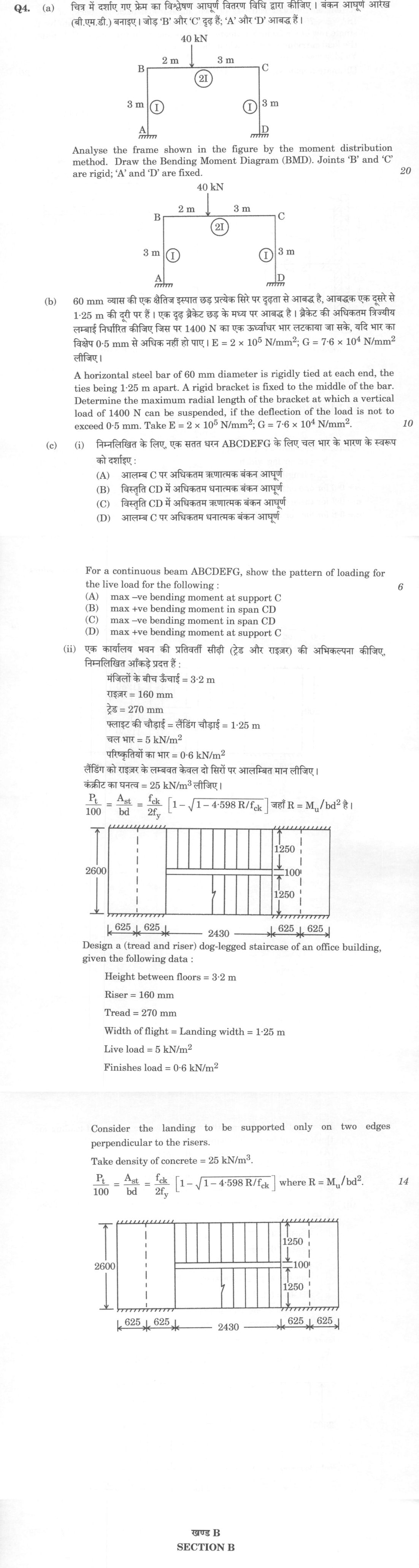
(a) Analyse the frame shown in the figure by the moment distribution method. Draw the Bending Moment Diagram (BMD). Joints 'B'…
Analyse the frame shown in the figure by the moment distribution method. Draw the Bending Moment Diagram (BMD). Joints 'B' and 'C' are rigid; 'A' and 'D' are fixed. 20 marks
A horizontal steel bar of 60 mm diameter is rigidly tied at each end, the ties being 1·25 m apart. A rigid bracket is fixed to the middle of the bar. Determine the maximum radial length of the bracket at which a vertical load of 1400 N can be suspended, if the deflection of the load is not to exceed 0·5 mm. Take E = 2 × 10⁵ N/mm²; G = 7·6 × 10⁴ N/mm². 10 marks
For a continuous beam ABCDEFG, show the pattern of loading for the live load for the following : (A) max –ve bending moment at support C (B) max +ve bending moment in span CD (C) max –ve bending moment in span CD (D) max +ve bending moment at support C
Design a (tread and riser) dog-legged staircase of an office building, given the following data : Height between floors = 3·2 m Riser = 160 mm Tread = 270 mm Width of flight = Landing width = 1·25 m Live load = 5 kN/m² Finishes load = 0·6 kN/m² Consider the landing to be supported only on two edges perpendicular to the risers. Take density of concrete = 25 kN/m³.
Pt/100 = Ast/bd = fck/2fy [1 - √(1 - 4.598 R/fck)] where R = Mu/bd². 14 marks
हिंदी में प्रश्न पढ़ें
चित्र में दर्शाए गए फ्रेम का विश्लेषण आघूर्ण वितरण विधि द्वारा कीजिए । बंकन आघूर्ण आरेख (बी.एम.डी.) बनाइए । जोड़ 'B' और 'C' दृढ़ हैं; 'A' और 'D' आबद्ध हैं । 20 अंक
60 mm व्यास की एक क्षैतिज इस्पात छड़ प्रत्येक सिरे पर दृढ़ता से आबद्ध है, आबद्धक एक दूसरे से 1·25 m की दूरी पर हैं । एक दृढ़ ब्रैकेट छड़ के मध्य पर आबद्ध है । ब्रैकेट की अधिकतम त्रिज्यीय लंबाई निर्धारित कीजिए जिस पर 1400 N का एक उल्लंबधर भार लटकाया जा सके, यदि भार का विस्थापन 0·5 mm से अधिक नहीं हो पाए । E = 2 × 10⁵ N/mm²; G = 7·6 × 10⁴ N/mm² लीजिए । 10 अंक
निम्नलिखित के लिए, एक सतत धरन ABCDEFG के लिए चल भार के भारण के स्वरूप को दर्शाइए : (A) आलम्ब C पर अधिकतम ऋणात्मक बंकन आघूर्ण (B) विस्तृति CD में अधिकतम धनात्मक बंकन आघूर्ण (C) विस्तृति CD में अधिकतम ऋणात्मक बंकन आघूर्ण (D) आलम्ब C पर अधिकतम धनात्मक बंकन आघूर्ण
एक कार्यालय भवन की प्रतिवर्ती सीढ़ी (ट्रेड और राइजर) की अभिकल्पना कीजिए, निम्नलिखित आँकड़े प्रदत हैं : मंजिलों के बीच ऊँचाई = 3·2 m राइजर = 160 mm ट्रेड = 270 mm फ्लाइट की चौड़ाई = लैंडिंग चौड़ाई = 1·25 m चल भार = 5 kN/m² परिष्कृतियों का भार = 0·6 kN/m²
लैंडिंग को राइजर के लम्बवत केवल दो सिरों पर आलम्बित मान लीजिए । कंक्रीट का घनत्व = 25 kN/m³ लीजिए ।
Pt/100 = Ast/bd = fck/2fy [1 - √(1 - 4.598 R/fck)] जहाँ R = Mu/bd² है । 14 अंक
The figure this question refers to, in words
The question paper is a scan and the diagram did not survive as text. This is the figure as read from the original page — every component, value and label — so the question can be worked from the text below.
(a) A rectangular frame with four joints labeled A, B, C, and D. Joint A is at the bottom-left, B at the top-left, C at the top-right, and D at the bottom-right. Supports at A and D are fixed supports (indicated by hatching). The vertical member AB has a length of 3 m and a moment of inertia labeled 'I' inside a circle. The vertical member CD has a length of 3 m and a moment of inertia labeled 'I' inside a circle. The horizontal member BC connects the top of the vertical members. A vertical downward point load of 40 kN is applied to member BC. The load is positioned 2 m from joint B and 3 m from joint C. The moment of inertia for the entire member BC is labeled '2I' inside a circle. Joints B and C are rigid connections.
(c) A 2D plan view of a dog-legged staircase landing. The landing is a rectangular slab with a total width of 2600 mm (vertical dimension in the drawing) and a total length of 3680 mm (horizontal dimension in the drawing). The slab is supported on the top and bottom edges (indicated by hatching), which are perpendicular to the direction of the risers. The slab is divided into three sections along its length: a left section of width 1250 mm (composed of two 625 mm segments), a central section of width 2430 mm, and a right section of width 1250 mm (composed of two 625 mm segments). The central section contains the stair treads, indicated by vertical lines. A horizontal line divides the central section into two flights of stairs, each with a vertical dimension of 1250 mm. The thickness of the slab is indicated as 100 mm. The supports are shown as fixed or continuous along the top and bottom edges.
What "Solve" is asking you to do
Choose the method, then carry it through to a final answer. Identifying what kind of problem this is and why that method applies is the first thing marked; a correct figure arrived at invisibly earns almost nothing.
Structure that answers it
Given data and what is required → method chosen, with the reason it applies → set-up (equation, circuit, free body, trial balance) → working, step by step → answer with units and any condition of validity
Where marks are lost
Doing the middle steps mentally and writing only the result. In mathematics papers, a further loss comes from giving a decimal where the exact value in surds or fractions was wanted, or from skipping the justification a part explicitly asks for.
How this answer will be evaluated
Approach
(a) analyse: intro > causes > effects > stakeholders/linkages > way forward | (b) calculate: given > formula > substitution > result with units > interpretation | (c(i)) describe: define > structure or process in order > labelled diagram > significance | (c(ii)) calculate: given > formula > substitution > result with units > interpretation Full marks: Complete, accurate, and well-structured answers with all steps shown and units carried through.
Key points expected
- Calculate fixed-end moments (FEM) for member BC
- Determine distribution and carry-over factors for joints B and C
- Perform iterative moment distribution cycles to convergence
- Draw the final Bending Moment Diagram (BMD)
- Calculate bending deflection at the bar's center
- Calculate torsional deflection at the bar's center
- Sum the deflections and equate to the 0.5 mm limit
- Solve for the radial length (L) of the bracket
Evaluation rubric
Each sub-part is marked on its own, against the marks and word limit printed on the paper.
- (a) Moment distribution analysis of the frame and BMD. 20 marks
analyse— intro → causes → effects → stakeholders/linkages → way forward
Must cover
- Calculate fixed-end moments (FEM) for member BC
- Determine distribution and carry-over factors for joints B and C
- Perform iterative moment distribution cycles to convergence
- Draw the final Bending Moment Diagram (BMD)
Loses marks
- Incorrect FEM calculation for the point load
- Omission of carry-over moments in the table
- BMD drawn without sign convention or scale
Earns more
- Explicitly state stiffness factors (K) for members
- Show the tabular format of the distribution process
- Verify equilibrium at joints B and C
Extra mark
- Calculate support reactions at A and D
- Label the BMD with specific numerical values
- (b) Maximum radial length of the bracket for a steel bar. 10 marks
calculate— given → formula → substitution → result with units → interpretation
Must cover
- Calculate bending deflection at the bar's center
- Calculate torsional deflection at the bar's center
- Sum the deflections and equate to the 0.5 mm limit
- Solve for the radial length (L) of the bracket
Loses marks
- Treating the bar as simply supported instead of fixed
- Ignoring the torsional component of deflection
- Unit conversion errors between N and kN
Earns more
- Correctly identify the bar as a fixed-fixed beam
- Use the correct formula for torsion of a circular shaft
- Maintain consistent units (N, mm) throughout
Extra mark
- State the specific formulas used for deflection
- Check the final length against practical limits
- (c(i)) Loading patterns for specific bending moments in a continuous beam. 6 marks
describe— define → structure or process in order → labelled diagram → significance
Must cover
- Show loading for max -ve moment at support C
- Show loading for max +ve moment in span CD
- Show loading for max -ve moment in span CD
- Show loading for max +ve moment at support C
Loses marks
- Confusing the loading for +ve and -ve moments
- Omitting the loading on adjacent spans
- Diagrams that are not to scale or clearly labeled
Earns more
- Use clear diagrams for each loading case
- Label the spans and supports clearly (A-G)
- Briefly explain the Muller-Breslau principle application
Extra mark
- Draw the corresponding influence line diagrams
- Provide a summary table of the loading patterns
- (c(ii)) Design of a dog-legged staircase including reinforcement. 14 marks
calculate— given → formula → substitution → result with units → interpretation
Must cover
- Calculate the total load on the flight and landing
- Determine the design moment (Mu) for the flight
- Calculate the required steel area (Ast) using the given formula
- Provide the final reinforcement details (bar diameter and spacing)
Loses marks
- Incorrect calculation of the effective span of the flight
- Using the wrong formula for Ast calculation
- Ignoring the live load and finishes load
Earns more
- Correctly calculate the self-weight of the sloping slab
- Show the free body diagram of the flight
- Check the deflection of the flight
Extra mark
- Design the landing slab as well
- Provide a neat sketch of the reinforcement layout
Model answer coming soon
Every evaluation on this site is marked against a verified model answer. This question's answer is still being written; evaluation opens the moment it lands.
More from Civil Engineering 2025 Paper I
- Q1 (a) Draw the free body diagram of link ABCD and determine all reaction forces acting at A…
- Q2 (a) A T-section beam is constructed by gluing two pieces of wood together as shown in the…
- Q3 (a) Analyse the continuous beam shown in the figure by slope-deflection method. Draw the…
- Q4 (a) Analyse the frame shown in the figure by the moment distribution method. Draw the Ben…
- Q5 (a) A rigid body having dimensions of 0·6 m wide, 0·9 m high and 1·2 m long weighs 10 kN…
- Q6 (a) The discharge Q over a small rectangular weir depends on head H over the weir, the we…
- Q7 (a) A braced cut 7·0 m deep and 3·0 m wide is proposed in a cohesionless sand deposit. As…