Paper I — Q5
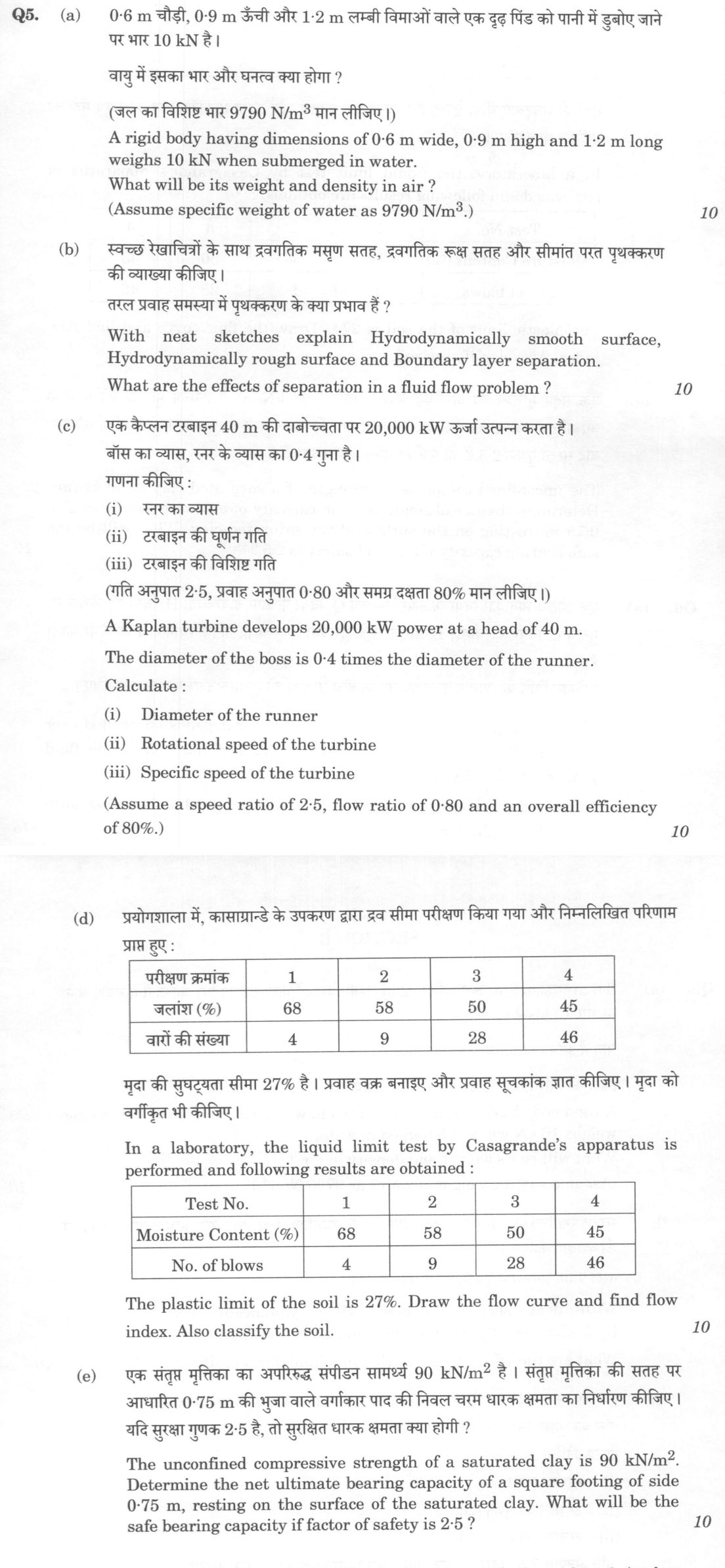
(a) A rigid body having dimensions of 0·6 m wide, 0·9 m high and 1·2 m long weighs 10 kN when submerged in water. What will be…
A rigid body having dimensions of 0·6 m wide, 0·9 m high and 1·2 m long weighs 10 kN when submerged in water. What will be its weight and density in air ? (Assume specific weight of water as 9790 N/m³.) 10 marks
With neat sketches explain Hydrodynamically smooth surface, Hydrodynamically rough surface and Boundary layer separation. What are the effects of separation in a fluid flow problem ? 10 marks
A Kaplan turbine develops 20,000 kW power at a head of 40 m. The diameter of the boss is 0·4 times the diameter of the runner. Calculate : (i) Diameter of the runner (ii) Rotational speed of the turbine (iii) Specific speed of the turbine (Assume a speed ratio of 2·5, flow ratio of 0·80 and an overall efficiency of 80%.) 10 marks
In a laboratory, the liquid limit test by Casagrande's apparatus is performed and following results are obtained :
| Test No. | 1 | 2 | 3 | 4 |
|---|---|---|---|---|
| Moisture Content (%) | 68 | 58 | 50 | 45 |
| No. of blows | 4 | 9 | 28 | 46 |
The plastic limit of the soil is 27%. Draw the flow curve and find flow index. Also classify the soil. 10 marks
The unconfined compressive strength of a saturated clay is 90 kN/m². Determine the net ultimate bearing capacity of a square footing of side 0·75 m, resting on the surface of the saturated clay. What will be the safe bearing capacity if factor of safety is 2·5 ? 10 marks
हिंदी में प्रश्न पढ़ें
0·6 m चौड़ी, 0·9 m ऊँची और 1·2 m लम्बी विमाओं वाले एक दृढ़ पिण्ड को पानी में डुबोए जाने पर भार 10 kN है। वायु में इसका भार और घनत्व क्या होगा ? (जल का विशिष्ट भार 9790 N/m³ मान लीजिए।) 10 अंक
स्वच्छ रेखाचित्रों के साथ द्रवगतिक मसृण सतह, द्रवगतिक रूक्ष सतह और सीमान्त परत पृथक्करण की व्याख्या कीजिए। तरल प्रवाह समस्या में पृथक्करण के क्या प्रभाव हैं ? 10 अंक
एक कैपलन टरबाइन 40 m की दाबोच्चता पर 20,000 kW ऊर्जा उत्पन्न करता है। बॉस का व्यास, रनर के व्यास का 0·4 गुना है। गणना कीजिए : (i) रनर का व्यास (ii) टरबाइन की घूर्णन गति (iii) टरबाइन की विशिष्ट गति (गति अनुपात 2·5, प्रवाह अनुपात 0·80 और समग्र दक्षता 80% मान लीजिए।) 10 अंक
प्रयोगशाला में, कासाग्रांडे के उपकरण द्वारा द्रव सीमा परीक्षण किया गया और निम्नलिखित परिणाम प्राप्त हुए :
| परीक्षण क्रमांक | 1 | 2 | 3 | 4 |
|---|---|---|---|---|
| जलांश (%) | 68 | 58 | 50 | 45 |
| वारों की संख्या | 4 | 9 | 28 | 46 |
मृदा की सुग्राह्यता सीमा 27% है। प्रवाह वक्र बनाइए और प्रवाह सूचकांक ज्ञात कीजिए। मृदा को वर्गीकृत भी कीजिए। 10 अंक
एक संतृप्त मृत्तिका का अपरिबद्ध संपीडन सामर्थ्य 90 kN/m² है। संतृप्त मृत्तिका की सतह पर आधारित 0·75 m की भुजा वाले वर्गाकार पाद की निवल चरम धारक क्षमता का निर्धारण कीजिए। यदि सुरक्षा गुणक 2·5 है, तो सुरक्षित धारक क्षमता क्या होगी ? 10 अंक
Model answer
Written by UPSC Answer Check against this question's marking rubric, to the expected length. UPSC does not publish answers for Mains — this is one way to score well, not an official key.
(a) Volume of the rigid body = 0·6 m × 0·9 m × 1·2 m = 0·648 m³. By Archimedes’ principle, the buoyant force when fully submerged is F_B = γ_water × V = 9790 N/m³ × 0·648 m³ = 6343·92 N = 6·34392 kN. The submerged weight is the apparent weight, so W_air − F_B = 10 kN. Therefore, W_air = 10 + 6·34392 = 16·34392 kN ≈ 16·344 kN. Mass of the body = W_air/g = 16343·92 N / 9·81 m/s² = 1666·047 kg. Density = mass/volume = 1666·047 kg / 0·648 m³ = 2571·06 kg/m³ ≈ 2571 kg/m³. Its specific weight in air = 16343·92 N / 0·648 m³ = 25222·1 N/m³ = 25·22 kN/m³. Thus, weight in air = 16·344 kN, and density = 2571 kg/m³.
(b) For a plate or surface in a turbulent stream, a very thin laminar sublayer of thickness δ′ exists immediately adjacent to the wall. The nature of the surface is decided by comparing the roughness height k_s with δ′.
Hydrodynamically smooth surface: If k_s < δ′, the roughness elements are completely submerged inside the viscous sublayer. The turbulent eddies do not touch the roughness projections, so the wall friction is governed mainly by Reynolds number and not by roughness. In the sketch, the wall is shown with small roughness bumps lying below the dashed line of the laminar sublayer; the velocity profile remains smooth near the wall, and the shear stress is essentially viscous in the sublayer. The friction factor depends on Re only.
Hydrodynamically rough surface: If k_s > δ′, the roughness elements protrude through the viscous sublayer into the turbulent zone. Each projection creates its own small wake and pressure drag. The skin friction then depends mainly on relative roughness k_s/D and becomes nearly independent of Reynolds number in the fully rough regime. In the sketch, the roughness bumps project above the laminar sublayer, eddies form behind them, and the near-wall velocity profile is disturbed.
Boundary layer separation: When a fluid flows over a surface under an adverse pressure gradient, the pressure increases in the direction of flow. The slow-moving fluid near the wall loses momentum and cannot overcome this adverse pressure gradient. The velocity gradient at the wall first becomes zero and then negative. The point where (∂u/∂y)_y=0 = 0 is the separation point. Downstream of it, reverse flow and a wake or eddying region are formed. In the sketch, the velocity profiles before separation are forward; at separation the wall velocity gradient is zero; after separation a backflow region appears near the wall.
Effects of separation: It increases pressure drag or form drag. It causes large energy losses, unsteady wakes, vibration and noise. In airfoils it reduces lift and causes stall. In diffusers, bends, pumps and turbines it reduces efficiency and may cause cavitation. It also makes flow unstable and increases pumping or power requirements. Hence, separation should be delayed or avoided by streamlining, proper pressure-gradient control, suction or blowing, and suitable design of flow passages.
(c) Given: P = 20,000 kW = 20,000,000 W, H = 40 m, boss diameter d = 0·4D, speed ratio φ = 2·5, flow ratio ψ = 0·80, overall efficiency η = 0·80. Take g = 9·81 m/s² and ρg = 9810 N/m³. First, √(2gH) = √(2 × 9·81 × 40) = √784·8 = 28·014 m/s. Flow velocity V_f = ψ√(2gH) = 0·80 × 28·014 = 22·411 m/s. Peripheral velocity u = φ√(2gH) = 2·5 × 28·014 = 70·036 m/s.
Discharge through the turbine is obtained from power: P = ηρgQH, so Q = P/(ηρgH) = 20,000,000 / (0·80 × 9810 × 40) = 63·710 m³/s. The flow area through the Kaplan runner is annular: A = π/4 (D² − d²) = π/4 (D² − 0·16D²) = 0·21πD² = 0·659734D². Also A = Q/V_f = 63·710 / 22·411 = 2·842 m². Hence D² = 2·842 / 0·659734 = 4·309, giving D = √4·309 = 2·076 m.
(i) Diameter of runner = D ≈ 2·076 m.
(ii) Rotational speed: u = πDN/60, so N = 60u/(πD) = 60 × 70·036 / (π × 2·076) = 644·4 rpm ≈ 644 rpm.
(iii) Specific speed in metric units is N_s = N√P / H^(5/4), with P in kW. H^(5/4) = 40^1·25 = 100·595. N_s = 644·4 × √20,000 / 100·595 = 644·4 × 141·421 / 100·595 = 905·9 ≈ 906. So, D = 2·076 m, N = 644 rpm, and N_s = 906 (metric).
(d) The test points are (N, w) = (4, 68%), (9, 58%), (28, 50%), (46, 45%). For the flow curve, plot moisture content w on the linear y-axis and number of blows N on the logarithmic x-axis. A best-fit straight line is drawn through the points. Using least squares on w versus log₁₀ N gives approximately w = 79·54 − 20·82 log₁₀ N. At the liquid limit, N = 25 blows. Since log₁₀ 25 = 1·39794, w_LL = 79·54 − 20·82 × 1·39794 = 50·43%. Thus, liquid limit LL ≈ 50·4%.
The flow index is the magnitude of the slope of the flow curve: I_f = −(Δw / Δlog₁₀ N) = 20·82% ≈ 20·8%. Plastic limit PL = 27%. Plasticity index PI = LL − PL = 50·4 − 27 = 23·4%. For classification, use the plasticity chart. The A-line equation is PI = 0·73(LL − 20). At LL = 50·4%, A-line PI = 0·73(50·4 − 20) = 22·2%. Since the soil has LL > 50% and PI = 23·4% > 22·2%, its point lies above the A-line. Therefore, the soil is an inorganic clay of high plasticity, classified as CH in the USCS/IS system.
(e) For a saturated clay, undrained cohesion is obtained from unconfined compressive strength: c = q_u/2 = 90/2 = 45 kN/m². Since the clay is saturated and undrained, take φ = 0. Using Skempton’s method for net ultimate bearing capacity of a footing on saturated clay: q_nu = c N_c, where N_c = 5·14 (1 + 0·2 D_f/B) (1 + 0·2 B/L). For a square footing, B = L = 0·75 m, so B/L = 1. The footing rests on the surface, so D_f = 0. Thus, N_c = 5·14 × (1 + 0) × (1 + 0·2 × 1) = 5·14 × 1·2 = 6·168. Therefore, q_nu = 45 × 6·168 = 277·56 kN/m². Safe net bearing capacity = q_nu / FOS = 277·56 / 2·5 = 111·024 kN/m² ≈ 111·02 kN/m². Since D_f = 0, the gross safe bearing capacity is also 111·02 kN/m². Thus, net ultimate bearing capacity = 277·56 kN/m², and safe bearing capacity = 111·02 kN/m².
What "Solve" is asking you to do
Choose the method, then carry it through to a final answer. Identifying what kind of problem this is and why that method applies is the first thing marked; a correct figure arrived at invisibly earns almost nothing.
Structure that answers it
Given data and what is required → method chosen, with the reason it applies → set-up (equation, circuit, free body, trial balance) → working, step by step → answer with units and any condition of validity
Where marks are lost
Doing the middle steps mentally and writing only the result. In mathematics papers, a further loss comes from giving a decimal where the exact value in surds or fractions was wanted, or from skipping the justification a part explicitly asks for.
How this answer will be evaluated
Approach
(a) calculate: given > formula > substitution > result with units > interpretation | (b) explain: definition/context > points in order > small example > short close | (c) calculate: given > formula > substitution > result with units > interpretation | (d) calculate: given > formula > substitution > result with units > interpretation | (e) calculate: given > formula > substitution > result with units > interpretation Full marks: All parts solved with correct formulas, units, and clear presentation.
Key points expected
- Calculate volume from given dimensions
- Apply Archimedes' principle for buoyancy
- Determine weight in air (W_air = W_water + Buoyancy)
- Calculate density using mass and volume
- Define hydrodynamically smooth surface
- Define hydrodynamically rough surface
- Explain boundary layer separation mechanism
- List effects of separation (drag, pressure drop)
Evaluation rubric
Each sub-part is marked on its own, against the marks and word limit printed on the paper.
- (a) Determine weight and density of the rigid body in air. 10 marks
calculate— given → formula → substitution → result with units → interpretation
Must cover
- Calculate volume from given dimensions
- Apply Archimedes' principle for buoyancy
- Determine weight in air (W_air = W_water + Buoyancy)
- Calculate density using mass and volume
Loses marks
- Confusing weight in water with weight in air
- Incorrect volume calculation
Earns more
- Correct unit conversion (kN to N)
- Explicit statement of specific weight of water
Extra mark
- Free body diagram of submerged body
- (b) Explain hydrodynamic surfaces and boundary layer separation with sketches. 10 marks
explain— definition/context → points in order → small example → short close
Must cover
- Define hydrodynamically smooth surface
- Define hydrodynamically rough surface
- Explain boundary layer separation mechanism
- List effects of separation (drag, pressure drop)
Loses marks
- Missing sketches or diagrams
- Confusing laminar and turbulent separation
Earns more
- Neat sketches of velocity profiles
- Mention of Reynolds number relevance
Extra mark
- Comparison of friction factors for smooth/rough
- (c) Calculate runner diameter, rotational speed, and specific speed. 10 marks
calculate— given → formula → substitution → result with units → interpretation
Must cover
- Use power equation to find flow rate
- Apply flow ratio to find runner diameter
- Apply speed ratio to find rotational speed
- Calculate specific speed using standard formula
Loses marks
- Incorrect application of speed/flow ratios
- Unit errors in power or head
Earns more
- Correct use of efficiency in power calculation
- Clear labeling of all variables
Extra mark
- Verification of specific speed range for Kaplan
- (d) Draw flow curve, find flow index, and classify soil. 10 marks
calculate— given → formula → substitution → result with units → interpretation
Must cover
- Plot moisture content vs log of blows
- Determine liquid limit at 25 blows
- Calculate flow index from slope
- Classify soil using plasticity chart
Loses marks
- Incorrect plotting of log scale
- Failure to classify soil
Earns more
- Correct interpolation for liquid limit
- Clear labeling of axes and points
Extra mark
- Mention of A-line for classification
- (e) Determine net ultimate and safe bearing capacity. 10 marks
calculate— given → formula → substitution → result with units → interpretation
Must cover
- Use Terzaghi's bearing capacity equation
- Apply shape factor for square footing
- Calculate net ultimate bearing capacity
- Apply factor of safety for safe capacity
Loses marks
- Ignoring shape factor for square footing
- Incorrect application of factor of safety
Earns more
- Correct use of unconfined compressive strength
- Explicit statement of assumptions
Extra mark
- Mention of IS code for bearing capacity
Practice this exact question
Write your answer and it is marked point by point against the model answer above — what you covered, what you missed, what you got wrong.
Evaluate my answer →More from Civil Engineering 2025 Paper I
- Q2 (a) A T-section beam is constructed by gluing two pieces of wood together as shown in the…
- Q3 (a) Analyse the continuous beam shown in the figure by slope-deflection method. Draw the…
- Q4 (a) Analyse the frame shown in the figure by the moment distribution method. Draw the Ben…
- Q5 (a) A rigid body having dimensions of 0·6 m wide, 0·9 m high and 1·2 m long weighs 10 kN…
- Q6 (a) The discharge Q over a small rectangular weir depends on head H over the weir, the we…
- Q7 (a) A braced cut 7·0 m deep and 3·0 m wide is proposed in a cohesionless sand deposit. As…
- Q8 (a) The consolidated undrained (CU) tests were performed on the four over-consolidated cl…