Paper I — Q7
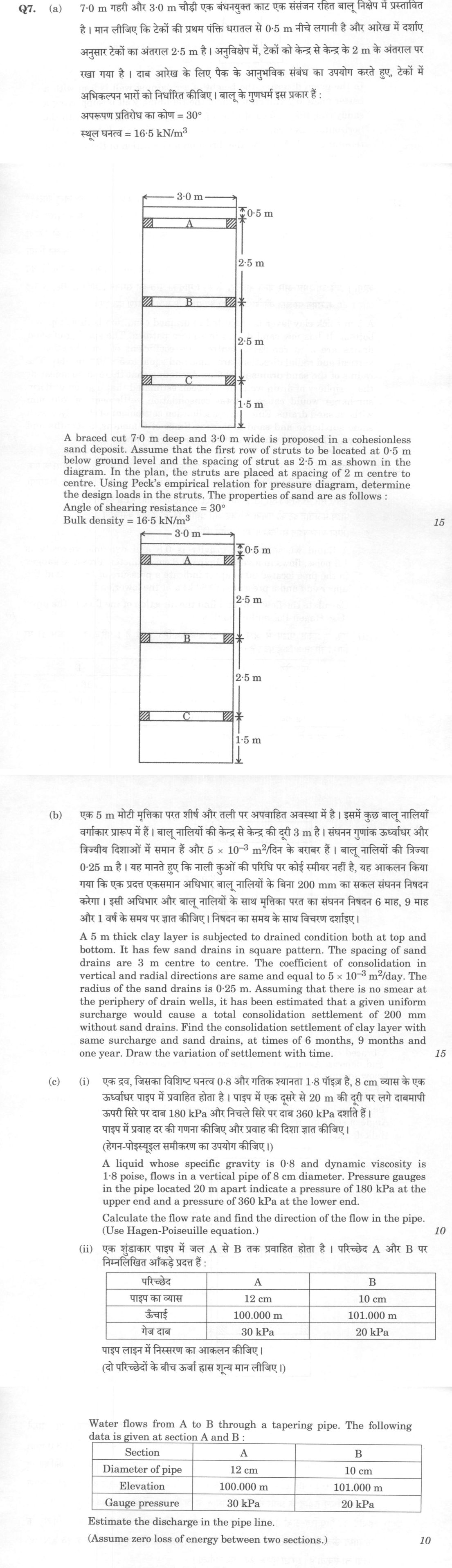
(a) A braced cut 7·0 m deep and 3·0 m wide is proposed in a cohesionless sand deposit. Assume that the first row of struts to be…
A braced cut 7·0 m deep and 3·0 m wide is proposed in a cohesionless sand deposit. Assume that the first row of struts to be located at 0·5 m below ground level and the spacing of strut as 2·5 m as shown in the diagram. In the plan, the struts are placed at spacing of 2 m centre to centre. Using Peck's empirical relation for pressure diagram, determine the design loads in the struts. The properties of sand are as follows: Angle of shearing resistance = 30° Bulk density = 16·5 kN/m³
A 5 m thick clay layer is subjected to drained condition both at top and bottom. It has few sand drains in square pattern. The spacing of sand drains are 3 m centre to centre. The coefficient of consolidation in vertical and radial directions are same and equal to 5 × 10⁻³ m²/day. The radius of the sand drains is 0·25 m. Assuming that there is no smear at the periphery of drain wells, it has been estimated that a given uniform surcharge would cause a total consolidation settlement of 200 mm without sand drains. Find the consolidation settlement of clay layer with same surcharge and sand drains, at times of 6 months, 9 months and one year. Draw the variation of settlement with time.
A liquid whose specific gravity is 0·8 and dynamic viscosity is 1·8 poise, flows in a vertical pipe of 8 cm diameter. Pressure gauges in the pipe located 20 m apart indicate a pressure of 180 kPa at the upper end and a pressure of 360 kPa at the lower end. Calculate the flow rate and find the direction of the flow in the pipe. (Use Hagen-Poiseuille equation.)
Water flows from A to B through a tapering pipe. The following data is given at section A and B:
| Section | A | B |
|---|---|---|
| Diameter of pipe | 12 cm | 10 cm |
| Elevation | 100.000 m | 101.000 m |
| Gauge pressure | 30 kPa | 20 kPa |
Estimate the discharge in the pipe line. (Assume zero loss of energy between two sections.)
हिंदी में प्रश्न पढ़ें
7·0 m गहरी और 3·0 m चौड़ी एक बंधनयुक्त काट एक संसजन रहित बालू निक्षेप में प्रस्तावित है। मान लीजिए कि टेकों की प्रथम पंक्ति धरातल से 0·5 m नीचे लगानी है और आरेख में दर्शाए अनुसार टेकों का अंतराल 2·5 m है। अनुविन्यास में, टेकों को केंद्र से केंद्र के 2 m के अंतराल पर रखा गया है। दाब आरेख के लिए पैक के अनुभाविक संबंध का उपयोग करते हुए, टेकों में अभिकल्प भारों को निर्धारित कीजिए। बालू के गुणधर्म इस प्रकार हैं : अपरूपण प्रतिरोध का कोण = 30° स्थूल घनत्व = 16·5 kN/m³
एक 5 m मोटी मृत्तिका परत शीर्ष और तली पर अपवाहित अवस्था में है। इसमें कुछ बालू नालियाँ वर्गाकार प्रारूप में हैं। बालू नालियों की केंद्र से केंद्र की दूरी 3 m है। संघनन गुणांक ऊर्ध्वाधर और त्रिजीय दिशाओं में समान है और 5 × 10⁻³ m²/दिन के बराबर है। बालू नालियों की त्रिज्या 0·25 m है। यह मानते हुए कि नाली कुओं की परिधि पर कोई स्मीयर नहीं है, यह आकलन किया गया कि एक प्रदत एकसमान अधिभार बालू नालियों के बिना 200 mm का सकल संघनन निष्पदन करेगा। इसी अधिभार और बालू नालियों के साथ मृत्तिका परत का संघनन निष्पदन 6 माह, 9 माह और 1 वर्ष के समय पर ज्ञात कीजिए। निष्पदन का समय के साथ विचरण दर्शाइए।
एक द्रव, जिसका विशिष्ट घनत्व 0·8 और गतिक श्यानता 1·8 पॉइज़ है, 8 cm व्यास के एक ऊर्ध्वाधर पाइप में प्रवाहित होता है। पाइप में एक दूसरे से 20 m की दूरी पर लगे दाबमापी ऊपरी सिरे पर दाब 180 kPa और निचले सिरे पर दाब 360 kPa दर्शाते हैं। पाइप में प्रवाह दर की गणना कीजिए और प्रवाह की दिशा ज्ञात कीजिए। (हैगन-पॉइज़ुइल समीकरण का उपयोग कीजिए।)
एक शुंडाकार पाइप में जल A से B तक प्रवाहित होता है। परिच्छेद A और B पर निम्नलिखित आँकड़े प्रदत हैं :
| परिच्छेद | A | B |
|---|---|---|
| पाइप का व्यास | 12 cm | 10 cm |
| ऊँचाई | 100.000 m | 101.000 m |
| गेज दाब | 30 kPa | 20 kPa |
पाइप लाइन में निस्सरण का आकलन कीजिए। (दो परिच्छेदों के बीच ऊर्जा ह्रास शून्य मान लीजिए।)
The figure this question refers to, in words
The question paper is a scan and the diagram did not survive as text. This is the figure as read from the original page — every component, value and label — so the question can be worked from the text below.
(a) Continuous beam with three supports: fixed support at left end A, roller support at B, and fixed support at right end C. Span AB is 4 m total, divided into two 2 m segments by a point load of 4 kN applied downward at the midpoint between A and B. Span BC is 6 m. EI is constant throughout the beam. The beam is labeled A, B, C at the supports.
Rectangular column cross-section, width 500 mm (horizontal dimension) and depth 300 mm (vertical dimension). Longitudinal reinforcement: 6 bars of 25 mm diameter (6-25 phi), arranged as 3 bars on the top face and 3 bars on the bottom face. Transverse reinforcement: 8 mm diameter ties (8 phi ties). Clear cover 40 mm. The section is subjected to loading eccentricity with respect to the major axis alone.
Model answer
Written by UPSC Answer Check against this question's marking rubric, to the expected length. UPSC does not publish answers for Mains — this is one way to score well, not an official key.
(a) Peck’s empirical pressure diagram for cohesionless sand is a uniform apparent pressure: K_a = tan²(45° − φ/2) = tan²(45° − 30°/2) = tan²30° = 1/3. p = 0.65 γ H K_a = 0.65 × 16.5 × 7 × 1/3 = 25.025 kN/m². Strut rows at depths 0.5 m, 3.0 m and 5.5 m. Horizontal spacing S = 2.0 m. Tributary heights:
- Top strut: h₁ = (0.5 + 3.0)/2 − 0 = 1.75 m.
- Middle strut: h₂ = (3.0 + 5.5)/2 − (0.5 + 3.0)/2 = 4.25 − 1.75 = 2.50 m.
- Bottom strut: h₃ = 7.0 − 4.25 = 2.75 m. Design loads:
- Top: P₁ = p S h₁ = 25.025 × 2 × 1.75 = 87.59 kN
- Middle: P₂ = 25.025 × 2 × 2.50 = 125.13 kN
- Bottom: P₃ = 25.025 × 2 × 2.75 = 137.64 kN
Check: total = 87.59 + 125.13 + 137.64 = 350.36 kN per 2 m bay = p S H. Valid for dry cohesionless sand with Peck’s uniform diagram.
(b) H = 5 m, drained at top and bottom, so H_d = 5/2 = 2.5 m. For square pattern, d_e = 1.13 s = 1.13 × 3 = 3.39 m. R_e = d_e/2 = 1.695 m, r_w = 0.25 m, n = R_e/r_w = 6.78. F(n) = [n²/(n²−1)] ln n − (3n²−1)/(4n²) = 1.212. T_v = C_v t / H_d² = 0.005 t / 6.25 = 0.0008 t. T_r = C_r t / d_e² = 0.005 t / 11.4921. U_v = 1 − (8/π²)[exp(−π²T_v/4) + (1/9)exp(−9π²T_v/4) + …] U_r = 1 − exp(−8T_r/F(n)) Combined: U = 1 − (1 − U_v)(1 − U_r) Settlement S_t = 200 U mm.
Using 1 month = 30 days for 6 and 9 months, and 1 year = 365 days:
- 6 months, t = 180 d: T_v = 0.144, U_v = 0.428; T_r = 0.0783, U_r = 0.404; U = 0.659; S = 131.8 mm
- 9 months, t = 270 d: T_v = 0.216, U_v = 0.524; T_r = 0.1175, U_r = 0.540; U = 0.781; S = 156.1 mm
- 1 year, t = 365 d: T_v = 0.292, U_v = 0.606; T_r = 0.1588, U_r = 0.650; U = 0.862; S = 172.3 mm
If 1 year is taken as 360 days, S ≈ 171.7 mm. Plot S against t: curve rises steeply initially, then flattens and approaches the ultimate settlement of 200 mm.
(c)(i) μ = 1.8 poise = 0.18 Pa·s, ρ = 0.8 × 1000 = 800 kg/m³, r = 0.04 m, L = 20 m. Piezometric head h = p/(ρg) + z. At lower end: h_lower = 360000/(800 × 9.81) + 0 = 45.87 m. At upper end: h_upper = 180000/(800 × 9.81) + 20 = 42.94 m. Since h_lower > h_upper, flow is from lower end to upper end, i.e. upward.
Effective driving pressure: Δp = p_lower − p_upper − ρgL = 360000 − 180000 − 800 × 9.81 × 20 = 23040 Pa. Hagen-Poiseuille: Q = π r⁴ Δp / (8 μ L) = π(0.04)⁴(23040)/(8 × 0.18 × 20) = 6.434 × 10⁻³ m³/s = 6.434 L/s. Reynolds number Re = ρVD/μ ≈ 455 < 2000, so laminar flow is valid.
(c)(ii) A_A = π(0.12)²/4 = 0.01131 m² A_B = π(0.10)²/4 = 0.007854 m² Continuity: V_B = V_A(A_A/A_B) = V_A(0.12/0.10)² = 1.44 V_A. Bernoulli from A to B: (30/9.81 + 100) + V_A²/(2g) = (20/9.81 + 101) + (1.44V_A)²/(2g). Thus (1.44² − 1)V_A²/(2g) = 10/9.81 − 1 = 0.01937 m. V_A² = 2 × 9.81 × 0.01937 / 1.0736 = 0.35394 V_A = 0.595 m/s. Q = A_A V_A = 0.01131 × 0.595 = 6.73 × 10⁻³ m³/s = 6.73 L/s.
What "Calculate" is asking you to do
Apply the standard formula or schedule to data the question has already supplied — a table of readings, cost records, a balance sheet — and produce the number. The method is rarely in doubt; the marks sit in the named intermediate quantities, each of which has to appear as a labelled line.
Structure that answers it
Data as given → formula or standard treatment, named → substitution → each intermediate, labelled → result with units
Where marks are lost
Omitting an intermediate the marking scheme pays for separately, or rounding at an intermediate line so the final figure drifts. In commerce and accountancy, any figure in a statement that no numbered working note supports is treated as unearned.
How this answer will be evaluated
Approach
Framework: null. (a) calculate: given > formula > substitution > result with units > interpretation | (b) calculate: given > formula > substitution > result with units > interpretation | (c(i)) calculate: given > formula > substitution > result with units > interpretation | (c(ii)) calculate: given > formula > substitution > result with units > interpretation Full marks: All parts solved with correct methods, clear steps, and proper units; diagrams and checks included.
Key points expected
- Calculate Ka using φ = 30°
- Apply Peck's pressure diagram for sand
- Distribute loads to struts A, B, C
- Account for 2 m strut spacing
- Calculate Tv and Tr for each time
- Use combined consolidation formula
- Apply sand drain parameters correctly
- Plot settlement vs time curve
Evaluation rubric
Each sub-part is marked on its own, against the marks and word limit printed on the paper.
- (a) Determine design loads in struts A, B, and C using Peck's empirical relation. 15 marks
calculate— given → formula → substitution → result with units → interpretation
Must cover
- Calculate Ka using φ = 30°
- Apply Peck's pressure diagram for sand
- Distribute loads to struts A, B, C
- Account for 2 m strut spacing
Loses marks
- Missing Ka calculation
- Incorrect strut spacing used
- No load distribution shown
Earns more
- Correct pressure diagram sketch
- Clear load distribution logic
- Units carried through steps
- Check against permissible limits
Extra mark
- Reference to IS code clause
- Neat labelled sketch of braced cut
- (b) Find consolidation settlement at 6, 9 months and 1 year with sand drains. 15 marks
calculate— given → formula → substitution → result with units → interpretation
Must cover
- Calculate Tv and Tr for each time
- Use combined consolidation formula
- Apply sand drain parameters correctly
- Plot settlement vs time curve
Loses marks
- Missing Tv or Tr calculation
- Incorrect combined formula
- No settlement-time plot
Earns more
- Correct calculation of Tv and Tr
- Proper use of combined formula
- Accurate settlement values
- Clear time-settlement graph
Extra mark
- Reference to Terzaghi's theory
- Detailed explanation of sand drain effect
- (c(i)) Calculate flow rate and direction using Hagen-Poiseuille equation. 10 marks
calculate— given → formula → substitution → result with units → interpretation
Must cover
- Apply Hagen-Poiseuille equation
- Determine pressure difference
- Calculate flow rate Q
- Determine flow direction
Loses marks
- Missing pressure difference
- Incorrect flow rate calculation
- No direction determination
Earns more
- Correct pressure difference calculation
- Accurate flow rate value
- Clear direction determination
- Units carried through steps
Extra mark
- Reference to Hagen-Poiseuille assumptions
- Neat calculation layout
- (c(ii)) Estimate discharge in tapering pipe using Bernoulli's equation. 10 marks
calculate— given → formula → substitution → result with units → interpretation
Must cover
- Apply Bernoulli's equation
- Use continuity equation
- Calculate velocities at A and B
- Determine discharge Q
Loses marks
- Missing Bernoulli application
- Incorrect velocity calculations
- No discharge determination
Earns more
- Correct Bernoulli application
- Accurate velocity calculations
- Proper discharge determination
- Units carried through steps
Extra mark
- Reference to Bernoulli's assumptions
- Clear energy line diagram
Practice this exact question
Write your answer and it is marked point by point against the model answer above — what you covered, what you missed, what you got wrong.
Evaluate my answer →More from Civil Engineering 2025 Paper I
- Q4 (a) Analyse the frame shown in the figure by the moment distribution method. Draw the Ben…
- Q5 (a) A rigid body having dimensions of 0·6 m wide, 0·9 m high and 1·2 m long weighs 10 kN…
- Q6 (a) The discharge Q over a small rectangular weir depends on head H over the weir, the we…
- Q7 (a) A braced cut 7·0 m deep and 3·0 m wide is proposed in a cohesionless sand deposit. As…
- Q8 (a) The consolidated undrained (CU) tests were performed on the four over-consolidated cl…