Paper I — Q6
(a) The discharge Q over a small rectangular weir depends on head H over the weir, the weir height P, gravity g, width of the…
The discharge Q over a small rectangular weir depends on head H over the weir, the weir height P, gravity g, width of the weir L and fluid properties : density ρ, dynamic viscosity μ. Express the relationship between the variables in dimensionless form using Buckingham method. 15 marks
A rectangular channel is 4·0 m wide and carries a discharge of 5·0 m³/s at a depth of 1·0 m. A smooth contraction of the channel width is proposed at a section. Find the smallest contracted width that will not affect the upstream flow conditions. Neglect the energy losses in the transition. 15 marks
In the given diagram, the height of a retaining wall is 5 m with a batter angle 6°. The back face of the retaining wall is supporting a sandy soil, the surface of which is sloping at an angle 12° with the horizontal. Determine the active force per unit length of the retaining wall. Also find the direction and location of the resultant force. The properties of backfill soil are as below : Angle of shearing resistance = 32° Cohesion = 0 Assume angle of wall friction as 50% of angle of shearing resistance. Bulk density = 15·5 kN/m³ 15 marks
What is the effect of earthquake on lateral earth pressure against a retaining wall ? 5 marks
हिंदी में प्रश्न पढ़ें
एक छोटे आयताकार विवर के ऊपर निस्सरण Q, विवर के ऊपर दाबोच्चता H, विवर की ऊँचाई P, गुरुत्व g, विवर की चौड़ाई L और तरल के गुणधर्मों : घनत्व ρ, गतिक श्यानता μ पर निर्भर करता है। बकिंघम विधि का उपयोग करते हुए चरों के बीच सम्बन्ध को विमारहित प्ररूप में व्यक्त कीजिए। 15 अंक
एक आयताकार वाहिका 4·0 m चौड़ी है और 1·0 m की गहराई पर 5·0 m³/s का निस्सरण वहन करती है । एक परिच्छेद पर वाहिका की चौड़ाई का मसृण संकुचन प्रस्तावित है । न्यूनतम संकुचित चौड़ाई ज्ञात कीजिए जिससे प्रतिप्रवाह प्रवाह अवस्थाएँ प्रभावित नहीं हों । संक्रमण में ऊर्जा ह्रास की उपेक्षा कीजिए । 15 अंक
दिए गए आरेख में, 6° के आन्त कोण वाली प्रतिधारक भित्ति की ऊँचाई 5 m है । प्रतिधारक भित्ति का पश्च पृष्ठ रेतीली मृदा को आलम्ब प्रदान कर रहा है जिसकी सतह क्षैतिज से 12° के कोण पर आनत है । प्रतिधारक भित्ति की प्रति एकक लम्बाई पर सक्रिय बल को निर्धारित कीजिए । परिणामी बल की स्थिति और दिशा भी ज्ञात कीजिए । पश्च भराव मृदा के गुणधर्म इस प्रकार हैं : अपरूपण प्रतिरोध का कोण = 32° संसजन = 0 भित्ति के घर्षण कोण को अपरूपण प्रतिरोध के कोण का 50% मान लीजिए । स्थूल घनत्व = 15·5 kN/m³ 15 अंक
एक प्रतिधारक भित्ति के विरुद्ध पार्श्व मृदा दाब पर भूकंप का क्या प्रभाव होता है ? 5 अंक
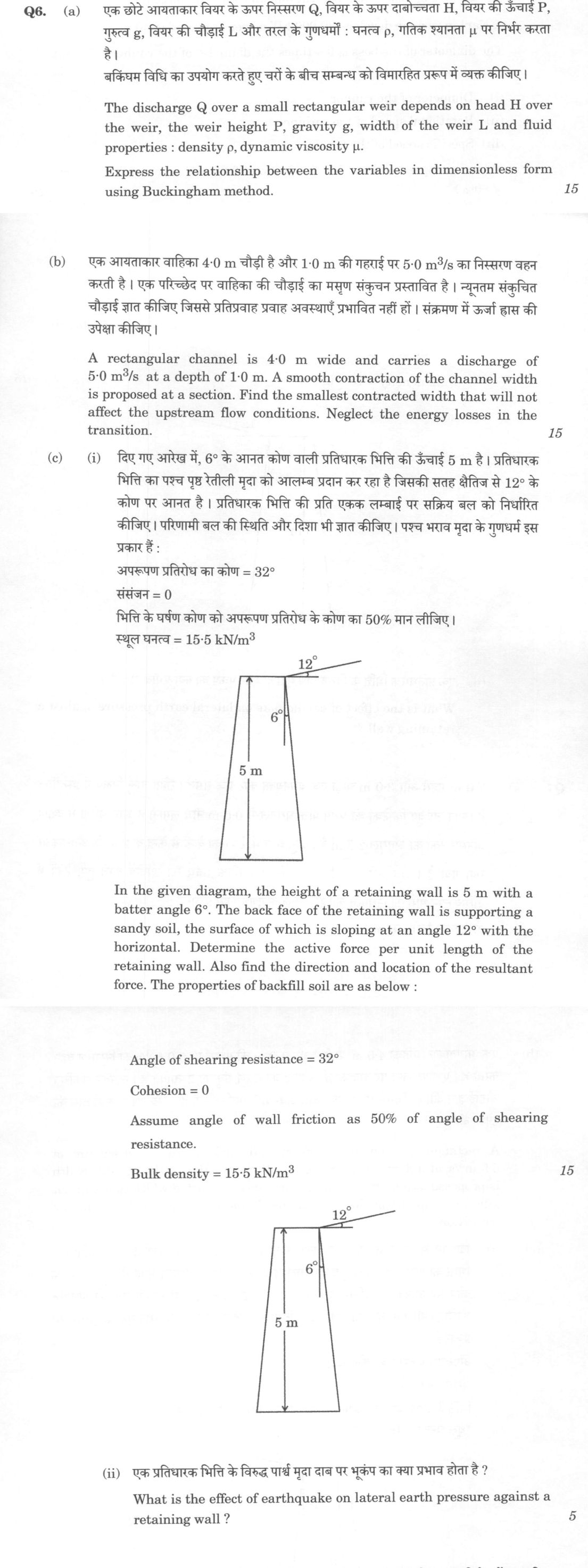
The figure this question refers to, in words
The question paper is a scan and the diagram did not survive as text. This is the figure as read from the original page — every component, value and label — so the question can be worked from the text below.
(c) A 2D cross-sectional diagram of a retaining wall. The wall is a trapezoidal shape with a vertical height dimensioned as 5 m. The back face of the wall is inclined, making an angle of 6 degrees with the vertical. The front face is vertical. The wall supports a sandy soil backfill. The ground surface of the backfill is sloping upwards away from the wall at an angle of 12 degrees with the horizontal. The base of the wall is horizontal.
What "Derive" is asking you to do
Reach the stated expression from a starting relation, justifying every step. The destination is printed in the question, so only the route earns marks, and the assumptions you work under are part of that route.
Structure that answers it
Assumptions and notation defined → starting relation or governing equation → each step with its justification → the required expression → limiting case or boundary check
Where marks are lost
Writing the standard result first and fitting three lines to it, which an examiner reads at a glance. Marks also go on assumptions left unstated — lossless medium, small amplitude, errors independent with zero mean — and on symbols used before they are defined, even when the question says usual notations.
How this answer will be evaluated
Approach
Framework: Buckingham Pi Theorem. (a) derive: given > assumptions > stepwise derivation > result > check | (b) calculate: given > formula > substitution > result with units > interpretation | (c(i)) calculate: given > formula > substitution > result with units > interpretation | (c(ii)) explain: definition/context > points in order > small example > short close Full marks: Complete derivations, correct formulas, clear diagrams, and accurate final values with units.
Key points expected
- List 6 variables and 4 base dimensions (M, L, T).
- Form dimensionless Pi groups (e.g., Q, H, P, g, L, ρ, μ).
- Derive final dimensionless equation relating the Pi groups.
- State assumptions regarding the variables.
- Calculate upstream Froude number (Fr) and specific energy (E).
- Apply critical flow condition (Fr=1) at the contraction.
- Use continuity equation (Q = A*V) to relate width and depth.
- Solve for the minimum contracted width (b_min).
Evaluation rubric
Each sub-part is marked on its own, against the marks and word limit printed on the paper.
- (a) Dimensionless relationship for weir discharge using Buckingham Pi method. 15 marks
derive— given → assumptions → stepwise derivation → result → check
Must cover
- List 6 variables and 4 base dimensions (M, L, T).
- Form dimensionless Pi groups (e.g., Q, H, P, g, L, ρ, μ).
- Derive final dimensionless equation relating the Pi groups.
- State assumptions regarding the variables.
Loses marks
- Missing base dimensions (M, L, T).
- Incorrect number of Pi groups.
- Final equation not dimensionless.
Earns more
- Correct identification of repeating variables.
- Clear step-by-step matrix or algebraic derivation.
- Mention of Reynolds number or Froude number explicitly.
Extra mark
- Neat tabular presentation of dimensions.
- (b) Smallest contracted width for a rectangular channel without affecting upstream flow. 15 marks
calculate— given → formula → substitution → result with units → interpretation
Must cover
- Calculate upstream Froude number (Fr) and specific energy (E).
- Apply critical flow condition (Fr=1) at the contraction.
- Use continuity equation (Q = A*V) to relate width and depth.
- Solve for the minimum contracted width (b_min).
Loses marks
- Ignoring specific energy conservation.
- Assuming depth remains constant at contraction.
- Calculation errors in Froude number.
Earns more
- Explicit calculation of critical depth (y_c).
- Verification that upstream flow is subcritical.
- Clear statement of energy conservation assumption.
Extra mark
- Sketch of the channel contraction with flow profile.
- (c(i)) Active force, direction, and location for a retaining wall with sloping backfill. 15 marks
calculate— given → formula → substitution → result with units → interpretation
Must cover
- Determine active earth pressure coefficient (Ka) for sloping backfill.
- Calculate magnitude of active force per unit length.
- Determine direction of resultant force (inclination to wall).
- Locate point of application (height from base).
Loses marks
- Using Ka for horizontal backfill instead of sloping.
- Ignoring wall friction angle in Ka calculation.
- Incorrect location of resultant force.
Earns more
- Correct use of wall friction angle (δ = 0.5φ).
- Clear free body diagram of the soil wedge.
- Explicit calculation of resultant components (horizontal/vertical).
Extra mark
- Neat labelled diagram of the retaining wall and soil wedge.
- (c(ii)) Effect of earthquake on lateral earth pressure against a retaining wall. 5 marks
explain— definition/context → points in order → small example → short close
Must cover
- Explain increase in lateral earth pressure due to seismic forces.
- Mention seismic active earth pressure coefficient (Ka_seismic).
- Describe the direction of the resultant force change.
Loses marks
- Stating pressure decreases during earthquake.
- No mention of seismic coefficient or acceleration.
Earns more
- Reference to Mononobe-Okabe method or similar.
- Mention of pseudo-static analysis.
Extra mark
- Brief mention of potential wall failure modes.
Model answer coming soon
Every evaluation on this site is marked against a verified model answer. This question's answer is still being written; evaluation opens the moment it lands.
More from Civil Engineering 2025 Paper I
- Q3 (a) Analyse the continuous beam shown in the figure by slope-deflection method. Draw the…
- Q4 (a) Analyse the frame shown in the figure by the moment distribution method. Draw the Ben…
- Q5 (a) A rigid body having dimensions of 0·6 m wide, 0·9 m high and 1·2 m long weighs 10 kN…
- Q6 (a) The discharge Q over a small rectangular weir depends on head H over the weir, the we…
- Q7 (a) A braced cut 7·0 m deep and 3·0 m wide is proposed in a cohesionless sand deposit. As…
- Q8 (a) The consolidated undrained (CU) tests were performed on the four over-consolidated cl…