Paper I — Q8
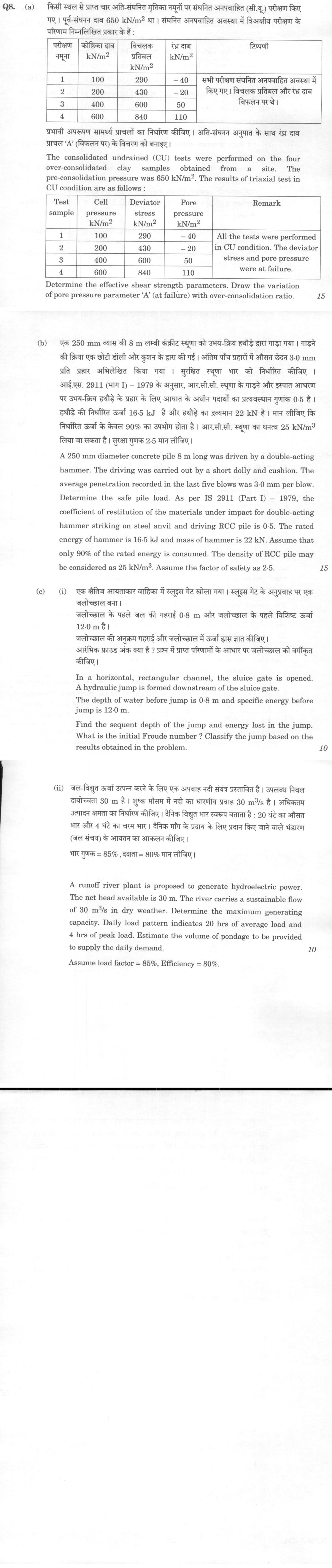
(a) The consolidated undrained (CU) tests were performed on the four over-consolidated clay samples obtained from a site. The…
The consolidated undrained (CU) tests were performed on the four over-consolidated clay samples obtained from a site. The pre-consolidation pressure was 650 kN/m². The results of triaxial test in CU condition are as follows:
| Test sample | Cell pressure kN/m² | Deviator stress kN/m² | Pore pressure kN/m² | Remark |
|---|---|---|---|---|
| 1 | 100 | 290 | – 40 | All the tests were performed in CU condition. The deviator stress and pore pressure were at failure. |
| 2 | 200 | 430 | – 20 | |
| 3 | 400 | 600 | 50 | |
| 4 | 600 | 840 | 110 |
Determine the effective shear strength parameters. Draw the variation of pore pressure parameter 'A' (at failure) with over-consolidation ratio.
A 250 mm diameter concrete pile 8 m long was driven by a double-acting hammer. The driving was carried out by a short dolly and cushion. The average penetration recorded in the last five blows was 3.0 mm per blow. Determine the safe pile load. As per IS 2911 (Part I) – 1979, the coefficient of restitution of the materials under impact for double-acting hammer striking on steel anvil and driving RCC pile is 0.5. The rated energy of hammer is 16.5 kJ and mass of hammer is 22 kN. Assume that only 90% of the rated energy is consumed. The density of RCC pile may be considered as 25 kN/m³. Assume the factor of safety as 2.5.
In a horizontal, rectangular channel, the sluice gate is opened. A hydraulic jump is formed downstream of the sluice gate. The depth of water before jump is 0.8 m and specific energy before jump is 12.0 m. Find the sequent depth of the jump and energy lost in the jump. What is the initial Froude number ? Classify the jump based on the results obtained in the problem.
A runoff river plant is proposed to generate hydroelectric power. The net head available is 30 m. The river carries a sustainable flow of 30 m³/s in dry weather. Determine the maximum generating capacity. Daily load pattern indicates 20 hrs of average load and 4 hrs of peak load. Estimate the volume of pondage to be provided to supply the daily demand. Assume load factor = 85%, Efficiency = 80%.
हिंदी में प्रश्न पढ़ें
किसी स्थल से प्राप्त चार अति-संघनित मृतिका नमूनों पर संघनित अनपवाहित (सी.यू.) परीक्षण किए गए । पूर्व-संघनन दाब 650 kN/m² था । संघनित अनपवाहित अवस्था में त्रिअक्षीय परीक्षण के परिणाम निम्नलिखित प्रकार के हैं :
| परीक्षण नमूना | कोष्ठिका दाब kN/m² | विचलक प्रतिबल kN/m² | रंध्र दाब kN/m² | टिप्पणी |
|---|---|---|---|---|
| 1 | 100 | 290 | – 40 | सभी परीक्षण संघनित अनपवाहित अवस्था में किए गए । विचलक प्रतिबल और रंध्र दाब विफलन पर थे। |
| 2 | 200 | 430 | – 20 | |
| 3 | 400 | 600 | 50 | |
| 4 | 600 | 840 | 110 |
प्रभावी अपरूपण सामर्थ्य प्राचलों का निर्धारण कीजिए । अति-संघनन अनुपात के साथ रंध्र दाब प्राचल 'A' (विफलन पर) के विचरण को बनाइए ।
एक 250 mm व्यास की 8 m लम्बी कंक्रीट स्तूपा को उभय-क्रिय हथौड़े द्वारा गाड़ा गया । गाड़ने की क्रिया एक छोटी डॉली और कुशन के द्वारा की गई । अंतिम पाँच प्रहारों में औसत छेदन 3.0 mm प्रति प्रहार अभिलेखित किया गया । सुरक्षित स्तूपा भार को निर्धारित कीजिए । आई.एस. 2911 (भाग I) – 1979 के अनुसार, आर.सी.सी. स्तूपा के गाड़ने और इस्पात आधरण पर उभय-क्रिय हथौड़े के प्रहार के लिए आघात के अधीन पदार्थों का प्रत्यवस्थान गुणांक 0.5 है । हथौड़े की निर्धारित ऊर्जा 16.5 kJ है और हथौड़े का द्रव्यमान 22 kN है । मान लीजिए कि निर्धारित ऊर्जा के केवल 90% का उपभोग होता है । आर.सी.सी. स्तूपा का घनत्व 25 kN/m³ लिया जा सकता है । सुरक्षा गुणक 2.5 मान लीजिए ।
एक क्षैतिज आयताकार वाहिका में स्लूस गेट खोला गया । स्लूस गेट के अनुप्रवाह पर एक जलोच्छाल बना । जलोच्छाल के पहले जल की गहराई 0.8 m और जलोच्छाल के पहले विशिष्ट ऊर्जा 12.0 m है । जलोच्छाल की अनुक्रम गहराई और जलोच्छाल में ऊर्जा ह्रास ज्ञात कीजिए । आरंभिक फ्राउड अंक क्या है ? प्रश्न में प्राप्त परिणामों के आधार पर जलोच्छाल को वर्गीकृत कीजिए ।
जल-विद्युत ऊर्जा उत्पन्न करने के लिए एक अपवाह नदी संयंत्र प्रस्तावित है। उपलब्ध निवल दाबोच्चता 30 m है। शुष्क मौसम में नदी का धारणीय प्रवाह 30 m³/s है। अधिकतम उत्पादन क्षमता का निर्धारण कीजिए। दैनिक विद्युत भार स्वरूप बताता है : 20 घंटे का औसत भार और 4 घंटे का चरम भार। दैनिक माँग के प्रदाय के लिए प्रदान किए जाने वाले भंडारण (जल संचय) के आयतन का आकलन कीजिए। भार गुणक = 85% , दक्षता = 80% मान लीजिए।
Model answer
Written by UPSC Answer Check against this question's marking rubric, to the expected length. UPSC does not publish answers for Mains — this is one way to score well, not an official key.
(a) Effective stresses: σ₃′ = σ₃ − u, σ₁′ = σ₁ − u = σ₃ + Δσ − u. Then p′ = (σ₁′ + σ₃′)/2, q = (σ₁′ − σ₃′)/2. Compute: 1: σ₃′ = 100 − (−40) = 140 kN/m², σ₁′ = 100+290+40 = 430 kN/m², p′ = 285 kN/m², q = 145 kN/m². 2: σ₃′ = 200 − (−20) = 220 kN/m², σ₁′ = 200+430+20 = 650 kN/m², p′ = 435 kN/m², q = 215 kN/m². 3: σ₃′ = 400 − 50 = 350 kN/m², σ₁′ = 400+600−50 = 950 kN/m², p′ = 650 kN/m², q = 300 kN/m². 4: σ₃′ = 600 − 110 = 490 kN/m², σ₁′ = 600+840−110 = 1330 kN/m², p′ = 910 kN/m², q = 420 kN/m².
Use Mohr-Coulomb criterion in triaxial invariants: q = c′ cos φ′ + p′ sin φ′. Least-squares fit of q on p′ gives slope m = 0.4355 and intercept b = 21.74 kN/m². Thus sin φ′ = 0.4355 → φ′ = 25.8°. c′ = b/cos φ′ = 21.74/0.900 = 24.1 kN/m². Effective shear strength parameters: c′ ≈ 24 kN/m², φ′ ≈ 25.8°.
Pore pressure parameter at failure: A = u/Δσ. OCR = σ_c′/σ₃ = 650/σ₃. Pairs (OCR, A): (6.5, −40/290 = −0.138), (3.25, −20/430 = −0.047), (1.625, 50/600 = 0.083), (1.083, 110/840 = 0.131). Plot A against OCR: A rises from negative values at high OCR to positive values near OCR = 1.
(b) Use Hiley’s formula as per IS 2911 (Part I): Q_u = ηE/(S + C/2) × (W + e²W_p)/(W + W_p). Given: ηE = 0.9 × 16.5 = 14.85 kN m, e = 0.5, W = 22 kN. Pile area = π(0.25)²/4 = 0.04909 m². Volume = 0.04909 × 8 = 0.3927 m³. W_p = 0.3927 × 25 = 9.82 kN. For RCC pile with short dolly and cushion, take C = 25 mm = 0.025 m. S = 3 mm = 0.003 m, C/2 = 0.0125 m. (W + e²W_p)/(W + W_p) = (22 + 0.25×9.82)/(22 + 9.82) = 24.45/31.82 = 0.7686. Q_u = 14.85/0.0155 × 0.7686 = 736.4 kN. Safe load = Q_u/FS = 736.4/2.5 = 294.6 kN. Safe pile load ≈ 294.6 kN.
(c)(i) Specific energy before jump: E₁ = y₁ + V₁²/(2g). 12.0 = 0.8 + V₁²/(2×9.81) → V₁²/(2g) = 11.2 m → V₁² = 219.744 → V₁ = 14.82 m/s. Fr₁ = V₁/√(g y₁) = 14.82/√(9.81×0.8) = 14.82/2.801 = 5.29 = 2√7.
Sequent depth formula for rectangular channel: y₂/y₁ = ½(√(1 + 8Fr₁²) − 1) = ½(√(1 + 8×28) − 1) = ½(15 − 1) = 7. y₂ = 7 × 0.8 = 5.6 m. Energy lost: ΔE = (y₂ − y₁)³/(4 y₁ y₂) = (4.8)³/(4×0.8×5.6) = 110.592/17.92 = 6.17 m = 216/35 m. Sequent depth = 5.6 m; energy lost = 6.17 m; initial Froude number = 5.29. Since 4.5 < Fr₁ < 9.0, it is a steady jump.
(c)(ii) Power from available flow: P = 9.81 Q H η = 9.81 × 30 × 30 × 0.80 = 7063.2 kW. This is the 24-hour average firm power. Load factor = average load / peak load = 0.85. Peak load = maximum generating capacity = 7063.2/0.85 = 8309.6 kW ≈ 8.31 MW.
Peak flow required = Q_peak = 30/0.85 = 35.29 m³/s. River flow = 30 m³/s. Deficit during 4-hour peak = 35.29 − 30 = 5.29 m³/s. Pondage volume = 5.29 × 4 × 3600 = 76,235 m³. Maximum generating capacity ≈ 8.31 MW; pondage volume ≈ 7.62×10⁴ m³.
What "Solve" is asking you to do
Choose the method, then carry it through to a final answer. Identifying what kind of problem this is and why that method applies is the first thing marked; a correct figure arrived at invisibly earns almost nothing.
Structure that answers it
Given data and what is required → method chosen, with the reason it applies → set-up (equation, circuit, free body, trial balance) → working, step by step → answer with units and any condition of validity
Where marks are lost
Doing the middle steps mentally and writing only the result. In mathematics papers, a further loss comes from giving a decimal where the exact value in surds or fractions was wanted, or from skipping the justification a part explicitly asks for.
How this answer will be evaluated
Approach
(a) calculate: given > formula > substitution > result with units > interpretation | (b) calculate: given > formula > substitution > result with units > interpretation | (c(i)) calculate: given > formula > substitution > result with units > interpretation | (c(ii)) calculate: given > formula > substitution > result with units > interpretation Full marks: Correct application of IS codes and formulas with clear steps and units.
Key points expected
- Compute effective stresses (σ'1, σ'3) for all 4 samples
- Plot Mohr circles and draw effective failure envelope
- Determine effective cohesion (c') and friction angle (φ')
- Calculate pore pressure parameter A for each sample
- State IS 2911 (Part I) - 1979 dynamic formula
- Calculate pile weight (W) from volume and density
- Substitute energy, mass, and penetration values
- Apply Factor of Safety (2.5) to ultimate load
Evaluation rubric
Each sub-part is marked on its own, against the marks and word limit printed on the paper.
- (a) Effective shear strength parameters and A-f plot for OC clay. 15 marks
calculate— given → formula → substitution → result with units → interpretation
Must cover
- Compute effective stresses (σ'1, σ'3) for all 4 samples
- Plot Mohr circles and draw effective failure envelope
- Determine effective cohesion (c') and friction angle (φ')
- Calculate pore pressure parameter A for each sample
Loses marks
- Using total stresses instead of effective stresses
- Omitting the A vs OCR plot
Earns more
- Calculate Over-Consolidation Ratio (OCR) for each sample
- Plot A vs OCR variation curve
- Identify transition from negative to positive A
Extra mark
- Label critical state line on Mohr-Coulomb plot
- (b) Safe pile load using IS 2911 dynamic formula. 15 marks
calculate— given → formula → substitution → result with units → interpretation
Must cover
- State IS 2911 (Part I) - 1979 dynamic formula
- Calculate pile weight (W) from volume and density
- Substitute energy, mass, and penetration values
- Apply Factor of Safety (2.5) to ultimate load
Loses marks
- Using rated energy without 90% efficiency factor
- Forgetting to divide by Factor of Safety
Earns more
- Explicitly state coefficient of restitution (0.5)
- Show unit conversions for penetration (mm to m)
Extra mark
- Mention specific clause number for the formula
- (c(i)) Sequent depth, energy loss, and Froude number for hydraulic jump. 10 marks
calculate— given → formula → substitution → result with units → interpretation
Must cover
- Calculate velocity (V1) from specific energy equation
- Compute initial Froude number (Fr1)
- Determine sequent depth (y2) using conjugate depth relation
- Calculate energy loss (ΔE) in the jump
Loses marks
- Using wrong formula for conjugate depth
- Omitting the Froude number calculation
Earns more
- Classify the jump type (e.g., weak, oscillating) based on Fr1
- Show step-by-step substitution in energy equation
Extra mark
- Sketch of the hydraulic jump profile
- (c(ii)) Maximum generating capacity and required pondage volume. 10 marks
calculate— given → formula → substitution → result with units → interpretation
Must cover
- Calculate maximum power (P) using head and flow
- Apply efficiency (80%) to find net capacity
- Determine average load using load factor (85%)
- Calculate energy deficit for peak hours (4 hrs)
Loses marks
- Ignoring the load factor in average load calculation
- Calculating pondage for 24 hours instead of peak deficit
Earns more
- Show calculation of energy generated vs demand
- State assumptions for load pattern clearly
Extra mark
- Mention specific formula for hydro power (P = ρgQHη)
Practice this exact question
Write your answer and it is marked point by point against the model answer above — what you covered, what you missed, what you got wrong.
Evaluate my answer →More from Civil Engineering 2025 Paper I
- Q5 (a) A rigid body having dimensions of 0·6 m wide, 0·9 m high and 1·2 m long weighs 10 kN…
- Q6 (a) The discharge Q over a small rectangular weir depends on head H over the weir, the we…
- Q7 (a) A braced cut 7·0 m deep and 3·0 m wide is proposed in a cohesionless sand deposit. As…
- Q8 (a) The consolidated undrained (CU) tests were performed on the four over-consolidated cl…