Paper II — Q1
(a) Briefly discuss why it is more advantageous to use high strength concrete for construction of high-rise buildings and…
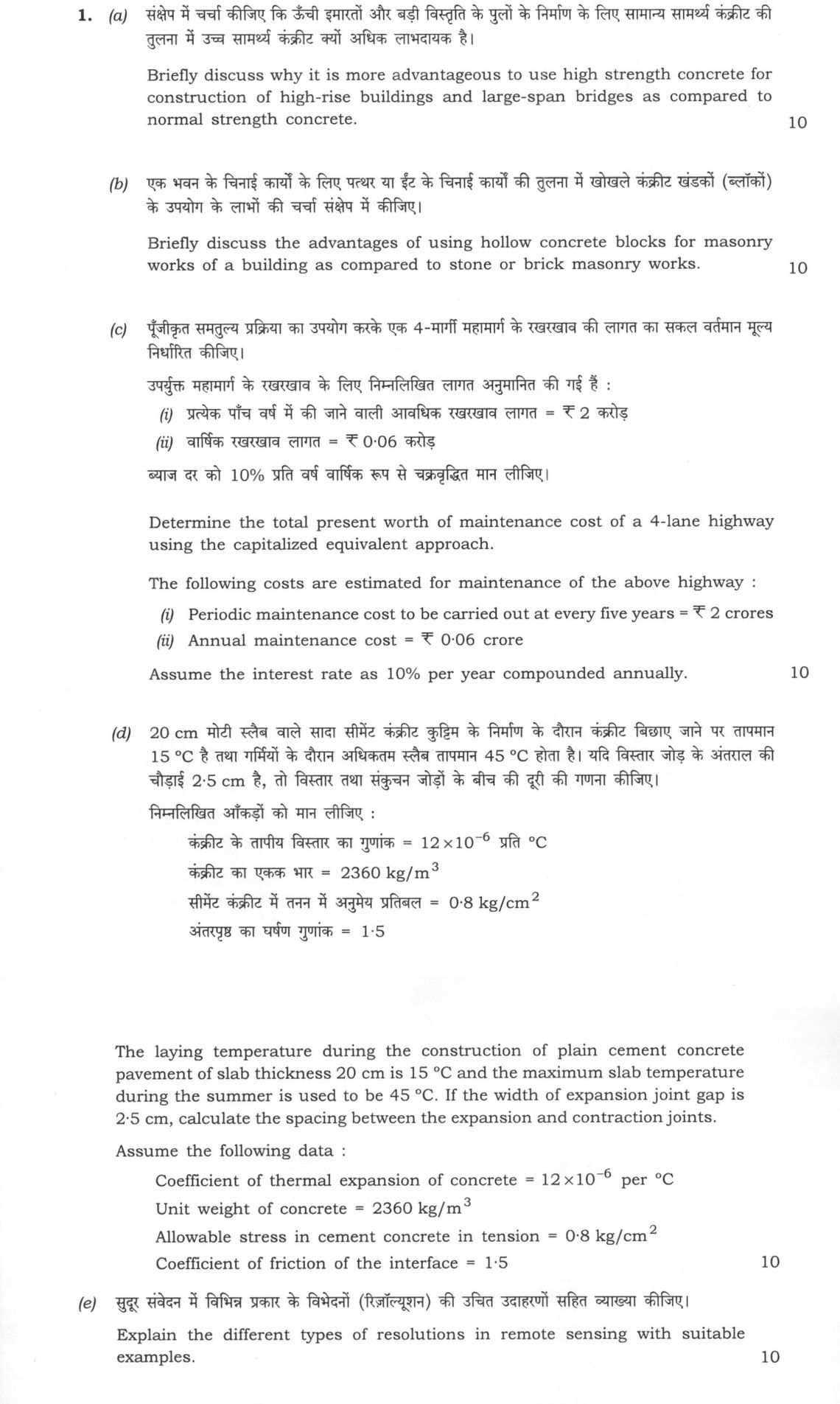
Briefly discuss why it is more advantageous to use high strength concrete for construction of high-rise buildings and large-span bridges as compared to normal strength concrete. 10 marks
Briefly discuss the advantages of using hollow concrete blocks for masonry works of a building as compared to stone or brick masonry works. 10 marks
Determine the total present worth of maintenance cost of a 4-lane highway using the capitalized equivalent approach.
The following costs are estimated for maintenance of the above highway : Periodic maintenance cost to be carried out at every five years = ₹ 2 crores
Annual maintenance cost = ₹ 0.06 crore
Assume the interest rate as 10% per year compounded annually. 10 marks
The laying temperature during the construction of plain cement concrete pavement of slab thickness 20 cm is 15 °C and the maximum slab temperature during the summer is used to be 45 °C. If the width of expansion joint gap is 2.5 cm, calculate the spacing between the expansion and contraction joints.
Assume the following data : Coefficient of thermal expansion of concrete = 12×10⁻⁶ per °C Unit weight of concrete = 2360 kg/m³ Allowable stress in cement concrete in tension = 0.8 kg/cm² Coefficient of friction of the interface = 1.5 10 marks
Explain the different types of resolutions in remote sensing with suitable examples. 10 marks
हिंदी में प्रश्न पढ़ें
संक्षेप में चर्चा कीजिए कि ऊँची इमारतों और बड़ी विस्तृति के पुलों के निर्माण के लिए सामान्य सामर्थ्य कंक्रीट की तुलना में उच्च सामर्थ्य कंक्रीट क्यों अधिक लाभदायक है। (10 अंक)
एक भवन के चिनाई कार्यों के लिए पत्थर या ईंट के चिनाई कार्यों की तुलना में खोखले कंक्रीट खंडकों (ब्लॉकों) के उपयोग के लाभों की चर्चा संक्षेप में कीजिए। (10 अंक)
पूँजीकृत समतुल्य प्रक्रिया का उपयोग करके एक 4-मार्गी महामार्ग के रखरखाव की लागत का सकल वर्तमान मूल्य निर्धारित कीजिए।
उपर्युक्त महामार्ग के रखरखाव के लिए निम्नलिखित लागत अनुमानित की गई हैं : प्रत्येक पाँच वर्ष में की जाने वाली आवधिक रखरखाव लागत = ₹ 2 करोड़
वार्षिक रखरखाव लागत = ₹ 0.06 करोड़
ब्याज दर को 10% प्रति वर्ष वार्षिक रूप से चक्रवृद्धि मान लीजिए। (10 अंक)
20 cm मोटी स्लैब वाले सादा सीमेंट कंक्रीट कुशिम के निर्माण के दौरान कंक्रीट बिछाए जाने पर तापमान 15 °C है तथा गर्मियों के दौरान अधिकतम स्लैब तापमान 45 °C होता है। यदि विस्तार जोड़ के अंतराल की चौड़ाई 2.5 cm है, तो विस्तार तथा संकुचन जोड़ों के बीच की दूरी की गणना कीजिए।
निम्नलिखित आँकड़ों को मान लीजिए : कंक्रीट के तापीय विस्तार का गुणांक = 12×10⁻⁶ प्रति °C कंक्रीट का एकक भार = 2360 kg/m³ सीमेंट कंक्रीट में तनन में अनुमेय प्रतिबल = 0.8 kg/cm² अंतरपृष्ठ का घर्षण गुणांक = 1.5 (10 अंक)
सुदूर संवेदन में विभिन्न प्रकार के विभेदनों (रिज़ॉल्यूशन) की उचित उदाहरणों सहित व्याख्या कीजिए। (10 अंक)
The figure this question refers to, in words
The question paper is a scan and the diagram did not survive as text. This is the figure as read from the original page — every component, value and label — so the question can be worked from the text below.
(a) Table titled 'Time from Start of Storm, t (h)' and 'Accumulated Rainfall (cm)'. Rows: (0, 0), (2, 0.6), (4, 2.8), (6, 5.2), (8, 6.7), (10, 7.5), (12, 9.2), (14, 9.6).
Table with two columns: 'Time from Start of Storm, t (h)' and 'Accumulated Rainfall (cm)'. Rows: 0, 0; 2, 0.6; 4, 2.8; 6, 5.2; 8, 6.7; 10, 7.5; 12, 9.2; 14, 9.6.
Table with two columns: 'Time from Start of Storm, t (h)' and 'Accumulated Rainfall (cm)'. Rows: 0, 0; 2, 0.6; 4, 2.8; 6, 5.2; 8, 6.7; 10, 7.5; 12, 9.2; 14, 9.6.
Model answer
Written by UPSC Answer Check against this question's marking rubric, to the expected length. UPSC does not publish answers for Mains — this is one way to score well, not an official key.
(a) High-strength concrete High-strength concrete is more advantageous for high-rise buildings and large-span bridges because it allows larger loads to be carried by smaller sections. In tall buildings, smaller columns, beams, and cores increase usable floor area, improve architectural flexibility, and reduce the self-weight of upper floors. The lower dead load also reduces foundation demand and makes taller structures more economical. In urban high-rises, the increase in leasable area can be significant. For bridges, high-strength concrete improves prestressing efficiency, reduces long-term creep and shrinkage, and limits deflection over long spans; thinner decks also improve clearance and reduce material volume. Its dense matrix gives lower permeability and enhanced durability against carbonation, chloride attack, sulphate action, and abrasion, which is important for marine and heavily trafficked structures. This also lowers long-term maintenance. Grades in the M60 to M100 range have been used in projects such as Burj Khalifa and the Bandra-Worli Sea Link, where compact sections, long spans, and long service life are critical. Thus HSC is not merely a stronger material; it changes the structural, economic, and durability performance of the project.
(b) Hollow concrete blocks Hollow concrete blocks offer several advantages over stone or brick masonry. The voids in the blocks reduce heat flow and provide thermal insulation, making interiors more comfortable and reducing cooling or heating demand. They also improve sound absorption and insulation compared with solid stone or brick walls. Because the blocks are hollow, about 50% material saving is possible compared with solid masonry, and the units are lighter, which reduces dead load, foundation cost, and transport cost. The lighter wall is also useful on soft ground. In Indian climates, thermal insulation can reduce cooling demand, and sound insulation is valuable near traffic. Construction is faster because the blocks are larger, require less mortar, and can be laid with simpler alignment. Compared with traditional Kota stone or Flemish-bond brickwork, hollow block masonry can reduce labour time, material handling, and wall weight while giving a reasonably smooth finish. The main design consideration is that load-bearing hollow block walls still require proper reinforcement, lintels, and bonding, but for ordinary building masonry the benefits are substantial.
(c) Capitalized equivalent For a highway with indefinite service life, the capitalized present worth is the equivalent annual cost divided by the interest rate. The method is appropriate because highway maintenance is a perpetual recurring cost; the five-year cost is spread over each cycle and then capitalized. The periodic maintenance of ₹2 crore every five years is not simply divided by five, because money has time value. With i = 10% and n = 5, the equivalent annual amount is found using the five-year factor i/[(1+i)^n - 1]. Thus A = 2 × 0.10/(1.10⁵ - 1) = 0.20/0.61051 = ₹0.3276 crore per year. Adding the annual maintenance of ₹0.06 crore gives a total equivalent annual maintenance cost of ₹0.3876 crore per year. The total present worth is therefore A/i = 0.3876/0.10 = ₹3.876 crore, approximately ₹3,87,60,000. This is the capitalized equivalent of the recurring five-year and annual maintenance obligations at 10% per year.
(d) Pavement joint spacing The temperature rise from laying to summer is ΔT = 45 °C - 15 °C = 30 °C. The expansion joint gap must accommodate thermal expansion, so the expansion joint spacing is L_e = δ/(α ΔT) = 2.5 cm/(12×10⁻⁶ × 30) = 6944 cm, or about 69.4 m. The calculation assumes the full gap is used at maximum temperature; a design margin would reduce spacing. For contraction joints, the friction-stress equilibrium is used. Convert unit weight to kg/cm³: γ = 2360 kg/m³ = 0.00236 kg/cm³. With slab thickness h = 20 cm, allowable tensile stress σ = 0.8 kg/cm², and friction coefficient μ = 1.5, the spacing is L_c = 2σh/(μγ×100) = (2×0.8×20)/(1.5×0.00236×100) = 90.4 m. The unit conversion is essential because the stress, thickness, and unit weight are given in mixed units. Equivalently, using γ in kg/m³, L_c = (2σh×10⁴)/(μγ) = 90.4 m. Thus the thermal calculation gives an expansion joint spacing of about 69.4 m, while the friction-tension calculation gives a contraction joint spacing of about 90.4 m; in actual layout the smaller or code-specified spacing would govern.
(e) Remote sensing resolutions Remote sensing data are characterized by four main types of resolution. Spatial resolution is the ground size of one pixel. A 2.5 m Cartosat-2 image can resolve buildings, roads, and small infrastructure, while a 30 m Landsat image is more suitable for land-cover mapping. Spectral resolution is the number and width of wavelength bands. Multispectral sensors, such as those on Resourcesat, record a limited set of broad bands for vegetation, water, and soil; hyperspectral sensors record many narrow bands and can distinguish minerals, crop stress, or water quality more precisely. Radiometric resolution is the sensor’s ability to distinguish small differences in brightness. An 8-bit sensor records 256 levels, while an 11-bit sensor records 2048 levels, giving better discrimination of subtle surface reflectance in urban, coastal, or agricultural mapping. Temporal resolution is the frequency of repeat observation. Indian missions such as Cartosat, Resourcesat, Oceansat, and RISAT provide repeat coverage for monitoring infrastructure, floods, coastal change, and land use; radar-based RISAT is especially useful for all-weather temporal monitoring. Cartosat supports cadastral and urban planning, Resourcesat supports agriculture and water resources, Oceansat supports coastal monitoring, and RISAT supports flood and disaster monitoring. The choice depends on scale: national mapping may use coarser spatial but frequent temporal data, while site-level engineering needs finer detail. Together, these resolutions determine whether a mission is best suited for mapping, monitoring, or detailed engineering assessment.
Overall, the advantages of HSC and hollow blocks are structural, economic, and service-life benefits; the highway maintenance cost is capitalized at about ₹3.876 crore; the pavement joint calculations give practical spacing values; and remote sensing resolutions define the scale, detail, and repeat capability needed for Indian infrastructure monitoring.
What "Discuss" is asking you to do
Lay the issue out from more than one side — how it arose, what is claimed for it, what is held against it, and where it now stands. UPSC attaches discuss to broad topics with several live dimensions, so coverage of the dimensions earns more than the strength of your opinion.
Structure that answers it
Set the issue up → the case as it is made → the case against → the dimension both sides leave out → where the balance now lies
Where marks are lost
Listing facts with no thread between them, or arguing one side throughout and calling it a discussion.
How this answer will be evaluated
Approach
(a) discuss: intro > 3-4 dimensions > example > balanced close | (b) discuss: intro > 3-4 dimensions > example > balanced close | (c) calculate: given > formula > substitution > result with units > interpretation | (d) calculate: given > formula > substitution > result with units > interpretation | (e) explain: definition/context > points in order > small example > short close Full marks: All parts fully answered with correct method, units, and checks; no missing components.
Key points expected
- Reduced self-weight of structural members
- Smaller cross-sections for high-rise columns
- Increased span capacity for bridges
- Improved durability and service life
- Lighter weight reducing dead load
- Faster construction speed
- Better thermal and acoustic insulation
- Uniformity and dimensional accuracy
Evaluation rubric
Each sub-part is marked on its own, against the marks and word limit printed on the paper.
- (a) Advantages of high-strength concrete (HSC) for high-rise and large-span structures. 10 marks
discuss— intro → 3-4 dimensions → example → balanced close
Must cover
- Reduced self-weight of structural members
- Smaller cross-sections for high-rise columns
- Increased span capacity for bridges
- Improved durability and service life
Loses marks
- Generic description of concrete
- Ignoring structural efficiency
- No comparison with normal strength
Earns more
- Mention of IS 456 or ACI 318
- Comparison of slenderness ratios
- Reference to creep and shrinkage
Extra mark
- Specific HSC grade examples (e.g., M60+)
- Cost-benefit analysis of HSC
- (b) Advantages of hollow concrete blocks over stone or brick masonry. 10 marks
discuss— intro → 3-4 dimensions → example → balanced close
Must cover
- Lighter weight reducing dead load
- Faster construction speed
- Better thermal and acoustic insulation
- Uniformity and dimensional accuracy
Loses marks
- Listing only one advantage
- Ignoring structural implications
- No comparison with traditional masonry
Earns more
- Mention of IS 2185
- Comparison of mortar usage
- Reference to labor efficiency
Extra mark
- Specific block size examples
- Cost comparison per square meter
- (c) Total present worth of highway maintenance using capitalized equivalent. 10 marks
calculate— given → formula → substitution → result with units → interpretation
Must cover
- Formula for capitalized cost of periodic expense
- Formula for capitalized cost of annual expense
- Substitution of given values (₹2 cr, ₹0.06 cr, 10%)
- Summation of both components
Loses marks
- Missing periodic cost component
- Incorrect interest rate application
- No final summation
Earns more
- Step-by-step calculation shown
- Units carried through (₹ crores)
- Mention of capitalized equivalent approach
Extra mark
- Sensitivity analysis on interest rate
- Comparison with other methods
- (d) Spacing between expansion and contraction joints for concrete pavement. 10 marks
calculate— given → formula → substitution → result with units → interpretation
Must cover
- Thermal expansion: ΔL_t = α * L * ΔT
- Total gap: ΔL_t + ΔL_f = 2.5 cm
- Solve for joint spacing L
Loses marks
- Ignoring frictional restraint
- Unit conversion errors
- No final value for L
Earns more
- All given data used correctly
- Units consistent (cm, kg, °C)
- Clear separation of thermal and friction terms
Extra mark
- Check for practical joint spacing
- Mention of IS 2387 or IRC 82
- (e) Different types of resolutions in remote sensing with examples. 10 marks
explain— definition/context → points in order → small example → short close
Must cover
- Spatial resolution definition and example
- Spectral resolution definition and example
- Temporal resolution definition and example
- Radiometric resolution definition and example
Loses marks
- Missing any of the four types
- No examples provided
- Confusing resolution types
Earns more
- Specific sensor examples (Landsat, MODIS)
- Table comparing resolutions
- Mention of trade-offs
Extra mark
- Recent satellite examples (Sentinel, WorldView)
- Application-specific resolution needs
Practice this exact question
Write your answer and it is marked point by point against the model answer above — what you covered, what you missed, what you got wrong.
Evaluate my answer →More from Civil Engineering 2025 Paper II
- Q1 (a) Briefly discuss why it is more advantageous to use high strength concrete for constru…
- Q2 (a) A contractor intends to bid for erecting a statue at a square in an urban area. The v…
- Q3 (a) (i) Observations were made with a theodolite from the points A and B of baseline AB h…
- Q4 (a) Compare the application of 'straight blade' and 'angle blade' of bulldozers for earth…