Paper II — Q4
(a) Compare the application of 'straight blade' and 'angle blade' of bulldozers for earthwork in a construction project…
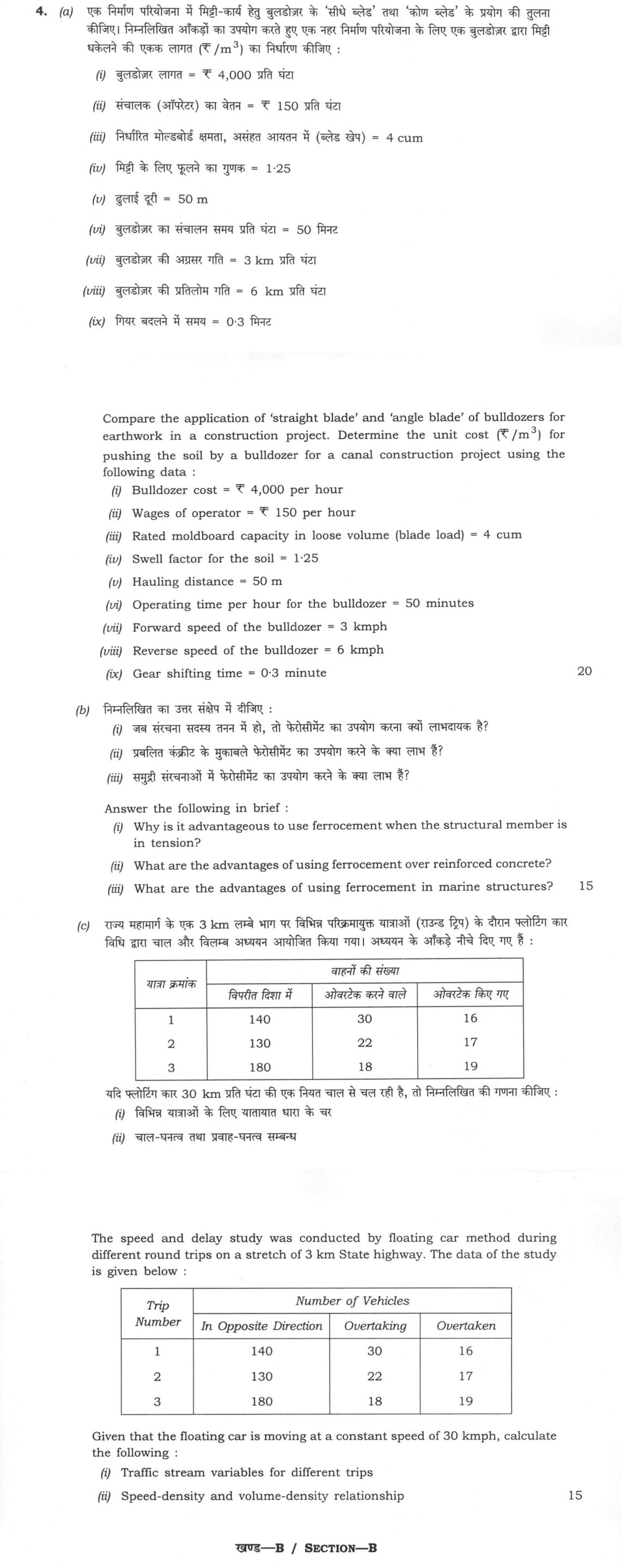
Compare the application of 'straight blade' and 'angle blade' of bulldozers for earthwork in a construction project. Determine the unit cost (₹/m³) for pushing the soil by a bulldozer for a canal construction project using the following data :
Bulldozer cost = ₹ 4,000 per hour
Wages of operator = ₹ 150 per hour
Rated moldboard capacity in loose volume (blade load) = 4 cum
Swell factor for the soil = 1·25
Hauling distance = 50 m
Operating time per hour for the bulldozer = 50 minutes
Forward speed of the bulldozer = 3 kmph
Reverse speed of the bulldozer = 6 kmph
Gear shifting time = 0·3 minute
20
Answer the following in brief :
Why is it advantageous to use ferrocement when the structural member is in tension?
What are the advantages of using ferrocement over reinforced concrete?
What are the advantages of using ferrocement in marine structures?
15
The speed and delay study was conducted by floating car method during different round trips on a stretch of 3 km State highway. The data of the study is given below :
| Trip Number | Number of Vehicles | ||
|---|---|---|---|
| In Opposite Direction | Overtaking | Overtaken | |
| 1 | 140 | 30 | 16 |
| 2 | 130 | 22 | 17 |
| 3 | 180 | 18 | 19 |
Given that the floating car is moving at a constant speed of 30 kmph, calculate the following :
Traffic stream variables for different trips
Speed-density and volume-density relationship
15
हिंदी में प्रश्न पढ़ें
(क) एक निर्माण परियोजना में मिट्टी-कार्य हेतु बुलडोजर के 'सीधे ब्लेड' तथा 'कोण ब्लेड' के प्रयोग की तुलना कीजिए। निम्नलिखित आँकड़ों का उपयोग करते हुए एक नहर निर्माण परियोजना के लिए एक बुलडोजर द्वारा मिट्टी धकेलने की एकक लागत (₹/m³) का निर्धारण कीजिए :
बुलडोजर लागत = ₹ 4,000 प्रति घंटा
संचालक (ऑपरेटर) का वेतन = ₹ 150 प्रति घंटा
निर्धारित मोल्डबोर्ड क्षमता, असंहत आयतन में (ब्लेड खेप) = 4 cum
मिट्टी के लिए फूलने का गुणक = 1·25
ढुलाई दूरी = 50 m
बुलडोजर का संचालन समय प्रति घंटा = 50 मिनट
बुलडोजर की अग्रसर गति = 3 km प्रति घंटा
बुलडोजर की प्रतिलोम गति = 6 km प्रति घंटा
गियर बदलने में समय = 0·3 मिनट
20
(ख) निम्नलिखित का उत्तर संक्षेप में दीजिए :
जब संरचना सदस्य तनन में हो, तो फेरोसीमेंट का उपयोग करना क्यों लाभदायक है?
प्रबलित कंक्रीट के मुकाबले फेरोसीमेंट का उपयोग करने के क्या लाभ हैं?
समुद्री संरचनाओं में फेरोसीमेंट का उपयोग करने के क्या लाभ हैं?
15
(ग) राज्य महामार्ग के एक 3 km लम्बे भाग पर विभिन्न परिक्रमायुक्त यात्राओं (राउंड ट्रिप) के दौरान फ्लोटिंग कार विधि द्वारा चाल और विलम्ब अध्ययन आयोजित किया गया। अध्ययन के आँकड़े नीचे दिए गए हैं :
यदि फ्लोटिंग कार 30 km प्रति घंटा की एक नियत चाल से चल रही है, तो निम्नलिखित की गणना कीजिए :
विभिन्न यात्राओं के लिए यातायात धारा के चर
चाल-घनत्व तथा प्रवाह-घनत्व सम्बन्ध
15
The figure this question refers to, in words
The question paper is a scan and the diagram did not survive as text. This is the figure as read from the original page — every component, value and label — so the question can be worked from the text below.
(c) Table with header row: Trip Number, Number of Vehicles (In Opposite Direction), Overtaking, Overtaken. Data rows: Trip 1: 140, 30, 16; Trip 2: 130, 22, 17; Trip 3: 180, 18, 19.
Model answer
Written by UPSC Answer Check against this question's marking rubric, to the expected length. UPSC does not publish answers for Mains — this is one way to score well, not an official key.
Blade comparison and unit cost Straight and angle blades both push soil, but they differ in geometry and use. A straight blade, or U-blade, has a rigid straight moldboard, higher rated capacity, and is best for heavy digging, crowding, and short hauls where large bank volumes must be moved quickly, such as canal embankment filling. An angle blade, or A-blade, can be swung to the side, has slightly lower capacity, and is preferred for side casting, ditching, spreading, cleaning, and shaping; it is useful for canal banks, side slopes and longer hauls where material must be cast to one side. The straight blade is less flexible but more productive for direct pushing; the angle blade is more versatile for finishing and side casting.
For the cost, hourly cost = 4000 + 150 = ₹4150. Forward time = 50 m / 50 m/min = 1.0 min; reverse time = 50 m / 100 m/min = 0.5 min; gear shifting = 0.3 min. Cycle time = 1.8 min. With 50 min operating time per hour, cycles = 50/1.8 = 27.78. Bank volume per load = 4/1.25 = 3.2 m³. Production = 27.78 × 3.2 = 88.9 bank m³/hr. Unit cost = 4150/88.9 = ₹46.7 per bank m³ (about ₹37.4 per loose m³).
Ferrocement (i) In tension, ferrocement is advantageous because its closely spaced thin wire mesh has high specific surface area, giving many small cracks and high bond. Tension is shared by numerous wires, crack widths are controlled, and the member remains ductile even in thin sections where conventional bars would be ineffective. (ii) Over reinforced concrete, ferrocement allows thinner sections, needs little or no conventional cover, is more impermeable, has better impact and fatigue resistance, can be prefabricated easily, and is repairable. Its fine mesh distributes stresses, reducing large cracks and improving durability. (iii) In marine structures, galvanized or corrosion-resistant mesh resists chloride attack, thin dense sections limit crack penetration, and the material performs well in splash zones. It is repairable, suitable for seawalls, breakwaters, pipes, tanks and marine platforms, and maintains integrity where conventional concrete cover may spall.
Floating car method Floating car time = 3/30 hr = 0.1 hr = 6 min. Let N be opposite-direction vehicles and D be the absolute difference between overtaking and overtaken vehicles. For the two-way stretch, stream speed is v = 30(N-D)/(N+D), volume per direction q = (N-D)/(2 × 0.1), density k = q/v, and travel time t = 3/v.
Trip 1: N=140, D=|30-16|=14. v=30×126/154=24.55 kmph; q=126/0.2=630 veh/hr; k=630/24.55=25.67 veh/km; t=3/24.55=7.33 min. Trip 2: N=130, D=|22-17|=5. v=30×125/135=27.78 kmph; q=125/0.2=625 veh/hr; k=22.50 veh/km; t=6.48 min. Trip 3: N=180, D=|18-19|=1. v=30×179/181=29.67 kmph; q=179/0.2=895 veh/hr; k=30.17 veh/km; t=6.07 min.
The computed density-speed pairs are (25.67,24.55), (22.50,27.78), (30.17,29.67), and the density-volume pairs are (25.67,630), (22.50,625), (30.17,895). Plotting these gives the speed-density and volume-density relationships. In the Greenshields idealisation, speed-density is linear, v = Vf(1 - k/Kj), and volume-density is parabolic, q = Vf k(1 - k/Kj); a straight-line fit to the k-v points gives Vf at k=0 and Kj at v=0.
Thus, for canal earthwork, a straight blade is preferred for high-capacity short-haul pushing, while an angle blade is preferred for side casting, ditching and spreading; the bulldozer unit cost is about ₹46.7 per bank m³.
What "Compare" is asking you to do
Set the items against each other on named dimensions. In UPSC practice compare already carries both halves — likeness and difference — and where the stem names the dimensions, as in region, nature and climatic impact, those are the headings the examiner expects to see.
Structure that answers it
Dimensions named → both items on dimension 1 → dimension 2 → dimension 3 → where they converge and where they part
Where marks are lost
Two self-contained descriptive blocks with the comparison left for the reader to make. Marks here sit on the dimensions, so an answer that names none of them gives the examiner nothing to award.
How this answer will be evaluated
Approach
(a) compare: paired headings or table > key differences > significance > conclusion | (b) explain: definition/context > points in order > small example > short close | (c) calculate: given > formula > substitution > result with units > interpretation Full marks: Precise calculations with correct units, clear comparison of blade types, and accurate application of floating car method formulas.
Key points expected
- Distinguish straight vs angle blade application
- Calculate total hourly cost (₹4,150)
- Determine cycle time using speeds and distance
- Compute unit cost in ₹/m³
- Explain tension capacity via mesh
- List advantages over reinforced concrete
- Identify marine durability benefits
- Apply floating car method formulas
Evaluation rubric
Each sub-part is marked on its own, against the marks and word limit printed on the paper.
- (a) Comparison of blade types and calculation of unit cost for soil pushing. 20 marks
compare— paired headings or table → key differences → significance → conclusion
Must cover
- Distinguish straight vs angle blade application
- Calculate total hourly cost (₹4,150)
- Determine cycle time using speeds and distance
- Compute unit cost in ₹/m³
Loses marks
- Ignoring gear shifting time
- Confusing loose vs bank volume
- Missing units in final cost
Earns more
- Correct application of swell factor
- Clear tabulation of time components
- Explicit statement of assumptions
Extra mark
- Sketch of blade geometry
- (b) Brief explanation of ferrocement advantages in tension, general, and marine contexts. 15 marks
explain— definition/context → points in order → small example → short close
Must cover
- Explain tension capacity via mesh
- List advantages over reinforced concrete
- Identify marine durability benefits
Loses marks
- Confusing with fiber reinforced concrete
- Vague generalities without specific features
Earns more
- Mention crack control mechanism
- Reference corrosion resistance
- Mention thin section capability
Extra mark
- Specific IS code reference
- (c) Calculation of traffic stream variables and speed-density/volume-density relationships. 15 marks
calculate— given → formula → substitution → result with units → interpretation
Must cover
- Apply floating car method formulas
- Calculate speed, flow, and density per trip
- Derive speed-density relationship
- Derive volume-density relationship
Loses marks
- Incorrect formula for density
- Ignoring the 3km stretch length
- Arithmetic errors in trip calculations
Earns more
- Correct use of 30 kmph floating car speed
- Tabulated results for all 3 trips
- Clear definition of variables
Extra mark
- Graphical representation of relationships
Practice this exact question
Write your answer and it is marked point by point against the model answer above — what you covered, what you missed, what you got wrong.
Evaluate my answer →More from Civil Engineering 2025 Paper II
- Q1 (a) Briefly discuss why it is more advantageous to use high strength concrete for constru…
- Q2 (a) A contractor intends to bid for erecting a statue at a square in an urban area. The v…
- Q3 (a) (i) Observations were made with a theodolite from the points A and B of baseline AB h…
- Q4 (a) Compare the application of 'straight blade' and 'angle blade' of bulldozers for earth…
- Q5 (a) A box culvert has an expected life of 10 years. (i) If the acceptable risk of at leas…
- Q6 (a) A storm over a catchment of area 5 km² had a duration of 14 hours. The mass curve of…
- Q7 (a) The data related to the activated sludge process is given below: Population = 500000…