Paper II — Q2
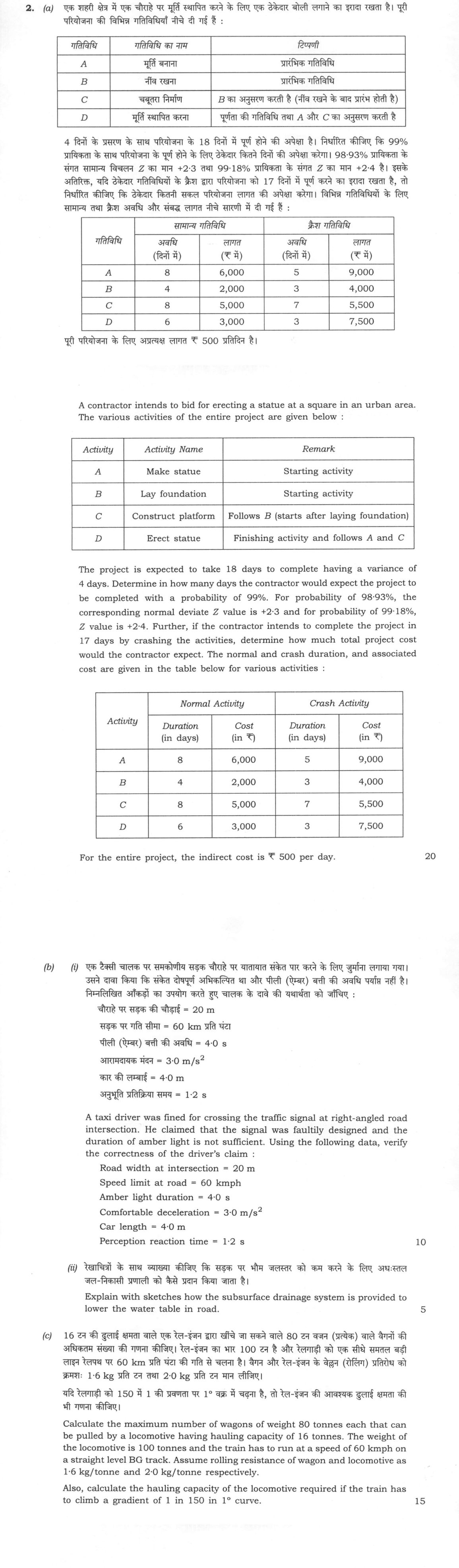
(a) A contractor intends to bid for erecting a statue at a square in an urban area. The various activities of the entire project…
A contractor intends to bid for erecting a statue at a square in an urban area. The various activities of the entire project are given below :
| Activity | Activity Name | Remark |
|---|---|---|
| A | Make statue | Starting activity |
| B | Lay foundation | Starting activity |
| C | Construct platform | Follows B (starts after laying foundation) |
| D | Erect statue | Finishing activity and follows A and C |
The project is expected to take 18 days to complete having a variance of 4 days. Determine in how many days the contractor would expect the project to be completed with a probability of 99%. For probability of 98.93%, the corresponding normal deviate Z value is +2.3 and for probability of 99.18%, Z value is +2.4. Further, if the contractor intends to complete the project in 17 days by crashing the activities, determine how much total project cost would the contractor expect. The normal and crash duration, and associated cost are given in the table below for various activities :
| Activity | Normal Activity | Crash Activity | ||
|---|---|---|---|---|
| Duration (in days) | Cost (in ₹) | Duration (in days) | Cost (in ₹) | |
| A | 8 | 6,000 | 5 | 9,000 |
| B | 4 | 2,000 | 3 | 4,000 |
| C | 8 | 5,000 | 7 | 5,500 |
| D | 6 | 3,000 | 3 | 7,500 |
For the entire project, the indirect cost is ₹ 500 per day. 20 marks
A taxi driver was fined for crossing the traffic signal at right-angled road intersection. He claimed that the signal was faultily designed and the duration of amber light is not sufficient. Using the following data, verify the correctness of the driver's claim :
Road width at intersection = 20 m Speed limit at road = 60 kmph Amber light duration = 4.0 s Comfortable deceleration = 3.0 m/s² Car length = 4.0 m Perception reaction time = 1.2 s 10 marks
Explain with sketches how the subsurface drainage system is provided to lower the water table in road. 5 marks
Calculate the maximum number of wagons of weight 80 tonnes each that can be pulled by a locomotive having hauling capacity of 16 tonnes. The weight of the locomotive is 100 tonnes and the train has to run at a speed of 60 kmph on a straight level BG track. Assume rolling resistance of wagon and locomotive as 1.6 kg/tonne and 2.0 kg/tonne respectively.
Also, calculate the hauling capacity of the locomotive required if the train has to climb a gradient of 1 in 150 in 1° curve. 15 marks
हिंदी में प्रश्न पढ़ें
एक शहरी क्षेत्र में एक चौराहे पर मूर्ति स्थापित करने के लिए एक ठेकेदार बोली लगाने का इरादा रखता है। पूरी परियोजना की विभिन्न गतिविधियाँ नीचे दी गई हैं :
4 दिनों के प्रसरण के साथ परियोजना के 18 दिनों में पूर्ण होने की अपेक्षा है। निर्धारित कीजिए कि 99% प्रायिकता के साथ परियोजना के पूर्ण होने के लिए ठेकेदार कितने दिनों की अपेक्षा करेगा। 98.93% प्रायिकता के संगत सामान्य विचलन Z का मान +2.3 तथा 99.18% प्रायिकता के संगत Z का मान +2.4 है। इसके अतिरिक्त, यदि ठेकेदार गतिविधियों के क्रैश द्वारा परियोजना को 17 दिनों में पूर्ण करने का इरादा रखता है, तो निर्धारित कीजिए कि ठेकेदार कितनी सकल परियोजना लागत की अपेक्षा करेगा। विभिन्न गतिविधियों के लिए सामान्य तथा क्रैश अवधि और संबद्ध लागत नीचे सारणी में दी गई हैं :
पूरी परियोजना के लिए अप्रत्यक्ष लागत ₹ 500 प्रतिदिन है। (20 अंक)
एक टैक्सी चालक पर समकोणीय सड़क चौराहे पर यातायात संकेत पार करने के लिए जुर्माना लगाया गया। उसने दावा किया कि संकेत दोषपूर्ण अभिकल्पित था और पीली (एम्बर) बत्ती की अवधि पर्याप्त नहीं है। निम्नलिखित आंकड़ों का उपयोग करते हुए चालक के दावे की यथार्थता को जाँचिए :
चौराहे पर सड़क की चौड़ाई = 20 m सड़क पर गति सीमा = 60 km प्रति घंटा पीली (एम्बर) बत्ती की अवधि = 4.0 s आरामदायक मंदन = 3.0 m/s² कार की लंबाई = 4.0 m अनुभूति प्रतिक्रिया समय = 1.2 s (10 अंक)
रेखाचित्रों के साथ व्याख्या कीजिए कि सड़क पर भौम जलस्तर को कम करने के लिए अधःस्तल जल-निकासी प्रणाली को कैसे प्रदान किया जाता है। (5 अंक)
16 टन की ढुलाई क्षमता वाले एक रेल-इंजन द्वारा खींचे जा सकने वाले 80 टन वजन (प्रत्येक) वाले वैगनों की अधिकतम संख्या की गणना कीजिए। रेल-इंजन का भार 100 टन है और रेलगाड़ी को एक सीधे समतल बड़ी लाइन रेलपथ पर 60 km प्रति घंटा की गति से चलना है। वैगन और रेल-इंजन के बेलून (रोलिंग) प्रतिरोध को क्रमशः: 1.6 kg प्रति टन तथा 2.0 kg प्रति टन मान लीजिए।
यदि रेलगाड़ी को 150 में 1 की प्रवणता पर 1° वक्र में चढ़ना है, तो रेल-इंजन की आवश्यक ढुलाई क्षमता की भी गणना कीजिए। (15 अंक)
Model answer
Written by UPSC Answer Check against this question's marking rubric, to the expected length. UPSC does not publish answers for Mains — this is one way to score well, not an official key.
(a) The network has two paths: A–D and B–C–D. Normal durations: A–D = 8 + 6 = 14 days; B–C–D = 4 + 8 + 6 = 18 days. Hence normal project duration μ = 18 days, critical path B–C–D. Variance = 4 day², so standard deviation σ = √4 = 2 days. For 99% probability, interpolate between 98.93% (Z = 2.3) and 99.18% (Z = 2.4): Z = 2.3 + ((99.00 − 98.93)/(99.18 − 98.93)) × (2.4 − 2.3) Z = 2.3 + (0.07/0.25) × 0.1 = 2.328 ≈ 2.33. Using T = μ + Zσ: T = 18 + 2.33 × 2 = 22.66 days ≈ 22.7 days. So the contractor can expect completion within about 22.66 days with 99% probability.
For crashing to 17 days, cost slopes: A = (9000 − 6000)/(8 − 5) = 1000 ₹/day B = (4000 − 2000)/(4 − 3) = 2000 ₹/day C = (5500 − 5000)/(8 − 7) = 500 ₹/day D = (7500 − 3000)/(6 − 3) = 1500 ₹/day
The critical path is B–C–D. To reduce project duration from 18 to 17 days, crash the critical activity with least slope, i.e. C, by 1 day. New C duration = 7 days. Direct cost = 6000 + 2000 + 5500 + 3000 = 16,500 ₹. Indirect cost for 17 days = 500 × 17 = 8,500 ₹. Total project cost = 16,500 + 8,500 = 25,000 ₹.
(b)(i) Required amber time for safe signal design is given by A = t_r + v/(2a) + (W + L)/v, where t_r = perception-reaction time, v = speed, a = comfortable deceleration, W = road width, L = car length. Speed v = 60 kmph = 60 × 5/18 = 50/3 m/s = 16.67 m/s. A = 1.2 + (50/3)/(2 × 3) + (20 + 4)/(50/3) A = 1.2 + 25/9 + 36/25 A = 1.2 + 2.7778 + 1.44 = 5.4178 s ≈ 5.42 s. Provided amber duration = 4.0 s. Since 4.0 s < 5.42 s, the amber period is insufficient. If amber and all-red are considered separately, stopping requirement is 1.2 + 2.7778 = 3.98 s and clearing time is 1.44 s, so total change interval still needs 5.42 s. Therefore the driver’s claim is correct.
(b)(ii) Subsurface drainage is provided to intercept seepage and lower the water table below the road subgrade. A longitudinal perforated pipe or French drain is laid in a trench along one or both shoulders of the road. The trench is filled with graded gravel/sand filter around the pipe, and a geotextile is wrapped around the filter to prevent clogging. Transverse collector drains are provided at intervals to intercept cross-flow and join the longitudinal drain. The collected water is led by outlet pipes to a side drain, natural stream, or sump. Sketch description: In cross-section, the road crust lies above the lowered water table; on the shoulder, a trench contains a perforated pipe at the bottom, surrounded by gravel and geotextile, with an outlet pipe. In plan, longitudinal drains run parallel to the road and are connected by transverse drains at regular spacing. This draws down the water table and keeps the subgrade dry.
(c) Let n be the number of wagons. Hauling capacity = 16 tonnes = 16,000 kg. Resistance of locomotive = 2.0 × 100 = 200 kg. Resistance of one wagon = 1.6 × 80 = 128 kg. On level straight track: 16,000 = 200 + n × 128 n = (16,000 − 200)/128 = 15,800/128 = 123.44. Maximum integer number of wagons = 123.
For the same train: Wagon weight = 123 × 80 = 9,840 tonnes. Total train weight = 100 + 9,840 = 9,940 tonnes. Rolling resistance = 200 + 1.6 × 9,840 = 200 + 15,744 = 15,944 kg. Gradient resistance for 1 in 150 = (1/150) × 9,940 × 1000 = 66,266.67 kg. Curve resistance for BG, 1° curve, taking 0.4 kg/tonne per degree = 0.4 × 9,940 = 3,976 kg. Total required hauling capacity = 15,944 + 66,266.67 + 3,976 = 86,186.67 kg = 86.19 tonnes. So the locomotive would require a hauling capacity of about 86.19 tonnes to climb the gradient in the 1° curve.
What "Solve" is asking you to do
Choose the method, then carry it through to a final answer. Identifying what kind of problem this is and why that method applies is the first thing marked; a correct figure arrived at invisibly earns almost nothing.
Structure that answers it
Given data and what is required → method chosen, with the reason it applies → set-up (equation, circuit, free body, trial balance) → working, step by step → answer with units and any condition of validity
Where marks are lost
Doing the middle steps mentally and writing only the result. In mathematics papers, a further loss comes from giving a decimal where the exact value in surds or fractions was wanted, or from skipping the justification a part explicitly asks for.
How this answer will be evaluated
Approach
Framework: CPM/PERT and Traffic Engineering. (a) calculate: given > formula > substitution > result with units > interpretation | (b) calculate: given > formula > substitution > result with units > interpretation | (c) calculate: given > formula > substitution > result with units > interpretation Full marks: Complete working with all formulas, units, and sketches; correct final values
Key points expected
- CPM network diagram and critical path
- Z-score application for probability
- Crashing cost calculation with indirects
- Stopping distance formula and calculation
- Subsurface drainage sketch with labels
- Rolling, gradient, and curve resistance formulas
- Unit consistency throughout
Evaluation rubric
Each sub-part is marked on its own, against the marks and word limit printed on the paper.
- (a) Determine 99% completion days and total cost for 17-day crash 20 marks
calculate— given → formula → substitution → result with units → interpretation
Must cover
- Draw network diagram with A, B, C, D
- Identify critical path (B-C-D)
- Apply Z-score formula for 99% probability
- Calculate crash cost including indirects
Loses marks
- Ignoring indirect cost in total
- Crashing non-critical activities first
- Missing network diagram
Earns more
- Correct Z-value selection (2.3 or 2.4)
- Step-by-step crashing of critical path
- Explicit calculation of indirect costs
- Comparison of normal vs crash costs
Extra mark
- Tabular summary of crashing steps
- Sensitivity analysis on critical path
- (b) Verify driver's claim on amber light and explain subsurface drainage 15 marks
calculate— given → formula → substitution → result with units → interpretation
Must cover
- Calculate stopping distance (reaction + braking)
- Compare stopping distance with road width
- Sketch subsurface drainage system
- Label components (trench, pipe, filter)
Loses marks
- Missing unit conversion
- No sketch for drainage part
- Confusing stopping distance with road width
Earns more
- Unit conversion (kmph to m/s)
- Clear distinction of reaction vs braking distance
- Neat labelled drainage sketch
- Explanation of water table lowering mechanism
Extra mark
- Reference to IS code for drainage
- Alternative drainage method mention
- (c) Calculate max wagons on level track and required capacity on curve 15 marks
calculate— given → formula → substitution → result with units → interpretation
Must cover
- Calculate total resistance on level track
- Determine max wagons from hauling capacity
- Calculate gradient resistance (1 in 150)
- Calculate curve resistance (1° curve)
Loses marks
- Ignoring locomotive weight in resistance
- Missing curve resistance calculation
- No units in final answer
Earns more
- Correct rolling resistance formula application
- Separate calculation for locomotive and wagons
- Clear formula for curve resistance
- Final result with units (tonnes)
Extra mark
- Tabular summary of resistance components
- Safety factor consideration
Practice this exact question
Write your answer and it is marked point by point against the model answer above — what you covered, what you missed, what you got wrong.
Evaluate my answer →More from Civil Engineering 2025 Paper II
- Q1 (a) Briefly discuss why it is more advantageous to use high strength concrete for constru…
- Q2 (a) A contractor intends to bid for erecting a statue at a square in an urban area. The v…
- Q3 (a) (i) Observations were made with a theodolite from the points A and B of baseline AB h…
- Q4 (a) Compare the application of 'straight blade' and 'angle blade' of bulldozers for earth…
- Q5 (a) A box culvert has an expected life of 10 years. (i) If the acceptable risk of at leas…