Paper II — Q3
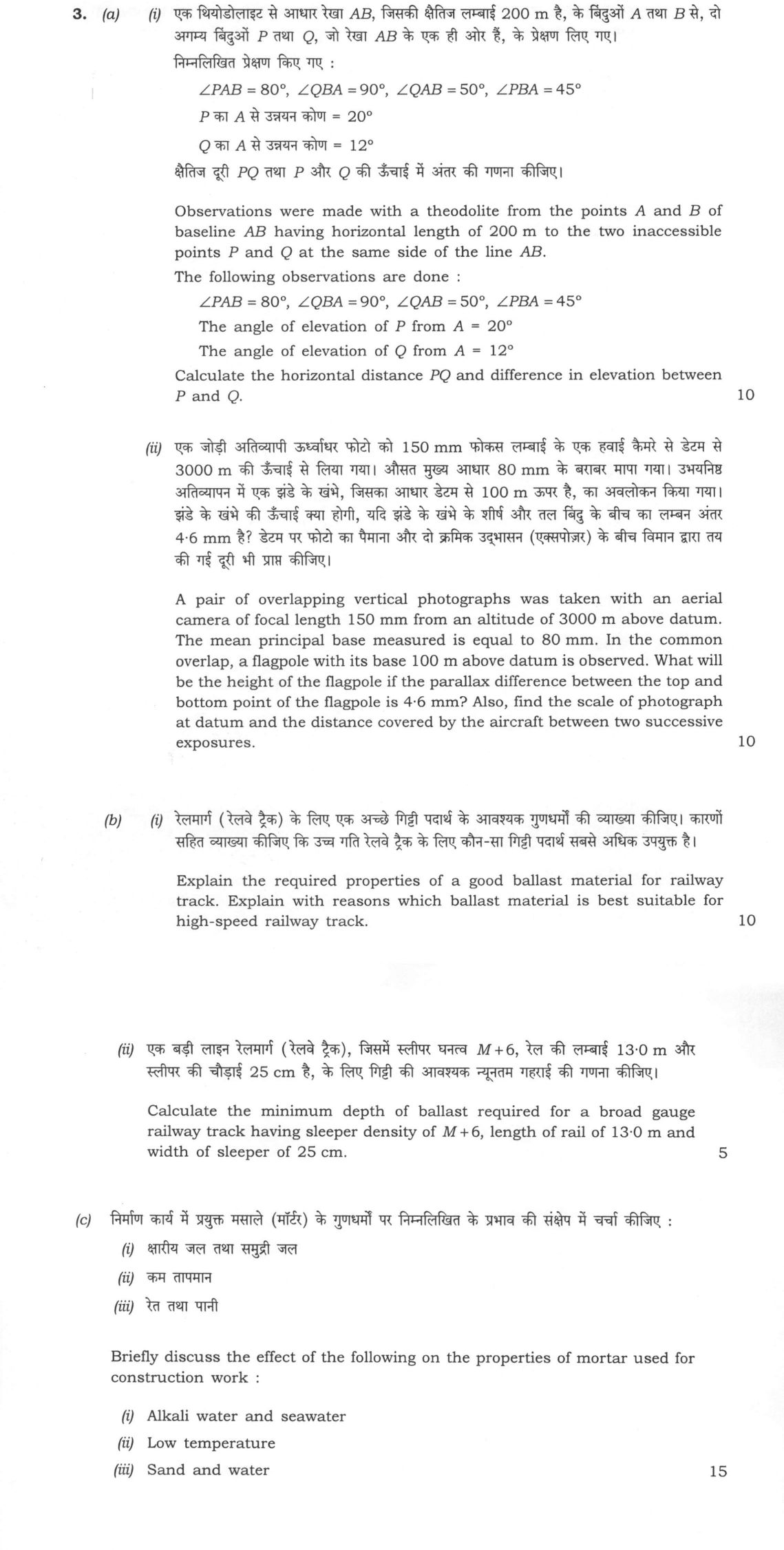
(a) (i) Observations were made with a theodolite from the points A and B of baseline AB having horizontal length of 200 m to the…
Observations were made with a theodolite from the points A and B of baseline AB having horizontal length of 200 m to the two inaccessible points P and Q at the same side of the line AB.
The following observations are done :
∠PAB = 80°, ∠QBA = 90°, ∠QAB = 50°, ∠PBA = 45°
The angle of elevation of P from A = 20°
The angle of elevation of Q from A = 12°
Calculate the horizontal distance PQ and difference in elevation between P and Q.
10
A pair of overlapping vertical photographs was taken with an aerial camera of focal length 150 mm from an altitude of 3000 m above datum. The mean principal base measured is equal to 80 mm. In the common overlap, a flagpole with its base 100 m above datum is observed. What will be the height of the flagpole if the parallax difference between the top and bottom point of the flagpole is 4·6 mm? Also, find the scale of photograph at datum and the distance covered by the aircraft between two successive exposures.
10
Explain the required properties of a good ballast material for railway track. Explain with reasons which ballast material is best suitable for high-speed railway track.
10
Calculate the minimum depth of ballast required for a broad gauge railway track having sleeper density of M+6, length of rail of 13·0 m and width of sleeper of 25 cm.
5
Briefly discuss the effect of the following on the properties of mortar used for construction work :
Alkali water and seawater
Low temperature
Sand and water
15
हिंदी में प्रश्न पढ़ें
(क) (i) एक थियोडोलाइट से आधार रेखा AB, जिसकी क्षैतिज लम्बाई 200 m है, के बिन्दुओं A तथा B से, दो अगम्य बिन्दुओं P तथा Q, जो रेखा AB के एक ही ओर हैं, के प्रेक्षण लिए गए।
निम्नलिखित प्रेक्षण किए गए :
∠PAB = 80°, ∠QBA = 90°, ∠QAB = 50°, ∠PBA = 45°
P का A से उन्नयन कोण = 20°
Q का A से उन्नयन कोण = 12°
क्षैतिज दूरी PQ तथा P और Q की ऊँचाई में अंतर की गणना कीजिए।
10
एक जोड़ी अतिव्यापी ऊर्ध्वाधर फोटो को 150 mm फोकस लम्बाई के एक हवाई कैमरे से डेटम से 3000 m की ऊँचाई से लिया गया। औसत मुख्य आधार 80 mm के बराबर मापा गया। उभयनिष्ठ अतिव्यापन में एक झंडे के खम्भे, जिसका आधार डेटम से 100 m ऊपर है, का अवलोकन किया गया। झंडे के खम्भे की ऊँचाई क्या होगी, यदि झंडे के खम्भे के शीर्ष और तल बिन्दु के बीच का लम्बन अंतर 4·6 mm है? डेटम पर फोटो का पैमाना और दो क्रमिक उद्घासन (एक्सपोजर) के बीच विमान द्वारा तय की गई दूरी भी प्राप्त कीजिए।
10
(ख) (i) रेलमार्ग (रेलवे ट्रैक) के लिए एक अच्छे गिट्टी पदार्थ के आवश्यक गुणधर्मों की व्याख्या कीजिए। कारणों सहित व्याख्या कीजिए कि उच्च गति रेलवे ट्रैक के लिए कौन-सा गिट्टी पदार्थ सबसे अधिक उपयुक्त है।
10
एक बड़ी लाइन रेलमार्ग (रेलवे ट्रैक), जिसमें स्लीपर घनत्व M+6, रेल की लम्बाई 13·0 m और स्लीपर की चौड़ाई 25 cm है, के लिए गिट्टी की आवश्यक न्यूनतम गहराई की गणना कीजिए।
5
(ग) निर्माण कार्य में प्रयुक्त मसाले (मोर्टर) के गुणधर्मों पर निम्नलिखित के प्रभाव की संक्षेप में चर्चा कीजिए :
क्षारीय जल तथा समुद्री जल
कम तापमान
रेत तथा पानी
15
Model answer
Written by UPSC Answer Check against this question's marking rubric, to the expected length. UPSC does not publish answers for Mains — this is one way to score well, not an official key.
(a)(i) Take A = (0, 0), B = (200, 0) m, with P and Q on the same side of AB.
For P, in ΔABP: ∠PAB = 80°, ∠PBA = 45°, so ∠APB = 180° − 80° − 45° = 55°. By sine rule: AP/sin45° = AB/sin55°. AP = 200 sin45°/sin55° = 172.644 m. Hence P = (AP cos80°, AP sin80°) = (29.979, 170.021) m.
For Q, in ΔABQ: ∠QAB = 50°, ∠QBA = 90°. Since AB is adjacent to 50° in the right triangle, AQ = AB/cos50° = 200/cos50° = 311.145 m. Q = (AQ cos50°, AQ sin50°) = (200.000, 238.351) m.
Therefore, Δx = 200.000 − 29.979 = 170.021 m and Δy = 238.351 − 170.021 = 68.330 m. PQ = √(170.021² + 68.330²) = 183.238 m.
Elevation of P above A = AP tan20° = 172.644 × 0.363970 = 62.837 m. Elevation of Q above A = AQ tan12° = 311.145 × 0.212557 = 66.136 m. Difference = 62.837 − 66.136 = −3.299 m. Thus Q is higher than P by 3.299 m ≈ 3.30 m.
(a)(ii) Using the vertical-photograph parallax equation, with f = 150 mm, H = 3000 m, mean principal base b = 80 mm, base elevation h_b = 100 m, and parallax difference Δp = 4.6 mm.
Scale at datum = f/H = 150 mm / 3000 m = 150 / 3,000,000 = 1:20,000.
Distance between successive exposures: B = bH/f = 80 mm × 3000 m / 150 mm = 1600 m.
Parallax at flagpole base: p_b = bH/(H − h_b) = 80 × 3000/(3000 − 100) = 82.7586 mm.
Height of flagpole: h = Δp(H − h_b)/(p_b + Δp) = 4.6 × 2900/(82.7586 + 4.6) = 13340/87.3586 = 152.704 m ≈ 152.70 m.
This is valid for vertical photographs, nearly level ground, and small parallax difference.
(b)(i) A good ballast material for railway track should be:
- strong, hard, tough and wear-resistant to resist crushing and abrasion under moving loads;
- angular or cubical with rough surfaces to interlock and prevent lateral movement;
- well-graded and free from dust, clay, loam, organic matter and soft particles;
- free-draining so that water does not accumulate and weaken the track;
- weather-resistant and chemically inert, not affected by rain, frost or salts;
- elastic and resilient enough to absorb shock and vibration;
- economical and easily available.
For high-speed railway track, crushed granite is generally best suitable. It has high compressive strength and toughness, low water absorption, good angularity, excellent drainage, and high resistance to attrition under repeated high-speed loads. Crushed basalt or quartzite may be used where granite is unavailable, but granite is preferred because it maintains gradation, interlock and drainage for a longer time.
(b)(ii) Sleeper density M + 6 for rail length 13.0 m: Number of sleepers = 13 + 6 = 19 per rail length. Sleeper spacing S = 1300/(19 − 1) = 1300/18 = 72.22 cm.
Width of sleeper b = 25 cm. Gap between sleepers = S − b = 72.22 − 25 = 47.22 cm.
Minimum depth of ballast is given by load-spread criterion: D = (S − b)/2 × cot θ. Taking the angle of repose of ballast θ = 30°, cot30° = √3 = 1.732. D = (47.22/2) × 1.732 = 23.61 × 1.732 = 40.90 cm.
Exact: D = 425√3/18 cm = 40.9 cm ≈ 0.409 m.
(c)(i) Alkali water and seawater contain sodium, potassium, chloride and sulfate salts. They may accelerate initial setting and give early strength, but later cause efflorescence, dampness, sulfate expansion, cracking, alkali–aggregate reaction, reduced bond, and lower long-term strength and durability. Chlorides promote corrosion of reinforcement. Therefore such water is prohibited for reinforced, prestressed or important mortar work; for plain mortar it may be used only after testing and with precautions.
(c)(ii) Low temperature slows cement hydration. Setting and hardening are retarded, early strength is low, and if mixing water freezes before setting, ice expansion causes cracks, loss of strength, bond and durability. Protective measures such as heated water/aggregates, accelerators, antifreeze admixtures, insulation and avoiding frozen subgrade are required.
(c)(iii) Sand affects gradation, water demand, strength, shrinkage and bond. Well-graded, clean, angular, coarse-to-medium sand gives dense, strong, durable mortar. Fine sand or excess silt/clay/organic matter increases water demand, shrinkage and permeability and reduces strength and bond. Water quantity controls the water/cement ratio. More water improves workability but lowers strength, increases shrinkage, permeability and efflorescence. Water should be potable and free from harmful acids, alkalis, salts, organic matter and oil so that setting and durability are not harmed.
What "Calculate" is asking you to do
Apply the standard formula or schedule to data the question has already supplied — a table of readings, cost records, a balance sheet — and produce the number. The method is rarely in doubt; the marks sit in the named intermediate quantities, each of which has to appear as a labelled line.
Structure that answers it
Data as given → formula or standard treatment, named → substitution → each intermediate, labelled → result with units
Where marks are lost
Omitting an intermediate the marking scheme pays for separately, or rounding at an intermediate line so the final figure drifts. In commerce and accountancy, any figure in a statement that no numbered working note supports is treated as unearned.
How this answer will be evaluated
Approach
(a(i)) calculate: given > formula > substitution > result with units > interpretation | (a(ii)) calculate: given > formula > substitution > result with units > interpretation | (b(i)) explain: definition/context > points in order > small example > short close | (b(ii)) calculate: given > formula > substitution > result with units > interpretation | (c) discuss: intro > 3-4 dimensions > example > balanced close Full marks: Complete working with all formulas, correct calculations, proper units, and clear explanations for all parts
Key points expected
- Apply sine rule to find horizontal distances AP and AQ
- Calculate horizontal distance PQ using cosine rule
- Compute vertical heights of P and Q from angles of elevation
- Determine difference in elevation between P and Q
- Use parallax formula to calculate flagpole height
- Calculate scale of photograph at datum level
- Determine distance covered by aircraft between exposures
- Apply correct parallax difference formula
Evaluation rubric
Each sub-part is marked on its own, against the marks and word limit printed on the paper.
- (a(i)) Horizontal distance PQ and difference in elevation between P and Q 10 marks
calculate— given → formula → substitution → result with units → interpretation
Must cover
- Apply sine rule to find horizontal distances AP and AQ
- Calculate horizontal distance PQ using cosine rule
- Compute vertical heights of P and Q from angles of elevation
- Determine difference in elevation between P and Q
Loses marks
- Missing sine rule application for AP and AQ
- Incorrect angle usage in trigonometric calculations
- No unit specification in final answers
Earns more
- Correct application of trigonometric identities
- Clear step-by-step substitution of given angles
- Proper unit conversion and significant figures
- Verification of results using alternative method
Extra mark
- Neat labelled diagram showing points A, B, P, Q
- Explicit statement of assumptions about horizontal plane
- (a(ii)) Flagpole height, photograph scale at datum, and aircraft distance between exposures 10 marks
calculate— given → formula → substitution → result with units → interpretation
Must cover
- Use parallax formula to calculate flagpole height
- Calculate scale of photograph at datum level
- Determine distance covered by aircraft between exposures
- Apply correct parallax difference formula
Loses marks
- Incorrect parallax formula application
- Missing scale calculation at datum
- No unit conversion between mm and m
Earns more
- Correct use of focal length and altitude values
- Proper application of parallax equations
- Clear identification of given parameters
- Consistent unit usage throughout calculations
Extra mark
- Reference to photogrammetry standard formulas
- Neat presentation of given data and formulas
- (b(i)) Properties of good ballast material and best material for high-speed track 10 marks
explain— definition/context → points in order → small example → short close
Must cover
- List required properties of good ballast material
- Explain why each property is important for track
- Identify best ballast material for high-speed track
- Provide reasons for material selection
Loses marks
- Missing explanation of property importance
- No specific material named for high-speed track
- Lack of reasoning for material selection
Earns more
- Mention specific properties like hardness, durability
- Reference to IS code for ballast specifications
- Comparison of different ballast materials
- Explanation of high-speed track requirements
Extra mark
- Mention of specific IS code number for ballast
- Reference to Indian Railways ballast standards
- (b(ii)) Minimum depth of ballast for broad gauge track 5 marks
calculate— given → formula → substitution → result with units → interpretation
Must cover
- State formula for minimum ballast depth
- Substitute given values: M+6, 13.0 m, 25 cm
- Calculate final depth with proper units
- Apply correct sleeper density interpretation
Loses marks
- Missing formula for ballast depth calculation
- Incorrect substitution of given values
- No unit specification in final answer
Earns more
- Clear identification of all given parameters
- Proper unit conversion and consistency
- Reference to standard ballast depth formula
- Verification of result against typical values
Extra mark
- Mention of IS code for ballast depth
- Note on practical considerations for depth
- (c) Effect of alkali water, low temperature, and sand/water on mortar properties 15 marks
discuss— intro → 3-4 dimensions → example → balanced close
Must cover
- Discuss effect of alkali water and seawater on mortar
- Explain impact of low temperature on mortar properties
- Analyze effect of sand and water on mortar
- Provide balanced discussion of each factor
Loses marks
- Missing discussion of any of the three factors
- No explanation of mechanism of effect
- Lack of practical construction implications
Earns more
- Mention specific chemical reactions involved
- Reference to standard mortar composition
- Practical implications for construction work
- Comparison of effects on different properties
Extra mark
- Reference to IS code for mortar specifications
- Mention of specific temperature thresholds
Practice this exact question
Write your answer and it is marked point by point against the model answer above — what you covered, what you missed, what you got wrong.
Evaluate my answer →More from Civil Engineering 2025 Paper II
- Q1 (a) Briefly discuss why it is more advantageous to use high strength concrete for constru…
- Q2 (a) A contractor intends to bid for erecting a statue at a square in an urban area. The v…
- Q3 (a) (i) Observations were made with a theodolite from the points A and B of baseline AB h…
- Q4 (a) Compare the application of 'straight blade' and 'angle blade' of bulldozers for earth…
- Q5 (a) A box culvert has an expected life of 10 years. (i) If the acceptable risk of at leas…
- Q6 (a) A storm over a catchment of area 5 km² had a duration of 14 hours. The mass curve of…