Paper II — Q7
(a) The data related to the activated sludge process is given below: Population = 500000 Wastewater contribution = 150 lpcd BOD…
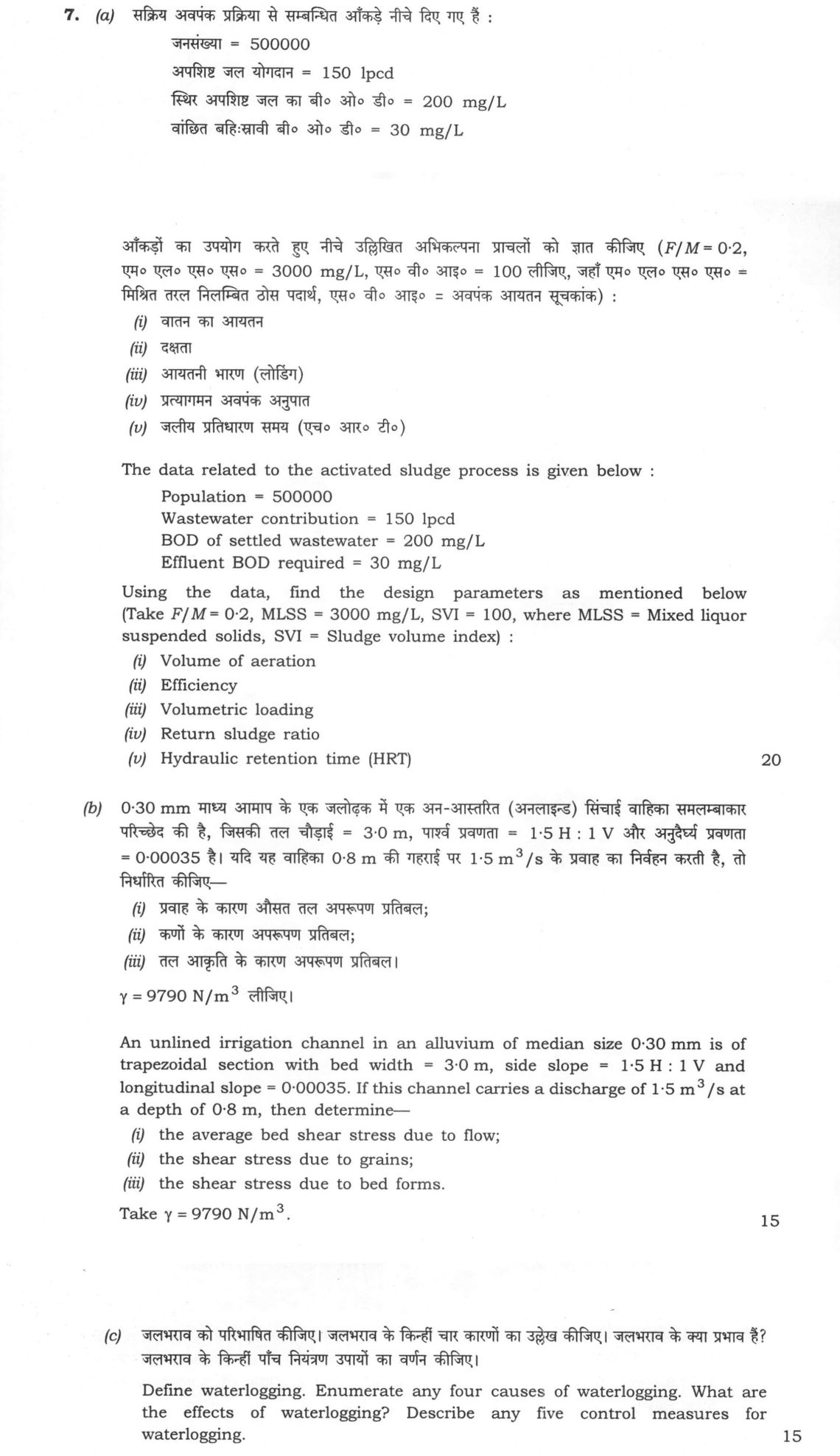
The data related to the activated sludge process is given below: Population = 500000 Wastewater contribution = 150 lpcd BOD of settled wastewater = 200 mg/L Effluent BOD required = 30 mg/L
Using the data, find the design parameters as mentioned below (Take F/M = 0·2, MLSS = 3000 mg/L, SVI = 100, where MLSS = Mixed liquor suspended solids, SVI = Sludge volume index): Volume of aeration
Efficiency
Volumetric loading
Return sludge ratio
Hydraulic retention time (HRT) 20 marks
An unlined irrigation channel in an alluvium of median size 0·30 mm is of trapezoidal section with bed width = 3·0 m, side slope = 1·5 H : 1 V and longitudinal slope = 0·00035. If this channel carries a discharge of 1·5 m³/s at a depth of 0·8 m, then determine— the average bed shear stress due to flow;
the shear stress due to grains;
the shear stress due to bed forms. Take γ = 9790 N/m³. 15 marks
Define waterlogging. Enumerate any four causes of waterlogging. What are the effects of waterlogging? Describe any five control measures for waterlogging. 15 marks
हिंदी में प्रश्न पढ़ें
सक्रिय अवंक प्रक्रिया से सम्बन्धित आँकड़े नीचे दिए गए हैं :
जनसंख्या = 500000
अपशिष्ट जल योगदान = 150 lpcd
स्थिर अपशिष्ट जल का बी० ओ० डी० = 200 mg/L
वांछित बहिःसावी बी० ओ० डी० = 30 mg/L
ऑकड़ों का उपयोग करते हुए नीचे उल्लिखित अभिकल्पना प्राचलों को ज्ञात कीजिए (F/M = 0·2, एम० एल० एस० एस० = 3000 mg/L, एस० वी० आई० = 100 लीजिए, जहाँ एम० एल० एस० एस० = मिश्रित तरल निलम्बित ठोस पदार्थ, एस० वी० आई० = अवपंक आयतन सूचकांक) : वातन का आयतन
दक्षता
आयतनी भारण (लोडिंग)
प्रत्यागमन अवपंक अनुपात
जलीय प्रतिधारण समय (एच० आर० टी०) 20 अंक
0·30 mm माध्य आमाप के एक जलोढक में एक अन-आस्तरित (अनलाइंड) सिंचाई वाहिका समलम्बाकार परिच्छेद की है, जिसकी तल चौड़ाई = 3·0 m, पार्श्व प्रवणता = 1·5 H : 1 V और अनुदैर्ध्य प्रवणता = 0·00035 है। यदि यह वाहिका 0·8 m की गहराई पर 1·5 m³/s के प्रवाह का निर्वहन करती है, तो निर्धारित कीजिए— प्रवाह के कारण औसत तल अपरूपण प्रतिबल;
कणों के कारण अपरूपण प्रतिबल;
तल आकृति के कारण अपरूपण प्रतिबल।
γ = 9790 N/m³ लीजिए। 15 अंक
जलभराव को परिभाषित कीजिए। जलभराव के किन्हीं चार कारणों का उल्लेख कीजिए। जलभराव के क्या प्रभाव हैं? जलभराव के किन्हीं पाँच नियंत्रण उपायों का वर्णन कीजिए। 15 अंक
The figure this question refers to, in words
The question paper is a scan and the diagram did not survive as text. This is the figure as read from the original page — every component, value and label — so the question can be worked from the text below.
(c) Table with columns: यात्रा क्रमांक (Trip number), and वाहनों की संख्या (Number of vehicles) with sub-columns विपरीत दिशा में (In opposite direction), ओवरटेक करने वाले (Overtaking), ओवरटेक किए गए (Overtaken). Rows: Trip 1: 140, 30, 16; Trip 2: 130, 22, 17; Trip 3: 180, 18, 19.
Model answer
Written by UPSC Answer Check against this question's marking rubric, to the expected length. UPSC does not publish answers for Mains — this is one way to score well, not an official key.
(a) Given: Population = 500000; wastewater contribution = 150 lpcd. Q = 500000 × 150 = 75,000,000 L/d = 75,000 m³/d. Influent BOD, S₀ = 200 mg/L = 0.2 kg/m³. Effluent BOD, Sₑ = 30 mg/L = 0.03 kg/m³. MLSS, X = 3000 mg/L = 3 kg/m³; F/M = 0.2 d⁻¹; SVI = 100 mL/g.
(i) Volume of aeration Use F/M = Q S₀ / (V X). V = Q S₀ / (F/M × X) = (75,000 × 0.2) / (0.2 × 3) = 15,000 / 0.6 = 25,000 m³. V = 25,000 m³
(ii) Efficiency η = (S₀ − Sₑ)/S₀ × 100 = (200 − 30)/200 × 100 = 85%. η = 85%
(iii) Volumetric loading Volumetric loading = Q S₀ / V = (75,000 × 0.2) / 25,000 = 0.6 kg BOD/m³·d. Also, it equals F/M × X = 0.2 × 3 = 0.6 kg BOD/m³·d. Volumetric loading = 0.6 kg BOD/m³·d
(iv) Return sludge ratio From SVI, return sludge concentration is Xᵣ = 10⁶ / SVI = 10⁶ / 100 = 10,000 mg/L = 10 kg/m³. Using clarifier mass balance, neglecting effluent solids: (Q + Qᵣ)X = Qᵣ Xᵣ Q X = Qᵣ (Xᵣ − X) R = Qᵣ/Q = X / (Xᵣ − X) = 3000 / (10,000 − 3000) = 3/7 = 0.4286. Return sludge ratio R = 0.4286, i.e. 3/7
(v) Hydraulic retention time HRT = V/Q = 25,000 / 75,000 = 1/3 d = 8 h. HRT = 8 h This is based on influent wastewater flow and assumes steady-state, complete-mix operation.
(b) Given: B = 3.0 m, side slope z = 1.5 H : 1 V, y = 0.8 m, S = 0.00035, Q = 1.5 m³/s, d₅₀ = 0.30 mm = 0.00030 m, γ = 9790 N/m³.
Trapezoidal section: A = B y + z y² = 3.0 × 0.8 + 1.5 × 0.8² = 2.4 + 0.96 = 3.36 m². P = B + 2y√(1 + z²) = 3.0 + 2 × 0.8 × √(1 + 1.5²) = 3.0 + 2.88444 = 5.88444 m. R = A/P = 3.36 / 5.88444 = 0.570997 m. V = Q/A = 1.5 / 3.36 = 0.44643 m/s.
(i) Average bed shear stress due to flow Use τ₀ = γ R S. τ₀ = 9790 × 0.570997 × 0.00035 = 1.9565 N/m². τ₀ = 1.956 N/m²
(ii) Shear stress due to grains Using Garde–Ranga Raju grain roughness, n_g = d₅₀^(1/6) / 24, with d₅₀ in metres. d₅₀^(1/6) = 0.00030^(1/6) = 0.25873 n_g = 0.25873 / 24 = 0.010780.
Total Manning n from the actual flow: V = (1/n) R^(2/3) S^(1/2) n = R^(2/3) S^(1/2) / V = 0.68826 × 0.018708 / 0.44643 = 0.02884.
For grain shear, R′ = R (n_g/n)^(3/2): R′ = 0.570997 × (0.010780 / 0.02884)^(3/2) = 0.13048 m. τ′ = γ R′ S = 9790 × 0.13048 × 0.00035 = 0.4471 N/m². τ′ = 0.447 N/m²
(iii) Shear stress due to bed forms By shear partition, τ″ = τ₀ − τ′. τ″ = 1.9565 − 0.4471 = 1.5094 N/m². τ″ = 1.509 N/m²
(c) Waterlogging is the condition in which soil pores in the root zone become saturated with water and air is expelled, either because the water table rises into the root zone or because surface water cannot drain away. It produces anaerobic soil and inhibits root respiration.
Four causes of waterlogging:
- Excessive and uncontrolled irrigation without adequate drainage.
- Seepage from unlined canals, reservoirs and distributaries.
- Obstruction of natural drainage by roads, railways, embankments or urbanisation.
- Heavy rainfall, floods and high recharge in flat alluvial tracts.
Effects of waterlogging:
- Poor soil aeration and anaerobic conditions; roots suffer oxygen deficiency.
- Reduced microbial activity and nitrogen availability; toxic substances accumulate.
- Stunted growth, yellowing, root rot, low yield or complete crop failure.
- Secondary salinisation/alkalinisation due to capillary rise and evaporation.
- Delayed farm operations, waterborne diseases, mosquito breeding and reduced bearing capacity.
Five control measures:
- Surface drainage: open ditches, field drains, land grading and contour bunds to remove ponded water.
- Subsurface drainage: tile drains, mole drains or corrugated plastic drains to lower the water table.
- Canal lining and seepage interception: concrete lining, cut-off walls and intercepting drains.
- Controlled irrigation: water budgeting, drip/sprinkler irrigation, avoiding over-irrigation and suitable crop planning.
- Vertical drainage and bio-drainage: tube wells for conjunctive use and deep-rooted trees such as eucalyptus to transpire excess water.
What "Calculate" is asking you to do
Apply the standard formula or schedule to data the question has already supplied — a table of readings, cost records, a balance sheet — and produce the number. The method is rarely in doubt; the marks sit in the named intermediate quantities, each of which has to appear as a labelled line.
Structure that answers it
Data as given → formula or standard treatment, named → substitution → each intermediate, labelled → result with units
Where marks are lost
Omitting an intermediate the marking scheme pays for separately, or rounding at an intermediate line so the final figure drifts. In commerce and accountancy, any figure in a statement that no numbered working note supports is treated as unearned.
How this answer will be evaluated
Approach
Framework: Civil Engineering Design & Analysis. (a) calculate: given > formula > substitution > result with units > interpretation | (b) calculate: given > formula > substitution > result with units > interpretation | (c) describe: define > structure or process in order > labelled diagram > significance Full marks: Accurate calculations with clear steps; comprehensive and well-organized descriptive answers.
Key points expected
- Calculate flow rate Q from population and lpcd
- Apply F/M ratio to find aeration volume
- Calculate efficiency from BOD removal
- Determine HRT and return sludge ratio
- Calculate hydraulic mean depth (R) from geometry
- Compute average bed shear stress using slope and depth
- Determine shear stress due to grains (Shields parameter)
- Calculate shear stress due to bed forms
Evaluation rubric
Each sub-part is marked on its own, against the marks and word limit printed on the paper.
- (a) Determine five design parameters for the activated sludge process. 20 marks
calculate— given → formula → substitution → result with units → interpretation
Must cover
- Calculate flow rate Q from population and lpcd
- Apply F/M ratio to find aeration volume
- Calculate efficiency from BOD removal
- Determine HRT and return sludge ratio
Loses marks
- Missing unit conversions leading to wrong magnitude
- Using wrong formula for F/M ratio
- Omitting the calculation for return sludge ratio
Earns more
- Correct unit conversions (mg/L to kg)
- Explicit statement of MLSS and SVI values
- Clear step-by-step substitution in formulas
Extra mark
- Verification of results against standard limits
- Neat tabulation of final parameters
- (b) Determine bed shear stress components for the trapezoidal channel. 15 marks
calculate— given → formula → substitution → result with units → interpretation
Must cover
- Calculate hydraulic mean depth (R) from geometry
- Compute average bed shear stress using slope and depth
- Determine shear stress due to grains (Shields parameter)
- Calculate shear stress due to bed forms
Loses marks
- Error in calculating hydraulic radius
- Confusing total shear stress with grain shear stress
- Omitting the calculation for bed form stress
Earns more
- Correct calculation of wetted perimeter
- Proper use of specific weight of water
- Clear distinction between total, grain, and form stress
Extra mark
- Reference to Shields diagram or formula
- Check for critical shear stress
- (c) Define waterlogging, list causes, effects, and control measures. 15 marks
describe— define → structure or process in order → labelled diagram → significance
Must cover
- Provide a precise definition of waterlogging
- Enumerate at least four causes
- Describe effects on soil and crops
- List five control measures
Loses marks
- Vague or incorrect definition of waterlogging
- Listing fewer than four causes or five measures
- Confusing waterlogging with water erosion
Earns more
- Logical grouping of causes and effects
- Specific examples of control measures (e.g., drainage)
- Clear distinction between causes and effects
Extra mark
- Reference to specific drainage methods
- Discussion of long-term soil management
Practice this exact question
Write your answer and it is marked point by point against the model answer above — what you covered, what you missed, what you got wrong.
Evaluate my answer →More from Civil Engineering 2025 Paper II
- Q4 (a) Compare the application of 'straight blade' and 'angle blade' of bulldozers for earth…
- Q5 (a) A box culvert has an expected life of 10 years. (i) If the acceptable risk of at leas…
- Q6 (a) A storm over a catchment of area 5 km² had a duration of 14 hours. The mass curve of…
- Q7 (a) The data related to the activated sludge process is given below: Population = 500000…
- Q8 (a) The figure shows an overflow spillway which is 40 m high. At the design energy head o…