Paper II — Q5
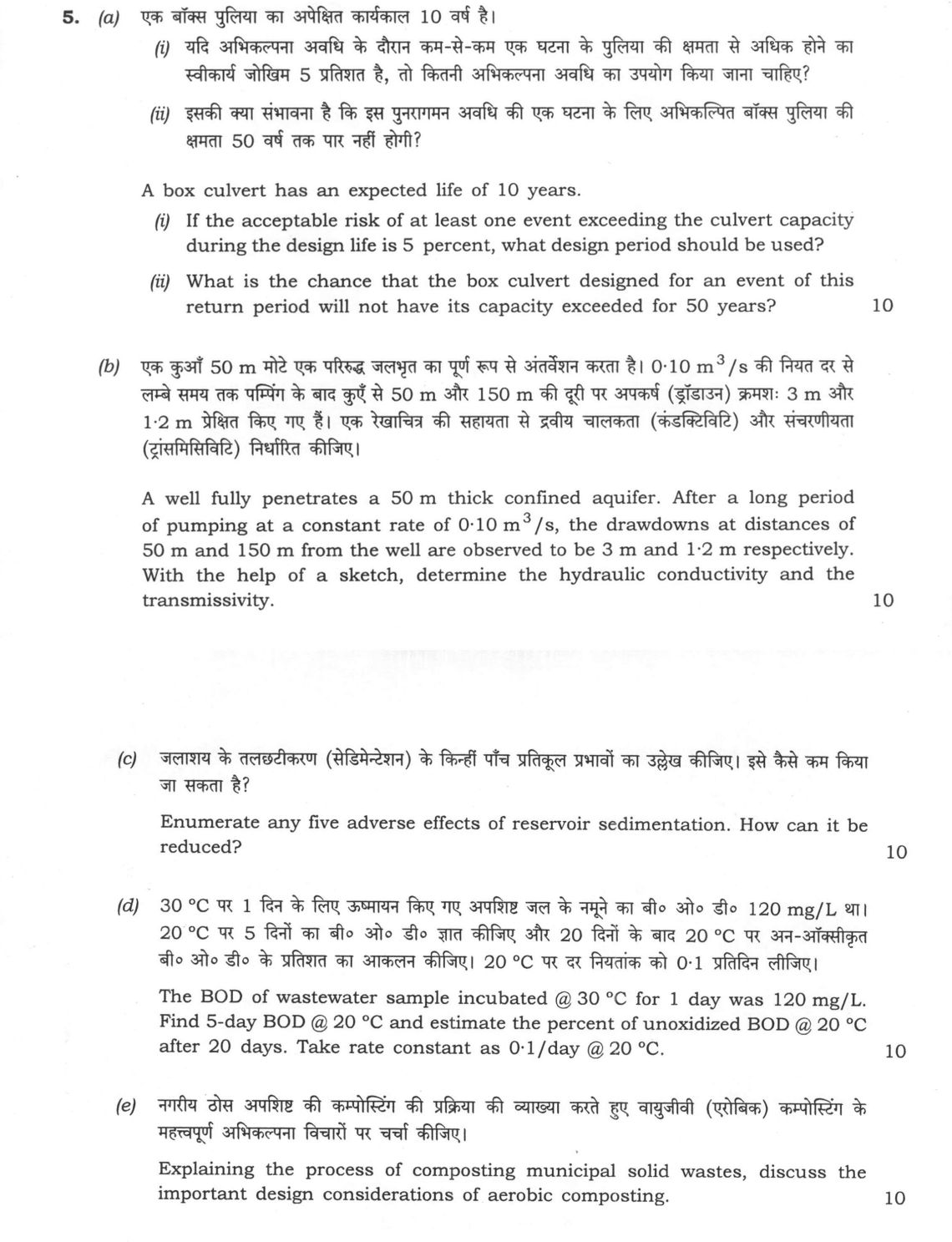
(a) A box culvert has an expected life of 10 years. (i) If the acceptable risk of at least one event exceeding the culvert…
A box culvert has an expected life of 10 years.
If the acceptable risk of at least one event exceeding the culvert capacity during the design life is 5 percent, what design period should be used?
What is the chance that the box culvert designed for an event of this return period will not have its capacity exceeded for 50 years?
10
A well fully penetrates a 50 m thick confined aquifer. After a long period of pumping at a constant rate of 0·10 m³/s, the drawdowns at distances of 50 m and 150 m from the well are observed to be 3 m and 1·2 m respectively. With the help of a sketch, determine the hydraulic conductivity and the transmissivity.
10
Enumerate any five adverse effects of reservoir sedimentation. How can it be reduced?
10
The BOD of wastewater sample incubated @ 30 °C for 1 day was 120 mg/L. Find 5-day BOD @ 20 °C and estimate the percent of unoxidized BOD @ 20 °C after 20 days. Take rate constant as 0·1/day @ 20 °C.
10
Explaining the process of composting municipal solid wastes, discuss the important design considerations of aerobic composting.
10
हिंदी में प्रश्न पढ़ें
एक बॉक्स पुलिया का अपेक्षित कार्यकाल 10 वर्ष है।
यदि अभिकल्पना अवधि के दौरान कम-से-कम एक घटना के पुलिया की क्षमता से अधिक होने का स्वीकार्य जोखिम 5 प्रतिशत है, तो कितनी अभिकल्पना अवधि का उपयोग किया जाना चाहिए?
इसकी क्या संभावना है कि इस पुनरागमन अवधि की एक घटना के लिए अभिकल्पित बॉक्स पुलिया की क्षमता 50 वर्ष तक पार नहीं होगी?
10
एक कुआँ 50 m मोटे एक परिरुद्ध जलभृत का पूर्ण रूप से अंतर्वेशन करता है। 0·10 m³/s की नियत दर से लम्बे समय तक पम्पिंग के बाद कुएँ से 50 m और 150 m की दूरी पर अपकर्ष (ड्रॉडाउन) क्रमशः 3 m और 1·2 m प्रेक्षित किए गए हैं। एक रेखाचित्र की सहायता से द्रवीय चालकता (कंडिक्टिविटी) और संचरणीयता (ट्रांसमिसिविटी) निर्धारित कीजिए।
10
जलाशय के तलछटीकरण (सेडिमेंटेशन) के किन्हीं पाँच प्रतिकूल प्रभावों का उल्लेख कीजिए। इसे कैसे कम किया जा सकता है?
10
30 °C पर 1 दिन के लिए उष्मायन किए गए अपशिष्ट जल के नमूने का बी० ओ० डी० 120 mg/L था। 20 °C पर 5 दिनों का बी० ओ० डी० ज्ञात कीजिए और 20 दिनों के बाद 20 °C पर अन-ऑक्सीकृत बी० ओ० डी० के प्रतिशत का आकलन कीजिए। 20 °C पर दर नियतांक को 0·1 प्रतिदिन लीजिए।
10
नगरीय ठोस अपशिष्ट की कम्पोस्टिंग की प्रक्रिया की व्याख्या करते हुए वायुजीवी (एरोबिक) कम्पोस्टिंग के महत्वपूर्ण अभिकल्पना विचारों पर चर्चा कीजिए।
10
Model answer
Written by UPSC Answer Check against this question's marking rubric, to the expected length. UPSC does not publish answers for Mains — this is one way to score well, not an official key.
(a)(i) Let T be the design return period in years and n = 10 years the expected life. For independent annual exceedance events, the risk of at least one event exceeding the culvert capacity is R = 1 − (1 − 1/T)ⁿ. Given R = 0.05 and n = 10: (1 − 1/T)¹⁰ = 0.95. So 1 − 1/T = 0.95^(1/10) = exp(ln 0.95 / 10) = exp(−0.051293/10) = 0.994884. Thus 1/T = 1 − 0.994884 = 0.005116. T = 1/0.005116 = 195.46 years. Design return period T ≈ 195.46 years, say 195.5 years.
(a)(ii) For T = 195.46 years, the annual non-exceedance probability is 1 − 1/T = 0.994884. The probability that capacity is not exceeded for 50 years is P(no exceedance in 50 years) = (1 − 1/T)⁵⁰ = (0.95^(1/10))⁵⁰ = 0.95⁵. 0.95⁵ = 0.7737809375. Chance of not exceeding capacity in 50 years = 77.38%. Chance of at least one exceedance = 22.62%.
(b) Sketch (vertical section, not to scale): `` Initial piezometric surface ─────────────────────────────── s₁=3 m ↓ s₂=1.2 m ↓ Pumping well | r₁=50 m | r₂=150 m ──────────────────────────────────────────────── Impervious layer ──────────────────────────────────────────────── Confined aquifer, thickness b = 50 m ──────────────────────────────────────────────── Impervious layer `` For steady radial flow to a fully penetrating well in a confined homogeneous aquifer, the Thiem equation is s₁ − s₂ = Q/(2πT) · ln(r₂/r₁). Therefore T = Q · ln(r₂/r₁) / [2π(s₁ − s₂)]. Given Q = 0.10 m³/s, r₁ = 50 m, r₂ = 150 m, s₁ = 3 m, s₂ = 1.2 m, b = 50 m. s₁ − s₂ = 3 − 1.2 = 1.8 m. r₂/r₁ = 150/50 = 3. T = 0.10 × ln 3 / (2π × 1.8) = 0.10 × 1.098612 / 11.309733 = 9.714 × 10⁻³ m²/s. Hydraulic conductivity K = T/b: K = 9.714 × 10⁻³ / 50 = 1.943 × 10⁻⁴ m/s. In m/day: K = 1.943 × 10⁻⁴ × 86400 = 16.79 m/day. K ≈ 1.94 × 10⁻⁴ m/s ≈ 16.8 m/day; T ≈ 9.71 × 10⁻³ m²/s. Condition of validity: steady state, confined aquifer, fully penetrating well, homogeneous and isotropic aquifer, constant thickness, and Darcy flow.
(c) Five adverse effects of reservoir sedimentation:
- Loss of live storage capacity, reducing water supply, irrigation, hydropower generation, and flood moderation.
- Upstream aggradation and rise in backwater levels, causing flooding, waterlogging, and river-bed rise.
- Delta formation at the reservoir head and deposition in navigation channels, obstructing navigation and increasing dredging.
- Downstream channel degradation, bank erosion, and ecological disturbance due to sediment-starved releases.
- Abrasion and erosion of turbines, pumps, gates, valves, and outlet works, increasing maintenance and reducing efficiency.
Reservoir sedimentation can be reduced by:
- Catchment-area treatment: soil conservation, contour bunding, check dams, afforestation, vegetated buffers, and stream-bank stabilisation.
- Sediment traps and detention basins upstream, plus bypass channels or tunnels to divert sediment-laden flows.
- Reservoir operation measures: sluicing, density-current venting, drawdown flushing, and low-level outlet operation.
- Dredging, hydro-suction, siphoning, and mechanical removal of deposited sediment.
- Proper design with allocated dead storage for sediment, multiple outlets, and sediment-pass-through facilities. Integrated watershed management plus sediment routing/flushing is the most sustainable reduction strategy.
(d) Using the standard base-10 BOD equation used in Indian practice: BOD_t = L₀[1 − 10^(−k t)], where L₀ is ultimate BOD. Temperature correction: k_T = k₂₀ θ^(T−20), with θ = 1.047. Given k₂₀ = 0.1/day at 20°C. At 30°C: k₃₀ = 0.1 × 1.047¹⁰ = 0.1583/day. At 30°C for 1 day, BOD₁ = 120 mg/L: 120 = L₀[1 − 10^(−0.1583 × 1)]. 10^(−0.1583) = 0.6946. 1 − 0.6946 = 0.3054. L₀ = 120/0.3054 = 392.9 mg/L. Now BOD₅ at 20°C: BOD₅ = 392.9[1 − 10^(−0.1 × 5)] = 392.9[1 − 10^(−0.5)] = 392.9[1 − 0.3162] = 392.9 × 0.6838 = 268.6 mg/L. Unoxidized BOD after 20 days at 20°C: Remaining = L₀ × 10^(−0.1 × 20) = L₀ × 10^(−2) = 0.01 L₀. Percent unoxidized = (0.01 L₀/L₀) × 100 = 1.00%. 5-day BOD at 20°C ≈ 268.6 mg/L; unoxidized BOD after 20 days = 1.00%, i.e. about 99.00% oxidised.
(e) Composting of municipal solid waste is the controlled aerobic biological decomposition of organic matter by bacteria, fungi, and actinomycetes into a stable humus-like material. The organic fraction is first segregated to remove plastics, metals, glass, and inerts. It is shredded and mixed with bulking agents to adjust moisture, porosity, and C/N ratio. In the presence of oxygen, microorganisms oxidise organic matter: organic matter + O₂ → CO₂ + H₂O + heat + compost. The process passes through mesophilic, thermophilic (about 55–65°C), cooling, and maturation phases. Aeration is provided by turning windrows, forced aeration in static piles, or in-vessel reactors. The thermophilic phase destroys pathogens and weed seeds, while the maturation phase stabilises the product.
Important design considerations of aerobic composting:
- C/N ratio: optimum about 25–30:1. High carbon slows decomposition; low carbon causes ammonia loss and odour.
- Moisture content: maintain about 50–60%. Too dry stops microbial activity; too wet causes anaerobic conditions.
- Aeration and oxygen: maintain oxygen above about 5–10%. Aeration controls temperature, moisture, and odour and is achieved by turning, forced air, or proper porosity.
- Temperature: keep 55–65°C for effective pathogen destruction; avoid exceeding about 70°C, which kills beneficial microbes.
- Particle size and porosity: 25–75 mm is generally suitable; bulking agents such as wood chips improve air flow.
- pH: maintain about 6.5–8.0; lime may be added if the waste is too acidic.
- Retention time: active composting for about 3–6 weeks, followed by maturation for 2–4 weeks or more.
- Pile/reactor design: windrow height, width, base slope, drainage, leachate collection, and turning equipment must be designed for the waste quantity and climate.
- Environmental control: manage leachate, odour, vectors, runoff, and gas emissions; provide buffer zones and proper siting. Thus aerobic composting requires careful control of C/N ratio, moisture, oxygen, temperature, particle size, pH, and retention time to produce stable, pathogen-free compost.
What "Solve" is asking you to do
Choose the method, then carry it through to a final answer. Identifying what kind of problem this is and why that method applies is the first thing marked; a correct figure arrived at invisibly earns almost nothing.
Structure that answers it
Given data and what is required → method chosen, with the reason it applies → set-up (equation, circuit, free body, trial balance) → working, step by step → answer with units and any condition of validity
Where marks are lost
Doing the middle steps mentally and writing only the result. In mathematics papers, a further loss comes from giving a decimal where the exact value in surds or fractions was wanted, or from skipping the justification a part explicitly asks for.
How this answer will be evaluated
Approach
(a(i)) calculate: given > formula > substitution > result with units > interpretation | (a(ii)) calculate: given > formula > substitution > result with units > interpretation | (b) calculate: given > formula > substitution > result with units > interpretation | (c) enumerate: list the items in order > one line each > no commentary | (d) calculate: given > formula > substitution > result with units > interpretation | (e) discuss: intro > 3-4 dimensions > example > balanced close Full marks: All parts show complete working with correct formulas, units, and assumptions; sketches where required; no arithmetic errors.
Key points expected
- State design life T = 10 years
- State risk p = 0.05
- Apply formula p = 1 - (1 - 1/T_r)^n
- Solve for return period T_r
- Use T_r from part (i)
- Set n = 50 years
- Apply formula P = (1 - 1/T_r)^n
- Calculate final probability
Evaluation rubric
Each sub-part is marked on its own, against the marks and word limit printed on the paper.
- (a(i)) Determine the design period (return period) for a 10-year life with 5% risk.
calculate— given → formula → substitution → result with units → interpretation
Must cover
- State design life T = 10 years
- State risk p = 0.05
- Apply formula p = 1 - (1 - 1/T_r)^n
- Solve for return period T_r
Loses marks
- Using wrong probability formula
- Confusing risk with reliability
Earns more
- Show intermediate calculation steps
- State final T_r with units (years)
Extra mark
- Mention standard design period tables
- (a(ii)) Calculate probability of no exceedance for 50 years using the T_r from (i).
calculate— given → formula → substitution → result with units → interpretation
Must cover
- Use T_r from part (i)
- Set n = 50 years
- Apply formula P = (1 - 1/T_r)^n
- Calculate final probability
Loses marks
- Using wrong T_r value
- Arithmetic error in exponentiation
Earns more
- Express result as percentage
- Compare with 50-year design life
Extra mark
- Discuss implications for long-term safety
- (b) Determine hydraulic conductivity and transmissivity of a confined aquifer. 10 marks
calculate— given → formula → substitution → result with units → interpretation
Must cover
- State Theis or Dupuit formula for confined aquifer
- List given: Q, r1, r2, s1, s2, b
- Calculate K using drawdown difference
- Calculate T = K * b
Loses marks
- Using unconfined aquifer formula
- Omitting units in final answer
Earns more
- Draw labelled sketch of well and aquifer
- Show units in every step
- Verify T = K*b consistency
Extra mark
- Mention assumptions of steady-state flow
- Reference IS code for aquifer testing
- (c) List five adverse effects of reservoir sedimentation and reduction methods. 10 marks
enumerate— list the items in order → one line each → no commentary
Must cover
- List exactly five distinct adverse effects
- Each effect in one line
- Provide at least one reduction method
- No commentary beyond list
Loses marks
- Listing more than five effects
- Vague or generic reduction methods
Earns more
- Effects ordered by severity
- Reduction method linked to specific effect
Extra mark
- Mention specific dam case study
- Reference IS code on sediment management
- (d) Find 5-day BOD at 20°C and percent unoxidized BOD after 20 days. 10 marks
calculate— given → formula → substitution → result with units → interpretation
Must cover
- State given: BOD_1d@30C = 120 mg/L, k@20C = 0.1/day
- Convert BOD to 20°C using temperature correction
- Calculate BOD_5d@20C using first-order kinetics
- Calculate % unoxidized BOD at 20 days
Loses marks
- Ignoring temperature correction
- Using wrong rate constant
Earns more
- Show temperature correction formula
- Use correct k value for 20°C
- Express final % with 2 decimal places
Extra mark
- Mention standard BOD test procedure
- Reference IS 10500 for BOD calculation
- (e) Explain composting process and design considerations for aerobic composting. 10 marks
discuss— intro → 3-4 dimensions → example → balanced close
Must cover
- Define aerobic composting process
- List 3-4 key design considerations
- Explain each consideration briefly
- Mention one practical example
Loses marks
- Confusing aerobic with anaerobic
- Omitting key design parameters
Earns more
- Include C:N ratio, moisture, aeration
- Reference IS code for composting
- Mention temperature control
Extra mark
- Draw simple composting unit sketch
- Mention specific municipal waste composition
Practice this exact question
Write your answer and it is marked point by point against the model answer above — what you covered, what you missed, what you got wrong.
Evaluate my answer →More from Civil Engineering 2025 Paper II
- Q2 (a) A contractor intends to bid for erecting a statue at a square in an urban area. The v…
- Q3 (a) (i) Observations were made with a theodolite from the points A and B of baseline AB h…
- Q4 (a) Compare the application of 'straight blade' and 'angle blade' of bulldozers for earth…
- Q5 (a) A box culvert has an expected life of 10 years. (i) If the acceptable risk of at leas…
- Q6 (a) A storm over a catchment of area 5 km² had a duration of 14 hours. The mass curve of…
- Q7 (a) The data related to the activated sludge process is given below: Population = 500000…
- Q8 (a) The figure shows an overflow spillway which is 40 m high. At the design energy head o…