Paper I — Q8
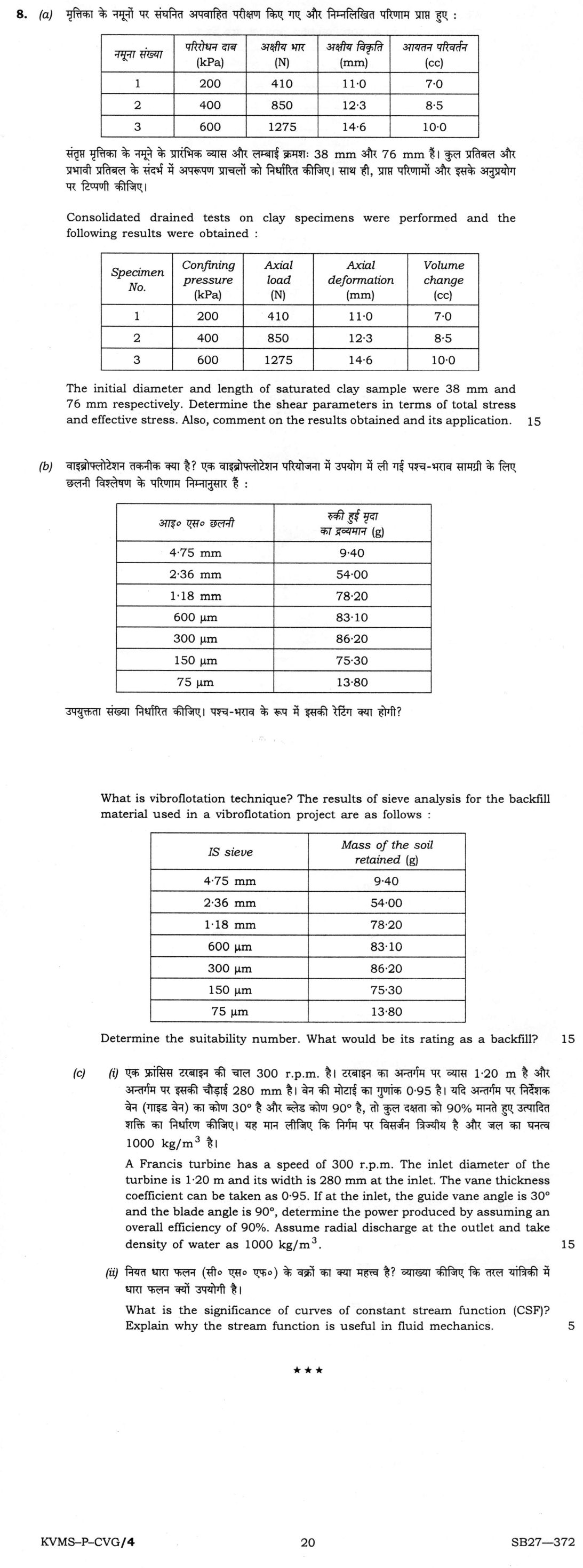
(a) Consolidated drained tests on clay specimens were performed and the following results were obtained : Specimen No. |…
Consolidated drained tests on clay specimens were performed and the following results were obtained :
Specimen No. | Confining pressure (kPa) | Axial load (N) | Axial deformation (mm) | Volume change (cc) 1 | 200 | 410 | 11·0 | 7·0 2 | 400 | 850 | 12·3 | 8·5 3 | 600 | 1275 | 14·6 | 10·0
The initial diameter and length of saturated clay sample were 38 mm and 76 mm respectively. Determine the shear parameters in terms of total stress and effective stress. Also, comment on the results obtained and its application. 15 marks
What is vibroflotation technique? The results of sieve analysis for the backfill material used in a vibroflotation project are as follows :
IS sieve | Mass of the soil retained (g) 4·75 mm | 9·40 2·36 mm | 54·00 1·18 mm | 78·20 600 μm | 83·10 300 μm | 86·20 150 μm | 75·30 75 μm | 13·80
Determine the suitability number. What would be its rating as a backfill? 15 marks
A Francis turbine has a speed of 300 r.p.m. The inlet diameter of the turbine is 1·20 m and its width is 280 mm at the inlet. The vane thickness coefficient can be taken as 0·95. If at the inlet, the guide vane angle is 30° and the blade angle is 90°, determine the power produced by assuming an overall efficiency of 90%. Assume radial discharge at the outlet and take density of water as 1000 kg/m³. 15 marks
What is the significance of curves of constant stream function (CSF)? Explain why the stream function is useful in fluid mechanics. 5 marks
हिंदी में प्रश्न पढ़ें
मृत्तिका के नमूनों पर संघनित अपवाहित परीक्षण किए गए और निम्नलिखित परिणाम प्राप्त हुए :
नमूना संख्या | परिरोधन दाब (kPa) | अक्षीय भार (N) | अक्षीय विकृति (mm) | आयतन परिवर्तन (cc) 1 | 200 | 410 | 11·0 | 7·0 2 | 400 | 850 | 12·3 | 8·5 3 | 600 | 1275 | 14·6 | 10·0
संतृप्त मृत्तिका के नमूने के प्रारंभिक व्यास और लम्बाई क्रमशः 38 mm और 76 mm हैं। कुल प्रतिबल और प्रभावी प्रतिबल के संदर्भ में अपरूपण प्राचलों को निर्धारित कीजिए। साथ ही, प्राप्त परिणामों और इसके अनुप्रयोग पर टिप्पणी कीजिए। (15 अंक)
वाइब्रोफ्लोटेशन तकनीक क्या है? एक वाइब्रोफ्लोटेशन परियोजना में उपयोग में ली गई पश्च-भार सामग्री के लिए छलनी विश्लेषण के परिणाम निम्नानुसार हैं :
आई० एस० छलनी | रुकी हुई मृदा का द्रव्यमान (g) 4·75 mm | 9·40 2·36 mm | 54·00 1·18 mm | 78·20 600 µm | 83·10 300 µm | 86·20 150 µm | 75·30 75 µm | 13·80
उपयुक्तता संख्या निर्धारित कीजिए। पश्च-भार के रूप में इसकी रेटिंग क्या होगी? (15 अंक)
एक फ्रांसिस टरबाइन की चाल 300 r.p.m. है। टरबाइन का अन्तर्गम पर व्यास 1·20 m है और अन्तर्गम पर इसकी चौड़ाई 280 mm है। वेन की मोटाई का गुणांक 0·95 है। यदि अन्तर्गम पर निर्देशक वेन (गाइड वेन) का कोण 30° है और ब्लेड कोण 90° है, तो कुल दक्षता को 90% मानते हुए उत्पादित शक्ति का निर्धारण कीजिए। यह मान लीजिए कि निर्गम पर विसर्जन त्रिल्यीय है और जल का घनत्व 1000 kg/m³ है। (15 अंक)
नियत धारा फलन (सी० एस० एफ०) के वक्रों का क्या महत्व है? व्याख्या कीजिए कि तरल यांत्रिकी में धारा फलन क्यों उपयोगी है। (5 अंक)
Model answer
Drafted with AI by UPSC Answer Check against this question's marking rubric, to the expected length. UPSC does not publish answers for Mains — this is one way to score well, not an official key. How we build rubrics and answers.
(a) Consolidated drained triaxial tests on clay (15 marks)
The initial area is A₀ = π/4 × 38² = 1134.1 mm² and the initial length L₀ = 76 mm, so V₀ = 1134.1 × 76 = 86.19 cc. In a drained test the volume change is decreasing, so the corrected area at failure is
A = A₀ (1 − ΔV/V₀)/(1 − ΔL/L₀)
- Test 1: A = 1134.1 × (1 − 7.0/86.19)/(1 − 11.0/76) = 1134.1 × 0.9188/0.8553 = 1218.3 mm². Deviator stress σ_d = 410/1218.3 = 0.3365 N/mm² = 336.5 kPa, so σ₁ = 200 + 336.5 = 536.5 kPa.
- Test 2: A = 1134.1 × (1 − 8.5/86.19)/(1 − 12.3/76) = 1134.1 × 0.9014/0.8382 = 1219.7 mm². σ_d = 850/1219.7 = 696.9 kPa, so σ₁ = 400 + 696.9 = 1096.9 kPa.
- Test 3: A = 1134.1 × (1 − 10.0/86.19)/(1 − 14.6/76) = 1134.1 × 0.8840/0.8079 = 1240.9 mm². σ_d = 1275/1240.9 = 1027.5 kPa, so σ₁ = 600 + 1027.5 = 1627.5 kPa.
The tests are drained, so the pore pressure is zero at failure: effective stresses equal total stresses (σ′₃ = σ₃ and σ′₁ = σ₁), and the total-stress and effective-stress parameters are identical.
Shear parameters. Plotting the Mohr circles (σ₃, σ₁) gives a straight envelope through the origin. On the p–q plot, p = (σ₁ + σ₃)/2 = 368.3, 748.5 and 1113.7 kPa and q = (σ₁ − σ₃)/2 = 168.3, 348.5 and 513.7 kPa. The best-fit line q = a + p tan α has tan α = sin φ′ = 0.463, so φ′ = 27.6°, with an intercept of about −1 kPa, so c′ ≈ 0. Each test alone gives φ′ = sin⁻¹[(σ₁ − σ₃)/(σ₁ + σ₃)] = 27.2°, 27.7° and 27.5°. Thus
c′ = c_d = 0, φ′ = φ_d ≈ 27.6° (total-stress values c = 0, φ = 27.6°, since u = 0).

Comment and application. The zero cohesion intercept shows a normally consolidated clay, with strength coming entirely from friction. The three φ values agree closely, so the tests are consistent and the envelope is linear over 200–600 kPa. These drained parameters govern long-term stability, when excess pore pressure has dissipated: cuts and natural slopes in clay, embankments after consolidation, and the long-term pressure on retaining walls and foundations. They do not apply to end-of-construction (undrained) conditions, for which c_u or the CU test with pore pressure measurement is used. The CD test is slow, taking days for a clay, because the shearing rate must allow full drainage.
(b) Vibroflotation and suitability number of the backfill (15 marks)
Vibroflotation. Vibroflotation is a ground-improvement method for densifying loose, clean, cohesionless soil (sand and gravel). The vibroflot is a cylindrical probe about 2 m long and 0.3–0.4 m in diameter, with an eccentric weight that gives horizontal vibrations, and water jets at the tip. It is lowered under its own weight and the jets to the required depth, up to about 15–20 m. It is then withdrawn in 0.3–0.5 m steps, holding at each step while coarse backfill is fed from the surface into the crater it makes. The vibration rearranges the grains into a denser state and the backfill fills the hole, so the ground is densified in a radius of about 1.5–2.5 m from each probe. Probes are placed on a triangular or square grid. The method raises relative density, bearing capacity, and resistance to settlement and liquefaction. It is unsuitable for soils with more than about 15–20% fines. For soft clays, the same equipment is used with stone backfill as vibro-replacement, forming stone columns.
Suitability number. The total mass is 9.4 + 54.0 + 78.2 + 83.1 + 86.2 + 75.3 + 13.8 = 400 g. The cumulative percentage finer is
- 4.75 mm: 97.65%
- 2.36 mm: 84.15%
- 1.18 mm: 64.60%
- 0.600 mm: 43.83%
- 0.300 mm: 22.28%
- 0.150 mm: 3.45%
- 0.075 mm: 0% (nothing finer than 75 μm remains after the last sieve)
Interpolating on the semilog grading curve:
- D₁₀ lies between 0.150 mm (3.45%) and 0.300 mm (22.28%): D₁₀ ≈ 0.191 mm.
- D₂₀ lies in the same interval: D₂₀ ≈ 0.276 mm.
- D₅₀ lies between 0.600 mm and 1.18 mm: D₅₀ ≈ 0.734 mm.
The suitability number is
SN = 1.7 √(3/D₅₀² + 1/D₂₀² + 1/D₁₀²) = 1.7 √(3/0.538 + 1/0.0761 + 1/0.0364)
SN = 1.7 √(5.57 + 13.14 + 27.4) = 1.7 × 6.79 ≈ 11.5
Rating. The Brown rating scale is: 0–10 excellent, 10–20 good, 20–30 fair, 30–50 poor, above 50 unsuitable. An SN of about 11.5 lies in the 10–20 band, so the backfill is rated good, close to the excellent boundary.
(c)(i) Francis turbine: inlet triangle, discharge and power (15 marks)
Inlet blade speed u₁ = πD₁N/60 = π × 1.20 × 300/60 = 18.85 m/s.
Inlet velocity triangle. The blade angle at inlet is 90°, so the relative velocity is radial and the whirl velocity equals the blade speed: V_w1 = u₁ = 18.85 m/s. The guide vane angle is α₁ = 30°, so the flow velocity is V_f1 = V_w1 tan 30° = 18.85 × 0.5774 = 10.88 m/s. The absolute velocity is V₁ = V_w1/cos 30° = 21.77 m/s.
Discharge. With the vane thickness coefficient k = 0.95: Q = k π D₁ B₁ V_f1 = 0.95 × π × 1.20 × 0.28 × 10.88 = 10.91 m³/s.
Work done. The discharge at the outlet is radial, so V_w2 = 0 and the work done on the runner per unit weight of water is V_w1 u₁/g = 18.85²/9.81 = 36.2 m. The power developed by the runner is
P_runner = ρQ V_w1 u₁ = 1000 × 10.91 × 18.85 × 18.85 = 3.88 × 10⁶ W = 3.88 MW.
Power produced. With the overall efficiency of 90%: P = 0.90 × 3.88 = 3.49 MW ≈ 3.5 MW.
(c)(ii) Curves of constant stream function (5 marks)
Significance. For two-dimensional incompressible flow, the stream function ψ(x, y) is defined by u = ∂ψ/∂y and v = −∂ψ/∂x. A curve ψ = constant is a streamline: the velocity is tangent to it and no fluid crosses it. The difference in ψ between two streamlines equals the volume flow per unit depth between them.
Why it is useful. The stream function satisfies continuity automatically, so it reduces the two velocity unknowns to one. For irrotational flow ψ satisfies Laplace's equation, is orthogonal to the equipotential lines of the velocity potential (which gives the flow net), and obeys linear superposition, so uniform flow, sources, sinks, vortices and doublets can be combined to model flow past bodies. A solid boundary is a streamline, which makes boundary conditions simple. Closely spaced streamlines show high velocity, so a plot of ψ gives a picture of the flow field.
How this answer will be evaluated
Evaluation rubric
Each sub-part is marked on its own, against the marks and word limit printed on the paper.
- (a) From three consolidated drained triaxial tests, compute the corrected areas and principal stresses at failure, the shear strength parameters in terms of total and effective stress, and comment on the results and their application. 15 marks
Must cover
- Corrected area A = A₀(1 − ΔV/V₀)/(1 − ΔL/L₀): 1218, 1220 and 1241 mm² with V₀ = 86.19 cc
- Failure stresses σ₁ = 536.5, 1096.9 and 1627.5 kPa for σ₃ = 200, 400 and 600 kPa
- Drained tests, u = 0, so total = effective; c′ ≈ 0 and φ′ ≈ 27.6° from the Mohr envelope or p–q line
- Comment: normally consolidated clay; use for long-term (drained) stability of slopes, embankments and walls
Loses marks
- Using the initial area without correction.
- Treating the volume change as an increase.
- Giving different total and effective parameters for a drained test.
Earns more
- Mohr circles or the p–q plot shown.
- Distinction from undrained conditions.
Extra mark
- Slow shearing rate required for full drainage
- (b) Explain vibroflotation and compute the suitability number of the backfill from the sieve analysis, stating its rating. 15 marks
Must cover
- Vibroflotation: vibrating probe with water jets, withdrawn in stages while coarse backfill is added; densifies clean sands and gravel over a 1.5–2.5 m radius
- Cumulative percentage finer from the retained masses (total 400 g); D₁₀ ≈ 0.19, D₂₀ ≈ 0.28, D₅₀ ≈ 0.73 mm
- SN = 1.7√(3/D₅₀² + 1/D₂₀² + 1/D₁₀²) ≈ 11.5
- Rating good (SN 10–20)
Loses marks
- Using percentage retained instead of percentage finer for the D sizes.
- Wrong formula, or omitting the factor 1.7.
- Rating the backfill as excellent or fair.
Earns more
- Rating scale stated (0–10 excellent, 10–20 good, 20–30 fair, 30–50 poor, over 50 unsuitable).
- Limit on fines and the vibro-replacement variant for clays.
Extra mark
- Grading curve sketched on the semilog scale
- (c)(i) For the Francis turbine (90° blade angle, 30° guide vane, D₁ = 1.20 m, B₁ = 280 mm, N = 300 rpm, k = 0.95, radial outlet, η₀ = 90%) find the inlet triangle, discharge, work done and power. 15 marks
Must cover
- u₁ = 18.85 m/s; V_w1 = u₁ (β = 90°); V_f1 = V_w1 tan 30° = 10.88 m/s; V₁ = 21.77 m/s
- Q = kπD₁B₁V_f1 = 10.91 m³/s
- Work done V_w1u₁/g = 36.2 m and runner power ρQV_w1u₁ = 3.88 MW (V_w2 = 0)
- Power produced at 90% = 3.49 MW
Loses marks
- Taking V_w1 as V_f1/tan α or the wrong triangle.
- Omitting the factor 0.95 in Q.
- Applying 90% to the wrong quantity or omitting it.
Earns more
- Velocity triangle sketched or described.
- Vane thickness coefficient applied in the discharge.
Extra mark
- Head equivalent of the work done, 36.2 m
- (c)(ii) State the significance of curves of constant stream function and explain why the stream function is useful in fluid mechanics. 5 marks
Must cover
- ψ = constant curves are streamlines: velocity is tangential and no flow crosses them
- Difference in ψ between two streamlines = volume flow per unit depth
- Velocity components u = ∂ψ/∂y, v = −∂ψ/∂x; continuity satisfied automatically for 2-D incompressible flow
- Uses: flow nets with the potential function, superposition for flow past bodies, solid boundaries as streamlines
Loses marks
- Calling ψ = constant lines equipotential lines.
- Stating that ψ exists for any 3-D flow.
- Listing uses without a link to continuity or flow nets.
Earns more
- Laplace equation for irrotational flow.
- Spacing of streamlines indicating velocity.
Extra mark
- Existence of ψ only for 2-D (or axisymmetric) incompressible flow
What "Calculate" is asking you to do
Apply the standard formula or schedule to data the question has already supplied — a table of readings, cost records, a balance sheet — and produce the number. The method is rarely in doubt; the marks sit in the named intermediate quantities, each of which has to appear as a labelled line.
Structure that answers it
Data as given → formula or standard treatment, named → substitution → each intermediate, labelled → result with units
Where marks are lost
Omitting an intermediate the marking scheme pays for separately, or rounding at an intermediate line so the final figure drifts. In commerce and accountancy, any figure in a statement that no numbered working note supports is treated as unearned.
Practice this exact question
Write your answer and it is marked point by point against the model answer above — what you covered, what you missed, what you got wrong.
Evaluate my answer →More from Civil Engineering 2026 Paper I
- Q5 (a) A free jet of water with constant cross-section area of 0·01 m² is deflected by a hin…
- Q6 (a) Assuming the law for the velocity distribution in the boundary layer as $\dfrac{v}{V}…
- Q7 (a) The data with respect to a normally consolidated clay are as follows : Thickness of t…
- Q8 (a) Consolidated drained tests on clay specimens were performed and the following results…