Paper I — Q6
(a) Assuming the law for the velocity distribution in the boundary layer as v/V = 2(y/(δ)) - (y/(δ))², derive an expression for…
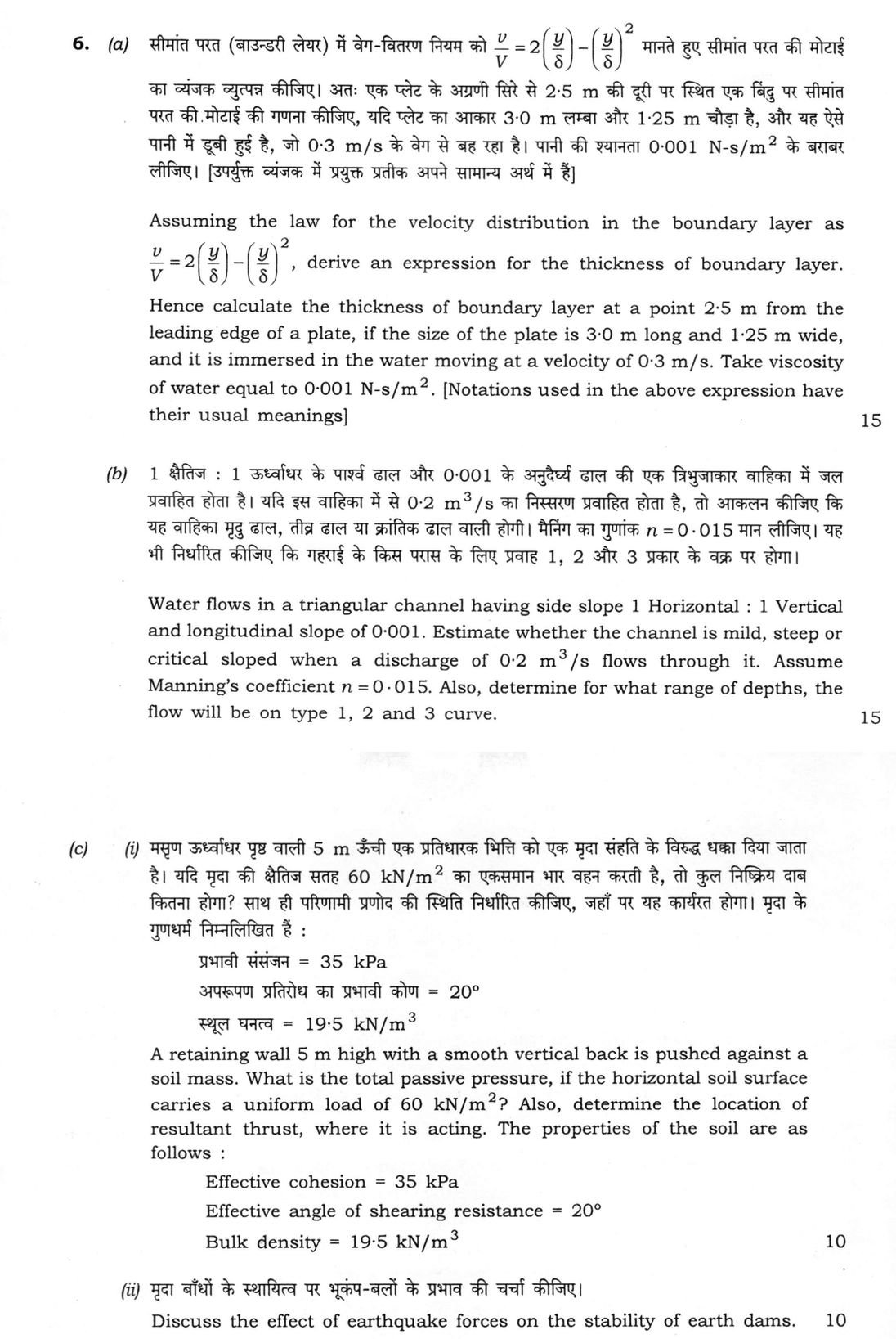
Assuming the law for the velocity distribution in the boundary layer as v/V = 2(y/(δ)) - (y/(δ))², derive an expression for the thickness of boundary layer. Hence calculate the thickness of boundary layer at a point 2.5 m from the leading edge of a plate, if the size of the plate is 3.0 m long and 1.25 m wide, and it is immersed in the water moving at a velocity of 0.3 m/s. Take viscosity of water equal to 0.001 N-s/m². [Notations used in the above expression have their usual meanings] 15 marks
Water flows in a triangular channel having side slope 1 Horizontal : 1 Vertical and longitudinal slope of 0.001. Estimate whether the channel is mild, steep or critical sloped when a discharge of 0.2 m³/s flows through it. Assume Manning's coefficient n = 0.015. Also, determine for what range of depths, the flow will be on type 1, 2 and 3 curve. 15 marks
A retaining wall 5 m high with a smooth vertical back is pushed against a soil mass. What is the total passive pressure, if the horizontal soil surface carries a uniform load of 60 kN/m²? Also, determine the location of resultant thrust, where it is acting. The properties of the soil are as follows : Effective cohesion = 35 kPa Effective angle of shearing resistance = 20° Bulk density = 19·5 kN/m³ 10 marks
Discuss the effect of earthquake forces on the stability of earth dams. 10 marks
हिंदी में प्रश्न पढ़ें
सीमांत परत (बाउन्डरी लेयर) में वेग-वितरण नियम को v/V = 2(y/(δ)) - (y/(δ))² मानते हुए सीमांत परत की मोटाई का व्यंजक व्युत्पन्न कीजिए। अतः एक प्लेट के अग्रणी सिरे से 2.5 m की दूरी पर स्थित एक बिंदु पर सीमांत परत की मोटाई की गणना कीजिए, यदि प्लेट का आकार 3.0 m लम्बा और 1.25 m चौड़ा है, और यह ऐसे पानी में डूबी हुई है, जो 0.3 m/s के वेग से बह रहा है। पानी की श्यानता 0.001 N-s/m² के बराबर लीजिए। [उपर्युक्त व्यंजक में प्रयुक्त प्रतीक अपने सामान्य अर्थ में हैं] (15 अंक)
1 क्षैतिज : 1 ऊर्ध्वाधर के पार्श्व ढाल और 0.001 के अनुदैर्घ्य ढाल की एक त्रिभुजाकार वाहिका में जल प्रवाहित होता है। यदि इस वाहिका में से 0.2 m³/s का निस्सरण प्रवाहित होता है, तो आकलन कीजिए कि यह वाहिका मृदु ढाल, तीव्र ढाल या क्रांतिक ढाल वाली होगी। मैनिंग का गुणांक n = 0.015 मान लीजिए। यह भी निर्धारित कीजिए कि गहराई के किस परास के लिए प्रवाह 1, 2 और 3 प्रकार के वक्र पर होगा। (15 अंक)
मृदा ऊर्ध्वाधर पृष्ठ वाली 5 m ऊँची एक प्रतिधारक भित्ति को एक मृदा संहति के विरुद्ध धका दिया जाता है। यदि मृदा की क्षैतिज सतह 60 kN/m² का एकसमान भार वहन करती है, तो कुल निष्क्रिय दाब कितना होगा? साथ ही परिणामी प्रणोद की स्थिति निर्धारित कीजिए, जहाँ पर यह कार्यरत होगा। मृदा के गुणधर्म निम्नलिखित हैं : प्रभावी संसंजन = 35 kPa अपरूपण प्रतिरोध का प्रभावी कोण = 20° स्थूल घनत्व = 19·5 kN/m³ (10 अंक)
मृदा बाँधों के स्थायित्व पर भूकंप-बलों के प्रभाव की चर्चा कीजिए। (10 अंक)
Model answer
Drafted with AI by UPSC Answer Check against this question's marking rubric, to the expected length. UPSC does not publish answers for Mains — this is one way to score well, not an official key. How we build rubrics and answers.
(a) Boundary layer thickness: derivation and value at 2.5 m (15 marks)
With u/V = 2η − η² and η = y/δ, the momentum-integral equation for a flat plate (zero pressure gradient) is τ₀ = ρV² dθ/dx, where θ is the momentum thickness.
Momentum thickness.
θ = ∫₀^δ (u/V)(1 − u/V) dy = δ ∫₀¹ (2η − η²)(1 − 2η + η²) dη = δ ∫₀¹ (2η − 5η² + 4η³ − η⁴) dη
θ = δ (1 − 5/3 + 1 − 1/5) = 2δ/15
Wall shear stress. τ₀ = μ (du/dy) at y = 0 = μ (V/δ)(2 − 2η) at η = 0 = 2μV/δ.
Equating. 2μV/δ = ρV² (2/15) dδ/dx, so
δ dδ = (15μ/ρV) dx
Integrating from the leading edge with δ = 0 at x = 0: δ²/2 = 15μx/ρV, so
δ = √(30 μx/ρV) = 5.48 x/√Re_x
Value at x = 2.5 m. With ρ = 1000 kg/m³ (water), V = 0.3 m/s and μ = 0.001 N·s/m²:
Re_x = 1000 × 0.3 × 2.5/0.001 = 7.5 × 10⁵
δ = 5.48 × 2.5/√(7.5 × 10⁵) = 13.7/866 = 0.0158 m ≈ 15.8 mm
The derivation assumes a laminar layer. At this Re_x, above the usual transition value of 5 × 10⁵, the layer may in practice already be turbulent, so 15.8 mm is the value on the laminar assumption asked for.
(b) Channel slope classification and zones of gradually varied flow (15 marks)
The section is triangular with side slope 1:1, so A = y², T = 2y, P = 2√2 y and R = y/(2√2) = 0.3536y.
Normal depth. Manning's equation gives
Q = (1/n) A R^(2/3) S₀^(1/2)
0.2 = (1/0.015) × y² × (0.3536y)^(2/3) × 0.001^(1/2) = 1.054 y^(8/3)
y^(8/3) = 0.1897, so y_n = 0.536 m.
Critical depth. Q²/g = A³/T gives Q²/g = y⁶/2y = y⁵/2, so
y_c⁵ = 2Q²/g = 2 × 0.04/9.81 = 0.008155, so y_c = 0.382 m.
Since y_n (0.536 m) is greater than y_c (0.382 m), the slope is mild. The zones for the type 1, 2 and 3 curves are then:
- Zone 1 (M1 curve): y > y_n, that is y > 0.536 m.
- Zone 2 (M2 curve): y_c < y < y_n, that is 0.382 m < y < 0.536 m.
- Zone 3 (M3 curve): y < y_c, that is y < 0.382 m.

(c)(i) Total passive pressure and point of application (10 marks)
The wall is smooth and vertical, so Rankine's passive theory applies, with φ′ = 20°, c′ = 35 kPa, γ = 19.5 kN/m³, H = 5 m and surcharge q = 60 kPa.
K_p = tan²(45° + φ′/2) = tan² 55° = 2.04, and √K_p = 1.428.
Passive pressure at the top: σ_p,top = qK_p + 2c′√K_p = 60 × 2.04 + 2 × 35 × 1.428 = 122.4 + 100.0 = 222.3 kPa
Passive pressure at the base: σ_p,base = 222.3 + γHK_p = 222.3 + 19.5 × 5 × 2.04 = 222.3 + 198.9 = 421.2 kPa
The diagram is a rectangle of intensity 222.3 kPa plus a triangle rising to 198.9 kPa. For a metre run of wall:
P₁ (rectangle) = 222.3 × 5 = 1111.7 kN/m, acting 2.5 m above the base
P₂ (triangle) = ½ × 198.9 × 5 = 497.2 kN/m, acting 5/3 = 1.667 m above the base
Total P_p = 1608.9 kN/m ≈ 1609 kN per metre run.
Height of the resultant above the base: ȳ = (1111.7 × 2.5 + 497.2 × 1.667)/1608.9 = 3608/1608.9 = 2.24 m, a little below mid-height, because the cohesion and surcharge terms are uniform with depth.
(c)(ii) Earthquake effects on the stability of earth dams (10 marks)
An earthquake affects an earth dam in four main ways:
- Inertia forces. The horizontal and vertical ground accelerations add inertia forces on the embankment, taken in the pseudo-static method as α_h W and α_v W with seismic coefficients from IS 1893 (Part 5). These add to the driving force on potential slip surfaces and reduce the factor of safety of the slopes, especially the downstream slope in the reservoir-full condition.
- Pore-pressure build-up and liquefaction. Cyclic shear raises pore water pressure in loose saturated cohesionless soils in the shell or foundation. Effective stress and strength fall, and in the extreme the soil liquefies, which can cause flow slides and a sudden loss of the dam.
- Deformation. Slumping, settlement and loss of freeboard, longitudinal and transverse cracks at the crest and abutment contacts, which can start piping through the crack, and sliding of the dam along a weak foundation layer.
- Hydrodynamic effects. Added dynamic water pressure on the upstream face, and waves or a seiche in the reservoir that can overtop the crest.
The measures to control the effects are flatter slopes, a wider crest and extra freeboard, dense compaction of the shell, removal or densification of liquefiable foundation soil, a well-graded filter and chimney drain to keep the phreatic surface low, crack-resistant transition zones, and design checks by pseudo-static and, for important dams, dynamic analysis.
How this answer will be evaluated
What earns full marks: Complete derivations with correct units, clear sketches, and accurate calculations.
Evaluation rubric
Each sub-part is marked on its own, against the marks and word limit printed on the paper.
- (a) Derive the boundary layer thickness for u/V = 2η − η² by the momentum-integral equation, then find δ at 2.5 m from the leading edge for V = 0.3 m/s and μ = 0.001 N·s/m². 15 marks
derive— given → assumptions → stepwise derivation → result → check
Must cover
- Momentum integral τ₀ = ρV² dθ/dx with θ = ∫(u/V)(1 − u/V)dy = 2δ/15
- Wall shear τ₀ = μ(du/dy)₀ = 2μV/δ
- Result δ = √(30μx/ρV) = 5.48x/√Re_x
- Re_x = 7.5 × 10⁵ and δ ≈ 15.8 mm at x = 2.5 m
Loses marks
- Using the Blasius constant 5.0 without derivation.
- Omitting ρ (1000 kg/m³) in Re_x.
- Using the plate length 3.0 m instead of x = 2.5 m.
Earns more
- Integration steps for θ shown fully.
- Noting that Re_x exceeds 5 × 10⁵, so the laminar value is an idealisation.
Extra mark
- Displacement thickness δ*/δ = 1/3 as a cross-check
- (b) Classify the 1:1 triangular channel (Q = 0.2 m³/s, S₀ = 0.001, n = 0.015) as mild, steep or critical, and give the depth ranges for zones 1, 2 and 3. 15 marks
calculate— given → formula → substitution → result with units → interpretation
Must cover
- Normal depth from Manning with A = y², R = 0.3536y: y_n ≈ 0.536 m
- Critical depth from Q²/g = A³/T, y_c⁵ = 2Q²/g: y_c ≈ 0.382 m
- y_n > y_c, so the slope is mild
- Zones for the M curves: M1 y > 0.536 m, M2 0.382–0.536 m, M3 y < 0.382 m
Loses marks
- Using a rectangular-channel formula for y_c.
- Classifying the slope as steep because of a wrong y_n.
- Labelling zones with S-curves instead of M-curves.
Earns more
- Correct triangular-section geometry (T = 2y, P = 2√2 y).
- Sketch of the NDL and CDL with zones.
Extra mark
- Critical slope check S_c > S₀
- (c)(i) Find the total passive pressure and its point of application for the 5 m smooth vertical wall with surcharge 60 kPa (c′ = 35 kPa, φ′ = 20°, γ = 19.5 kN/m³). 10 marks
calculate— given → formula → substitution → result with units → interpretation
Must cover
- K_p = tan²(55°) = 2.04, √K_p = 1.428
- Pressures 222.3 kPa at top (qK_p + 2c√K_p) and 421.2 kPa at the base
- P_p = 1111.7 + 497.2 = 1608.9 kN/m
- Resultant at ȳ ≈ 2.24 m above the base
Loses marks
- Using K_a instead of K_p, or the cohesion term with a negative sign.
- Omitting the surcharge.
- Placing the resultant at H/3.
Earns more
- Rectangle and triangle handled separately for the lever arm.
- Pressure diagram sketched or described.
Extra mark
- Comment that passive earth pressure with cohesion has no tension zone
- (c)(ii) Discuss the effect of earthquake forces on the stability of earth dams. 10 marks
discuss— intro → 3-4 dimensions → example → balanced close
Must cover
- Inertia forces (seismic coefficients α_h, α_v) reduce the slope factor of safety in the pseudo-static method
- Pore-pressure rise and liquefaction of loose saturated soils, with loss of strength
- Deformation: slumping, settlement, cracking, loss of freeboard, piping through cracks
- Hydrodynamic pressure and reservoir waves, with design measures such as flatter slopes, filters and drains, densification and extra freeboard
Loses marks
- Writing only a general note on earthquakes without reference to dam behaviour.
- Ignoring pore pressure and liquefaction.
- Listing measures with no link to the effect.
Earns more
- Reference to IS 1893 (Part 5) for the coefficients.
- Link between each effect and a design remedy.
Extra mark
- Distinction between pseudo-static and dynamic analysis for important dams
What "Calculate" is asking you to do
Apply the standard formula or schedule to data the question has already supplied — a table of readings, cost records, a balance sheet — and produce the number. The method is rarely in doubt; the marks sit in the named intermediate quantities, each of which has to appear as a labelled line.
Structure that answers it
Data as given → formula or standard treatment, named → substitution → each intermediate, labelled → result with units
Where marks are lost
Omitting an intermediate the marking scheme pays for separately, or rounding at an intermediate line so the final figure drifts. In commerce and accountancy, any figure in a statement that no numbered working note supports is treated as unearned.
Practice this exact question
Write your answer and it is marked point by point against the model answer above — what you covered, what you missed, what you got wrong.
Evaluate my answer →More from Civil Engineering 2026 Paper I
- Q3 (a) A vertical member in a truss is subjected to the following member force (factored) :…
- Q4 (a) Three bodies of weights 200 N, 800 N and 400 N are connected with inextensible string…
- Q5 (a) A free jet of water with constant cross-section area of 0·01 m² is deflected by a hin…
- Q6 (a) Assuming the law for the velocity distribution in the boundary layer as $\dfrac{v}{V}…
- Q7 (a) The data with respect to a normally consolidated clay are as follows : Thickness of t…
- Q8 (a) Consolidated drained tests on clay specimens were performed and the following results…