Paper I — Q5
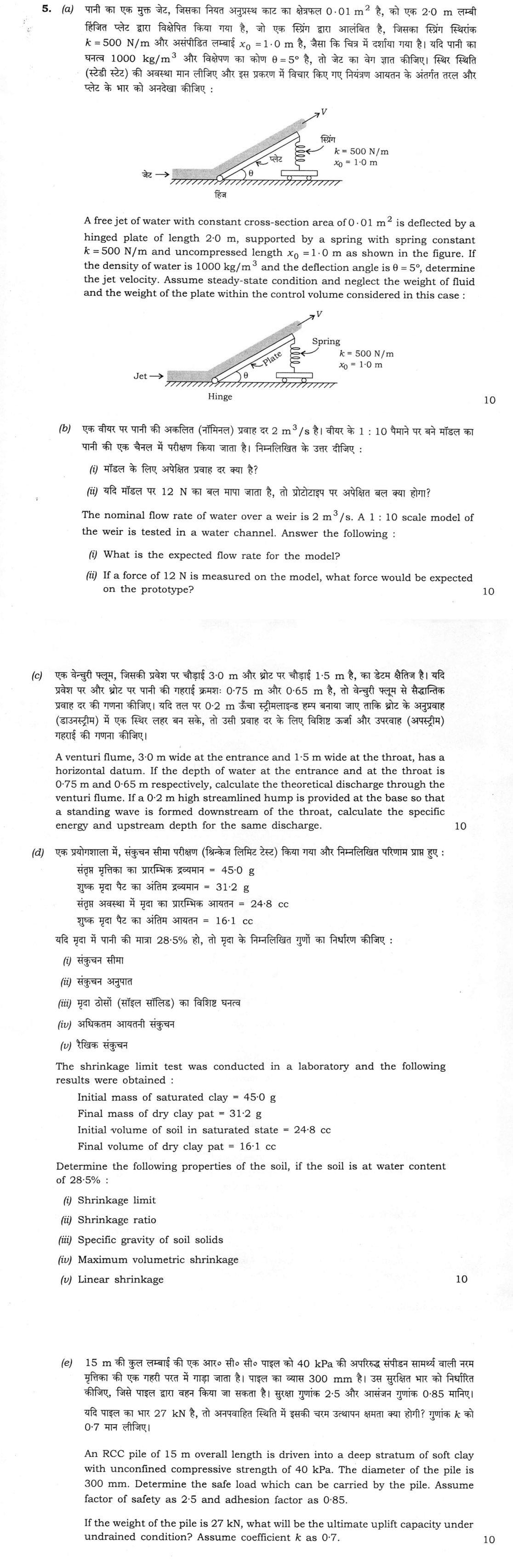
(a) A free jet of water with constant cross-section area of 0·01 m² is deflected by a hinged plate of length 2·0 m, supported by…
A free jet of water with constant cross-section area of 0·01 m² is deflected by a hinged plate of length 2·0 m, supported by a spring with spring constant k = 500 N/m and uncompressed length x₀ = 1·0 m as shown in the figure. If the density of water is 1000 kg/m³ and the deflection angle is θ = 5°, determine the jet velocity. Assume steady-state condition and neglect the weight of fluid and the weight of the plate within the control volume considered in this case : 10 marks
The nominal flow rate of water over a weir is 2 m³/s. A 1 : 10 scale model of the weir is tested in a water channel. Answer the following : What is the expected flow rate for the model?
If a force of 12 N is measured on the model, what force would be expected on the prototype? 10 marks
A venturi flume, 3·0 m wide at the entrance and 1·5 m wide at the throat, has a horizontal datum. If the depth of water at the entrance and at the throat is 0·75 m and 0·65 m respectively, calculate the theoretical discharge through the venturi flume. If a 0·2 m high streamlined hump is provided at the base so that a standing wave is formed downstream of the throat, calculate the specific energy and upstream depth for the same discharge. 10 marks
The shrinkage limit test was conducted in a laboratory and the following results were obtained : Initial mass of saturated clay = 45·0 g Final mass of dry clay pat = 31·2 g Initial volume of soil in saturated state = 24·8 cc Final volume of dry clay pat = 16·1 cc Determine the following properties of the soil, if the soil is at water content of 28·5% : Shrinkage limit
Shrinkage ratio
Specific gravity of soil solids
Maximum volumetric shrinkage
Linear shrinkage 10 marks
An RCC pile of 15 m overall length is driven into a deep stratum of soft clay with unconfined compressive strength of 40 kPa. The diameter of the pile is 300 mm. Determine the safe load which can be carried by the pile. Assume factor of safety as 2.5 and adhesion factor as 0.85.
If the weight of the pile is 27 kN, what will be the ultimate uplift capacity under undrained condition? Assume coefficient k as 0.7. 10 marks
हिंदी में प्रश्न पढ़ें
पानी का एक मुक्त जेट, जिसका नियत अनुप्रस्थ काट का क्षेत्रफल 0·01 m² है, को एक 2·0 m लम्बी हिंजित प्लेट द्वारा विक्षेपित किया गया है, जो एक स्प्रिंग द्वारा आलंबित है, जिसका स्प्रिंग स्थिरांक k = 500 N/m और असंपीडित लम्बाई x₀ = 1·0 m है, जैसा कि चित्र में दर्शाया गया है। यदि पानी का घनत्व 1000 kg/m³ और विक्षेपण का कोण θ = 5° है, तो जेट का वेग ज्ञात कीजिए। स्थिर स्थिति (स्टेडी स्टेट) की अवस्था मान लीजिए और इस प्रकरण में विचार किए गए नियंत्रण आयतन के अंतर्गत तरल और प्लेट के भार को अनदेखा कीजिए : (10 अंक)
एक वीयर पर पानी की अकलित (नॉमिनल) प्रवाह दर 2 m³/s है। वीयर के 1 : 10 पैमाने पर बने मॉडल का पानी की एक चैनल में परीक्षण किया जाता है। निम्नलिखित के उत्तर दीजिए : मॉडल के लिए अपेक्षित प्रवाह दर क्या है?
यदि मॉडल पर 12 N का बल मापा जाता है, तो प्रोटोटाइप पर अपेक्षित बल क्या होगा? (10 अंक)
एक वेन्चुरी फ्लूम, जिसकी प्रवेश पर चौड़ाई 3·0 m और थ्रोट पर चौड़ाई 1·5 m है, का डेटम क्षैतिज है। यदि प्रवेश पर और थ्रोट पर पानी की गहराई क्रमश: 0·75 m और 0·65 m है, तो वेन्चुरी फ्लूम से सैद्धान्तिक प्रवाह दर की गणना कीजिए। यदि तल पर 0·2 m ऊँचा स्ट्रीमलाइन्ड हम्प बनाया जाए ताकि थ्रोट के अनुप्रवाह (डाउनस्ट्रीम) में एक स्थिर लहर बन सके, तो उसी प्रवाह दर के लिए विशिष्ट ऊर्जा और उपरवाह (अपस्ट्रीम) गहराई की गणना कीजिए। (10 अंक)
एक प्रयोगशाला में, संकुचन सीमा परीक्षण (श्रिङ्केज लिमिट टेस्ट) किया गया और निम्नलिखित परिणाम प्राप्त हुए : संतृप्त मृत्तिका का प्रारम्भिक द्रव्यमान = 45·0 g शुष्क मृदा पैट का अंतिम द्रव्यमान = 31·2 g संतृप्त अवस्था में मृदा का प्रारम्भिक आयतन = 24·8 cc शुष्क मृदा पैट का अंतिम आयतन = 16·1 cc यदि मृदा में पानी की मात्रा 28·5% हो, तो मृदा के निम्नलिखित गुणों का निर्धारण कीजिए : संकुचन सीमा
संकुचन अनुपात
मृदा ठोसों (साइल सॉलिड) का विशिष्ट घनत्व
अधिकतम आयतनी संकुचन
रैखिक संकुचन (10 अंक)
15 m की कुल लम्बाई की एक आर० सी० सी० पाइल को 40 kPa की अपरिरुद्ध संपीडन सामर्थ्य वाली नरम मृत्तिका की एक गहरी परत में गाड़ा जाता है। पाइल का व्यास 300 mm है। उस सुरक्षित भार को निर्धारित कीजिए, जिसे पाइल द्वारा वहन किया जा सकता है। सुरक्षा गुणांक 2.5 और आसंजन गुणांक 0.85 मानिए।
यदि पाइल का भार 27 kN है, तो अनपवाहित स्थिति में इसकी चरम उत्थापन क्षमता क्या होगी? गुणांक k को 0.7 मान लीजिए। (10 अंक)
Model answer
Drafted with AI by UPSC Answer Check against this question's marking rubric, to the expected length. UPSC does not publish answers for Mains — this is one way to score well, not an official key. How we build rubrics and answers.
(a) Jet force on the hinged plate and jet velocity (10 marks)
The jet leaves horizontally with velocity V, area A = 0.01 m² and density ρ = 1000 kg/m³. The plate is smooth, so the force on it is normal to the plate and only the component of the jet momentum normal to the plate is destroyed. The jet is horizontal and the plate is inclined at θ = 5°, so the normal component of the jet velocity is V sin θ. By the linear momentum equation for steady flow, with the mass flow rate ρAV:
F_n = ρAV × V sin θ = ρAV² sin θ = 1000 × 0.01 × V² × sin 5° = 0.8716 V² (newtons)
Assume that this force acts at the mid-length of the 2.0 m plate, 1.0 m from the hinge, and that the spring is fixed at the free end and stays vertical.

The spring is compressed from its free length x₀ = 1.0 m to the vertical height of the plate end, 2 sin 5° = 0.1743 m. Its compression is 1.0 − 0.1743 = 0.8257 m, so
F_s = k × 0.8257 = 500 × 0.8257 = 412.8 N
Its horizontal distance from the hinge is 2 cos 5° = 1.992 m. Moments about the hinge, with the plate in equilibrium:
F_n × 1.0 = F_s × 1.992
0.8716 V² = 412.8 × 1.992 = 822.6
V² = 943.8, so V ≈ 30.7 m/s
The discharge is Q = AV = 0.01 × 30.7 = 0.307 m³/s.
(b) Froude similitude for a 1:10 weir model (10 marks)
Gravity governs flow over a weir, so the Froude number is the same in the model and the prototype. With length scale L_r = L_m/L_p = 1/10, the velocity scale is V_r = L_r^½, the discharge scale is Q_r = L_r^2.5 and the force scale, with the same fluid, is F_r = L_r³.
(i) Model discharge. Q_m = Q_p × (1/10)^2.5 = 2 × 0.003162 = 0.00632 m³/s (about 6.3 litres per second).
(ii) Prototype force. F_p = F_m/(1/10)³ = 12 × 1000 = 12 000 N = 12 kN.
(c) Venturi flume: discharge and hump effect (10 marks)
Theoretical discharge. The widths are b₁ = 3.0 m and b₂ = 1.5 m and the depths are y₁ = 0.75 m and y₂ = 0.65 m. By continuity, V₁ = Q/(3.0 × 0.75) = Q/2.25 and V₂ = Q/(1.5 × 0.65) = Q/0.975. The datum is horizontal, so the energy equation gives
y₁ + V₁²/2g = y₂ + V₂²/2g
0.10 = (Q²/19.62) × (1/0.975² − 1/2.25²) = (Q²/19.62) × (1.0519 − 0.1975)
Q² = 0.10 × 19.62/0.8544 = 2.296, so Q ≈ 1.52 m³/s.
With a 0.2 m hump. A standing wave forms just downstream of the throat when the flow is critical at the throat. The discharge per metre width at the throat is q = 1.5154/1.5 = 1.010 m²/s, so
y_c = (q²/g)^⅓ = (1.0206/9.81)^⅓ = 0.470 m
The specific energy at the throat is E_c = 1.5 y_c = 0.705 m. Upstream, the energy measured from the channel floor is E₁ = E_c + Δz = 0.705 + 0.20 = 0.905 m. With q₁ = 1.5154/3.0 = 0.505 m²/s, the subcritical upstream depth satisfies
y₁ + q₁²/(2g y₁²) = y₁ + 0.0130/y₁² = 0.905
so y₁ ≈ 0.889 m, compared with 0.75 m before the hump: the hump raises the upstream water level.
(d) Shrinkage limit test (10 marks)
Data: wet mass 45.0 g, dry mass M_d = 31.2 g, initial volume V₁ = 24.8 cc and dry volume V₂ = 16.1 cc, with ρ_w = 1 g/cc.
(i) Shrinkage limit. The initial water content is w₁ = (45.0 − 31.2)/31.2 = 44.2%. Then
w_s = w₁ − (V₁ − V₂)ρ_w/M_d × 100 = 44.23 − (8.7/31.2) × 100 = 44.23 − 27.88 = 16.3%
(ii) Shrinkage ratio. SR = M_d/(V₂ρ_w) = 31.2/16.1 = 1.94.
(iii) Specific gravity of solids. G = 1/(1/SR − w_s/100) = 1/(0.5160 − 0.1635) = 2.84.
(iv) Volumetric shrinkage. For the stated water content of 28.5%: VS = (w − w_s) × SR = (28.5 − 16.35) × 1.938 = 23.6%.
(v) Linear shrinkage. LS = 100 × [1 − (100/(100 + VS))^⅓] = 100 × [1 − (100/123.6)^⅓] = 6.8%.
(e) Driven pile in soft clay (10 marks)
The undrained cohesion is c_u = q_u/2 = 20 kPa. The diameter is 0.30 m and the length is 15 m, so the shaft area is A_s = π × 0.30 × 15 = 14.14 m² and the base area is A_b = π/4 × 0.30² = 0.0707 m².
(i) Safe load. Skin friction Q_s = α c_u A_s = 0.85 × 20 × 14.14 = 240.3 kN. End bearing Q_b = 9 c_u A_b = 9 × 20 × 0.0707 = 12.7 kN. The ultimate load is Q_u = 240.3 + 12.7 = 253.0 kN, so
Q_safe = 253.0/2.5 = 101.2 kN
(ii) Ultimate uplift capacity. The base contributes no tension, so with the uplift coefficient k = 0.7 on the skin friction and the pile weight 27 kN:
Q_up = k α c_u A_s + W = 0.7 × 240.3 + 27 = 168.2 + 27 = 195.2 kN
How this answer will be evaluated
Evaluation rubric
Each sub-part is marked on its own, against the marks and word limit printed on the paper.
- (a) Use the linear momentum equation for the jet force on the smooth hinged plate and take moments about the hinge against the spring force to find the jet velocity at θ = 5°. 10 marks
Must cover
- Jet force normal to the plate F_n = ρAV² sin θ = 0.8716 V², acting at the plate mid-length (assumption stated)
- Spring force F_s = k(x₀ − 2 sin θ) = 500 × 0.8257 = 412.8 N with horizontal arm 2 cos θ = 1.992 m
- Moment balance about the hinge: 0.8716 V² × 1.0 = 412.8 × 1.992
- V ≈ 30.7 m/s (Q ≈ 0.307 m³/s)
Loses marks
- Taking the force as ρAV² without the sin θ, or as horizontal.
- Taking the spring compression as 1.0 m or ignoring the vertical rise of the plate end.
- Ignoring the moment arms.
Earns more
- Correct free-body diagram with the forces and arms marked.
- Use of the change in normal momentum only, since the plate is smooth.
Extra mark
- Discussion of how the result changes if the jet strikes at another point
- (b) Apply Froude similitude to the 1:10 weir model: (i) the model discharge for 2 m³/s at prototype, and (ii) the prototype force for 12 N on the model. 10 marks
Must cover
- Froude number equal in model and prototype, length ratio 1/10
- Discharge scale L_r^2.5, so Q_m = 2/10^2.5 = 0.00632 m³/s
- Force scale L_r³ (same fluid), so F_p = 12 × 10³ = 12 kN
Loses marks
- Using Q scale of L_r² or L_r³.
- Using a force scale of L_r² or L_r^2.5.
- Applying the ratios in the wrong direction.
Earns more
- Velocity scale L_r^½ derived and used consistently.
- Units stated for both answers.
Extra mark
- Model discharge also expressed as about 6.3 L/s
- (c) For the venturi flume, find the theoretical discharge from continuity and the energy equation, then, with a 0.2 m hump and critical flow at the throat, the specific energy and upstream depth. 10 marks
Must cover
- V₁ = Q/(3.0 × 0.75), V₂ = Q/(1.5 × 0.65) and the energy equation giving Q ≈ 1.52 m³/s
- Critical throat: q = Q/1.5, y_c = (q²/g)^⅓ = 0.470 m
- Specific energy at the throat E_c = 1.5 y_c ≈ 0.705 m
- Upstream energy E₁ = E_c + 0.20 = 0.905 m and the subcritical root y₁ ≈ 0.889 m
Loses marks
- Using the same width for the entrance and the throat.
- Adding the hump height to the throat energy with the wrong sign.
- Choosing the supercritical root upstream.
Earns more
- Use of the discharge per unit width at each section.
- Choosing the subcritical root for the upstream depth.
Extra mark
- Comment that the hump raises the upstream level from 0.75 m to 0.889 m
- (d) From the shrinkage limit test data compute the shrinkage limit, shrinkage ratio, specific gravity of solids, volumetric shrinkage and linear shrinkage, using the stated water content of 28.5%. 10 marks
Must cover
- Shrinkage limit w_s = w₁ − (V₁ − V₂)ρ_w/M_d ≈ 16.3%, with w₁ = 44.2%
- Shrinkage ratio SR = M_d/(V₂ρ_w) = 1.94
- G = 1/(1/SR − w_s/100) = 2.84
- VS = (28.5 − w_s) × SR ≈ 23.6% and LS ≈ 6.8% from the volumetric shrinkage
Loses marks
- Using 28.5% as the initial water content in the shrinkage-limit formula.
- Using the initial volume for SR.
- Omitting the cube root in the linear shrinkage.
Earns more
- Sequential use of each result in the next step.
- Using w = 28.5% only in the volumetric shrinkage.
Extra mark
- Check of G by an independent relation
- (e) For the 300 mm × 15 m driven pile in soft clay (q_u = 40 kPa): (a) safe load with α = 0.85 and FS = 2.5; (b) ultimate uplift capacity with k = 0.7 and pile weight 27 kN. 10 marks
Must cover
- c_u = q_u/2 = 20 kPa; A_s = π × 0.3 × 15 = 14.14 m²; A_b = 0.0707 m²
- Q_s = 0.85 × 20 × 14.14 = 240.3 kN and end bearing 9 c_u A_b = 12.7 kN, Q_u ≈ 253 kN
- Safe load = 253.0/2.5 ≈ 101.2 kN
- Uplift = kαc_uA_s + W = 0.7 × 240.3 + 27 = 195.2 kN
Loses marks
- Taking c = 40 kPa.
- Omitting the pile weight in uplift or the factor of safety in the safe load.
- Using the base resistance in the uplift capacity.
Earns more
- Explaining that the base gives no tension in uplift.
- Correct use of c_u as half of q_u.
Extra mark
- Statement that skin friction alone (240.3/2.5 = 96 kN) is a lower bound
What "Calculate" is asking you to do
Apply the standard formula or schedule to data the question has already supplied — a table of readings, cost records, a balance sheet — and produce the number. The method is rarely in doubt; the marks sit in the named intermediate quantities, each of which has to appear as a labelled line.
Structure that answers it
Data as given → formula or standard treatment, named → substitution → each intermediate, labelled → result with units
Where marks are lost
Omitting an intermediate the marking scheme pays for separately, or rounding at an intermediate line so the final figure drifts. In commerce and accountancy, any figure in a statement that no numbered working note supports is treated as unearned.
Practice this exact question
Write your answer and it is marked point by point against the model answer above — what you covered, what you missed, what you got wrong.
Evaluate my answer →More from Civil Engineering 2026 Paper I
- Q2 (a) Using limit state method, design a reinforced concrete circular column (with lateral…
- Q3 (a) A vertical member in a truss is subjected to the following member force (factored) :…
- Q4 (a) Three bodies of weights 200 N, 800 N and 400 N are connected with inextensible string…
- Q5 (a) A free jet of water with constant cross-section area of 0·01 m² is deflected by a hin…
- Q6 (a) Assuming the law for the velocity distribution in the boundary layer as $\dfrac{v}{V}…
- Q7 (a) The data with respect to a normally consolidated clay are as follows : Thickness of t…
- Q8 (a) Consolidated drained tests on clay specimens were performed and the following results…