Paper I — Q7
(a) The data with respect to a normally consolidated clay are as follows : Thickness of the clay layer = 3·0 m Initial void ratio…
The data with respect to a normally consolidated clay are as follows : Thickness of the clay layer = 3·0 m Initial void ratio = 0·75 Liquid limit = 50% Effective overburden pressure on the clay layer = 130 kN/m² Increment of effective pressure on the clay layer = 50 kN/m² Secondary compression index, C_α = 0·02 Time for completion of primary settlement = 2·0 years
What will be the consolidation settlement of the clay layer, six years after the completion of primary consolidation settlement? 15 marks
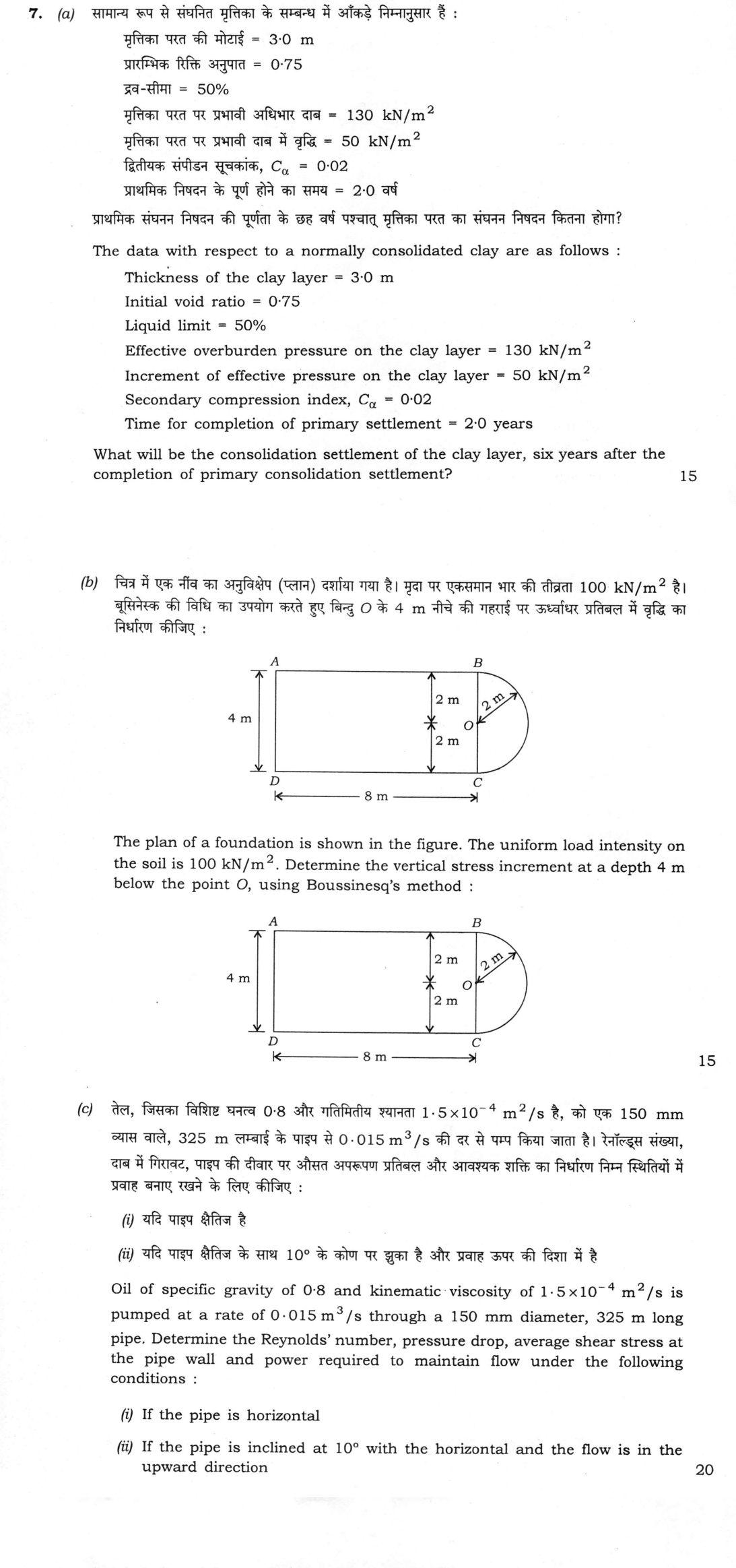
The plan of a foundation is shown in the figure. The uniform load intensity on the soil is 100 kN/m². Determine the vertical stress increment at a depth 4 m below the point O, using Boussinesq's method : 15 marks
Oil of specific gravity of 0.8 and kinematic viscosity of 1.5×10⁻⁴ m²/s is pumped at a rate of 0.015 m³/s through a 150 mm diameter, 325 m long pipe. Determine the Reynolds' number, pressure drop, average shear stress at the pipe wall and power required to maintain flow under the following conditions :
If the pipe is horizontal
If the pipe is inclined at 10° with the horizontal and the flow is in the upward direction 20 marks
हिंदी में प्रश्न पढ़ें
सामान्य रूप से संघनित मृत्तिका के सम्बन्ध में आँकड़े निम्नानुसार हैं : मृत्तिका परत की मोटाई = 3·0 m प्रारम्भिक रिक्ति अनुपात = 0·75 द्रव-सीमा = 50% मृत्तिका परत पर प्रभावी अधिभार दाब = 130 kN/m² मृत्तिका परत पर प्रभावी दाब में वृद्धि = 50 kN/m² द्वितीयक संपीडन सूचकांक, C_α = 0·02 प्राथमिक निषदन के पूर्ण होने का समय = 2·0 वर्ष
प्राथमिक संघनन निषदन की पूर्णता के छह वर्ष पश्चात् मृत्तिका परत का संघनन निषदन कितना होगा? (15 अंक)
चित्र में एक नींव का अनुविक्षेप (प्लान) दर्शाया गया है। मृदा पर एकसमान भार की तीव्रता 100 kN/m² है। बूसिनेस्क की विधि का उपयोग करते हुए बिंदु O के 4 m नीचे की गहराई पर ऊर्ध्वाधर प्रतिबल में वृद्धि का निर्धारण कीजिए : (15 अंक)
तेल, जिसका विशिष्ट घनत्व 0.8 और गतिमितीय श्यानता 1.5×10⁻⁴ m²/s है, को एक 150 mm व्यास वाले, 325 m लम्बाई के पाइप से 0.015 m³/s की दर से पम्प किया जाता है। रेनॉल्ड्स संख्या, दाब में गिरावट, पाइप की दीवार पर औसत अपरूपण प्रतिबल और आवश्यक शक्ति का निर्धारण निम्न स्थितियों में प्रवाह बनाए रखने के लिए कीजिए :
यदि पाइप क्षैतिज है
यदि पाइप क्षैतिज के साथ 10° के कोण पर झुका है और प्रवाह ऊपर की दिशा में है (20 अंक)
Model answer
Drafted with AI by UPSC Answer Check against this question's marking rubric, to the expected length. UPSC does not publish answers for Mains — this is one way to score well, not an official key. How we build rubrics and answers.
(a) Consolidation settlement of the clay layer (15 marks)
The total settlement six years after the end of primary consolidation is the primary settlement plus the secondary compression between t₁ = 2 years and t₂ = 2 + 6 = 8 years.
Primary settlement. For a normally consolidated clay the compression index is estimated from the liquid limit as C_c = 0.009(LL − 10) = 0.009 × 40 = 0.36. With H = 3.0 m, e₀ = 0.75, σ′₀ = 130 kPa and Δσ′ = 50 kPa:
S_c = [C_c H/(1 + e₀)] log₁₀[(σ′₀ + Δσ′)/σ′₀] = (0.36 × 3.0/1.75) × log₁₀(180/130)
S_c = 0.6171 × 0.1413 = 0.0872 m = 87.2 mm
Secondary settlement. The void ratio at the end of primary consolidation is e_p = e₀ − C_c log₁₀(180/130) = 0.75 − 0.0509 = 0.699, so
S_s = [C_α H/(1 + e_p)] log₁₀(t₂/t₁) = (0.02 × 3.0/1.699) × log₁₀(8/2) = 0.0353 × 0.602 = 0.0213 m = 21.3 mm
Total settlement. S = 87.2 + 21.3 = 108.5 mm ≈ 109 mm, about 0.11 m.
(b) Vertical stress under a rectangle plus a semicircle (15 marks)
Point O is the mid-point of edge BC of the 8 m × 4 m rectangle, and it is also the centre of the semicircle. The load is split into two rectangles with a corner at O and one half of a circle loaded about its own centre. By Boussinesq's theory and superposition, z = 4 m:

Two rectangles, each 8 m × 2 m with O at the corner. m = B/z = 2/4 = 0.5 and n = L/z = 8/4 = 2.0. The corner influence factor is
I_r = (1/4π)[(2mn√(m² + n² + 1)/(m² + n² + m²n² + 1)) × ((m² + n² + 2)/(m² + n² + 1)) + tan⁻¹(2mn√(m² + n² + 1)/(m² + n² + 1 − m²n²))] = 0.135
Δσ₁ = 2 × 0.135 × 100 = 27.0 kPa
Semicircle of radius 2 m. Under the centre of a circular load, Δσ = q[1 − (1/(1 + (R/z)²))^(3/2)]. Here R/z = 0.5, so the factor is 1 − (1/1.25)^1.5 = 1 − 0.7155 = 0.2845 for the full circle. The semicircle gives half, by symmetry about the diameter through O:
Δσ₂ = 100 × 0.2845/2 = 14.2 kPa
Total Δσ_z = 27.0 + 14.2 ≈ 41.2 kN/m² at 4 m below O.
(c) Oil flow in a 150 mm pipe, horizontal and inclined (20 marks)
Data: ρ = 0.8 × 1000 = 800 kg/m³, ν = 1.5 × 10⁻⁴ m²/s, so μ = ρν = 0.12 N·s/m². The discharge is Q = 0.015 m³/s, the diameter is D = 0.15 m and the length is L = 325 m. The area is A = π(0.15)²/4 = 0.01767 m² and the velocity V = Q/A = 0.849 m/s.
(c)(i) Horizontal pipe
Reynolds number: Re = VD/ν = 0.849 × 0.15/1.5 × 10⁻⁴ = 849. This is below 2000, so the flow is laminar.
Pressure drop (Hagen-Poiseuille): Δp = 32μVL/D² = 32 × 0.12 × 0.849 × 325/0.15² = 47.1 kPa. The equivalent head loss is h_f = Δp/ρg = 6.0 m of oil, with f = 64/Re = 0.0754.
Average wall shear stress: τ₀ = ΔpD/4L = 47 080 × 0.15/(4 × 325) = 5.43 N/m².
Power: P = ΔpQ = 47 080 × 0.015 = 706 W ≈ 0.71 kW.
(c)(ii) Pipe inclined at 10°, flow upward
The length of pipe along the slope is still 325 m, so the rise is Δz = 325 sin 10° = 56.4 m.
Reynolds number: unchanged, 849, because V, D and ν are unchanged.
Pressure drop: the pressure drop now supplies the friction loss and the elevation gain, Δp = 47 080 + ρgΔz = 47 080 + 800 × 9.81 × 56.44 = 47 080 + 442 900 = 490 kPa.
Average wall shear stress: only the friction part of the pressure drop acts against the wall, so τ₀ = (Δp − ρgΔz)D/4L = 5.43 N/m², unchanged.
Power: P = ΔpQ = 489 990 × 0.015 = 7350 W ≈ 7.35 kW, of which 706 W overcomes friction and 6.64 kW raises the oil.
The Reynolds number and the wall shear stress do not change with inclination because they depend on the flow alone, while the pressure drop and the pumping power rise about ten-fold because of the elevation gain.
How this answer will be evaluated
Evaluation rubric
Each sub-part is marked on its own, against the marks and word limit printed on the paper.
- (a) Compute the consolidation settlement six years after the end of primary consolidation: primary settlement with C_c from the liquid limit, plus secondary settlement between 2 and 8 years. 15 marks
Must cover
- C_c = 0.009(LL − 10) = 0.36 and S_c = C_cH/(1 + e₀) log(180/130) ≈ 87.2 mm
- Void ratio at end of primary e_p ≈ 0.699
- S_s = C_αH/(1 + e_p) log(t₂/t₁) with t₁ = 2 and t₂ = 8 years ≈ 21.3 mm
- Total ≈ 108.5 mm
Loses marks
- Using t₂ = 6 years instead of 8 years.
- Using e₀ rather than e_p in the secondary formula.
- Using the Skempton formula without stating it, or omitting the log.
Earns more
- Correct time limits: secondary compression is counted from the end of primary consolidation.
- Both settlements added with units.
Extra mark
- Remark that using the compressed thickness after primary changes S_s by under 1 mm
- (b) Find the vertical stress increment 4 m below O for the 8 m × 4 m rectangle with a semicircle of radius 2 m (q = 100 kN/m²) by Boussinesq's theory and superposition. 15 marks
Must cover
- Two 8 m × 2 m rectangles with O at the corner: m = 0.5, n = 2, I_r ≈ 0.135, giving 27.0 kPa
- Semicircle as half a circle loaded about its centre: factor 1 − (1/(1 + (R/z)²))^1.5 = 0.2845, half of it giving 14.2 kPa
- Total Δσ_z ≈ 41.2 kN/m²
Loses marks
- Using the full circle instead of the semicircle.
- Treating O as the centre of the rectangle.
- Applying m and n with the full 8 × 4 dimensions and O at a corner.
Earns more
- Plan sketch showing how the areas are divided.
- Correct use of the corner influence factor twice.
Extra mark
- Cross-check with the 2:1 method or the Newmark chart
- (c) For oil (S = 0.8, ν = 1.5 × 10⁻⁴ m²/s) pumped at 0.015 m³/s through a 150 mm, 325 m pipe, find Re, pressure drop, average wall shear stress and power when horizontal and when inclined 10° upward, and state which quantities change. 20 marks
Must cover
- V = 0.849 m/s, Re = 849 (laminar), f = 64/Re
- Horizontal: Δp = 32μVL/D² ≈ 47.1 kPa, τ₀ = ΔpD/4L ≈ 5.43 N/m², P ≈ 706 W
- Inclined: elevation gain 325 sin 10° = 56.4 m; Δp ≈ 490 kPa and P ≈ 7.35 kW
- Re and wall shear stress unchanged (τ₀ from friction only); pressure drop and power change
Loses marks
- Using a turbulent friction factor although Re < 2000.
- Taking the wall shear as ΔpD/4L with the full inclined Δp.
- Using 325 sin 10° with the horizontal length wrongly interpreted.
Earns more
- Use of the dynamic viscosity μ = ρν = 0.12 N·s/m².
- Splitting the inclined-pipe power into friction (706 W) and elevation (6.64 kW).
Extra mark
- Head-loss form h_f = 6.0 m of oil
What "Explain" is asking you to do
Make the working of something clear — what sets it off, what follows from what, and what it produces. Explain is the Commission's mechanism word: it dominates the technical papers and the “explain why” stems, where the marks sit in the causal chain and not in the label.
Structure that answers it
State what it is → the initiating condition → the chain of cause, step by step → an instance where it plays out → what the chain produces
Where marks are lost
Describing what something looks like instead of why it works that way. Naming the stages without linking them reads as description too.
Practice this exact question
Write your answer and it is marked point by point against the model answer above — what you covered, what you missed, what you got wrong.
Evaluate my answer →More from Civil Engineering 2026 Paper I
- Q4 (a) Three bodies of weights 200 N, 800 N and 400 N are connected with inextensible string…
- Q5 (a) A free jet of water with constant cross-section area of 0·01 m² is deflected by a hin…
- Q6 (a) Assuming the law for the velocity distribution in the boundary layer as $\dfrac{v}{V}…
- Q7 (a) The data with respect to a normally consolidated clay are as follows : Thickness of t…
- Q8 (a) Consolidated drained tests on clay specimens were performed and the following results…