Paper I — Q2
(a) Using limit state method, design a reinforced concrete circular column (with lateral ties) of height 3·0 m. It is subjected…
Using limit state method, design a reinforced concrete circular column (with lateral ties) of height 3·0 m. It is subjected to an unfactored axial load of 1150 kN (dead load + live load). Use M25 grade of concrete and Fe500 grade of steel. Take effective length factor as 1·2. Show the design details in a neat sketch. 15 marks
A straight bar of alloy is mounted in a strut-testing machine with both ends pin jointed and loaded axially till it buckles. Using Euler's formula, calculate the maximum central deflection before the alloy material attains the yield point at 300 MN/m². Take bar length = 2·0 m, cross-section of the bar as 20 mm × 15 mm and modulus of elasticity E as 90 GN/m². 15 marks
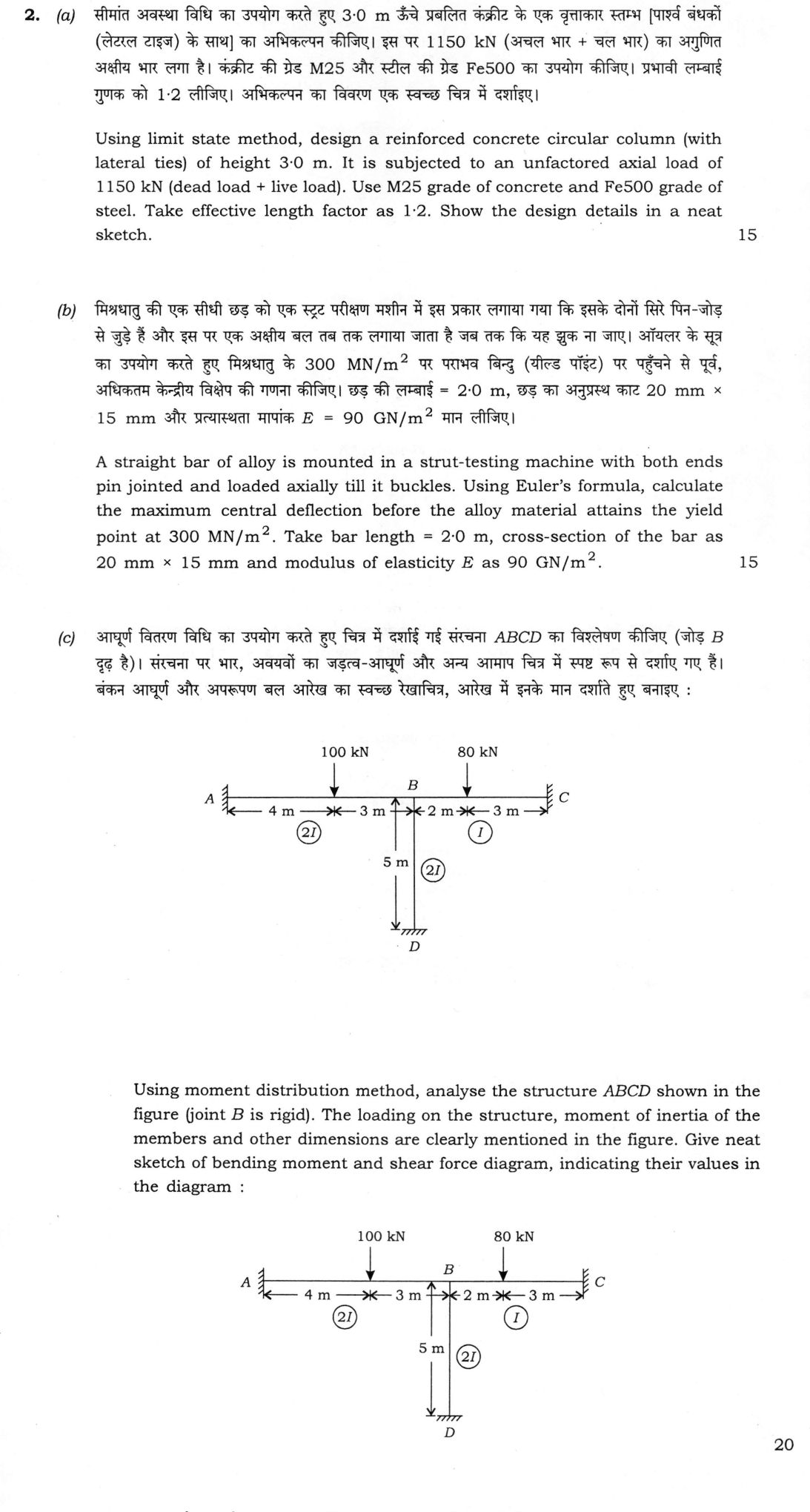
Using moment distribution method, analyse the structure ABCD shown in the figure (joint B is rigid). The loading on the structure, moment of inertia of the members and other dimensions are clearly mentioned in the figure. Give neat sketch of bending moment and shear force diagram, indicating their values in the diagram : 20 marks
हिंदी में प्रश्न पढ़ें
सीमांत अवस्था विधि का उपयोग करते हुए 3·0 m ऊँचे प्रबलित कंक्रीट के एक वृत्ताकार स्तंभ (पार्श्व बंधकों (लेटरल टाइज़) के साथ) का अभिकल्पन कीजिए। इस पर 1150 kN (अचल भार + चल भार) का अगुणित अक्षीय भार लगा है। कंक्रीट की ग्रेड M25 और स्टील की ग्रेड Fe500 का उपयोग कीजिए। प्रभावी लम्बाई गुणक को 1·2 लीजिए। अभिकल्पन का विवरण एक स्वच्छ चित्र में दर्शाइए। (15 अंक)
मिश्रधातु की एक सीधी छड़ को एक स्ट्रट परीक्षण मशीन में इस प्रकार लगाया गया कि इसके दोनों सिरे पिन-जोड़ से जुड़े हैं और इस पर एक अक्षीय बल तब तक लगाया जाता है जब तक कि यह झुक न जाए। ऑयलर के सूत्र का उपयोग करते हुए मिश्रधातु के 300 MN/m² पर पाभव बिन्दु (यील्ड पॉइंट) पर पहुँचने से पूर्व, अधिकतम केन्द्रीय विश्लेष की गणना कीजिए। छड़ की लम्बाई = 2·0 m, छड़ का अनुप्रस्थ काट 20 mm × 15 mm और प्रत्यास्थता मापांक E = 90 GN/m² मान लीजिए। (15 अंक)
आघूर्ण वितरण विधि का उपयोग करते हुए, चित्र में दर्शाई गई संरचना ABCD का विश्लेषण कीजिए (जोड़ B दृढ़ है)। संरचना पर भारण, सदस्यों का जड़त्व आघूर्ण तथा अन्य विमाएँ चित्र में स्पष्ट रूप से दर्शाई गई हैं। बंकन आघूर्ण तथा अपरूपण बल आरेख का स्वच्छ रेखाचित्र दीजिए, जिसमें आरेख पर उनके मान दर्शाए गए हों : (20 अंक)
Model answer
Drafted with AI by UPSC Answer Check against this question's marking rubric, to the expected length. UPSC does not publish answers for Mains — this is one way to score well, not an official key. How we build rubrics and answers.
(a) Design of a tied circular RC column (15 marks)
Data: height 3.0 m, unfactored load 1150 kN, M25, Fe500, effective length factor 1.2.
Factored load: P_u = 1.5 × 1150 = 1725 kN. Effective length l_eff = 1.2 × 3.0 = 3.6 m.
Size of the column. Assume 1.5% longitudinal steel. For a short column with a small eccentricity (IS 456 cl. 39.3), P_u = 0.4 f_ck A_c + 0.67 f_y A_sc, with A_c = 0.985 A_g and A_sc = 0.015 A_g:
P_u = (0.4 × 25 × 0.985 + 0.67 × 500 × 0.015) A_g = 14.875 A_g, so A_g = 1725 × 10³/14.875 = 115 966 mm², giving D = 384 mm. Adopt D = 400 mm (A_g = 125 664 mm²).
Short-column check: l_eff/D = 3600/400 = 9 < 12, so the column is short and slenderness moments are not required.
Minimum eccentricity: e_min = l/500 + D/30 = 3000/500 + 400/30 = 6 + 13.3 = 19.3 mm, which is not more than 0.05D = 20 mm, so the axial-load formula for short columns applies.
Longitudinal steel: 1725 × 10³ = 0.4 × 25 × (125 664 - A_sc) + 0.67 × 500 × A_sc = 1 256 637 + 325 A_sc, so A_sc = 1441 mm².
Check against the limits: the minimum is 0.8% of A_g = 1005 mm² and the maximum is 6% (7540 mm²), so 1441 mm² is acceptable. A circular column needs at least 6 bars of 12 mm. Provide 6 bars of 18 mm diameter, A_sc = 6 × 254.5 = 1527 mm² (1.22%).
Capacity check: P_u = 0.4 × 25 × (125 664 - 1527) + 0.67 × 500 × 1527 = 1241 + 512 = 1753 kN > 1725 kN, so the design is safe.
Lateral ties. Diameter not less than one-quarter of the largest bar (18/4 = 4.5 mm) and not less than 6 mm; provide 8 mm ties. Pitch: not more than the least of the least lateral dimension (400 mm), 16 times the smallest longitudinal bar diameter (16 × 18 = 288 mm) and 300 mm, so provide 280 mm centre to centre. Clear cover 40 mm.
Details: column 400 mm diameter, 6-18φ longitudinal bars, 8φ circular ties at 280 mm c/c, 40 mm cover.

(b) Alloy strut: Euler load and maximum deflection (15 marks)
Data: pin-ended strut, L = 2.0 m, section 20 mm × 15 mm, E = 90 GN/m², yield stress 300 MN/m².
Least second moment of area: I = 20 × 15³/12 = 5625 mm⁴ = 5.625 × 10⁻⁹ m⁴, and the buckling occurs about this axis.
Euler load: P_E = π²EI/L² = π² × 90 × 10⁹ × 5.625 × 10⁻⁹/2.0² = 1249 N (about 1.25 kN).
When the bar has buckled, the load is P = P_E, and the bar has a central deflection δ, with a bending moment at mid-length M = Pδ (the buckled shape is a half sine wave, so the central deflection is the maximum). The extreme fibre stress is the sum of the direct and bending stresses:
σ_max = P/A + Pδ/Z
Area A = 20 × 15 = 300 mm² = 3 × 10⁻⁴ m². Section modulus about the weak axis Z = bd²/6 = 20 × 15²/6 = 750 mm³ = 7.5 × 10⁻⁷ m³.
Direct stress: P/A = 1249/3 × 10⁻⁴ = 4.16 MN/m².
Setting σ_max = 300 MN/m²: 300 = 4.16 + 1249 δ/(7.5 × 10⁻⁷) × 10⁻⁶, so the bending stress is 295.8 MN/m² and
δ = 295.8 × 10⁶ × 7.5 × 10⁻⁷/1249 = 0.1776 m ≈ 178 mm.
The maximum central deflection before the material yields is about 178 mm. (Because the load stays at P_E after buckling, the bar can deflect a long way before the extreme fibre reaches yield; the sinusoidal shape is used as the approximation.)
(c) Analysis of frame ABCD by moment distribution (20 marks)
Members: AB, 7 m (2I; A fixed) with 100 kN at 4 m from A; BC, 5 m (I; C fixed) with 80 kN at 2 m from B; BD, 5 m (2I; D fixed), unloaded. Joint B is rigid, and there is no sway. End moments are taken clockwise positive.
Fixed end moments:
M_AB = -Wab²/L² = -100 × 4 × 3²/7² = -73.47 kN·m; M_BA = +Wa²b/L² = 100 × 4² × 3/7² = +97.96 kN·m.
M_BC = -80 × 2 × 3²/5² = -57.60 kN·m; M_CB = +80 × 2² × 3/5² = +38.40 kN·m. BD carries no load, so its fixed end moments are zero.
Stiffness and distribution factors at B (K = 4EI/L, with far ends fixed):
K_BA = 4(2I)/7 = 1.143I, K_BC = 4I/5 = 0.800I, K_BD = 4(2I)/5 = 1.600I, sum = 3.543I.
DF_BA = 0.3226, DF_BC = 0.2258, DF_BD = 0.4516 (sum 1.000).
Distribution. Unbalanced moment at B = 97.96 - 57.60 = +40.36 kN·m; the balancing moment is -40.36, distributed as BA -13.02, BC -9.11, BD -18.23 kN·m. Carry-over one-half to the fixed far ends: AB -6.51, CB -4.56, DB -9.11 kN·m. As A, C and D are fixed, no further unbalanced moment arises and the process ends after one cycle.
- Joint B: FEM: BA +97.96, BC -57.60, BD 0; balance: -13.02, -9.11, -18.23.
- Far ends: FEM: AB -73.47, CB +38.40, DB 0; carry-over: -6.51, -4.56, -9.11.
Final end moments (kN·m): M_AB = -79.98, M_BA = +84.94, M_BC = -66.71, M_CB = +33.84, M_BD = -18.23, M_DB = -9.11. Check at B: 84.94 - 66.71 - 18.23 = 0.
Shear forces and reactions (from statics of each member with its end moments):
- AB: V_A = (100 × 3 - 84.94 + 79.98)/7 = 42.15 kN; V_B = 57.85 kN. Moment under the 100 kN load = 42.15 × 4 - 79.98 = 88.61 kN·m (sagging).
- BC: V_B = (80 × 3 - 33.84 + 66.71)/5 = 54.57 kN; V_C = 25.43 kN. Moment under the 80 kN load = 54.57 × 2 - 66.71 = 42.43 kN·m (sagging).
- BD: horizontal shear = (18.23 + 9.11)/5 = 5.47 kN; the moment changes sign at 18.23/27.34 × 5 = 3.33 m from B.
- Vertical reaction at D = 57.85 + 54.57 = 112.43 kN (axial force in the column); the totals check: 42.15 + 25.43 + 112.43 = 180 kN.
Bending moment diagram (kN·m): AB: -79.98 at A, +88.61 under the load, -84.94 at B; BC: -66.71 at B, +42.43 under the load, -33.84 at C; BD: 18.23 at B (right face in tension), zero at 3.33 m, 9.11 at D (left face in tension).

Shear force diagram (kN): AB: +42.15 from A to the load, -57.85 from the load to B; BC: +54.57 from B to the load, -25.43 to C; BD: constant 5.47.

How this answer will be evaluated
Evaluation rubric
Each sub-part is marked on its own, against the marks and word limit printed on the paper.
- (a) Design a tied circular RC column 3.0 m high for an unfactored axial load of 1150 kN (M25, Fe500, effective length factor 1.2): fix the diameter, check short-column and minimum eccentricity, compute longitudinal steel, detail lateral ties and give a neat sketch. 15 marks
Must cover
- P_u = 1.725 MN; D = 400 mm from about 1.5% steel (A_g about 116 000 mm² required)
- l_eff/D = 9 < 12 (short); e_min = 19.3 mm ≤ 0.05D = 20 mm
- A_sc = 1441 mm² (above 0.8% minimum); provide 6-18φ (1527 mm²), minimum 6 bars for a circular column
- 8φ ties at 280 mm c/c (not more than 16φ = 288, D = 400 or 300 mm); 40 mm cover; labelled sketch
Loses marks
- Not applying the 1.5 load factor.
- Using fewer than six bars in a circular column.
- Tie pitch above the code limit; no sketch.
Earns more
- Capacity check with the provided steel (about 1753 kN ≥ 1725 kN).
- Tie diameter rule (not less than φ/4 and 6 mm) stated.
- (b) For a pin-ended alloy strut of 2.0 m and 20 × 15 mm section (E = 90 GN/m², yield 300 MN/m²) compute the Euler load and the maximum central deflection at which the extreme fibre reaches yield. 15 marks
Must cover
- I_min = 5625 mm⁴ and P_E = π²EI/L² = 1249 N
- σ_max = P/A + Pδ/Z with P = P_E, A = 300 mm², Z = 750 mm³
- Direct stress 4.16 MN/m²; bending stress 295.8 MN/m²
- δ = 0.178 m (about 178 mm)
Loses marks
- Using the 20 mm side for the least second moment of area.
- Ignoring the direct stress or using δ = L/500 type assumptions.
Earns more
- Buckling about the weak axis identified.
- Units kept consistent.
- (c) Analyse the T-shaped frame ABCD by moment distribution: fixed end moments, distribution factors, carry-overs, final end moments, and draw the BMD and SFD with values. 20 marks
Must cover
- FEMs: AB -73.47, BA +97.96, BC -57.60, CB +38.40, BD 0
- DF at B: BA 0.3226, BC 0.2258, BD 0.4516
- Final moments: AB -79.98, BA +84.94, BC -66.71, CB +33.84, BD -18.23, DB -9.11 (equilibrium at B verified)
- BMD with 88.61 and 42.43 under the loads, and SFD: 42.15/-57.85, 54.57/-25.43, 5.47 in BD
Loses marks
- Wrong span lengths (using 4 m or 3 m as the whole span).
- Not carrying over to the fixed ends.
- Diagrams without values marked.
Earns more
- Reactions: V_A = 42.15, V_C = 25.43, V_D = 112.43 kN, H = 5.47 kN, with vertical check 180 kN.
- Point of contraflexure in BD at 3.33 m from B.
What "Design" is asking you to do
Produce a specification that meets the given brief and demonstrate that it does. In civil and electrical papers the design is incomplete until it is expressed in buildable numbers — diameter, spacing, section, component value — and checked back against every limit stated.
Structure that answers it
Requirements and permissible values listed → code clause or design basis adopted → proportioning calculations → the specification in final dimensions → check against each requirement → sketch
Where marks are lost
Stopping at a required area or a required value without converting it into the bar size, spacing or component actually provided. The provided-against-required comparison and the serviceability or stability check are separately marked and routinely left out.
Practice this exact question
Write your answer and it is marked point by point against the model answer above — what you covered, what you missed, what you got wrong.
Evaluate my answer →More from Civil Engineering 2026 Paper I
- Q1 (a) A frictionless pulley A as shown in the figure is supported by two bars AB and AC whi…
- Q2 (a) Using limit state method, design a reinforced concrete circular column (with lateral…
- Q3 (a) A vertical member in a truss is subjected to the following member force (factored) :…
- Q4 (a) Three bodies of weights 200 N, 800 N and 400 N are connected with inextensible string…
- Q5 (a) A free jet of water with constant cross-section area of 0·01 m² is deflected by a hin…