Paper I — Q1
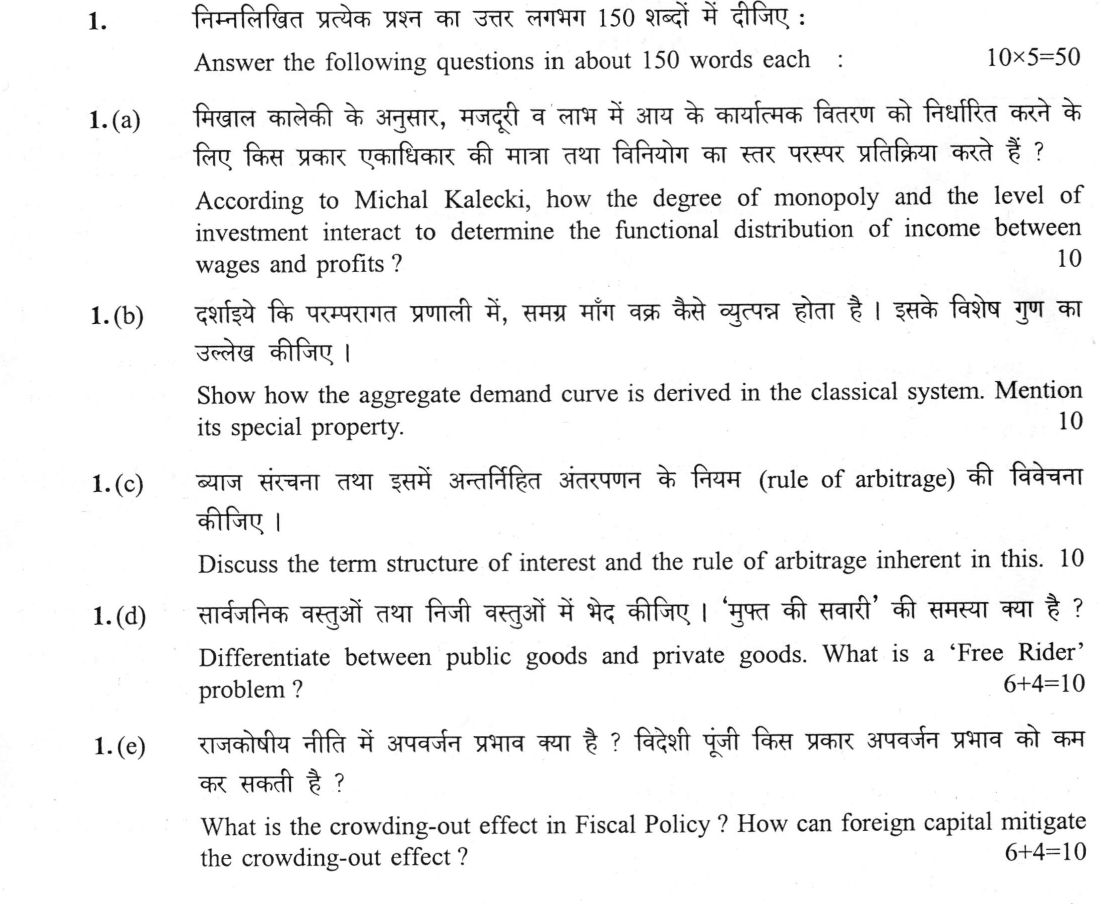
(a) According to Michal Kalecki, how the degree of monopoly and the level of investment interact to determine the functional…
Answer the following questions in about 150 words each :
According to Michal Kalecki, how the degree of monopoly and the level of investment interact to determine the functional distribution of income between wages and profits ? 10 marks
Show how the aggregate demand curve is derived in the classical system. Mention its special property. 10 marks
Discuss the term structure of interest and the rule of arbitrage inherent in this. 10 marks
Differentiate between public goods and private goods. What is a ‘Free Rider’ problem ? 10 marks
What is the crowding-out effect in Fiscal Policy ? How can foreign capital mitigate the crowding-out effect ? 10 marks
हिंदी में प्रश्न पढ़ें
निम्नलिखित प्रत्येक प्रश्न का उत्तर लगभग 150 शब्दों में दीजिए :
मिखाल कालेकी के अनुसार, मजदूरी व लाभ में आय के कार्यात्मक वितरण को निर्धारित करने के लिए किस प्रकार एकाधिकार की मात्रा तथा विनियोग का स्तर परस्पर प्रतिक्रिया करते हैं ? (10 अंक)
दर्शाइए कि परम्परागत प्रणाली में, समग्र मांग वक्र कैसे व्युत्पन्न होता है । इसके विशेष गुण का उल्लेख कीजिए । (10 अंक)
ब्याज की अवधि संरचना (term structure) तथा इसमें अन्तर्निहित अंतरणपण के नियम (rule of arbitrage) की विवेचना कीजिए । (10 अंक)
सार्वजनिक वस्तुओं तथा निजी वस्तुओं में भेद कीजिए । ‘मुफ्त की सवारी’ की समस्या क्या है ? (10 अंक)
राजकोषीय नीति में अपवर्जन प्रभाव क्या है ? विदेशी पूँजी किस प्रकार अपवर्जन प्रभाव को कम कर सकती है ? (10 अंक)
Model answer
Drafted with AI by UPSC Answer Check against this question's marking rubric, to the 150-word length. UPSC does not publish answers for Mains — this is one way to score well, not an official key. How we build rubrics and answers.
(a) Kalecki distribution (10 marks)
According to Michal Kalecki (Theory of Economic Dynamics, 1954), the functional distribution of income is determined by the interaction of the degree of monopoly and the level of investment. The degree of monopoly, measured by the mark-up factor m (the ratio of price to average prime cost), fixes the wage-profit share. Using the pricing equation p = m(u + w), the relative wage share is expressed as W/Y = 1/[1 + (m - 1)(1 + j)], where j is the materials-to-wages ratio. Thus, a higher mark-up implies a lower wage share.
Simultaneously, the level of investment determines the absolute mass of profits. Under the classical savings assumption that workers do not save, total profits equal investment plus capitalists' consumption (P = I + Cₖ). These two determinants interact to determine the level of output: while investment fixes the total mass of profits, the degree of monopoly determines how that mass is divided. Consequently, a higher mark-up requires a lower equilibrium level of income and employment to deliver the same profit mass. This framework rejects marginal productivity theory, emphasizing instead the role of industrial composition and the mark-up in the wage-profit division.
(b) Classical AD (10 marks)
In the classical system, the aggregate demand (AD) curve is derived from the quantity theory of money. Using the equation of exchange MV = PY (Irving Fisher) or the Cambridge equation M = kPY, where M is the money supply, V is the velocity of circulation, and P is the price level, the classical AD function is expressed as Y = MV/P. This relationship implies that the real value of output is determined by the real value of the fixed nominal money stock.
The special property of this curve is that it is a rectangular hyperbola with unit elasticity. It is downward sloping (dY/dP = -MV/P² < 0) because an increase in the price level reduces the real value of money, thereby reducing the quantity of goods demanded. The curve shifts only with changes in M or V. In the classical model, the aggregate supply curve is vertical at full-employment output, reflecting the classical dichotomy and the neutrality of money. Thus, changes in the money supply affect only the price level, leaving real output unchanged.
(c) Term structure (10 marks)
The term structure of interest rates, or the yield curve, describes the relationship between interest rates and the maturity of bonds. The arbitrage rule inherent in this structure is the pure expectations theory (Fisher, Lutz), which states that a long-term rate equals the geometric average of expected future short-term rates. The condition is (1 + Rₙ)ⁿ = Π(1 + E rₜ), where Rₙ is the long rate and E rₜ are expected future spot rates. This implies that the forward rate is the expected future spot rate, as riskless profits from rolling over short-term bonds versus holding to maturity are competed away by arbitrage.
However, the pure expectations theory does not explain the normally upward slope of the yield curve. Modifying theories include Hicks's liquidity premium theory, which adds a positive term premium for holding long-term bonds; Culbertson's market segmentation theory, which argues that different maturities are separate markets; and Modigliani-Sutch's preferred habitat theory, which suggests investors have preferred maturities but will shift if the return is sufficiently higher. These theories explain the shape of the curve and the role of risk premia.
(d) Public vs private; free rider (10 marks)
Public and private goods are distinguished by the criteria of rivalry and excludability. Private goods are rival and excludable, where the optimality condition is MRS = MRT and demand curves are summed horizontally. In contrast, public goods (Samuelson, 1954) are non-rival and non-excludable. The Samuelson condition for public goods is Σ MRS = MRT, and demand curves are summed vertically. This distinction is crucial for determining the efficient level of provision.
The 'Free Rider' problem arises because individuals can benefit from public goods without paying for them. This leads to a failure of voluntary preference revelation, as individuals have an incentive to understate their willingness to pay. The consequence is the under-provision of public goods, a significant market failure. Lindahl pricing, in which each person pays a tax-price equal to his marginal benefit, would be efficient but cannot be reached voluntarily for the same reason. While club goods (Buchanan) and common-pool resources sit in between these categories, the free-rider problem necessitates tax finance or demand-revealing mechanisms like the Clarke-Groves mechanism to achieve an efficient outcome.
(e) Crowding-out and foreign capital (10 marks)
The crowding-out effect in fiscal policy refers to the displacement of private investment by government borrowing. When the government increases spending, it raises the demand for loanable funds, which increases the interest rate. Costlier borrowing then reduces private investment. The magnitude of this effect depends on the slope of the LM curve: it is complete when the LM curve is vertical (at full employment) and zero in a liquidity trap. Under Ricardian equivalence (Barro, 1974), debt-financed spending is offset by higher private saving, neutralising the stimulus itself.
Foreign capital inflows (FDI, FPI, external commercial borrowings) can mitigate this effect by augmenting the supply of loanable funds. Under the Mundell-Fleming model, with perfect capital mobility and a fixed exchange rate, fiscal policy is fully effective because capital inflows finance the deficit, preventing the interest rate from rising. This relaxes the savings and foreign-exchange constraints (Chenery-Strout two-gap logic). However, under flexible exchange rates, the inflow may lead to currency appreciation, which can crowd out net exports. Where the deficit finances public infrastructure, higher private returns can even 'crowd in' investment. Thus, foreign capital helps to mute the interest-rate channel of crowding-out.
How this answer will be evaluated
Evaluation rubric
Each sub-part is marked on its own, against the marks and word limit printed on the paper.
- (a) Explain Kalecki's theory of functional (factor) distribution: how the 'degree of monopoly' fixes the WAGE/PROFIT SHARE while the level of investment (plus capitalists' consumption) fixes the ABSOLUTE MASS of profits, and how the two interact to determine output and the wage-profit division. Both determinants must be handled and linked, not described separately. 10 marks · 150 words
Must cover
- degree of monopoly (mark-up factor m: ratio of price to average prime cost) fixes the relative shares
- p = m(u + w)
- relative wage share W/Y = 1/[1 + (m - 1)(1 + j)]
- P = I + C_k (profits equal investment plus capitalists' consumption)
- classical savings assumption: workers do not save
Loses marks
- Treating the question as a general essay on income distribution and using marginal productivity theory, which Kalecki explicitly rejects
- Describing the degree of monopoly and investment in separate paragraphs without showing the interaction (share versus mass of profits)
- Reversing Kalecki's causation by saying profits determine investment
- Omitting the mark-up pricing equation or the wage-share expression, leaving the answer purely verbal
- Ignoring the role of the materials-to-wages ratio j and of industrial composition in the wage share
Earns more
- Interaction: investment fixes the mass of profits while the degree of monopoly fixes the share, so a higher mark-up implies a lower equilibrium level of income/employment for the same profit mass
Extra mark
- Citation of Kalecki, Theory of Economic Dynamics (1954)
- (b) Derive the classical aggregate demand curve from the quantity theory of money (MV = PY or the Cambridge equation M = kPY) and state its special property - that it is a rectangular hyperbola with unit elasticity, shifting only with M (or V). Both the derivation and the special property must be answered. 10 marks · 150 words
Must cover
- Equation of exchange MV = PY (Irving Fisher) or Cambridge equation M = kPY
- Y = MV/P as the classical AD function
- rectangular hyperbola; unit elasticity
- vertical classical AS at full-employment output
- classical dichotomy and neutrality of money
Loses marks
- Deriving AD from the Keynesian C + I + G + (X - M) or from an IS-LM framework instead of the quantity theory
- Explaining the downward slope through the Keynes interest-rate effect or the net-export effect of the Keynesian AD curve, which are not the classical route
- Stating that the curve slopes downward but failing to name the special property (rectangular hyperbola, unit elasticity) - the second half of the question
- Claiming the classical AD curve depends on the rate of interest
- Drawing AD with Y on the vertical axis or mislabelling the axes
Earns more
- Statement and explanation of the downward slope, dY/dP = -MV/P^2 < 0, through the real value of the fixed nominal money stock
- (c) Explain what the term structure of interest rates (yield curve) is and set out the arbitrage rule embedded in it - the pure expectations condition that a long rate equals the geometric average of expected future short rates because riskless profits from rolling over versus holding to maturity are competed away. Both the concept and the arbitrage rule must be covered. 10 marks · 150 words
Must cover
- yield curve / term structure
- pure expectations theory (Fisher, Lutz)
- (1 + R_2)^2 = (1 + r_1)(1 + E(r_2))
- forward rate as expected future spot rate
- Hicks liquidity premium theory
- market segmentation (Culbertson) and preferred habitat (Modigliani-Sutch)
Loses marks
- Writing about the general determination of the rate of interest (loanable funds / liquidity preference) instead of the maturity structure
- Describing the yield curve's shapes but never stating the arbitrage equation, which the question explicitly demands
- Adding the short rates arithmetically without recognising that the exact condition is a geometric (compounded) average
- Confusing the term structure with the risk structure of interest rates (default-risk premia across borrowers)
- Asserting that the expectations theory alone explains the normally upward slope, which in fact requires a positive liquidity premium
Earns more
- The arbitrage mechanism - buying/selling across maturities until no riskless gain remains - and the resulting reading of forward rates as expected future spot rates
- Modifying theories: Hicks's liquidity/term premium, Culbertson's market segmentation, Modigliani-Sutch preferred habitat
- (d) Two explicit tasks: (i) distinguish public from private goods on the criteria of rivalry and excludability, including the different optimality conditions; and (ii) define and explain the free-rider problem and its consequence for provision. Both parts must be answered. 10 marks · 150 words
Must cover
- Paul A. Samuelson, The Pure Theory of Public Expenditure (1954)
- non-rivalry (non-rival consumption) and non-excludability
- Samuelson condition: Sigma MRS = MRT; vertical summation of demand curves
- Lindahl equilibrium / Lindahl prices
- free rider and under-provision as market failure
- club goods (Buchanan) and common-pool resources (tragedy of the commons)
Loses marks
- Equating public goods with goods produced in the public sector (railways, public-sector steel), which are private goods commercially supplied
- Listing only examples without stating the two defining criteria
- Omitting the vertical-versus-horizontal summation distinction or the Samuelson condition at the 10-mark level
- Defining the free-rider problem but not stating its consequence - under-provision and the failure of voluntary preference revelation
- Confusing free riding with externalities or with the moral-hazard/adverse-selection problems of insurance
Earns more
- Samuelson condition Sigma MRS = MRT and vertical summation of demand curves versus MRS = price ratio and horizontal summation for private goods
- Consequence and remedies: preference-revelation failure, under-provision/market failure, Lindahl equilibrium unattainable voluntarily, tax finance and Clarke-Groves demand-revealing mechanisms; four-fold classification including club goods and common-pool resources
- (e) Two explicit tasks: (i) define the crowding-out effect of fiscal policy and explain its mechanism and the conditions governing its size; and (ii) explain how foreign capital inflows can mitigate it. Both must be answered; a mere definition will not do. 10 marks · 150 words
Must cover
- crowding out of private investment through a rise in the rate of interest
- IS-LM: vertical LM = complete crowding out; liquidity trap = zero crowding out
- Ricardian equivalence (Barro, 1974)
- FDI / FPI / external commercial borrowings augmenting loanable funds and relaxing the savings and foreign-exchange gaps
- Mundell-Fleming: fiscal policy fully effective under fixed rates with perfect capital mobility
- exchange-rate appreciation crowding out net exports under flexible rates
- crowding in through public infrastructure investment
Loses marks
- Defining crowding out without naming the interest-rate channel, so the mechanism is left unexplained
- Failing to state the conditions under which crowding out is complete or zero (slope of the LM curve, interest elasticity of investment)
- Answering only the first half and ignoring the foreign-capital part, which carries half the marks
- Claiming foreign capital removes crowding out unconditionally, without the flexible-exchange-rate/net-export caveat
- Confusing crowding out with inflationary financing or with the government's revenue-expenditure mix
Earns more
- Conditions on its magnitude: complete with a vertical LM or at full employment, zero in a liquidity trap or with interest-inelastic investment; mention of Ricardian equivalence and of resource/direct crowding out
- Mundell-Fleming result: with perfect capital mobility under a fixed exchange rate fiscal policy is fully effective and crowding out vanishes; two-gap logic that foreign capital relaxes the savings and foreign-exchange constraints
What "Calculate" is asking you to do
Apply the standard formula or schedule to data the question has already supplied — a table of readings, cost records, a balance sheet — and produce the number. The method is rarely in doubt; the marks sit in the named intermediate quantities, each of which has to appear as a labelled line.
Structure that answers it
Data as given → formula or standard treatment, named → substitution → each intermediate, labelled → result with units
Where marks are lost
Omitting an intermediate the marking scheme pays for separately, or rounding at an intermediate line so the final figure drifts. In commerce and accountancy, any figure in a statement that no numbered working note supports is treated as unearned.
Practice this exact question
Write your answer and it is marked point by point against the model answer above — what you covered, what you missed, what you got wrong.
Evaluate my answer →More from Economics 2026 Paper I
- Q1 Answer the following questions in about 150 words each : (a) According to Michal Kalecki,…
- Q2 (a) Under what conditions, does a market reach equilibrium ? Analyse the differences in s…
- Q3 (a) The following values for an economy are given : C = 0.8 (1 – t)Y t = 0.25 I = 900 – 5…
- Q4 (a) Explain the instruments through which the government of any country tries to successf…