Paper I — Q3
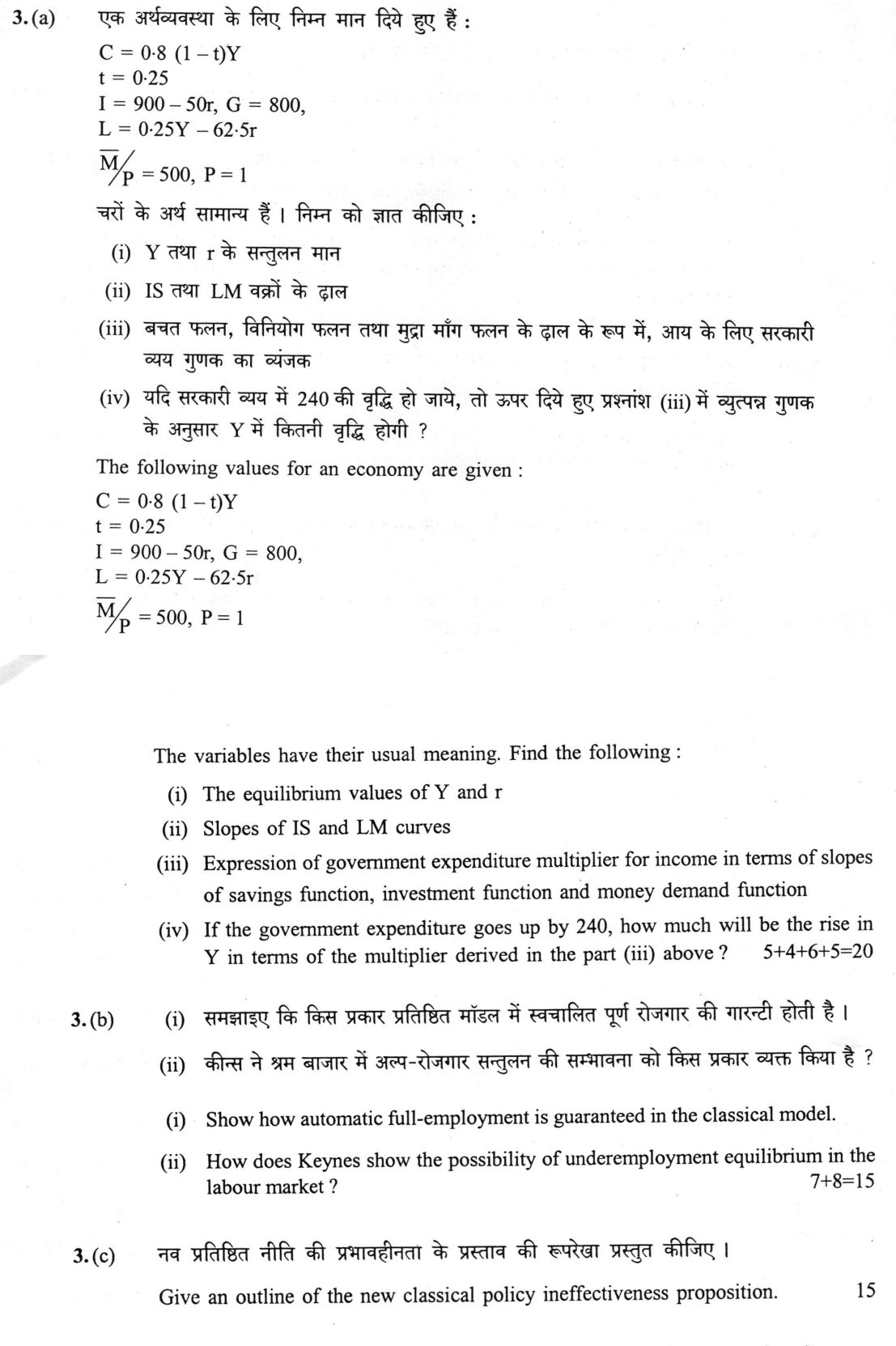
(a) The following values for an economy are given : C = 0.8 (1 – t)Y t = 0.25 I = 900 – 50r, G = 800, L = 0.25Y – 62.5r M̄/P =…
The following values for an economy are given : C = 0.8 (1 – t)Y t = 0.25 I = 900 – 50r, G = 800, L = 0.25Y – 62.5r M̄/P = 500, P = 1 The variables have the usual meaning. Find out the following : Equilibrium values of Y and r
Slopes of IS and LM curves
Expression of Government expenditure multiplier for income in terms of slopes of saving function, investment function and money demand function
If Government expenditure increases by 240, then how much Y would increase as per the multiplier derived in the question part (iii) above ? 20 marks
Show how automatic full-employment is guaranteed in the classical model.
How does Keynes show the possibility of underemployment equilibrium in the labour market ? 15 marks
Give an outline of the new classical policy ineffectiveness proposition. 15 marks
हिंदी में प्रश्न पढ़ें
एक अर्थव्यवस्था के लिए निम्न मान दिये हुए हैं : C = 0.8 (1 – t)Y t = 0.25 I = 900 – 50r, G = 800, L = 0.25Y – 62.5r M̄/P = 500, P = 1 चरों के अर्थ सामान्य हैं । निम्न को ज्ञात कीजिए : Y तथा r के सन्तुलन मान
IS तथा LM वक्रों के ढाल
बचत फलन, विनियोग फलन तथा मुद्रा माँग फलन के ढाल के रूप में, आय के लिए सरकारी व्यय गुणक का व्यंजक
यदि सरकारी व्यय में 240 की वृद्धि हो जाये, तो ऊपर दिये हुए प्रश्नांश (iii) में व्युत्पन्न गुणक के अनुसार Y में कितनी वृद्धि होगी ? (20 अंक)
समझाइए कि किस प्रकार प्रतिष्ठित मॉडल में स्वचालित पूर्ण रोजगार की गारन्टी होती है ।
कीन्स ने श्रम बाजार में अल्प-रोजगार सन्तुलन की सम्भावना को किस प्रकार व्यक्त किया है ? (15 अंक)
नव प्रतिष्ठित नीति की प्रभावहीनता के प्रस्ताव की रूपरेखा प्रस्तुत कीजिए । (15 अंक)
Model answer
Drafted with AI by UPSC Answer Check against this question's marking rubric, to the expected length. UPSC does not publish answers for Mains — this is one way to score well, not an official key. How we build rubrics and answers.
(a) IS–LM Model Analysis (20 marks)
Step 1: IS curve Post-tax MPC = 0.8 × (1 − 0.25) = 0.6. Goods market: Y = C + I + G Y = 0.6Y + (900 − 50r) + 800 0.4Y = 1700 − 50r Y = 4250 − 125r (IS)
Step 2: LM curve Money market: L = M̄/P = 500 0.25Y − 62.5r = 500 Y = 2000 + 250r (LM)
(i) Equilibrium values of Y and r 4250 − 125r = 2000 + 250r 2250 = 375r **r* = 6** Y* = 2000 + 250(6) = 3500 (check on IS: 4250 − 750 = 3500)
(ii) Slopes of IS and LM curves With r on the vertical axis and Y on the horizontal axis (slope = dr/dY):
- IS slope: from Y = 4250 − 125r, dr/dY = −1/125 (−0.008)
- LM slope: from Y = 2000 + 250r, dr/dY = +1/250 (+0.004)
(iii) Government expenditure multiplier dY/dG = 1/(s + bk/h) where:
- s = 1 − c(1 − t) = 0.4, slope of the leakage (saving plus tax) function
- b = 50, slope of the investment function with respect to r
- k = 0.25 and h = 62.5, income and interest slopes of the money demand function
dY/dG = 1/(0.4 + (50 × 0.25)/62.5) = 1/(0.4 + 0.2) = 1/0.6 Multiplier = 5/3 ≈ 1.667
(iv) Increase in Y when G rises by 240 ΔY = (5/3) × 240 = 400 The simple multiplier 1/s = 2.5 would give 600. The gap of 200 is crowding out: r rises by 400/250 = 1.6, cutting investment by 50 × 1.6 = 80, and 2.5 × 80 = 200.
(b) Classical Full Employment vs. Keynesian Underemployment (15 marks)
(i) Automatic Full Employment in the Classical Model The classical model guarantees full employment through the continuous adjustment of prices and wages.
- Labour Market: Labour demand is determined by the marginal product of labour (MPL = W/P). Because there is no "money illusion," workers respond to changes in the real wage (W/P). If unemployment exists, the real wage is above the equilibrium; flexible wages will fall until the labour market clears.
- Goods Market (Say’s Law): "Supply creates its own demand." A flexible interest rate equates saving and investment (S(r) = I(r)), so any excess saving is absorbed as investment; Pigou later reinforced this with the real-balance effect (falling prices raise real money balances and consumption). Thus, the only unemployment in this model is frictional or voluntary.
(ii) Keynesian Underemployment Equilibrium Keynes argues that the economy can settle at an equilibrium below full employment.
- Money Wage Rigidity: Wages are determined by bargaining in terms of money, not real wages. They are "downward rigid," meaning they do not fall easily to clear the labour market.
- Effective Demand: Employment is determined by the point where the Aggregate Demand Price (D) equals the Aggregate Supply Price (Z). If D is insufficient, firms will not hire all available workers.
- Involuntary Unemployment (General Theory, 1936): This occurs when workers are willing to work at the prevailing money wage but cannot find jobs. Because of the "liquidity trap" (where money demand is perfectly interest-elastic, so the interest rate cannot fall further) and interest-inelastic investment, even if wages were flexible, the resulting fall in aggregate demand could prevent a return to full employment.
(c) New Classical Policy Ineffectiveness Proposition (15 marks)
The Policy Ineffectiveness Proposition (PIP), associated with Robert Lucas, Thomas Sargent, and Neil Wallace (1975/1976), argues that only unanticipated policy changes can affect real output.
Building Blocks:
- Rational Expectations (Muth, 1961): Agents use all available information and the true structure of the economy to form expectations. They do not make systematic errors.
- Continuous Market Clearing: Prices and wages are perfectly flexible, and markets clear instantly.
- Lucas Surprise Supply Function: Output (Y) deviates from its natural level (Yₙ) only when there is a "surprise" in the price level: Y = Yₙ + α(P - P^e) Where P is the actual price level and P^e is the expected price level.
Central Result: If the central bank announces a policy (e.g., increasing money supply), rational agents will immediately adjust P^e to match the new P. Consequently, (P - P^e) = 0, and Y remains at Yₙ. Only a policy that agents did not foresee can temporarily shift output.
Policy Corollaries and Criticisms:
- Corollaries: Anticipated policy moves the economy only along a vertical Phillips curve, so a credible disinflation can have a near-zero sacrifice ratio. The related Lucas Critique (1976) states that traditional models are invalid because they ignore how expectations change with policy. It also supports Kydland and Prescott’s (1977) argument for "rules" over "discretion" due to the time-inconsistency of policy.
- Criticisms: Fischer (1977) and Taylor (1980) showed that if wages are set via overlapping contracts (staggered), even rational agents cannot all adjust at once, making policy effective in the short run. New Keynesian models also emphasize "price stickiness" (menu costs) which allows for real effects of anticipated policy.
How this answer will be evaluated
Evaluation rubric
Each sub-part is marked on its own, against the marks and word limit printed on the paper.
- (a) A four-part IS-LM problem with C = 0.8(1 - t)Y, t = 0.25, I = 900 - 50r, G = 800, L = 0.25Y - 62.5r, M/P = 500, P = 1. Required: (i) equilibrium Y and r; (ii) the slopes of the IS and LM curves; (iii) an algebraic expression for the government-expenditure multiplier in terms of the slopes of the saving, investment and money-demand functions; (iv) the resulting increase in Y when G rises by 240. All four parts must be answered. 20 marks
Must cover
- IS: Y = 4250 - 125r
- LM: Y = 2000 + 250r
- r* = 6, Y* = 3500
- IS slope -1/125 (-0.008) and LM slope +1/250 (+0.004) in (Y, r) space
- dY/dG = 1/(s + bk/h) with s = 1 - c(1 - t) = 0.4, b = 50, k = 0.25, h = 62.5, giving 1/0.6 = 1.667
- Delta Y = 400
Loses marks
- Forgetting the tax rate and using an MPC of 0.8 instead of the post-tax marginal propensity to consume 0.8(0.75) = 0.6, which wrongly gives a leakage of 0.2
- Sign error in the LM equation, writing 0.25Y + 62.5r = 500 and obtaining a negative interest rate
- Reporting slopes without saying which variable is on which axis, so the grader cannot tell whether -0.008 or -125 is meant
- Answering part (iii) with the simple Keynesian multiplier 1/s = 2.5 instead of deriving the IS-LM multiplier 1/(s + bk/h)
- Using the simple multiplier in part (iv) and reporting Delta Y = 600, or failing to note that crowding out accounts for the difference
Earns more
- Correct post-tax MPC 0.8(1 - 0.25) = 0.6 and step-by-step derivation of the IS and LM equations
- Explaining the 200 gap between the simple-multiplier (600) and IS-LM (400) outcomes as crowding out: r rises by 1.6, investment falls by 80
- (b) Two explicit sub-parts: (i) show how the classical model guarantees automatic full employment (labour-market clearing through flexible real wages, plus Say's Law and a flexible interest rate); and (ii) show how Keynes establishes the possibility of an underemployment equilibrium in the labour market. Both must be answered, with the labour-market mechanics made explicit. 15 marks
Must cover
- MPL = W/P as the classical labour demand condition
- absence of money illusion in classical labour supply
- Say's Law; S(r) = I(r); Pigou real-balance effect
- downward rigidity of money wages / bargaining over money wages
- point of effective demand: aggregate demand price D1 + D2 = aggregate supply price Z
- involuntary unemployment as defined in the General Theory (1936)
- liquidity trap and interest-inelastic investment
Loses marks
- Answering only with the IS-LM or AD-AS apparatus and never presenting the LABOUR MARKET, which both sub-parts explicitly require
- Reducing Keynes's case to money-wage rigidity alone; the General Theory argues that even flexible wages need not restore full employment
- Asserting that the classical model assumes money-wage rigidity, which is the opposite of its assumption
- Confusing voluntary and frictional unemployment with Keynes's involuntary unemployment, or not defining the latter
- Omitting Say's Law and the saving-investment mechanism, which is what completes the classical guarantee
Earns more
- Classical demand-side closure: Say's Law and a flexible interest rate equating S(r) and I(r), with the Pigou real-balance effect; unemployment only frictional or voluntary
- Keynes's definition of involuntary unemployment and the resulting underemployment equilibrium as a stable position of the system, justifying demand management
- (c) Outline the new classical policy ineffectiveness proposition (PIP): its three building blocks (rational expectations, continuous market clearing, and the Lucas surprise supply function), its central result that only UNANTICIPATED policy affects real output, and its policy corollaries and criticisms. 15 marks
Must cover
- Sargent and Wallace (1975/1976); Robert Lucas
- rational expectations (John Muth, 1961)
- continuous market clearing
- Lucas surprise supply function Y = Y_n + alpha(P - P^e)
- only unanticipated policy has real effects
- Lucas critique (1976); Kydland-Prescott time inconsistency (1977)
- Fischer (1977) / Taylor overlapping wage contracts as the standard rebuttal
Loses marks
- Confusing the proposition with Friedman's natural-rate hypothesis; the new classical claim is stronger - neutrality in the SHORT run too, for anticipated policy
- Stating rational expectations but omitting the surprise supply function or continuous market clearing, so the result is asserted rather than derived
- Claiming that new classical economists hold that NO policy has real effects; unanticipated policy does
- Writing an outline with no critique, when 'give an outline' at 15 marks expects the limitations too
- Attributing the proposition to real business cycle theory, which is a later and separate strand
Earns more
- Policy corollaries: short-run vertical Phillips curve for anticipated policy, near-zero sacrifice ratio for a credible disinflation, the Lucas critique (1976), time inconsistency (Kydland-Prescott, 1977) and the case for rules over discretion
- Criticisms: Fischer (1977) and Taylor overlapping nominal contracts restore effectiveness under rational expectations; superior policymaker information; new Keynesian price stickiness; contrary empirical evidence
What "Solve" is asking you to do
Choose the method, then carry it through to a final answer. Identifying what kind of problem this is and why that method applies is the first thing marked; a correct figure arrived at invisibly earns almost nothing.
Structure that answers it
Given data and what is required → method chosen, with the reason it applies → set-up (equation, circuit, free body, trial balance) → working, step by step → answer with units and any condition of validity
Where marks are lost
Doing the middle steps mentally and writing only the result. In mathematics papers, a further loss comes from giving a decimal where the exact value in surds or fractions was wanted, or from skipping the justification a part explicitly asks for.
Practice this exact question
Write your answer and it is marked point by point against the model answer above — what you covered, what you missed, what you got wrong.
Evaluate my answer →More from Economics 2026 Paper I
- Q1 Answer the following questions in about 150 words each : (a) According to Michal Kalecki,…
- Q2 (a) Under what conditions, does a market reach equilibrium ? Analyse the differences in s…
- Q3 (a) The following values for an economy are given : C = 0.8 (1 – t)Y t = 0.25 I = 900 – 5…
- Q4 (a) Explain the instruments through which the government of any country tries to successf…
- Q5 Answer the following questions in about 150 words each : (a) “Import tariffs typically re…
- Q6 (a) Discuss the major differences between Old and New international trade theories. (20 m…