Paper I — Q5
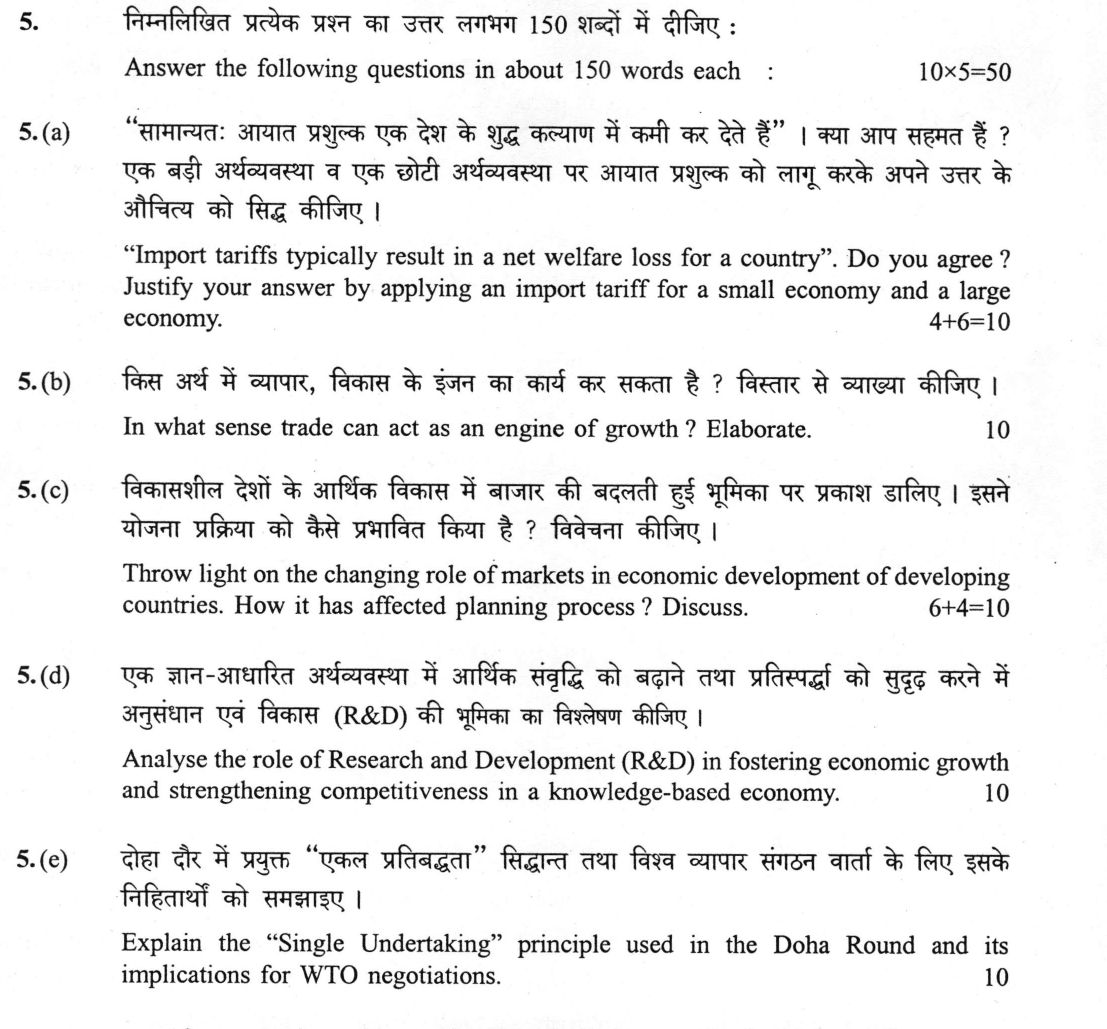
(a) “Import tariffs typically result in a net welfare loss for a country”. Do you agree ? Justify your answer by applying an…
Answer the following questions in about 150 words each :
“Import tariffs typically result in a net welfare loss for a country”. Do you agree ? Justify your answer by applying an import tariff for a small economy and a large economy. 10 marks
In what sense trade can act as an engine of growth ? Elaborate. 10 marks
Throw light on the changing role of markets in economic development of developing countries. How it has affected planning process ? Discuss. 10 marks
Analyse the role of Research and Development (R&D) in fostering economic growth and strengthening competitiveness in a knowledge-based economy. 10 marks
Explain the “Single Undertaking” principle used in the Doha Round and its implications for WTO negotiations. 10 marks
हिंदी में प्रश्न पढ़ें
निम्नलिखित प्रत्येक प्रश्न का उत्तर लगभग 150 शब्दों में दीजिए :
“सामान्यत: आयात प्रशुल्क एक देश के शुद्ध कल्याण में कमी कर देते हैं” । क्या आप सहमत हैं ? एक बड़ी अर्थव्यवस्था व एक छोटी अर्थव्यवस्था पर आयात प्रशुल्क को लागू करके अपने उत्तर के औचित्य को सिद्ध कीजिए । (10 अंक)
किस अर्थ में व्यापार, संवृद्धि (growth) के इंजन का कार्य कर सकता है ? विस्तार से व्याख्या कीजिए । (10 अंक)
विकासशील देशों के आर्थिक विकास में बाजार की बदलती हुई भूमिका पर प्रकाश डालिए । इसने योजना प्रक्रिया को कैसे प्रभावित किया है ? विवेचना कीजिए । (10 अंक)
एक ज्ञान-आधारित अर्थव्यवस्था में आर्थिक संवृद्धि को बढ़ाने तथा प्रतिस्पर्द्धा को सुदृढ़ करने में अनुसंधान एवं विकास (R&D) की भूमिका का विश्लेषण कीजिए । (10 अंक)
दोहा दौर में प्रयुक्त “एकल प्रतिबद्धता” सिद्धान्त तथा विश्व व्यापार संगठन वार्ता के लिए इसके निहितार्थों को समझाइए । (10 अंक)
Model answer
Drafted with AI by UPSC Answer Check against this question's marking rubric, to the 150-word length. UPSC does not publish answers for Mains — this is one way to score well, not an official key. How we build rubrics and answers.
(a) Tariffs (10 marks)
I agree with the statement for a small economy, but only with qualifications for a large one. In a small economy, which is a price-taker, an import tariff raises the domestic price by the full amount of the duty. The resulting welfare change is a loss in consumer surplus that exceeds the gain in producer surplus and government tariff revenue. The net welfare loss is represented by the two deadweight loss triangles (b + d), reflecting the production (protection) and consumption effects.
For a large economy, the analysis differs because the country can influence the world price. A tariff reduces the world price, generating a terms-of-trade gain (a rectangle). If this gain exceeds the domestic deadweight loss (b + d), the country experiences a net welfare gain. This occurs up to the optimum tariff rate, t* = 1/e*. However, this is a beggar-thy-neighbour policy that reduces world welfare and risks retaliation or tariff wars. Extensions: Lerner symmetry (an import tariff equals an export tax) and the Metzler paradox (the domestic price may even fall).
(b) Trade as engine of growth (10 marks)
Trade acts as an engine of growth, a concept popularised by D. H. Robertson, by raising the long-run growth rate rather than just the income level. The static "vent for surplus" (Adam Smith, revived by Hla Myint) allows a country to utilise idle resources. More importantly, dynamic channels drive growth: access to larger markets enables economies of scale and Kaldor-Verdoorn effects, where higher output leads to lower costs. Trade facilitates technology transfer, FDI spillovers, and learning by doing, which are central to endogenous growth models (Romer, Grossman-Helpman). Additionally, exports finance capital-goods imports, alleviating the foreign-exchange constraint described in Thirlwall’s law.
However, this role is qualified. Nurkse was sceptical of trade's benefits, and the Prebisch-Singer thesis argues that terms of trade deteriorate for developing nations. Bhagwati’s "immiserizing growth" shows trade can be harmful. East Asia's export-led growth shows its potential; yet, as Kravis (1970) noted, trade is more a "handmaiden" of growth, requiring sound domestic institutions.
(c) Markets and planning (10 marks)
The role of markets in developing countries has evolved from state-led planning to a market-friendly approach. Early theories, Rosenstein-Rodan's "big push", Nurkse's balanced growth and Hirschman's unbalanced growth, supported import-substituting industrialisation (ISI) under heavy state intervention and licensing. The rise of rent-seeking (Anne Krueger) and wasteful "DUP" activities (Bhagwati) led to a shift: the Washington Consensus (Williamson, 1989), structural adjustment and the World Development Report 1991 advocated a market-friendly approach. New institutional economics then stressed property rights, contract enforcement and regulation; after 2008, industrial and mission-oriented policy returned.
This shift altered the planning process. Planning moved from imperative (direct control) to indicative (guidance), and the state's role turned to building institutions, independent regulators and public-private partnerships. In India, the 1991 reforms ended most industrial licensing, the Twelfth Five Year Plan (2012-17) was the last, and NITI Aayog replaced the Planning Commission on 1 January 2015, with outcome-based budgeting.
(d) R&D (10 marks)
In a knowledge-based economy, Research and Development (R&D) is the primary driver of growth. According to Paul Romer (1990), knowledge is a non-rival good with increasing returns, making growth endogenous; R&D shows up as higher total factor productivity (the Solow residual). Aghion and Howitt (1992) link R&D to Schumpeterian "creative destruction", where new innovations replace old technologies. Because knowledge has positive spillovers, the social return on R&D exceeds the private return (Arrow, Nelson), justifying public support to correct market failure.
R&D also strengthens competitiveness by moving a country up the value chain. It lets firms lead the product cycle (Vernon) and exploit technological gaps (Posner), strengthening Porter's "diamond" of national advantage. However, its impact depends on absorptive capacity (Cohen and Levinthal) and a strong national innovation system (Freeman, Lundvall, Nelson). In India, gross expenditure on R&D (GERD) remains below 1% of GDP, with a small private share and weak university-industry links.
(e) Single undertaking (10 marks)
The "Single Undertaking" principle means "nothing is agreed until everything is agreed". First used in the Uruguay Round, it produced the WTO Agreement (1995), which members had to accept as a whole, with only the Annex 4 plurilaterals outside it. The Doha Ministerial Declaration (November 2001) applied it to the Doha Development Agenda, so agriculture, NAMA (non-agricultural market access), services and rules formed one package.
The intended implication was to protect weaker members, since concessions in one area could be traded against gains in another. In practice, combined with consensus decision-making, it let any single issue hold the whole round hostage: disputes over agricultural subsidies, the special safeguard mechanism, public stockholding and NAMA stalled Doha. Negotiators turned to "early harvests" such as the Bali Package (2013) and the Trade Facilitation Agreement (in force 2017), to plurilateral Joint Statement Initiatives (JSIs), which India opposes as outside the WTO mandate, and to regional trade agreements.
How this answer will be evaluated
Evaluation rubric
Each sub-part is marked on its own, against the marks and word limit printed on the paper.
- (a) Take a position on whether an import tariff always causes a net welfare loss, and justify it by applying partial-equilibrium tariff analysis SEPARATELY to a small economy (price-taker) and a large economy (able to move the world price). The expected answer is qualified agreement: unambiguous net loss for a small country, but a possible net gain up to the optimum tariff for a large country. 10 marks · 150 words
Must cover
- consumer surplus, producer surplus and tariff revenue areas; deadweight loss b + d
- production (protection) effect and consumption effect
- terms-of-trade gain for a large country
- optimum tariff t* = 1/e* (elasticity of foreign export supply)
- retaliation and tariff war; beggar-thy-neighbour
- Lerner symmetry theorem or the Metzler paradox (as an extension)
Loses marks
- Treating the two cases identically and concluding that a tariff always reduces welfare, which ignores the terms-of-trade effect that the question sets up
- Forgetting that government tariff revenue is a transfer, not a loss, and counting the whole consumer-surplus loss as deadweight
- Mixing up the areas - the net loss is the two TRIANGLES b and d, not the revenue rectangle
- Asserting a large-country gain without the optimum-tariff condition or without noting the retaliation risk and the loss of world welfare
- Not giving a direct verdict on the statement, although the question asks 'Do you agree?'
Earns more
- Qualifications: beggar-thy-neighbour nature and loss of world welfare, retaliation and tariff wars, WTO bindings, rent-seeking and distributional (Stolper-Samuelson) effects
- (b) Explain the sense in which trade acts as an 'engine of growth' - the static and, more importantly, the DYNAMIC channels through which it raises long-run growth - and elaborate, which requires both the supporting mechanisms and the standard qualifications. 10 marks · 150 words
Must cover
- D. H. Robertson - trade as an engine of growth
- vent for surplus (Adam Smith; Hla Myint)
- economies of scale and widened markets; Kaldor / Verdoorn's law
- learning by doing, technology transfer, FDI spillovers, endogenous growth (Romer, Grossman-Helpman)
- Thirlwall's law / balance-of-payments constrained growth
- Nurkse (1959) scepticism; Prebisch-Singer; Kravis - trade as a handmaiden of growth
- East Asian export-led growth
Loses marks
- Listing only the static comparative-advantage gains, which explain a higher income level, not a higher growth RATE
- Writing a general essay on the benefits of globalisation without naming the specific transmission channels
- Offering no qualification at all, when 'elaborate' at 10 marks expects Nurkse's or Prebisch-Singer's counter-argument
- Attributing the phrase to the wrong author or leaving it unattributed
- Claiming trade guarantees growth, ignoring absorptive capacity, institutions and the enclave problem
Earns more
- Foreign-exchange constraint channel: exports finance capital-goods imports; Thirlwall's balance-of-payments constrained growth rate and two-gap analysis
- Qualifications and evidence: Nurkse's scepticism, Prebisch-Singer terms of trade, immiserizing growth (Bhagwati), commodity volatility, Kravis's 'handmaiden of growth'; East Asian export-led experience
- (c) Two linked tasks: trace how the role assigned to markets in the development of developing countries has CHANGED over time (state-led planning, the market-friendly turn, the institutional and post-crisis rebalancing), and then discuss how that shift altered the nature and content of PLANNING. Both parts must be answered. 10 marks · 150 words
Must cover
- Rosenstein-Rodan's big push; Nurkse's balanced growth; Hirschman's unbalanced growth
- import-substituting industrialisation and industrial licensing
- Anne Krueger on rent-seeking; Bhagwati on DUP activities
- Washington Consensus (Williamson, 1989); structural adjustment; World Development Report 1991 market-friendly approach
- new institutional economics - property rights, contract enforcement, regulation
- shift from imperative to indicative planning; regulators and public-private partnerships
- India: 1991 reforms, Twelfth Five Year Plan (2012-17) as the last, NITI Aayog from 2015
Loses marks
- Writing a history of Indian planning alone, when the question asks about developing countries generally, with India as an illustration
- Presenting the change as a simple story of the state retreating, missing the post-2008 return of industrial and mission-oriented policy
- Answering only the first half and ignoring the effect on the PLANNING PROCESS, which carries explicit marks
- Confusing indicative planning with the abandonment of planning altogether
- Getting the institutional facts wrong - for instance placing the end of the Planning Commission in the wrong year; it was replaced by NITI Aayog on 1 January 2015
Earns more
- Phase 3: the institutional and post-crisis rebalancing - property rights and regulation (North, Acemoglu), Stiglitz and information failures, the revival of industrial and mission-oriented policy after 2008
- Effect on planning in INSTITUTIONS: independent regulators for network industries and finance, public-private partnerships, outcome budgeting and evaluation, and in India the end of industrial licensing, the Twelfth Plan (2012-17) as the last Five Year Plan and the replacement of the Planning Commission by NITI Aayog in 2015
- (d) Analyse how research and development drives economic GROWTH and strengthens COMPETITIVENESS in a knowledge-based economy - the endogenous growth mechanism, the spillover/market-failure case for policy support, the competitiveness channels, and the constraints. Both the growth and the competitiveness limbs must be covered. 10 marks · 150 words
Must cover
- Paul Romer (1990) - non-rival ideas, increasing returns, endogenous growth
- Aghion and Howitt (1992) - Schumpeterian creative destruction
- knowledge as a quasi-public good; spillovers; social return above private return (Nelson, Arrow)
- total factor productivity / Solow residual
- Vernon's product cycle or Posner's technological gap; Porter's diamond
- absorptive capacity (Cohen and Levinthal); national innovation system (Freeman, Lundvall, Nelson)
- gross expenditure on R&D (GERD) as a share of GDP
Loses marks
- Writing a general essay on education and technology without naming an endogenous growth mechanism
- Treating knowledge as an ordinary private good and missing the non-rivalry and spillover argument that justifies public support
- Answering only the growth limb and ignoring competitiveness, or vice versa
- Quoting R&D intensity figures as though they were precise and current; they should be given as approximate and dated
- Ignoring absorptive capacity and the innovation system, which explain why raising the R&D budget alone does not raise productivity
Earns more
- Constraints in a developing economy: low GERD as a share of GDP, small private-sector share, few researchers per million, weak university-industry linkage, brain drain and commercialisation gaps, with named policy responses
- Caveats: R&D is an input not an outcome, skewed and long-gestation returns, and the access costs of strong appropriability
- (e) Explain the 'single undertaking' principle as applied in the Doha Round - that nothing is agreed until everything is agreed, so the whole negotiating agenda is one package - and set out its implications for WTO negotiations, both the intended advantages and the gridlock it produced. Both the principle and its implications must be covered. 10 marks · 150 words
Must cover
- 'nothing is agreed until everything is agreed'
- Doha Ministerial Declaration, November 2001 - Doha Development Agenda
- Uruguay Round single undertaking and the WTO Agreement of 1995; Annex 4 plurilaterals as the exception
- consensus decision-making compounding the gridlock
- agriculture and NAMA as the blocking issues; special safeguard mechanism and public stockholding
- Bali Package 2013 and the Trade Facilitation Agreement; early harvest
- Joint Statement Initiatives / plurilateral approaches and India's objection
Loses marks
- Defining the single undertaking merely as 'a comprehensive agenda' rather than as an all-or-nothing package binding in its entirety
- Confusing the single undertaking with the consensus rule or with the most-favoured-nation principle; they are distinct and their combination is what causes deadlock
- Listing only disadvantages, when the principle was adopted precisely to protect developing members from a series of unbalanced sectoral deals
- Getting the chronology wrong - Doha was launched in 2001, the Bali Package agreed in 2013 and the Trade Facilitation Agreement in force from 2017
- Omitting the implications for negotiations, which is half the question
Earns more
- Adverse implications: combined with consensus decision-making it produces a hostage effect and gridlock; agriculture (domestic support, special safeguard mechanism, public stockholding) and NAMA stalled the whole Doha Round
- Systemic consequences: the turn to early harvest and partial deals (Bali 2013 and the Trade Facilitation Agreement, Nairobi 2015, the MC12 fisheries subsidies agreement in 2022), plurilateral Joint Statement Initiatives opposed by India and South Africa, and the proliferation of regional trade agreements
What "Justify" is asking you to do
Defend a position with reasons that carry evidence, and show why the contrary view does not hold. Where the stem runs as a question and asks you to justify your answer, the position is yours to choose and the marks lie wholly in the defence.
Structure that answers it
Position stated plainly → reason 1 with evidence → reason 2 with evidence → strongest objection, met → position restated as qualified
Where marks are lost
Reasons stated and none of them evidenced. The other standard loss is fence-sitting — an answer that finds merit on both sides and commits to neither has justified nothing.
Practice this exact question
Write your answer and it is marked point by point against the model answer above — what you covered, what you missed, what you got wrong.
Evaluate my answer →More from Economics 2026 Paper I
- Q2 (a) Under what conditions, does a market reach equilibrium ? Analyse the differences in s…
- Q3 (a) The following values for an economy are given : C = 0.8 (1 – t)Y t = 0.25 I = 900 – 5…
- Q4 (a) Explain the instruments through which the government of any country tries to successf…
- Q5 Answer the following questions in about 150 words each : (a) “Import tariffs typically re…
- Q6 (a) Discuss the major differences between Old and New international trade theories. (20 m…
- Q7 (a) Analyse the role of human capital as a driver of economic development in developing c…
- Q8 (a) “Earth provides enough to satisfy every man’s needs, but not every man’s greed”. Anal…