Paper I — Q7
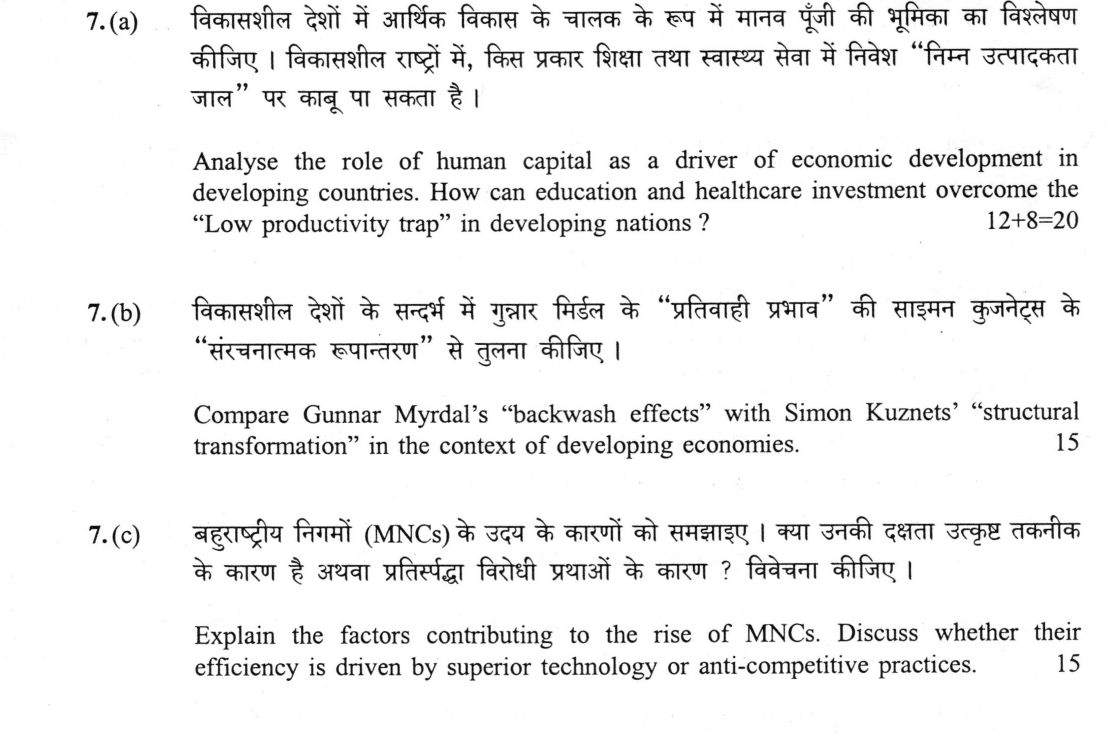
(a) Analyse the role of human capital as a driver of economic development in developing countries. How can education and…
Analyse the role of human capital as a driver of economic development in developing countries. How can education and healthcare investment overcome the “Low productivity trap” in developing nations ? 20 marks
Compare Gunnar Myrdal’s “backwash effects” with Simon Kuznets’ “structural transformation” in the context of developing economies. 15 marks
Explain the factors contributing to the rise of MNCs. Discuss whether their efficiency is driven by superior technology or anti-competitive practices. 15 marks
हिंदी में प्रश्न पढ़ें
विकासशील देशों में आर्थिक विकास के चालक के रूप में मानव पूँजी की भूमिका का विश्लेषण कीजिए । विकासशील राष्ट्रों में, किस प्रकार शिक्षा तथा स्वास्थ्य सेवा में निवेश “निम्न उत्पादकता जाल” पर काबू पा सकता है । (20 अंक)
विकासशील देशों के सन्दर्भ में गुन्नार मिर्डल के “प्रतिवाही प्रभाव” की साइमन कुजनेट्स के “संरचनात्मक रूपान्तरण” से तुलना कीजिए । (15 अंक)
बहुराष्ट्रीय निगमों (MNCs) के उदय के कारणों को समझाइए । क्या उनकी दक्षता उत्कृष्ट तकनीक के कारण है अथवा प्रतिस्पर्द्धा विरोधी प्रथाओं के कारण ? विवेचना कीजिए । (15 अंक)
Model answer
Drafted with AI by UPSC Answer Check against this question's marking rubric, to the expected length. UPSC does not publish answers for Mains — this is one way to score well, not an official key. How we build rubrics and answers.
(a) Human capital and the low-productivity trap (20 marks)
Human capital, defined as the stock of knowledge, skills, and health embodied in the workforce, is a primary driver of economic development in developing countries. The theoretical foundation, established by T. W. Schultz (1961) and Gary Becker (1964), treats education and health as investments that yield returns. The Mincer earnings function quantifies this by linking wages to years of schooling, while Robert Lucas (1988) and Mankiw, Romer, and Weil (1992) demonstrate that human capital externalities and accumulation are essential for long-run growth. Amartya Sen’s capability approach and the Human Development Index (Mahbub ul Haq and Sen, 1990) add that human well-being is itself the goal.
The "Low productivity trap" is a self-reinforcing low-level equilibrium, akin to Nurkse’s vicious circle of poverty and Nelson’s (1956) low-level equilibrium trap, where low income restricts investment in nutrition and schooling, which in turn sustains low productivity. Leibenstein’s nutrition-based efficiency wage theory explains that undernourished workers have lower output, while Galor and Zeira (1993) show that credit constraints prevent the poor from financing the upfront costs of education.
Investment in education and healthcare breaks this trap through several mechanisms. First, public investment substitutes for missing credit markets, allowing the poor to access schooling. Second, health investment (Grossman, 1972) and improved nutrition raise cognitive ability and school attendance; the WHO Commission on Macroeconomics and Health (2001) showed that better health raises growth itself. Third, longer life expectancy increases the return to schooling. Conditional cash transfers and school feeding reinforce this. However, the "learning crisis" (World Development Report 2018; ASER findings) highlights that mere expansion of schooling does not equal human capital formation; quality and skill matching are essential for the escape to be sustained.
(b) Myrdal vs Kuznets (15 marks)
Gunnar Myrdal’s "backwash effects" and Simon Kuznets’ "structural transformation" offer contrasting views on the dynamics of growth in developing economies. Myrdal (1957), in Economic Theory and Underdeveloped Regions, argues that growth is driven by circular and cumulative causation. He posits that "backwash effects"—the adverse drain of capital, talent, and resources from the periphery to the center—typically outweigh "spread effects" (the favorable diffusion of growth). This leads to regional divergence and polarization, a view parallel to Hirschman’s "polarisation" thesis.
In contrast, Simon Kuznets, in his account of "modern economic growth" (1966), emphasizes "structural transformation," the process where labor shifts from low-productivity agriculture to high-productivity industry and services, accompanied by urbanisation and demographic transition. Kuznets’ inverted-U curve (1955) suggests that inequality may rise initially but eventually falls as structural change progresses.
The comparison reveals a fundamental difference: Myrdal sees growth as a process that divides unless actively countered, while Kuznets views it as a process that eventually equalises. Policy implications differ accordingly: Myrdal advocates for active state intervention and regional transfers to counter backwash, whereas Kuznets emphasizes facilitating labor mobility and structural change. Empirically, the Kuznets curve is a contested hypothesis (Deininger-Squire, Piketty), while Myrdal’s backwash is visible in Indian interstate divergence, necessitating equalising transfers as a policy response.
(c) Rise of MNCs (15 marks)
The rise of Multinational Corporations (MNCs) is explained by the theory of Foreign Direct Investment (FDI). Stephen Hymer (1960) identified "firm-specific advantages" (FSAs) and market imperfections as drivers. John Dunning’s eclectic OLI paradigm (Ownership, Location, Internalisation) provides the standard framework: firms go global when they possess ownership advantages (technology, brands), find favorable location advantages, and can internalise transactions to avoid market failures. Buckley and Casson further developed the internalisation theory based on Coasean transaction costs, while Vernon’s product cycle and Knickerbocker’s oligopolistic reaction explain the timing and competitive dynamics. The fall in transport and communication costs and the rise of global value chains have further accelerated this trend.
Regarding efficiency, MNCs are driven by both superior technology and anti-competitive practices. On one hand, O-advantages are genuinely technological, leading to vertical spillovers and technology transfer. On the other hand, incumbency generates rents defended by anti-competitive conduct. This includes transfer pricing and profit shifting (addressed by OECD/G20 BEPS and the Pillar Two 15% global minimum tax), abuse of dominance, predatory pricing, and "killer acquisitions."
The reasoned verdict is that both operate: MNCs possess real technological efficiency, but they also exploit market power to maintain dominance. The policy corollary is a dual approach: encouraging technology transfer while enforcing competition law (e.g., India’s Competition Act, 2002, whose 2023 amendment added a deal-value threshold to catch killer acquisitions) and strict transfer-pricing rules to prevent the abuse of market power.
How this answer will be evaluated
Evaluation rubric
Each sub-part is marked on its own, against the marks and word limit printed on the paper.
- (a) Two linked tasks: analyse human capital as a driver of development in developing countries (theory, channels, evidence), and then explain specifically how investment in EDUCATION and HEALTHCARE breaks the low-productivity trap - which requires defining that trap as a self-reinforcing low-level equilibrium and showing the mechanism of escape. 20 marks
Must cover
- T. W. Schultz (1961) and Gary Becker (1964); Mincer earnings function
- Lucas (1988) human capital externalities; Mankiw, Romer and Weil (1992)
- Grossman (1972) health capital; WHO Commission on Macroeconomics and Health (2001)
- low-productivity trap as a vicious circle / low-level equilibrium (Nurkse; Nelson's 1956 low-level equilibrium trap as the analogue); nutrition-based efficiency wage (Leibenstein)
- credit-constrained schooling (Galor and Zeira, 1993)
- Amartya Sen's capability approach; Human Development Index (Mahbub ul Haq and Sen, 1990)
- learning crisis - schooling is not learning (World Development Report 2018; ASER findings)
Loses marks
- Describing human capital in general terms without ever defining the LOW PRODUCTIVITY TRAP, which the question names explicitly
- Treating health merely as welfare spending rather than as investment in a productive capital stock
- Equating educational expansion with human capital formation and ignoring learning outcomes and quality
- Asserting that education automatically raises growth, without the complementary conditions of labour demand, health and institutions
- Omitting the vicious-circle logic, so the 'escape' is asserted rather than shown as a shift between equilibria
Earns more
- Health as human capital: Grossman's (1972) health capital model, Fogel on nutrition and long-run growth, the WHO Commission on Macroeconomics and Health (2001), and the demographic dividend conditional on skills and health
- The escape mechanism: public investment substituting for missing credit markets, health and nutrition raising attendance and cognition, longer life expectancy raising the return to schooling, conditional cash transfers and school feeding, and coordinated big-push investment to shift equilibria - with the quality caveat (learning crisis, skill mismatch, out-of-pocket health spending)
- (b) Compare Gunnar Myrdal's backwash effects with Simon Kuznets' structural transformation for developing economies - what each concept asserts, how they differ in their view of whether growth equalises or divides, and what each implies for policy. Both must be explained accurately before they are compared. 15 marks
Must cover
- Gunnar Myrdal, Economic Theory and Underdeveloped Regions (1957); circular and cumulative causation
- backwash and spread effects; Hirschman's polarisation and trickling-down as the parallel formulation
- Simon Kuznets, modern economic growth and structural transformation
- Kuznets inverted-U curve (1955) relating inequality to income
- sectoral shift of labour from agriculture to industry and services; urbanisation; demographic transition
- regional divergence and the case for deliberate state intervention
Loses marks
- Describing the two ideas separately without the comparison the question requires
- Reversing Myrdal's terms - backwash is the ADVERSE drain on the periphery, spread is the favourable diffusion
- Reducing Kuznets to the inverted-U curve alone and omitting structural transformation, which is what the question names
- Presenting the Kuznets curve as an established empirical law rather than a contested hypothesis
- Confusing Myrdal's cumulative causation with the neoclassical convergence hypothesis, which he explicitly rejected
Earns more
- Policy implications contrasted: Myrdal's case for active regional and redistributive intervention against Kuznets' emphasis on facilitating mobility and structural change
- Evidence and assessment: contested status of the Kuznets curve (Deininger-Squire, Piketty), East Asia versus Latin America, and backwash visible in Indian interstate divergence and migration, with equalising transfers as the policy response
- (c) Two tasks: explain the factors behind the rise of multinational corporations, drawing on the theory of foreign direct investment; and then adjudicate whether their efficiency rests on superior technology or on anti-competitive practices - which calls for evidence on both sides and a reasoned verdict, not a one-sided answer. 15 marks
Must cover
- Stephen Hymer (1960) - firm-specific advantages and market imperfections
- John Dunning's eclectic OLI paradigm (ownership, location, internalisation)
- Buckley and Casson - internalisation and Coasean transaction costs
- Vernon's product cycle; Knickerbocker's oligopolistic reaction
- global value chains and the fall in transport and communication costs
- transfer pricing and profit shifting; OECD/G20 BEPS and the global minimum tax
- technology transfer and vertical spillovers; competition law response (Competition Act, 2002 in India)
Loses marks
- Listing the advantages and disadvantages of FDI instead of explaining WHY the multinational form arises, which is what FDI theory addresses
- Omitting the OLI paradigm, the standard organising framework for this question
- Taking a one-sided position - either uncritical praise of technology transfer or blanket condemnation - when the question asks for adjudication
- Confusing transfer pricing (an internal pricing and tax-avoidance issue) with predatory pricing or with dumping
- Giving no verdict at the end, leaving the 'whether' question of the second half unanswered
Earns more
- Evidence for anti-competitive conduct: transfer pricing and profit shifting (BEPS, the Pillar Two 15 per cent global minimum tax), abuse of dominance and predatory pricing, killer acquisitions, patent evergreening, regulatory capture, digital gatekeeping and crowding out of domestic firms
- Reasoned verdict that both operate - the OLI ownership advantage is genuinely technological, but incumbency generates rents defended by anti-competitive conduct - with the policy corollary of competition law, transfer-pricing rules and minimum taxation
What "Analyse" is asking you to do
Break the subject into its working parts and show how they act on each other. The marks are in the interconnections — which factor drives which, and what the resulting structure explains — not in the inventory of factors.
Structure that answers it
Define the whole → separate it into its parts → show which part drives which → what that interaction produces → what the structure implies
Where marks are lost
A flat list of causes with no account of which drives which. An answer of neatly separated headings, each self-contained, scores as description.
Practice this exact question
Write your answer and it is marked point by point against the model answer above — what you covered, what you missed, what you got wrong.
Evaluate my answer →More from Economics 2026 Paper I
- Q4 (a) Explain the instruments through which the government of any country tries to successf…
- Q5 Answer the following questions in about 150 words each : (a) “Import tariffs typically re…
- Q6 (a) Discuss the major differences between Old and New international trade theories. (20 m…
- Q7 (a) Analyse the role of human capital as a driver of economic development in developing c…
- Q8 (a) “Earth provides enough to satisfy every man’s needs, but not every man’s greed”. Anal…