Paper I — Q4
(a) Explain the instruments through which the government of any country tries to successfully carry out its three major roles…
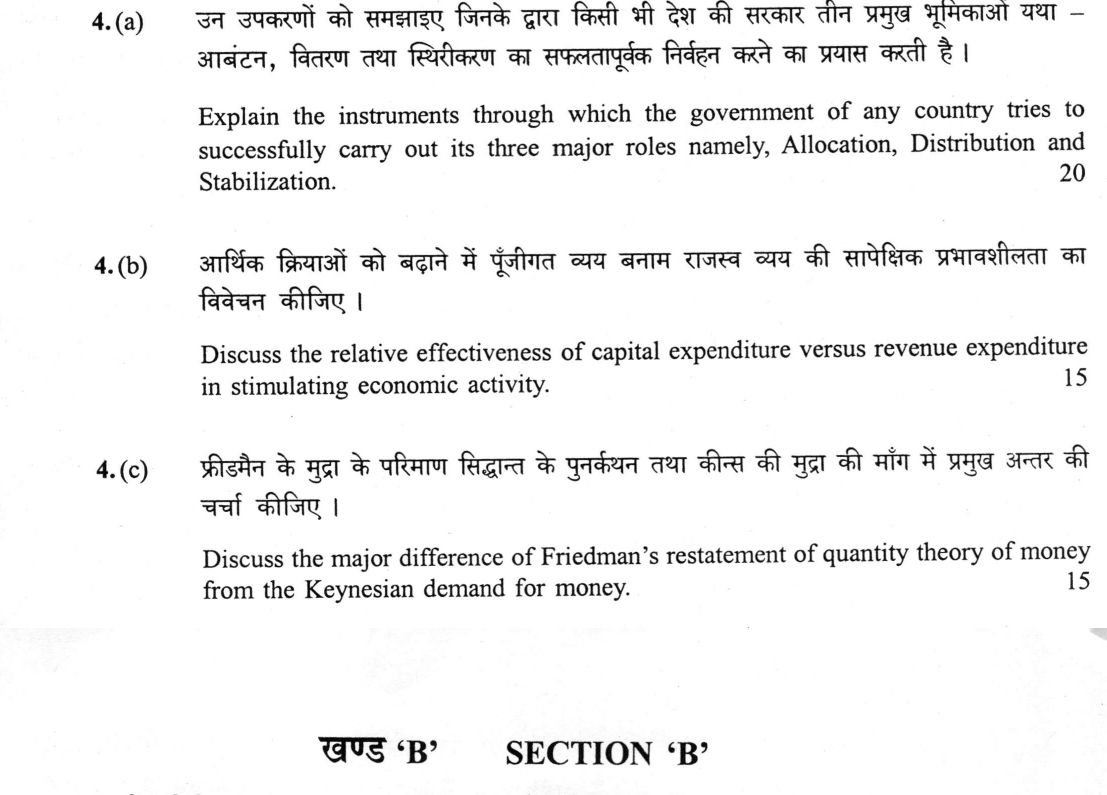
Explain the instruments through which the government of any country tries to successfully carry out its three major roles namely, Allocation, Distribution and Stabilization. 20 marks
Discuss the relative effectiveness of capital expenditure versus revenue expenditure in stimulating economic activity. 15 marks
Discuss the major difference of Friedman's restatement of quantity theory of money from the Keynesian demand for money. 15 marks
हिंदी में प्रश्न पढ़ें
उन उपकरणों को समझाइए जिनके द्वारा किसी भी देश की सरकार तीन प्रमुख भूमिकाओं यथा – आबंटन, वितरण तथा स्थिरीकरण का सफलतापूर्वक निर्वहन करने का प्रयास करती है । (20 अंक)
आर्थिक क्रियाओं को बढ़ाने में पूँजीगत व्यय बनाम राजस्व व्यय की सापेक्षिक प्रभावशीलता का विवेचन कीजिए । (15 अंक)
फ्रीडमैन के मुद्रा के परिमाण सिद्धान्त के पुनर्कथन तथा कीन्स की मुद्रा की मांग में प्रमुख अन्तर की चर्चा कीजिए । (15 अंक)
Model answer
Drafted with AI by UPSC Answer Check against this question's marking rubric, to the expected length. UPSC does not publish answers for Mains — this is one way to score well, not an official key. How we build rubrics and answers.
(a) Instruments for Allocation, Distribution and Stabilisation (20 marks)
Richard A. Musgrave (The Theory of Public Finance, 1959) divided the budget's tasks into three branches, each with its own instruments.
Allocation focuses on the efficient distribution of resources. The primary instruments include Pigouvian taxes and subsidies to correct market failures, such as taxing pollution or subsidizing merit goods (education, healthcare) and taxing demerit goods (tobacco). Governments also use tradable permits for environmental regulation and rely on social cost-benefit analysis (SCBA) and shadow pricing to determine the optimal level of public investment.
Distribution aims to achieve equity. The key instruments are progressive taxation, where the tax rate rises with income, and transfer payments such as pensions and social security. Milton Friedman’s concept of the negative income tax (NIT) is a theoretical instrument for guaranteeing a minimum income. Public services act as in-kind transfers.
Stabilization seeks to maintain full employment and price stability. Instruments include automatic stabilizers (like progressive tax systems and unemployment benefits) that provide built-in flexibility, and counter-cyclical discretionary fiscal policy (adjusting G and T). Public debt management is also used to smooth out economic fluctuations. In India, the FRBM Act, 2003 provides the legal framework; from 2026-27 its anchor is central government debt of 50 ± 1% of GDP by 2030-31.
According to Oates's decentralization theorem (1972), these functions are assigned across different levels of government based on the scope of the problem; in India the 16th Finance Commission has kept the states' share of the divisible pool at 41% for 2026-31. A major tension exists between these branches: a distributionally attractive subsidy may be allocatively distorting, and the equity-efficiency trade-off is a constant challenge.
(b) Capital versus Revenue Expenditure (15 marks)
The relative effectiveness of capital and revenue expenditure in stimulating the economy depends on the time horizon and the specific economic channel involved.
Capital Expenditure (Capex) involves the creation of assets or reduction of liabilities, such as infrastructure, roads, and public loans. According to the golden rule of public finance, borrowing should be used for assets rather than consumption. Capex is generally more effective for long-term growth because it has a larger expenditure multiplier (NIPFP estimates by Bose and Bhanumurthy, 2015: about 2.45 for capital against about 0.99 for revenue expenditure) and leads to crowding in of private investment by raising the productivity of private capital (lowering the incremental capital-output ratio, ICOR). However, its effectiveness as a short-run counter-cyclical tool is limited by gestation and implementation lags, absorptive capacity constraints, and the risk of import leakage or unutilized assets.
Revenue Expenditure (Revex) is recurring and asset-neutral, covering salaries, interest payments, pensions, and subsidies. While much of this is committed expenditure that contributes to the revenue deficit (and the effective revenue deficit, which nets out grants for creating capital assets), certain forms of revenue spending—specifically transfers and health and education—are highly effective in the short run. Transfers stimulate demand quickly because the marginal propensity to consume (MPC) of the recipients is high. Furthermore, spending on health and education builds human capital, which is a critical driver of long-term productivity.
Verdict: Capital expenditure (Union capex budgeted at ₹12.2 lakh crore for 2026-27) is superior for trend growth and structural transformation, while well-targeted revenue expenditure (human capital and transfers) is more effective for immediate cyclical relief and demand management.
(c) Friedman's Restatement versus Keynesian Demand for Money (15 marks)
The major difference between Friedman’s restatement (1956) and the Keynesian demand for money lies in the nature of the demand function, the variables involved, and the resulting policy conclusions.
Nature of Money Demand: Friedman treats money demand as a branch of capital/wealth (portfolio) theory, where money is just one asset among many. In contrast, Keynes views money demand through three specific motives: transactions, precautionary, and speculative.
Scale and Opportunity-Cost Variables: Friedman’s characteristic scale variable is permanent income (yp) rather than current income, which he argues makes the demand for money more stable. His function is Md/P = f(yp, w, rb, re, (1/P)(dP/dt), u), where 'w' is the wealth ratio, 'rb' and 're' are yields on bonds and equities, and '(1/P)(dP/dt)' is expected inflation. Keynes’s function is M = L1(Y) + L2(r), where L1 depends on income and L2 depends on the interest rate. Friedman's wealth-holder substitutes money against bonds, equities and physical goods, whereas Keynes's speculative choice is only between money and bonds.
Interest Elasticity and Stability: Friedman includes several yields but holds that the empirical interest elasticity of money demand is low, making the function stable and velocity predictable. This supports his k-per-cent money growth rule. Conversely, Keynes argues that speculative demand is volatile and can lead to a liquidity trap (infinite interest elasticity), where monetary policy becomes ineffective.
Policy Conclusions: Friedman’s stable function leads to a preference for monetary rules, while Keynes’s volatile demand leads to the primacy of fiscal policy in managing aggregate demand.
How this answer will be evaluated
Evaluation rubric
Each sub-part is marked on its own, against the marks and word limit printed on the paper.
- (a) Explain the INSTRUMENTS through which government discharges Musgrave's three budgetary functions - allocation, distribution and stabilisation. The emphasis is on instruments under each head, not merely on describing the three functions, and all three branches must be covered. 20 marks
Must cover
- Richard A. Musgrave, The Theory of Public Finance (1959); allocation, distribution, stabilisation branches
- Pigouvian tax/subsidy; tradable permits; merit and demerit goods
- social cost-benefit analysis / shadow pricing
- progressive taxation; transfer payments; negative income tax (Friedman)
- automatic stabilisers and built-in flexibility
- counter-cyclical discretionary fiscal policy; public debt management; FRBM Act, 2003
- Oates's decentralisation theorem for assigning functions across levels of government
Loses marks
- Describing the three functions in the abstract without naming concrete INSTRUMENTS, which is exactly what the question asks for
- Treating stabilisation as purely monetary policy and ignoring automatic stabilisers and discretionary fiscal measures
- Allocating grossly unequal space to the three branches; the marks are symmetric
- Reducing the answer to a description of the Indian budget without the underlying public-finance rationale
- Missing the tensions between branches, for example that a distributionally attractive subsidy may be allocatively distorting
Earns more
- Attribution of the three-branch framework to Richard Musgrave (The Theory of Public Finance, 1959) and a clear statement of what each branch is for
- Conflicts and trade-offs between the branches (equity-efficiency trade-off, distortion from subsidies, debt and crowding out) and the special constraints of developing economies
- (b) Compare the RELATIVE effectiveness of capital expenditure and revenue expenditure in stimulating economic activity - definitions, the multiplier evidence, the demand-side versus supply-side channels, the limitations of each, and a reasoned verdict. A one-sided answer will not meet the demand. 15 marks
Must cover
- definition: capital expenditure creates assets or reduces liabilities; revenue expenditure is recurring and asset-neutral
- expenditure multiplier; capital-expenditure multiplier much larger than the revenue-expenditure multiplier (RBI/NIPFP estimates)
- crowding in of private investment; incremental capital-output ratio
- golden rule of public finance / borrowing for assets versus for consumption
- high marginal propensity to consume of transfer recipients
- committed expenditure: interest payments, pensions, subsidies
- revenue deficit and effective revenue deficit; FRBM framework
Loses marks
- Turning the answer into a one-sided defence of capital expenditure with no case at all for revenue expenditure
- Confusing the plan/non-plan classification (discontinued in the Union Budget from 2017-18) with the capital/revenue classification
- Quoting a precise multiplier value as though it were an established constant rather than a study-specific estimate
- Omitting implementation lags, which are exactly why capital expenditure is a weak short-run counter-cyclical instrument
- Overlooking that health and education spending is largely revenue expenditure yet builds human capital, which is central to a balanced verdict
Earns more
- Correct definitions and classification of capital versus revenue expenditure, with examples (infrastructure and loans versus salaries, interest, pensions, subsidies)
- Limitations of capital expenditure: gestation and implementation lags, absorptive capacity, import leakage, unutilised assets, need for matching operation and maintenance
- (c) Set out the MAJOR differences between Friedman's restatement of the quantity theory (1956) and the Keynesian demand for money - on the nature of money demand, the scale and opportunity-cost variables, the range of substitute assets, interest elasticity, the stability of the function and the policy conclusions that follow. 15 marks
Must cover
- Milton Friedman, 'The Quantity Theory of Money - A Restatement' in Studies in the Quantity Theory of Money (1956)
- money demand as part of capital/wealth theory; money as one asset in a portfolio
- Md/P = f(y_p, w, r_b, r_e, (1/P)(dP/dt), u)
- permanent income versus current income as the scale variable
- Keynes's three motives and M = L1(Y) + L2(r)
- liquidity trap and infinite interest elasticity
- stability of the demand for money; k-per-cent money growth rule
Loses marks
- Presenting Friedman's restatement as the old Fisher quantity theory, missing that it is a theory of the DEMAND for money with velocity a function of several variables rather than a constant
- Omitting permanent income, which is Friedman's characteristic scale variable and the source of the stability claim
- Confusing the two functions' arguments, for example putting the interest rate in Keynes's transactions demand or omitting expected inflation from Friedman's
- Describing the two theories in sequence without drawing the comparison the question demands
- Asserting that Friedman denies any role for the interest rate; he includes several yields but holds the empirical elasticity to be low
Earns more
- Friedman treats money demand as a branch of capital/wealth (portfolio) theory - money as one asset among many - against Keynes's three motives, transactions, precautionary and speculative
- Stability of the function and the policy divide: a stable money demand and predictable velocity supporting a k-per-cent rule in Friedman, versus volatile speculative demand and the primacy of fiscal policy in Keynes
What "Explain" is asking you to do
Make the working of something clear — what sets it off, what follows from what, and what it produces. Explain is the Commission's mechanism word: it dominates the technical papers and the “explain why” stems, where the marks sit in the causal chain and not in the label.
Structure that answers it
State what it is → the initiating condition → the chain of cause, step by step → an instance where it plays out → what the chain produces
Where marks are lost
Describing what something looks like instead of why it works that way. Naming the stages without linking them reads as description too.
Practice this exact question
Write your answer and it is marked point by point against the model answer above — what you covered, what you missed, what you got wrong.
Evaluate my answer →More from Economics 2026 Paper I
- Q1 Answer the following questions in about 150 words each : (a) According to Michal Kalecki,…
- Q2 (a) Under what conditions, does a market reach equilibrium ? Analyse the differences in s…
- Q3 (a) The following values for an economy are given : C = 0.8 (1 – t)Y t = 0.25 I = 900 – 5…
- Q4 (a) Explain the instruments through which the government of any country tries to successf…
- Q5 Answer the following questions in about 150 words each : (a) “Import tariffs typically re…
- Q6 (a) Discuss the major differences between Old and New international trade theories. (20 m…
- Q7 (a) Analyse the role of human capital as a driver of economic development in developing c…