Paper I — Q6
(a) Discuss the major differences between Old and New international trade theories. (20 marks) (b) Explain the effect of a…
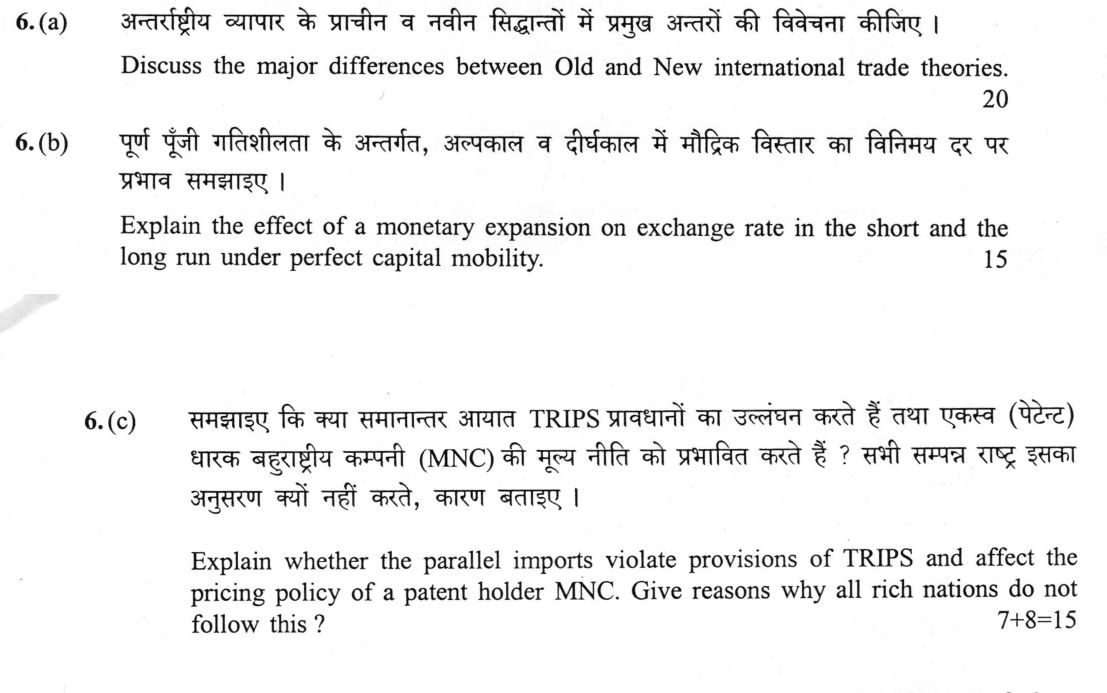
Discuss the major differences between Old and New international trade theories. 20 marks
Explain the effect of a monetary expansion on exchange rate in the short and the long run under perfect capital mobility. 15 marks
Explain whether the parallel imports violate provisions of TRIPS and affect the pricing policy of a patent holder MNC. Give reasons why all rich nations do not follow this ? 15 marks
हिंदी में प्रश्न पढ़ें
अन्तर्राष्ट्रीय व्यापार के प्राचीन व नवीन सिद्धान्तों में प्रमुख अन्तरों की विवेचना कीजिए । (20 अंक)
पूर्ण पूँजी गतिशीलता के अन्तर्गत, अल्पकाल व दीर्घकाल में मौद्रिक विस्तार का विनिमय दर पर प्रभाव समझाइए । (15 अंक)
समझाइए कि क्या समानान्तर आयात TRIPS प्रावधानों का उल्लंघन करते हैं तथा एकस्व (पेटेन्ट) धारक बहुराष्ट्रीय कम्पनी (MNC) की मूल्य नीति को प्रभावित करते हैं ? सभी सम्पन्न राष्ट्र इसका अनुसरण क्यों नहीं करते, कारण बताइए । (15 अंक)
Model answer
Drafted with AI by UPSC Answer Check against this question's marking rubric, to the expected length. UPSC does not publish answers for Mains — this is one way to score well, not an official key. How we build rubrics and answers.
(a) Old versus New Trade Theories (20 marks)
Old trade theory, rooted in the works of Adam Smith, David Ricardo, and the Heckscher-Ohlin (HO) model, assumes constant returns to scale (CRS), perfect competition, and homogeneous goods. It posits that trade is driven by comparative advantage—whether based on labor productivity or factor endowments—and predicts inter-industry trade (e.g., cloth for wine). The gains from trade are allocative, and the theory provides determinate distributional effects through the Stolper-Samuelson theorem, the Rybczynski theorem, and the factor-price equalization theorem. However, this framework struggled to explain the Leontief paradox and the dominance of trade between similar advanced economies.
New trade theory, pioneered by Paul Krugman (1979, 1980) and Helpman and Krugman (1985), relaxes these assumptions by introducing increasing returns to scale (IRS) and imperfect competition (specifically Dixit-Stiglitz monopolistic competition). It argues that trade is driven by product differentiation and the "love of variety," leading to intra-industry trade (e.g., cars for cars), measured by the Grubel-Lloyd index, and a home-market effect whereby large markets export goods subject to scale economies. The gains from trade here are derived from economies of scale and consumer variety. Unlike the Old theory, New trade theory suggests that free trade may not be optimal, leading to the strategic trade policy argument (Brander and Spencer), where governments can shift profits to domestic firms. The "new new" trade theory, exemplified by Melitz (2003), further refines this by focusing on firm-level heterogeneity and self-selection into exporting, consistent with the gravity model of trade flows. Ultimately, New trade theory does not refute comparative advantage but supplements it, providing a more robust explanation for modern trade patterns.
(b) Monetary Expansion and the Exchange Rate (15 marks)
Under perfect capital mobility, a monetary expansion leads to an immediate and disproportionate depreciation of the exchange rate in the short run, followed by a gradual appreciation to a new long-run equilibrium. This phenomenon, known as exchange rate overshooting, was formalized by Rudiger Dornbusch (1976). The mechanism relies on the divergence between sticky goods prices and instantly adjusting asset prices.
In the long run, the economy returns to purchasing power parity (PPP), where the exchange rate depreciates in direct proportion to the increase in the money supply. However, in the short run, the expansion of the money supply lowers the domestic interest rate. According to uncovered interest parity (UIP), i = i* + ê^e (expected depreciation), a domestic interest rate below the world rate (i < i*) requires an expected future appreciation of the currency (ê^e < 0). To make the currency expected to appreciate later, the spot exchange rate must initially depreciate by more than its long-run target. This "overshoot" creates a temporary real depreciation, which boosts net exports and output. Over time, as goods prices rise and real money balances shrink, the domestic interest rate returns to the world level, and the exchange rate appreciates along a saddle path back to the new long-run level. This result is consistent with the Mundell-Fleming model, which demonstrates that monetary policy is effective under a flexible exchange rate regime with perfect capital mobility, whereas it would be ineffective under a fixed rate.
(c) Parallel Imports, TRIPS and MNC Pricing (15 marks)
Parallel imports do not violate the provisions of the TRIPS Agreement. The legal status of parallel imports is governed by the "exhaustion of rights" doctrine, which determines whether a patent holder can control the resale of goods after they have been lawfully sold. TRIPS Article 6 explicitly excludes the exhaustion doctrine from dispute settlement, stating that the Agreement shall not be used to prejudice the right of Members to determine their own approach. This was reinforced by the Doha Declaration on TRIPS and Public Health (2001, paragraph 5(d)), which allows countries to use international exhaustion to address public health issues. For example, India’s Patents Act, 1970 (Section 107A(b), as amended in 2005) adopts international exhaustion, permitting the importation of patented goods.
Parallel imports significantly affect the pricing policy of multinational corporations (MNCs) by destroying their ability to engage in third-degree price discrimination. MNCs typically charge higher prices in wealthy markets and lower prices in developing markets. If parallel imports are permitted, arbitrageurs can buy goods in low-price markets and resell them in high-price markets, forcing the MNC to lower prices globally to prevent profit erosion. This explains why many rich, technology-exporting nations do not follow international exhaustion; they prefer national or regional exhaustion to protect R&D rents and high margins, and because the MNC may respond by withdrawing supply from poor markets (Malueg and Schwartz), hurting the consumers price discrimination served. While some jurisdictions have shifted—such as the US Supreme Court in Impression Products v. Lexmark (2017) which supported international exhaustion for patents—many nations still utilize TRIPS-plus provisions in bilateral trade agreements to restrict parallel imports and protect domestic innovation incentives.
How this answer will be evaluated
Evaluation rubric
Each sub-part is marked on its own, against the marks and word limit printed on the paper.
- (a) Set out the major differences between OLD trade theory (Smith, Ricardo, Heckscher-Ohlin and its theorems) and NEW trade theory (Krugman, Helpman, Lancaster and the later firm-level 'new new' literature) - in assumptions, determinants of trade, the pattern of trade predicted, the nature of the gains, distributional effects, policy implications and empirical performance. 20 marks
Must cover
- Ricardo's comparative advantage; Heckscher-Ohlin factor-proportions theory
- Stolper-Samuelson theorem; Rybczynski theorem; factor-price equalisation; Leontief paradox
- Paul Krugman (1979, 1980); Helpman and Krugman (1985); Dixit-Stiglitz monopolistic competition
- increasing returns to scale; product differentiation; love of variety; home-market effect
- intra-industry trade; Grubel-Lloyd index
- strategic trade policy and profit shifting (Brander and Spencer)
- Melitz (2003) firm heterogeneity and self-selection into exporting; gravity model
Loses marks
- Describing the two bodies of theory in succession without the point-by-point comparison the question demands
- Missing the central empirical fact that motivated new trade theory - the dominance of intra-industry trade among similar advanced economies
- Claiming new trade theory refutes comparative advantage; it supplements it, and both operate in the data
- Omitting the policy contrast, in particular the strategic trade policy argument and Krugman's own caution about it
- Confusing the Stolper-Samuelson and Rybczynski theorems, or attributing factor-price equalisation to Ohlin rather than to Samuelson
Earns more
- Contrast on GAINS and DISTRIBUTION: allocative specialisation gains with determinate Stolper-Samuelson distributional effects, against variety, scale, pro-competitive and selection gains with ambiguous distributional consequences
- Contrast on POLICY and level of analysis, plus the 'new new' extension: free trade optimality against strategic trade policy and profit shifting (Brander-Spencer, with Krugman's own caveats); country/industry against firm-level analysis with Melitz (2003) self-selection, the gravity model and global value chains
- (b) Trace the effect of a monetary expansion on the exchange rate under perfect capital mobility, distinguishing the SHORT run from the LONG run. The expected core is Dornbusch's (1976) overshooting model: sticky prices plus uncovered interest parity produce an immediate depreciation larger than the long-run one, followed by gradual appreciation to the new long-run level. 15 marks
Must cover
- Rudiger Dornbusch (1976), exchange rate overshooting
- uncovered interest parity: i = i* + expected depreciation
- sticky goods prices versus instantly adjusting asset prices
- long-run neutrality and purchasing power parity - proportional depreciation
- saddle path adjustment back to the long-run rate
- Mundell-Fleming: monetary policy effective under flexible rates, ineffective under fixed rates with perfect capital mobility
Loses marks
- Predicting only a depreciation, without the overshooting result that gives the question its point
- Getting the interest-parity logic backwards - a domestic rate BELOW the world rate requires an expected APPRECIATION, which is exactly why the spot rate must jump too far first
- Confusing nominal and real exchange rates, or forgetting that the real rate is unchanged in the long run
- Assuming prices adjust instantly, which removes the mechanism altogether and leaves only long-run neutrality
- Failing to distinguish the fixed-rate from the flexible-rate case under perfect capital mobility
Earns more
- The overshooting result named and attributed to Dornbusch (1976), with the subsequent adjustment path - real depreciation raises net exports and output, prices rise gradually, real balances shrink, i returns to i* and the rate appreciates back to e-bar along the saddle path
- Relation to Mundell-Fleming (monetary policy effective under floating, ineffective under a fixed rate with perfect mobility) and empirical qualifications such as Meese-Rogoff and delayed overshooting
- (c) Three explicit tasks: (i) decide whether parallel imports violate TRIPS - the answer turns on Article 6 and the exhaustion doctrine, and is NO; (ii) explain how parallel imports affect the pricing policy of a patent-holding multinational, by destroying international price discrimination; and (iii) explain why the rich, technology-exporting nations do not all permit them. 15 marks
Must cover
- exhaustion of rights: national, regional and international
- TRIPS Article 6 - exhaustion excluded from dispute settlement
- Doha Declaration on the TRIPS Agreement and Public Health, 2001, paragraph 5(d)
- section 107A(b), Patents Act, 1970 (as amended, 2005) - India's international exhaustion
- third-degree price discrimination across national markets and arbitrage
- re-importation concerns and TRIPS-plus provisions in bilateral/free trade agreements
Loses marks
- Confusing parallel imports with counterfeit or pirated goods; parallel imports are genuine goods lawfully placed on the market
- Answering that parallel imports violate TRIPS; Article 6 makes exhaustion a matter for each member to decide
- Confusing parallel importation with compulsory licensing under Article 31 or with the Article 31bis export mechanism - related public-health tools but legally distinct
- Explaining the law but not the PRICING consequence, which is a third of the question
- Asserting flatly that rich countries always prohibit parallel imports, when the position varies by right and by jurisdiction and has shifted in United States patent law since 2017
Earns more
- Welfare ambiguity and the contested state of practice: consumer gain in high-price markets against possible abandonment of poor markets (Malueg and Schwartz) and weakened dynamic R&D incentives; Impression Products v. Lexmark (2017) and the Japanese BBS case (1997) showing the divide is not fixed
What "Discuss" is asking you to do
Lay the issue out from more than one side — how it arose, what is claimed for it, what is held against it, and where it now stands. UPSC attaches discuss to broad topics with several live dimensions, so coverage of the dimensions earns more than the strength of your opinion.
Structure that answers it
Set the issue up → the case as it is made → the case against → the dimension both sides leave out → where the balance now lies
Where marks are lost
Listing facts with no thread between them, or arguing one side throughout and calling it a discussion.
Practice this exact question
Write your answer and it is marked point by point against the model answer above — what you covered, what you missed, what you got wrong.
Evaluate my answer →More from Economics 2026 Paper I
- Q3 (a) The following values for an economy are given : C = 0.8 (1 – t)Y t = 0.25 I = 900 – 5…
- Q4 (a) Explain the instruments through which the government of any country tries to successf…
- Q5 Answer the following questions in about 150 words each : (a) “Import tariffs typically re…
- Q6 (a) Discuss the major differences between Old and New international trade theories. (20 m…
- Q7 (a) Analyse the role of human capital as a driver of economic development in developing c…
- Q8 (a) “Earth provides enough to satisfy every man’s needs, but not every man’s greed”. Anal…