Paper I — Q8
(a) “Earth provides enough to satisfy every man’s needs, but not every man’s greed”. Analyse this statement in the context of…
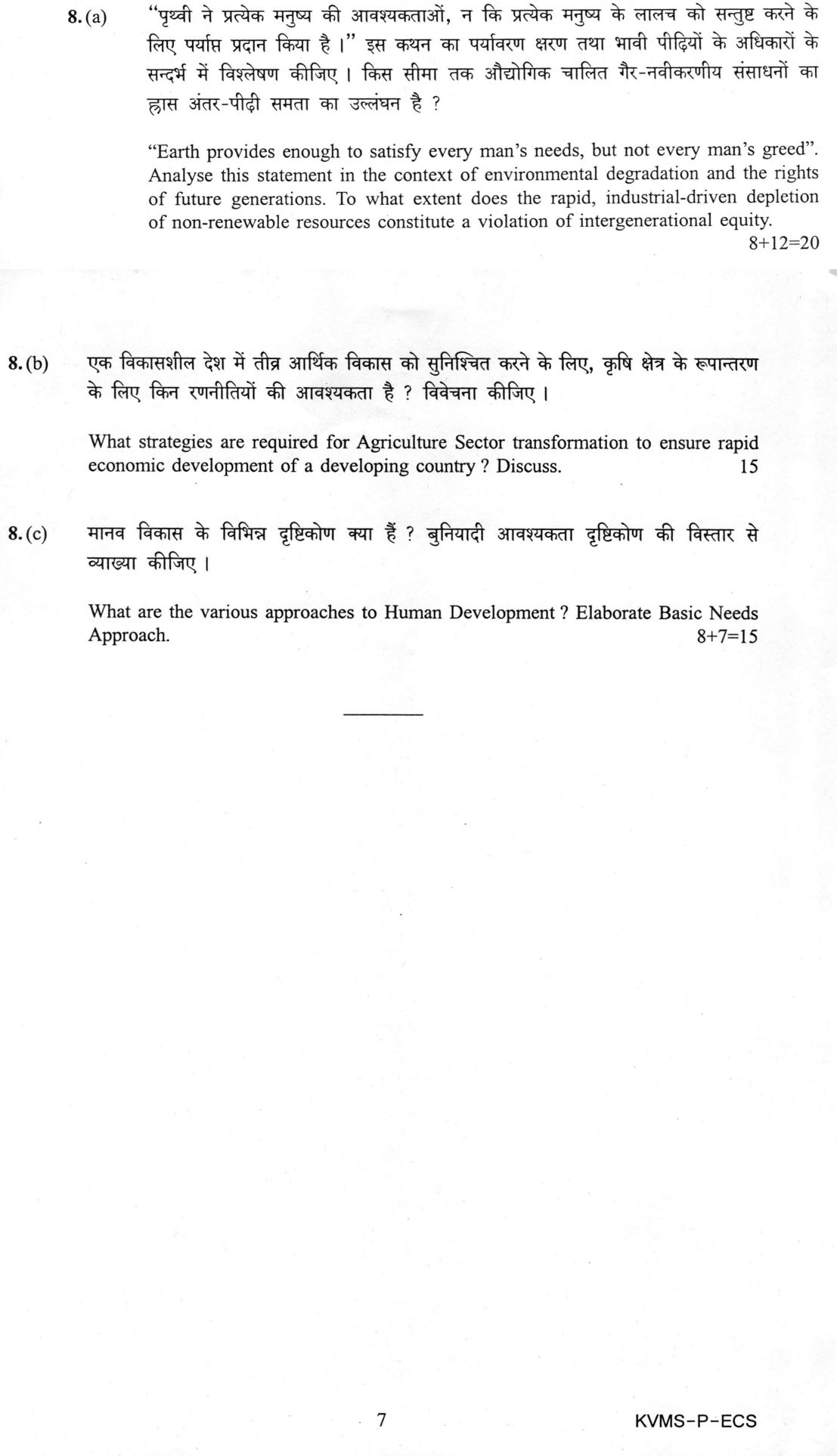
“Earth provides enough to satisfy every man’s needs, but not every man’s greed”. Analyse this statement in the context of environmental degradation and the rights of future generations. To what extent does the rapid, industrial-driven depletion of non-renewable resources constitute a violation of intergenerational equity. 20 marks
What strategies are required for Agriculture Sector transformation to ensure rapid economic development of a developing country ? Discuss. 15 marks
What are the various approaches to Human Development ? Elaborate Basic Needs Approach. 15 marks
हिंदी में प्रश्न पढ़ें
“पृथ्वी ने प्रत्येक मनुष्य की आवश्यकताओं, न कि प्रत्येक मनुष्य के लालच को सन्तुष्ट करने के लिए पर्याप्त प्रदान किया है ।” इस कथन का पर्यावरण क्षरण तथा भावी पीढ़ियों के अधिकारों के सन्दर्भ में विश्लेषण कीजिए । किस सीमा तक औद्योगिक चालित गैर-नवीकरणीय संसाधनों का ह्रास अंतर-पीढ़ी समता का उल्लंघन है ? (20 अंक)
एक विकासशील देश में तीव्र आर्थिक विकास को सुनिश्चित करने के लिए, कृषि क्षेत्र के रूपान्तरण के लिए किन रणनीतियों की आवश्यकता है ? विवेचना कीजिए । (15 अंक)
मानव विकास के विभिन्न दृष्टिकोण क्या हैं ? बुनियादी आवश्यकता दृष्टिकोण की विस्तार से व्याख्या कीजिए । (15 अंक)
Model answer
Drafted with AI by UPSC Answer Check against this question's marking rubric, to the expected length. UPSC does not publish answers for Mains — this is one way to score well, not an official key. How we build rubrics and answers.
(a) Needs vs greed; intergenerational equity (20 marks)
The aphorism distinguishes between biological requirements and unbounded consumption, a distinction central to the Brundtland Commission’s definition of sustainable development in Our Common Future (1987). In the context of environmental degradation, "greed" represents the extraction of resources at a rate that exceeds the regenerative capacity of the biosphere, violating the rights of future generations as codified in Principle 3 of the Rio Declaration (1992). The precautionary and polluter-pays principles follow from it.
Economic formalisation of this equity involves the Hotelling rule (1931), which dictates the efficient price path for exhaustible resources, and the Hartwick rule (1977), which mandates that the rents from resource depletion be invested in manufactured capital to maintain total wealth. The debate between weak and strong sustainability is critical: weak sustainability assumes manufactured capital can substitute for natural capital, while strong sustainability identifies "critical natural capital" (like the atmosphere) as irreplaceable. The Stern Review (2006) and Nordhaus disagree on the social discount rate given by the Ramsey rule (r = δ + ηg); a low rate (Stern) prioritises future generations, while a high rate (Nordhaus) justifies current consumption. Open-access resources suffer Hardin's tragedy of the commons (1968), though Ostrom showed communities can govern commons.
The extent of the violation is calibrated: industrial-driven depletion is not a violation if rents are reinvested (e.g., Norway’s sovereign wealth fund) and backstop technologies exist. However, it is a violation where the "resource curse" leads to rent consumption, where atmospheric sinks and biodiversity are irreversibly damaged, and where the burden falls on the poor. The binding constraint today is the atmospheric sink, not the fossil-fuel stock. Remedies include carbon pricing, resource funds and the circular economy, with burdens shared under common but differentiated responsibilities (Paris Agreement, 2015) and India targeting net zero by 2070.
(b) Agri transformation (15 marks)
Agricultural transformation is the engine of rapid development, as the sector provides the four contributions identified by Johnston and Mellor (1961): product, market, factor, and foreign-exchange. In the Lewis labour-surplus model (and the Ranis-Fei extension), development requires moving surplus labour from the low-productivity agricultural sector to the industrial sector. Schultz (Transforming Traditional Agriculture, 1964) argued that traditional agriculture is "efficient but poor," meaning the solution is not better management but new technology.
Strategies for transformation include:
- Technological: Public agricultural research and extension, high-yielding varieties (HYVs) and climate-resilient crops, alongside diversification into horticulture, livestock, and fisheries (e.g., the Operation Flood/Amul model).
- Institutional: Land reform to provide secure titles, recorded tenancy, and consolidation to address fragmentation, as in the East Asian sequence (Japan, Korea, Taiwan). The formation of Farmer Producer Organisations (FPOs) and crop insurance to mitigate risk.
- Market and Infrastructure: Marketing reforms, electronic trading, and warehousing with warehouse receipts to reduce post-harvest losses and price volatility.
- Labour Exit: Transformation requires the exit of surplus labour into rural non-farm employment (RNFE) and agro-processing MSMEs.
Sustainability is a live constraint; groundwater depletion and subsidy-driven distortions must be addressed to ensure that productivity gains translate into long-term development rather than environmental distress.
(c) HD approaches; basic needs (15 marks)
The various approaches to human development include the income/growth approach (trickle-down), the welfare approach, the human-capital approach (Schultz, Becker), the basic needs approach, the capability approach (Sen's functionings and capabilities; Nussbaum's central capabilities), the rights-based approach, and sustainable human development.
The Basic Needs Approach (BNA) originated at the ILO World Employment Conference (1976) and was formalised by Paul Streeten and S. J. Burki in First Things First (1981). It defines development as the satisfaction of a minimum bundle of needs: food, shelter, clothing, safe water, sanitation, health, education, employment, and participation. It is measured by outcome indicators such as the Physical Quality of Life Index (PQLI) developed by Morris D. Morris (1979).
The merit of the BNA is its focus on the poorest and its recognition that social indicators are attainable at low income levels, as evidenced by Sri Lanka, Kerala, and Costa Rica. However, it faces significant criticisms. It is commodity-centred and paternalistic, assuming a universal bundle of needs. Amartya Sen critiqued this through his "conversion factor" argument, noting that equal bundles of commodities do not produce equal well-being due to individual differences. These limitations led to the development of the Capability Approach and the Human Development Index (HDI), constructed under Mahbub ul Haq for the first Human Development Report in 1990.
How this answer will be evaluated
Evaluation rubric
Each sub-part is marked on its own, against the marks and word limit printed on the paper.
- (a) Three linked tasks: analyse the needs-versus-greed aphorism in the context of environmental degradation and the rights of future generations; explain intergenerational equity and its economic formalisation; and answer the 'to what extent' question about whether industry-driven depletion of non-renewable resources violates that equity - which requires a calibrated verdict, not a blanket yes or no. 20 marks
Must cover
- Brundtland Commission, Our Common Future (1987); sustainable development
- Rio Declaration 1992 Principle 3; precautionary principle and polluter pays
- Hotelling's rule (1931); Hartwick's rule (1977)
- weak versus strong sustainability; critical natural capital
- social discount rate; Ramsey rule; Stern Review (2006) versus Nordhaus
- tragedy of the commons (Hardin, 1968); Ostrom on governing the commons
- common but differentiated responsibilities; Paris Agreement (2015); India's net-zero by 2070
Loses marks
- Writing a moral essay on consumerism with no economic analysis - no externality, no Hotelling or Hartwick rule, no discounting
- Answering 'to what extent' with an unqualified yes; the question invites a calibrated judgement, and Hartwick's rule supplies the condition under which depletion is NOT inequitable
- Confusing Hotelling's rule (an efficiency condition on the price path) with Hartwick's rule (an equity condition on the use of rents)
- Ignoring the discount-rate question, which is where the rights of future generations actually enter the arithmetic
- Treating the fossil-fuel STOCK as the binding constraint when the operative limit today is the atmospheric SINK
Earns more
- Weak versus strong sustainability and the discounting debate: substitutability of natural and manufactured capital against critical natural capital and planetary boundaries; the Ramsey rule and the Stern-Nordhaus disagreement over the social discount rate as a judgement about future generations
- Calibrated verdict on the 'to what extent' question: NOT a violation where rents are reinvested and substitutes exist (Hartwick, Norway's fund, backstop technologies, Barnett-Morse evidence), but a real violation where rents are consumed (resource curse), where the atmospheric sink and biodiversity are irreversibly damaged, and where the burden falls on those least responsible - with carbon pricing, resource funds, the Paris Agreement and the circular economy as remedies
Extra mark
- Vellore Citizens' Welfare Forum v. Union of India (1996) / public trust doctrine (M. C. Mehta v. Kamal Nath, 1997)
- (b) Set out the strategies needed to TRANSFORM the agricultural sector of a developing country so as to secure rapid overall development. This requires the structural role of agriculture in development theory plus a set of concrete, sequenced strategies - technological, institutional, market, infrastructural and sustainability - not a list of schemes. 15 marks
Must cover
- Lewis labour-surplus model; Ranis-Fei
- Johnston and Mellor (1961) - product, market, factor and foreign-exchange contributions of agriculture
- Schultz, Transforming Traditional Agriculture (1964) - efficient but poor
- agricultural research and extension; climate-resilient and high-yielding varieties
- diversification to horticulture, livestock, dairy and fisheries; Operation Flood/Amul
- farmer producer organisations, marketing reform, warehousing, crop insurance
- land reform, tenancy records and consolidation; the East Asian sequence
- absorption of surplus labour into rural non-farm and agro-processing activity
Loses marks
- Listing current government schemes without the underlying strategy or any theoretical rationale
- Confining the answer to raising production and ignoring markets, prices, risk and institutions, which is where small-farmer incomes are actually determined
- Omitting sustainability - groundwater depletion, soil degradation and subsidy-driven distortion are central to whether gains last
- Forgetting that transformation requires labour to LEAVE agriculture, and that rural non-farm absorption is therefore part of the strategy
- Treating land reform as a historical footnote rather than as a live constraint through tenancy insecurity and fragmentation
Earns more
- Market and institutional reform: marketing and electronic trading reform, warehousing and warehouse receipts, contract farming with safeguards, farmer producer organisations, crop insurance and credit; land reform, secure titles, recorded tenancy and consolidation, with the East Asian and Chinese precedents
- Infrastructure, human capital and the exit of surplus labour into rural non-farm activity, agro-processing and MSMEs, so that productivity gains translate into development rather than distress
- (c) Two tasks with unequal weight: first briefly enumerate the main approaches to human development (income/growth, welfare, human-capital or human-resource, basic needs, capability, rights-based and sustainable human development); then ELABORATE the Basic Needs Approach - its origin, content, merits, measurement and criticisms. 15 marks
Must cover
- income/growth approach and trickle-down; welfare approach; human capital approach (Schultz, Becker)
- capability approach - Amartya Sen; functionings and capabilities; Nussbaum's central capabilities
- Human Development Index; Mahbub ul Haq; first Human Development Report, 1990
- ILO World Employment Conference, 1976; Paul Streeten and S. J. Burki, First Things First (1981)
- basic needs content: food, shelter, clothing, safe water, sanitation, health, education, employment, participation
- Physical Quality of Life Index (Morris D. Morris, 1979)
- Sen's critique - conversion of commodities into functionings differs across persons
Loses marks
- Writing only about the HDI and the capability approach, when the question specifically asks for the BASIC NEEDS approach to be elaborated
- Reducing basic needs to food, clothing and shelter and omitting the public services, employment and participation components
- Confusing the basic needs approach with the poverty-line/calorie-norm method of measuring poverty; they are related but distinct
- Offering no critique of the basic needs approach, when the elaboration is expected to include its limitations
- Misattributing the HDI - it was constructed under Mahbub ul Haq with Sen's involvement for the 1990 Human Development Report, not by Sen alone
Earns more
- Merits and measurement: outcome indicators rather than income, with Morris's Physical Quality of Life Index (1979); focus on the poorest; and the evidence from Sri Lanka, Kerala, Costa Rica and Cuba that good social indicators are attainable at low income through public provisioning
- Criticisms and the link forward: commodity-centred and paternalistic, with Sen's conversion-factor objection that equal bundles do not produce equal well-being; arbitrary bundle, costing and financing problems; risk of a minimalist welfare programme - leading to the capability approach and the HDI
What "Analyse" is asking you to do
Break the subject into its working parts and show how they act on each other. The marks are in the interconnections — which factor drives which, and what the resulting structure explains — not in the inventory of factors.
Structure that answers it
Define the whole → separate it into its parts → show which part drives which → what that interaction produces → what the structure implies
Where marks are lost
A flat list of causes with no account of which drives which. An answer of neatly separated headings, each self-contained, scores as description.
Practice this exact question
Write your answer and it is marked point by point against the model answer above — what you covered, what you missed, what you got wrong.
Evaluate my answer →More from Economics 2026 Paper I
- Q5 Answer the following questions in about 150 words each : (a) “Import tariffs typically re…
- Q6 (a) Discuss the major differences between Old and New international trade theories. (20 m…
- Q7 (a) Analyse the role of human capital as a driver of economic development in developing c…
- Q8 (a) “Earth provides enough to satisfy every man’s needs, but not every man’s greed”. Anal…