Paper I — Q2
(a) Under what conditions, does a market reach equilibrium ? Analyse the differences in stability between Marshallian and…
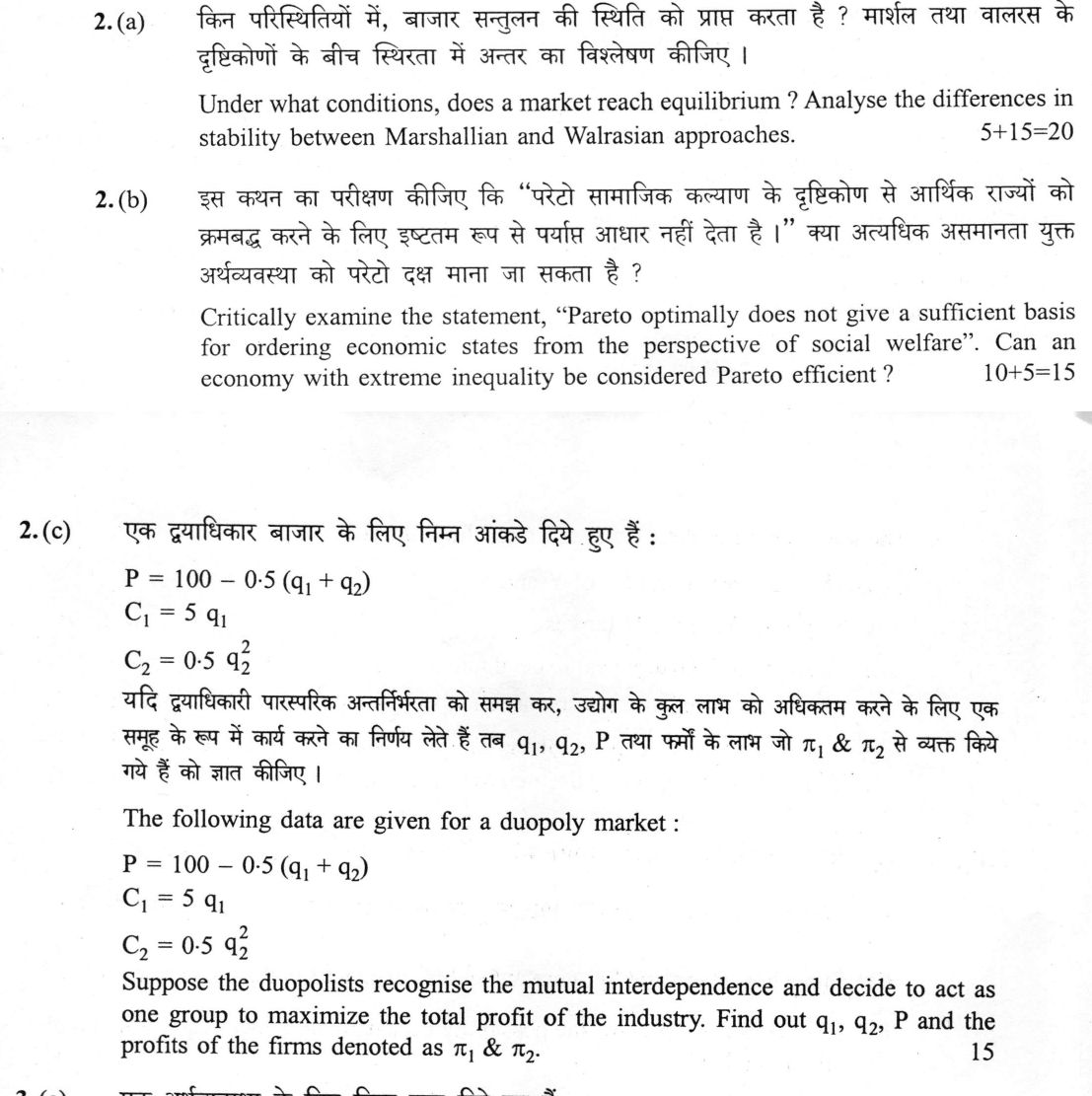
Under what conditions, does a market reach equilibrium ? Analyse the differences in stability between Marshallian and Walrasian approaches. 20 marks
Critically examine the statement, “Pareto optimally does not give a sufficient basis for ordering economic states from the perspective of social welfare”. Can an economy with extreme inequality be considered Pareto efficient ? 15 marks
The following data are given for a duopoly market : P = 100 – 0.5 (q₁ + q₂) C₁ = 5 q₁ C₂ = 0.5 q₂² Suppose the duopolists recognise the mutual interdependence and decide to act as one group to maximize the total profit of the industry. Find out q₁, q₂, P and the profits of the firms denoted as π₁ & π₂. 15 marks
हिंदी में प्रश्न पढ़ें
किन परिस्थितियों में, बाजार सन्तुलन की स्थिति को प्राप्त करता है ? मार्शल तथा वालरस के दृष्टिकोणों के बीच स्थिरता में अन्तर का विश्लेषण कीजिए । (20 अंक)
इस कथन का समालोचनात्मक परीक्षण कीजिए कि “परेटो इष्टतमता सामाजिक कल्याण के दृष्टिकोण से आर्थिक अवस्थाओं को क्रमबद्ध करने के लिए पर्याप्त आधार नहीं देती है ।” क्या अत्यधिक असमानता युक्त अर्थव्यवस्था को परेटो दक्ष माना जा सकता है ? (15 अंक)
एक द्वयाधिकार बाजार के लिए निम्न आंकड़े दिये हुए हैं : P = 100 – 0.5 (q₁ + q₂) C₁ = 5 q₁ C₂ = 0.5 q₂² यदि द्वयाधिकारी पारस्परिक अन्तर्निर्भरता को समझ कर, उद्योग के कुल लाभ को अधिकतम करने के लिए एक समूह के रूप में कार्य करने का निर्णय लेते हैं तब q₁, q₂, P तथा फर्मों के लाभ जो π₁ & π₂ से व्यक्त किये गये हैं को ज्ञात कीजिए । (15 अंक)
Model answer
Drafted with AI by UPSC Answer Check against this question's marking rubric, to the expected length. UPSC does not publish answers for Mains — this is one way to score well, not an official key. How we build rubrics and answers.
(a) Equilibrium and Stability
A market reaches equilibrium when the quantity demanded equals the quantity supplied (Q_d = Qₛ), or equivalently, when the demand price equals the supply price. Existence requires a continuous excess-demand function that becomes zero at a non-negative price; uniqueness requires a single such crossing. However, the existence of an equilibrium point is distinct from its stability. Stability refers to the dynamic process by which the market returns to equilibrium after a disturbance.
The Walrasian approach assumes that prices adjust to clear the market. Under the tatonnement process, the price rises if there is excess demand and falls if there is excess supply. The condition for local stability is that the slope of the excess demand function with respect to price must be negative: d(D - S)/dP < 0.
The Marshallian approach assumes that output adjusts to clear the market. Producers increase or decrease output based on the difference between the demand price and the supply price. The condition for stability is that the slope of the excess demand price with respect to quantity must be negative: d(Dₚ - Sₚ)/dQ < 0.
In the "normal" case where the supply curve is upward-sloping, both criteria yield the same verdict: the equilibrium is stable. However, they can diverge when both curves are negatively sloped. If the supply curve is steeper than the demand curve, the Walrasian criterion indicates stability (price adjustment converges), while the Marshallian criterion indicates instability (quantity adjustment diverges). Dynamic extensions include the cobweb theorem (Ezekiel, 1938), where lagged supply makes convergence depend on relative slopes, and Hicks's distinction between perfect and imperfect stability in multi-market systems. Samuelson's correspondence principle links these static stability conditions to the dynamic behavior of the system.
(b) Pareto Optimality and Social Welfare
The statement is correct because the Pareto criterion is distribution-blind and yields only a partial ordering of economic states. Vilfredo Pareto defined an improvement as a change where at least one person is better off and no one is worse off. While the First Fundamental Theorem of Welfare Economics establishes that a competitive equilibrium is Pareto efficient, it does not determine which of the infinite points on the utility-possibility frontier is "best" for society.
The Second Fundamental Theorem suggests that any Pareto optimum can be reached via competitive markets with appropriate lump-sum transfers, but it does not provide a normative basis for choosing the initial endowments. Attempts to bridge this gap, such as the Kaldor-Hicks compensation criterion, fail due to the Scitovsky paradox (reversal). Ranking optima needs a Bergson-Samuelson social welfare function embodying interpersonal value judgements, such as Rawls's maximin principle, which ranks states by the welfare of the worst-off. Furthermore, Arrow's Impossibility Theorem (1951) demonstrates that no social welfare function can satisfy a set of minimal rationality conditions. Amartya Sen has shown that a state can be Pareto efficient even if it involves starvation, as long as no individual can be made better off without making another worse off; his capability approach therefore judges states by what people can actually do and be.
Yes, an economy with extreme inequality can be considered Pareto efficient. If the distribution of resources is such that no further voluntary exchange can benefit one person without harming another, the state is Pareto optimal, regardless of how unequal the distribution may be.
(c) Duopoly Market: Joint Profit Maximisation
When duopolists act as one group to maximize total industry profit, they behave as a multi-plant monopolist. The objective is to maximize joint profit π = π₁ + π₂.
- Total Revenue (TR): P = 100 - 0.5(q₁ + q₂) Let Q = q₁ + q₂. TR = P × Q = (100 - 0.5Q)Q = 100Q - 0.5Q²
- Marginal Revenue (MR): MR = d(TR)/dQ = 100 - Q
- Marginal Costs (MC): C₁ = 5q₁ implies MC₁ = 5 C₂ = 0.5q₂² implies MC₂ = q₂
- Optimisation Condition: For a multi-plant monopoly, the group maximizes profit where MR = MC₁ = MC₂. 100 - Q = 5 Q = 95
Since MC₂ = q₂ and MC₂ = 5, we have: q₂ = 5
Since Q = q₁ + q₂: 95 = q₁ + 5 implies q₁ = 90
- Price (P): P = 100 - 0.5(95) = 100 - 47.5 = 52.50
- Profits: π₁ = Pq₁ - C₁ = (52.5 × 90) - (5 × 90) = 4725 - 450 = 4275 π₂ = Pq₂ - C₂ = (52.5 × 5) - (0.5 × 5²) = 262.5 - 12.5 = 250
Final Results: q₁ = 90, q₂ = 5, P = 52.50 π₁ = 4275, π₂ = 250 Joint Profit = 4525
How this answer will be evaluated
Evaluation rubric
Each sub-part is marked on its own, against the marks and word limit printed on the paper.
- (a) Two linked tasks: (i) state the conditions for market equilibrium - existence, and the distinction between equilibrium and stability (local/global, static/dynamic); and (ii) analyse how the Marshallian (quantity-adjustment) and Walrasian (price-adjustment) stability criteria differ, including the cases where they give opposite verdicts. 20 marks
Must cover
- Walrasian tatonnement; price adjustment to excess demand
- Marshallian quantity adjustment to excess demand price
- Walras stability condition: d(D - S)/dP < 0
- Marshall stability condition: d(Dp - Sp)/dQ < 0
- the case of both curves negatively sloped, where the two criteria give opposite verdicts
- cobweb theorem (Ezekiel); Hicks on perfect and imperfect stability; Samuelson's correspondence principle
Loses marks
- Describing how equilibrium price is determined but never addressing stability, which is the core of the question
- Asserting that Walras and Marshall 'always differ' - in the normal case with a rising supply curve they agree
- Getting the divergent case backwards; the mark hinges on the correct pairing (negatively sloped supply steeper than demand = Walras-stable, Marshall-unstable)
- Confusing the cobweb (lagged) model with the instantaneous Walrasian and Marshallian criteria
- Using only diagrams with arrows and giving no algebraic stability condition at the 20-mark level
Earns more
- Conditions for equilibrium: Qd = Qs, demand price equal to supply price, plus the distinction between existence, uniqueness and stability and between market, short and long period
- Interpretation and extensions: Walras suits the market period with fixed stocks, Marshall the periods in which output adjusts; cobweb (Ezekiel) lagged adjustment, Hicksian perfect/imperfect stability, Samuelson's correspondence principle
- (b) Critically examine why the Pareto criterion cannot by itself rank economic states for social welfare - it yields only a partial ordering over an infinity of optima and is silent on distribution - and then answer the direct question: yes, an economy with extreme inequality can be Pareto efficient. Both the critique and the explicit verdict are required. 15 marks
Must cover
- Vilfredo Pareto; Pareto optimality / Pareto improvement
- First and Second Fundamental Theorems of Welfare Economics
- utility-possibility frontier; infinity of Pareto optima
- Bergson-Samuelson social welfare function; interpersonal comparability
- Kaldor-Hicks compensation criterion and the Scitovsky paradox
- Arrow's Impossibility Theorem (1951)
- Amartya Sen: Pareto optimality consistent with starvation; capability approach
- Rawls's maximin / difference principle
Loses marks
- Merely describing the marginal conditions of Pareto optimality without delivering the critique the question asks for
- Failing to state the direct verdict on extreme inequality - the answer must say YES and explain why
- Confusing the Second Fundamental Theorem with a claim that Pareto optimality itself guarantees equity
- Stating the Kaldor-Hicks tests without noting the Scitovsky reversal, which is the point of citing them
- Attributing to Pareto a normative preference for laissez-faire instead of showing that the criterion is simply distribution-blind
Earns more
- Definition and the three marginal conditions of Pareto optimality plus the First Fundamental Theorem linking competitive equilibrium to efficiency
- Failed escapes: Kaldor-Hicks compensation tests, the Scitovsky reversal paradox, Arrow's Impossibility Theorem, Sen's impossibility of a Paretian liberal
- (c) A duopoly with P = 100 - 0.5(q1 + q2), C1 = 5q1 and C2 = 0.5q2^2. The firms COLLUDE and act as a multi-plant monopolist maximising joint industry profit. Compute q1, q2, P and the individual profits pi1 and pi2. This is a cartel/joint-profit-maximisation problem, not Cournot, Stackelberg or Bertrand. 15 marks
Must cover
- joint profit maximisation / cartel as a multi-plant monopoly
- MR = 100 - Q
- MC1 = 5, MC2 = q2, and the rule MR = MC1 = MC2
- q1 = 90, q2 = 5, Q = 95
- P = 52.50
- pi1 = 4275, pi2 = 250, joint profit = 4525
Loses marks
- Solving the Cournot reaction-function problem (each firm maximising its own profit) although the question states the firms act as one group
- Splitting output equally between the two firms instead of allocating it by equating marginal costs - firm 1's constant MC of 5 means it should produce far more
- Using MR = 100 - 0.5Q (forgetting to double the slope when differentiating 100Q - 0.5Q^2)
- Computing pi2 as Pq2 - 5q2 or using C2 = 0.5q2 instead of the quadratic 0.5q2^2
- Reporting only total industry profit without splitting it into pi1 and pi2, which the question explicitly asks for
Earns more
- Correct derivatives and first-order conditions: MR = 100 - Q, MC1 = 5, MC2 = q2, giving Q = 95 and q2 = 5
- Correct price P = 52.50
What "Analyse" is asking you to do
Break the subject into its working parts and show how they act on each other. The marks are in the interconnections — which factor drives which, and what the resulting structure explains — not in the inventory of factors.
Structure that answers it
Define the whole → separate it into its parts → show which part drives which → what that interaction produces → what the structure implies
Where marks are lost
A flat list of causes with no account of which drives which. An answer of neatly separated headings, each self-contained, scores as description.
Practice this exact question
Write your answer and it is marked point by point against the model answer above — what you covered, what you missed, what you got wrong.
Evaluate my answer →More from Economics 2026 Paper I
- Q1 Answer the following questions in about 150 words each : (a) According to Michal Kalecki,…
- Q2 (a) Under what conditions, does a market reach equilibrium ? Analyse the differences in s…
- Q3 (a) The following values for an economy are given : C = 0.8 (1 – t)Y t = 0.25 I = 900 – 5…
- Q4 (a) Explain the instruments through which the government of any country tries to successf…
- Q5 Answer the following questions in about 150 words each : (a) “Import tariffs typically re…