Paper I — Q2
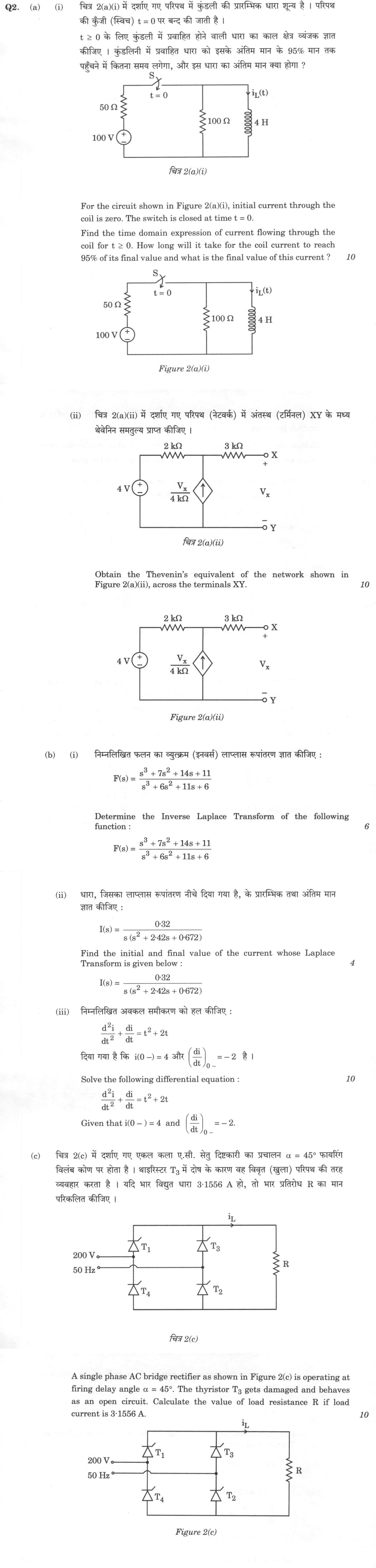
(a) (i) For the circuit shown in Figure 2(a)(i), initial current through the coil is zero. The switch is closed at time t = 0…
For the circuit shown in Figure 2(a)(i), initial current through the coil is zero. The switch is closed at time t = 0. Find the time domain expression of current flowing through the coil for t ≥ 0. How long will it take for the coil current to reach 95% of its final value and what is the final value of this current? 10 marks
Obtain the Thevenin's equivalent of the network shown in Figure 2(a)(ii), across the terminals XY. 10 marks
Determine the Inverse Laplace Transform of the following function: F(s) = (s³ + 7s² + 14s + 11)/(s³ + 6s² + 11s + 6) 6 marks
Find the initial and final value of the current whose Laplace Transform is given below: I(s) = 0.32/[s(s² + 2.42s + 0.672)] 4 marks
Solve the following differential equation: d²i/dt² + di/dt = t² + 2t. Given that i(0-) = 4 and (di/dt)₀₋ = -2. 10 marks
A single phase AC bridge rectifier as shown in Figure 2(c) is operating at firing delay angle α = 45°. The thyristor T₃ gets damaged and behaves as an open circuit. Calculate the value of load resistance R if load current is 3·1556 A. 10 marks
हिंदी में प्रश्न पढ़ें
चित्र 2(a)(i) में दर्शाए गए परिपथ में कुंडली की प्रारंभिक धारा शून्य है। परिपथ की कुंजी (स्विच) t = 0 पर बंद की जाती है। t ≥ 0 के लिए कुंडली में प्रवाहित होने वाली धारा का काल क्षेत्र व्यंजक ज्ञात कीजिए। कुंडली में प्रवाहित धारा को इसके अंतिम मान के 95% मान तक पहुँचने में कितना समय लगेगा, और इस धारा का अंतिम मान क्या होगा? (10 अंक)
चित्र 2(a)(ii) में दर्शाए गए परिपथ (नेटवर्क) में अंतस्थ (टर्मिनल) XY के मध्य थेवेनिन समतुल्य प्राप्त कीजिए। (10 अंक)
निम्नलिखित फलन का व्युत्क्रम (इनवर्स) लाप्लास रूपांतरण ज्ञात कीजिए: F(s) = (s³ + 7s² + 14s + 11)/(s³ + 6s² + 11s + 6) (6 अंक)
धारा, जिसका लाप्लास रूपान्तरण नीचे दिया गया है, के प्रारम्भिक तथा अन्तिम मान ज्ञात कीजिए: I(s) = 0.32/[s(s² + 2.42s + 0.672)] (4 अंक)
निम्नलिखित अवकल समीकरण को हल कीजिए: d²i/dt² + di/dt = t² + 2t। दिया गया है कि i(0-) = 4 और (di/dt)₀₋ = -2 है। (10 अंक)
चित्र 2(c) में दर्शाए गए एकल कला ए.सी. सेतु दिष्टकारी का प्रचालन α = 45° फायरिंग विलम्ब कोण पर होता है। थायरिस्टर T₃ में दोष के कारण वह विद्युत (खुला) परिपथ की तरह व्यवहार करता है। यदि भार विद्युत धारा 3.1556 A हो, तो भार प्रतिरोध R का मान परिकलित कीजिए। (10 अंक)
The figure this question refers to, in words
The question paper is a scan and the diagram did not survive as text. This is the figure as read from the original page — every component, value and label — so the question can be worked from the text below.
(a) Circuit diagram labeled Figure 2(a)(ii). The circuit consists of a 4 V DC voltage source on the left, with its positive terminal connected to a 2 kΩ resistor. The other end of the 2 kΩ resistor is connected to a central node. From this central node, a dependent current source is connected in parallel, pointing upwards, with a value of Vx / 4 kΩ. Also from this central node, a 3 kΩ resistor is connected in series to the right, leading to terminal X. The negative terminal of the 4 V source is connected to a bottom wire, which also connects to the bottom of the dependent current source and to terminal Y. The voltage Vx is defined across terminals X and Y, with the positive reference at X and negative at Y.
(c) A single-phase AC bridge rectifier circuit. The AC source is connected to the left side of the bridge, labeled '200 V' and '50 Hz'. The bridge consists of four thyristors arranged in a standard full-bridge configuration: T1 and T4 are on the left leg, and T3 and T2 are on the right leg. T1 and T3 are the upper thyristors, while T4 and T2 are the lower thyristors. The load is a resistor labeled 'R' connected across the output terminals of the bridge. The load current is labeled 'iL' flowing into the top of the resistor. The figure is labeled 'Figure 2(c)'.
What "Solve" is asking you to do
Choose the method, then carry it through to a final answer. Identifying what kind of problem this is and why that method applies is the first thing marked; a correct figure arrived at invisibly earns almost nothing.
Structure that answers it
Given data and what is required → method chosen, with the reason it applies → set-up (equation, circuit, free body, trial balance) → working, step by step → answer with units and any condition of validity
Where marks are lost
Doing the middle steps mentally and writing only the result. In mathematics papers, a further loss comes from giving a decimal where the exact value in surds or fractions was wanted, or from skipping the justification a part explicitly asks for.
How this answer will be evaluated
Approach
(a(i)) calculate: given > formula > substitution > result with units > interpretation | (a(ii)) calculate: given > formula > substitution > result with units > interpretation | (b(i)) calculate: given > formula > substitution > result with units > interpretation | (b(ii)) calculate: given > formula > substitution > result with units > interpretation | (b(iii)) calculate: given > formula > substitution > result with units > interpretation | (c) calculate: given > formula > substitution > result with units > interpretation Full marks: All parts show complete method with correct calculations, proper units, and clear presentation of equivalent circuits or transforms.
Key points expected
- Redraw circuit with Thevenin equivalent seen by inductor
- Calculate Thevenin resistance and voltage correctly
- Derive time constant τ = L/R_th
- Solve for t when i_L(t) = 0.95 * i_L(∞)
- Calculate open-circuit voltage V_th across XY
- Calculate Thevenin resistance R_th looking into XY
- Handle dependent source correctly for R_th calculation
- Present final Thevenin equivalent circuit
Evaluation rubric
Each sub-part is marked on its own, against the marks and word limit printed on the paper.
- (a(i)) Time-domain expression for coil current, time to reach 95% of final value, and the final value. 10 marks
calculate— given → formula → substitution → result with units → interpretation
Must cover
- Redraw circuit with Thevenin equivalent seen by inductor
- Calculate Thevenin resistance and voltage correctly
- Derive time constant τ = L/R_th
- Solve for t when i_L(t) = 0.95 * i_L(∞)
Loses marks
- Using source resistance directly without Thevenin reduction
- Incorrect time constant calculation
- Missing units in final answer
Earns more
- Explicitly state initial condition i_L(0) = 0
- Show step-by-step calculation of R_th
- Provide final expression in standard form i_L(t) = I_f(1 - e^(-t/τ))
Extra mark
- Sketch the current response curve with 95% point marked
- (a(ii)) Thevenin equivalent circuit (V_th and R_th) across terminals XY. 10 marks
calculate— given → formula → substitution → result with units → interpretation
Must cover
- Calculate open-circuit voltage V_th across XY
- Calculate Thevenin resistance R_th looking into XY
- Handle dependent source correctly for R_th calculation
- Present final Thevenin equivalent circuit
Loses marks
- Treating dependent source as independent for R_th
- Sign errors in KVL/KCL equations
- Missing Thevenin resistance calculation
Earns more
- Use test source method for R_th with dependent source
- Show KVL/KCL equations clearly
- Verify V_th using alternative method
Extra mark
- Draw the final Thevenin equivalent circuit diagram
- (b(i)) Inverse Laplace Transform of F(s) = (s³ + 7s² + 14s + 11)/(s³ + 6s² + 11s + 6). 6 marks
calculate— given → formula → substitution → result with units → interpretation
Must cover
- Perform partial fraction decomposition
- Factor denominator correctly
- Apply inverse Laplace transform to each term
- Present final time-domain expression
Loses marks
- Incorrect partial fraction decomposition
- Missing terms in final expression
- Algebraic errors in coefficient calculation
Earns more
- Show partial fraction coefficients calculation
- Verify result by forward transform
- Identify repeated or complex roots if present
Extra mark
- Plot the time-domain response
- (b(ii)) Initial and final values of current from I(s) = 0.32/[s(s² + 2.42s + 0.672)]. 4 marks
calculate— given → formula → substitution → result with units → interpretation
Must cover
- Apply initial value theorem: lim_{s→∞} sI(s)
- Apply final value theorem: lim_{s→0} sI(s)
- Verify stability for final value theorem
- State both values with units
Loses marks
- Applying final value theorem without stability check
- Incorrect limit evaluation
- Missing units
Earns more
- Check pole locations for final value theorem validity
- Show limit calculations explicitly
Extra mark
- Sketch the time-domain current response
- (b(iii)) Solution to differential equation d²i/dt² + di/dt = t² + 2t with given initial conditions. 10 marks
calculate— given → formula → substitution → result with units → interpretation
Must cover
- Find complementary function from characteristic equation
- Find particular integral for t² + 2t forcing function
- Apply initial conditions i(0) = 4 and di/dt(0) = -2
- Present complete solution i(t)
Loses marks
- Incorrect particular integral form
- Missing complementary function
- Incorrect application of initial conditions
Earns more
- Show characteristic equation and roots
- Use method of undetermined coefficients for PI
- Verify solution satisfies original ODE
Extra mark
- Plot the solution i(t) for t ≥ 0
- (c) Value of load resistance R given load current 3.1556 A with T₃ open and α = 45°. 10 marks
calculate— given → formula → substitution → result with units → interpretation
Must cover
- Analyze circuit with T₃ as open circuit
- Determine effective output voltage waveform
- Calculate average or RMS output voltage as appropriate
- Use Ohm's law to find R = V/I
Loses marks
- Ignoring T₃ open circuit condition
- Incorrect voltage calculation for half-bridge operation
- Using wrong current value or units
Earns more
- Show waveform analysis with T₃ open
- Calculate output voltage integral correctly
- Specify whether using average or RMS value
Extra mark
- Draw the output voltage waveform with T₃ open
Model answer coming soon
Every evaluation on this site is marked against a verified model answer. This question's answer is still being written; evaluation opens the moment it lands.
More from Electrical Engineering 2022 Paper I
- Q1 (a) For the circuit shown in Figure 1(a), find the V_in, V_S and power supplied by the de…
- Q2 (a) (i) For the circuit shown in Figure 2(a)(i), initial current through the coil is zero…
- Q3 A common-emitter amplifier circuit is shown in Figure 3(a). Neglect r_x and r_o and assum…
- Q4 For the network shown in Figure 4(a)(i) and its excitation function shown in Figure 4(a)(…
- Q5 (a) The diagram of Master-Slave S-R flip-flop and the waveform applied to the Master flip…