Paper I — Q8
(a) (i) Differentiate between the functions of Decade counter and BCD counter with example. (10 marks) (ii) Draw the diagram of…
Differentiate between the functions of Decade counter and BCD counter with example. 10 marks
Draw the diagram of cascading BCD adders to add two three-digit decimal numbers. Also explain the function of this adder with suitable example. 10 marks
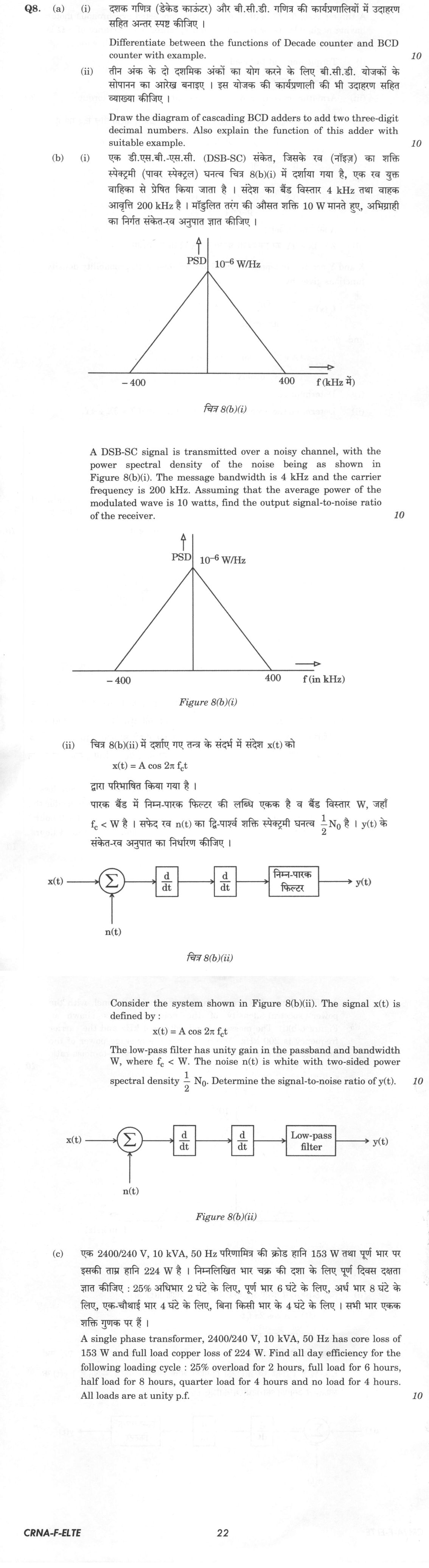
A DSB-SC signal is transmitted over a noisy channel, with the power spectral density of the noise being as shown in Figure 8(b)(i). The message bandwidth is 4 kHz and the carrier frequency is 200 kHz. Assuming that the average power of the modulated wave is 10 watts, find the output signal-to-noise ratio of the receiver. 10 marks
Figure 8(b)(i)
Consider the system shown in Figure 8(b)(ii). The signal x(t) is defined by : x(t) = A cos 2π f_c t
The low-pass filter has unity gain in the passband and bandwidth W, where f_c < W. The noise n(t) is white with two-sided power spectral density 1/2 N_0. Determine the signal-to-noise ratio of y(t). 10 marks
Figure 8(b)(ii)
A single phase transformer, 2400/240 V, 10 kVA, 50 Hz has core loss of 153 W and full load copper loss of 224 W. Find all day efficiency for the following loading cycle : 25% overload for 2 hours, full load for 6 hours, half load for 8 hours, quarter load for 4 hours and no load for 4 hours. All loads are at unity p.f. 10 marks
हिंदी में प्रश्न पढ़ें
दशक गणित्र (डेकड काउंटर) और बी.सी.डी. गणित्र की कार्यप्रणालियों में उदाहरण सहित अंतर स्पष्ट कीजिए । 10 marks
तीन अंक के दो दशमिक अंकों का योग करने के लिए बी.सी.डी. योजकों के सोपानन का आरेख बनाइए । इस योजक की कार्यप्रणाली की भी उदाहरण सहित व्याख्या कीजिए । 10 marks
एक डी.एस.बी.-एस.सी. (DSB-SC) संकेत, जिसके रव (नॉइज) का शक्ति स्पेक्ट्रमी (पावर स्पेक्ट्रल) घनत्व चित्र 8(b)(i) में दर्शाया गया है, एक रव युक्त वाहिका से प्रेषित किया जाता है । संदेश का बैंड विस्तार 4 kHz तथा वाहक आवृत्ति 200 kHz है । मॉडुलित तरंग की औसत शक्ति 10 W मानते हुए, अभिग्राही का निर्गत संकेत-रव अनुपात ज्ञात कीजिए । 10 marks
चित्र 8(b)(i)
चित्र 8(b)(ii) में दर्शाए गए तंत्र के संदर्भ में संदेश x(t) को x(t) = A cos 2π f_ct द्वारा परिभाषित किया गया है ।
पारक बैंड में निम्न-पारक फिल्टर की लंबि एकक है व बैंड विस्तार W, जहाँ f_c < W है । सफेद शब्द n(t) का द्वि-पार्श्व शक्ति स्पेक्ट्रमी घनत्व 1/2N₀ है । y(t) के संकेत-शब्द अनुपात का निर्धारण कीजिए । 10 marks
चित्र 8(b)(ii)
एक 2400/240 V, 10 kVA, 50 Hz परिणामित्र की क्रोड हानि 153 W तथा पूर्ण भार पर इसकी ताम्र हानि 224 W है । निम्नलिखित भार चक्र की दशा के लिए पूर्ण दिवस दक्षता ज्ञात कीजिए : 25% अधिभार 2 घंटे के लिए, पूर्ण भार 6 घंटे के लिए, अर्थ भार 8 घंटे के लिए, एक-चौथाई भार 4 घंटे के लिए, बिना किसी भार के 4 घंटे के लिए । सभी भार एकक शक्ति गुणक पर हैं । 10 marks
The figure this question refers to, in words
The question paper is a scan and the diagram did not survive as text. This is the figure as read from the original page — every component, value and label — so the question can be worked from the text below.
(b) A graph of noise power spectral density (PSD) versus frequency f in kHz. The vertical axis is labeled PSD with a peak value of 10^-6 W/Hz at f = 0. The horizontal axis is labeled f (kHz में) with marked points at -400 and 400. The plot is a symmetric triangle centered at f = 0, rising linearly from 0 at f = -400 kHz to a peak value of 10^-6 W/Hz at f = 0 kHz, and decreasing linearly to 0 at f = 400 kHz.
(b) A graph of noise power spectral density (PSD) versus frequency f (in kHz). The vertical axis is labeled 'PSD' with the peak value marked as 10^-6 W/Hz at f = 0. The horizontal axis is labeled 'f (in kHz)' with values marked at -400 and 400. The curve is a symmetric triangle centered at f = 0, rising linearly from 0 at f = -400 kHz to 10^-6 W/Hz at f = 0, and decreasing linearly back to 0 at f = 400 kHz. The value is zero for |f| > 400 kHz.
(b) Block diagram of a system labeled 'Figure 8(b)(ii)': A summing junction (circle with a summation symbol) receives signal x(t) from the left and noise n(t) from below. The output of the summing junction passes in series through a first differentiator block labeled 'd/dt', then a second differentiator block labeled 'd/dt', and then through a block labeled 'Low-pass filter'. The output of the low-pass filter is labeled y(t).
Model answer
Written by UPSC Answer Check against this question's marking rubric, to the expected length. UPSC does not publish answers for Mains — this is one way to score well, not an official key.
(a)(i) A decade counter has modulus 10: it advances through ten clock states and then returns to the initial state. Its outputs need not be BCD; often it gives one-of-ten decoded outputs. Example: IC 4017 produces sequential outputs Q₀ to Q₉. A BCD counter is a decade counter whose ten states are coded in 8421 BCD, i.e. 0000, 0001, ..., 1001. It is used for decimal display, decimal arithmetic and BCD adders. Example: 7490/74160 in BCD mode gives 0000 to 1001. Thus every BCD counter is a decade counter, but a decade counter need not provide BCD output.
(a)(ii) Schematic of cascaded BCD adders for three-digit numbers:
A₀ B₀ → [4-bit adder + BCD correction] → D₀, C₀ C₀, A₁, B₁ → [4-bit adder + BCD correction] → D₁, C₁ C₁, A₂, B₂ → [4-bit adder + BCD correction] → D₂, C₂
Each stage adds one BCD digit. The correction block uses a second 4-bit adder to add 0110 when C_out = 1 or S₃S₂ + S₃S₁ = 1. The carry C₀ goes to the tens stage, C₁ to the hundreds stage. Example: 456 + 789. Units: 6 + 9 = 15 → corrected BCD 0101, carry 1. Tens: 5 + 8 + 1 = 14 → corrected BCD 0100, carry 1. Hundreds: 4 + 7 + 1 = 12 → corrected BCD 0010, carry 1. Result = 1245.
(b)(i) For DSB-SC coherent detection, output signal power S_o = 2P_s = 2 × 10 = 20 W (multiplier constant does not change SNR). The noise PSD is S_n(f) = 10⁻⁶(1 − |f|/400000) W/Hz, |f| ≤ 400 kHz, else 0. Given f_c = 200 kHz and W = 4 kHz, the output noise after LPF is N_o = ∫₋_W^W [S_n(f − f_c) + S_n(f + f_c)] df = 2∫₁₉₆₀₀₀^204000 10⁻⁶(1 − u/400000) du = 2 × 10⁻⁶ [8000 − 4000] = 0.008 W. Therefore SNR_o = 20/0.008 = 2500 = 10 log₁₀ 2500 = 33.98 dB ≈ 34 dB.
(b)(ii) Let r(t) = x(t) + n(t). Two differentiators have frequency response H(f) = (j2πf)², so |H(f)|² = (2πf)⁴. Signal: x(t) = A cos 2πf_c t. After two derivatives, x_y(t) = −A(2πf_c)² cos 2πf_c t. Since f_c < W, LPF passes it. S_y = A²(2πf_c)⁴/2 = 8A²π⁴f_c⁴. Noise PSD after differentiators is S_v(f) = (N₀/2)(2πf)⁴. After LPF, N_y = ∫₋_W^W (N₀/2)(2πf)⁴ df = N₀(2π)⁴ ∫₀^W f⁴ df = (16/5)π⁴N₀W⁵. Thus SNR_y = S_y/N_y = [8A²π⁴f_c⁴]/[(16/5)π⁴N₀W⁵] = 5A²f_c⁴/(2N₀W⁵).
(c) Full-load output = 10 kW at unity pf. Output energy: 25% overload: 12.5 kW × 2 h = 25 kWh. Full load: 10 kW × 6 h = 60 kWh. Half load: 5 kW × 8 h = 40 kWh. Quarter load: 2.5 kW × 4 h = 10 kWh. No load: 0 kWh. Total output = 135 kWh. Copper losses: 25% overload: 224(1.25)² = 350 W, energy = 350 × 2 = 0.700 kWh. Full load: 224 × 6 = 1.344 kWh. Half load: 224(0.5)² = 56 W, energy = 56 × 8 = 0.448 kWh. Quarter load: 224(0.25)² = 14 W, energy = 14 × 4 = 0.056 kWh. No load: 0. Total copper loss = 0.700 + 1.344 + 0.448 + 0.056 = 2.548 kWh. Core loss = 153 W × 24 h = 3.672 kWh. Total loss = 2.548 + 3.672 = 6.220 kWh. All-day efficiency = 135/(135 + 6.220) × 100 = 95.5955% ≈ 95.60%.
What "Solve" is asking you to do
Choose the method, then carry it through to a final answer. Identifying what kind of problem this is and why that method applies is the first thing marked; a correct figure arrived at invisibly earns almost nothing.
Structure that answers it
Given data and what is required → method chosen, with the reason it applies → set-up (equation, circuit, free body, trial balance) → working, step by step → answer with units and any condition of validity
Where marks are lost
Doing the middle steps mentally and writing only the result. In mathematics papers, a further loss comes from giving a decimal where the exact value in surds or fractions was wanted, or from skipping the justification a part explicitly asks for.
How this answer will be evaluated
Approach
(a(i)) compare: paired headings or table > key differences > significance > conclusion | (a(ii)) describe: define > structure or process in order > labelled diagram > significance | (b(i)) calculate: given > formula > substitution > result with units > interpretation | (b(ii)) calculate: given > formula > substitution > result with units > interpretation | (c) calculate: given > formula > substitution > result with units > interpretation Full marks: Accurate diagrams, correct formulas, and precise numerical results with units.
Key points expected
- Define Decade counter (0-9) and BCD counter (0-99).
- Show three cascaded 4-bit adders with correction logic.
- Calculate noise power from the given PSD triangle.
- Analyze the effect of the two differentiators on the signal.
- Calculate total energy output over the 24-hour cycle.
Evaluation rubric
Each sub-part is marked on its own, against the marks and word limit printed on the paper.
- (a(i)) Differentiate Decade and BCD counters with examples. 10 marks
compare— paired headings or table → key differences → significance → conclusion
Must cover
- Define Decade counter (0-9) and BCD counter (0-99).
Loses marks
- Confusing BCD counter with a simple 8-bit binary counter.
Earns more
- State that Decade counter is a 4-bit counter.
Extra mark
- Provide a state diagram for the Decade counter.
- (a(ii)) Draw cascading BCD adders for 3-digit addition and explain function. 10 marks
describe— define → structure or process in order → labelled diagram → significance
Must cover
- Show three cascaded 4-bit adders with correction logic.
Loses marks
- Omitting the BCD correction logic (adding 6) in the diagram.
Earns more
- Explain the role of the carry-lookahead or ripple carry.
Extra mark
- Provide a specific numerical example of the addition.
- (b(i)) Find output SNR for DSB-SC signal over noisy channel. 10 marks
calculate— given → formula → substitution → result with units → interpretation
Must cover
- Calculate noise power from the given PSD triangle.
Loses marks
- Using the total noise power instead of the in-band noise power.
Earns more
- State the formula for DSB-SC output SNR.
Extra mark
- Sketch the noise PSD relative to the carrier frequency.
- (b(ii)) Determine SNR of y(t) for the given system with white noise. 10 marks
calculate— given → formula → substitution → result with units → interpretation
Must cover
- Analyze the effect of the two differentiators on the signal.
Loses marks
- Ignoring the bandwidth W of the low-pass filter in noise calculation.
Earns more
- Calculate the noise power after the differentiators.
Extra mark
- Show the frequency response of the differentiator block.
- (c) Find all-day efficiency for the given transformer loading cycle. 10 marks
calculate— given → formula → substitution → result with units → interpretation
Must cover
- Calculate total energy output over the 24-hour cycle.
Loses marks
- Using full-load copper loss for all load conditions.
Earns more
- Calculate copper loss for each specific load fraction.
Extra mark
- Present the calculation in a clear tabular format.
Practice this exact question
Write your answer and it is marked point by point against the model answer above — what you covered, what you missed, what you got wrong.
Evaluate my answer →More from Electrical Engineering 2022 Paper I
- Q5 (a) The diagram of Master-Slave S-R flip-flop and the waveform applied to the Master flip…
- Q6 (a) The plane wave E = 30 cos (ωt – z) aₓ V/m in air normally hits a lossless medium (μ =…
- Q7 (a) A three-phase, 5 kW, 440 V, 6 pole, star connected synchronous motor having negligibl…
- Q8 (a) (i) Differentiate between the functions of Decade counter and BCD counter with exampl…