Paper I — Q5
(a) The diagram of Master-Slave S-R flip-flop and the waveform applied to the Master flip-flop is shown in Figure 5(a). Draw the…
The diagram of Master-Slave S-R flip-flop and the waveform applied to the Master flip-flop is shown in Figure 5(a). Draw the waveform that appears at the output of Slave flip-flop. 10 marks
An ideal lossless λ/4 extension line of Z₀ = 60 Ω is terminated with a load resistance of 60 Ω. Find the value of Z_in. 10 marks
The power supplied to a 3-phase induction motor is 40 kW and the corresponding stator losses are 1·5 kW. Calculate the net (shaft) mechanical power developed and the rotor Cu loss, when the slip is 0·04 pu. What will be the net power developed if the speed of the above motor is reduced to 40% of the synchronous speed by means of external rotor resistance, assuming the torque and stator losses remain unaltered ? Friction and windage losses may be assumed to be 0·8 kW. 10 marks
An audio frequency signal 10 sin (2π × 500 t) is used to amplitude modulate a carrier of 50 sin (2π × 10⁵ t). Determine : (i) the modulation index (ii) the amplitude of each sideband frequency (iii) the bandwidth required (iv) total power delivered to the load of 500 Ω (v) and draw the frequency spectrum. 10 marks
For a two-port network, the currents I₁ and I₂ are as given below : I₁ = 2V₁ – V₂, I₂ = – V₁ + 2V₂. Find the transmission and hybrid parameters of the network. 10 marks
हिंदी में प्रश्न पढ़ें
एक मास्टर-स्लेव S-R फ्लिप-फ्लॉप व उसके मास्टर फ्लिप-फ्लॉप पर अनुप्रयुक्त तरंग रूप का आरेख चित्र 5(a) में दर्शाया गया है । स्लेव फ्लिप-फ्लॉप के निर्गम पर प्रकट होने वाले तरंग रूप का आरेखण कीजिए । 10 अंक
Z₀ = 60 Ω वाली एक आदर्श क्षयहीन λ/4 विस्तार लाइन एक 60 Ω के भार प्रतिरोध के साथ अंतस्थ होती है । Z_in का मान ज्ञात कीजिए । 10 अंक
एक त्रि-कला प्रेरण मोटर को 40 kW शक्ति की आपूर्ति की जा रही है, तदनुसार स्टेटर में 1·5 kW शक्ति हानि होती है । जब सर्पण 0·04 pu हो, तो रोटर में ताम्र हानि व उत्पन्न शुद्ध (शैफ्ट) यांत्रिक शक्ति की गणना कीजिए । यदि उपर्युक्त मोटर की गति को बाह्य रोटर प्रतिरोध की सहायता से तुल्यकालिक गति के 40% तक कम कर दिया जाए, तो बल-आघूर्ण व स्टेटर हानि को अपरिवर्तित मान कर, उत्पन्न शुद्ध शक्ति का मान क्या होगा ? यांत्रिक घर्षण हानि व वायु घर्षण हानि को 0·8 kW मान लीजिए । 10 अंक
एक वाहक 50 sin (2π × 10⁵ t) का एक श्रव्य आवृत्ति संकेत 10 sin (2π × 500 t) के द्वारा आयाम मॉडुलन किया जाता है । निर्धारित कीजिए : (i) मॉडुलन सूचकांक (ii) प्रत्येक पार्श्व बैंड आवृत्ति का आयाम (iii) आवश्यक बैंड विस्तार (iv) 500 Ω भार को प्रदत्त पूर्ण शक्ति (v) तथा आवृत्ति स्पेक्ट्रम का आरेखण कीजिए । 10 अंक
एक द्वि-प्रद्वार जालक्रम के लिए धारा I₁ व I₂ के मान निम्न प्रकार हैं : I₁ = 2V₁ – V₂, I₂ = – V₁ + 2V₂ । जालक्रम के संचरण व संकर प्राचल ज्ञात कीजिए । 10 अंक
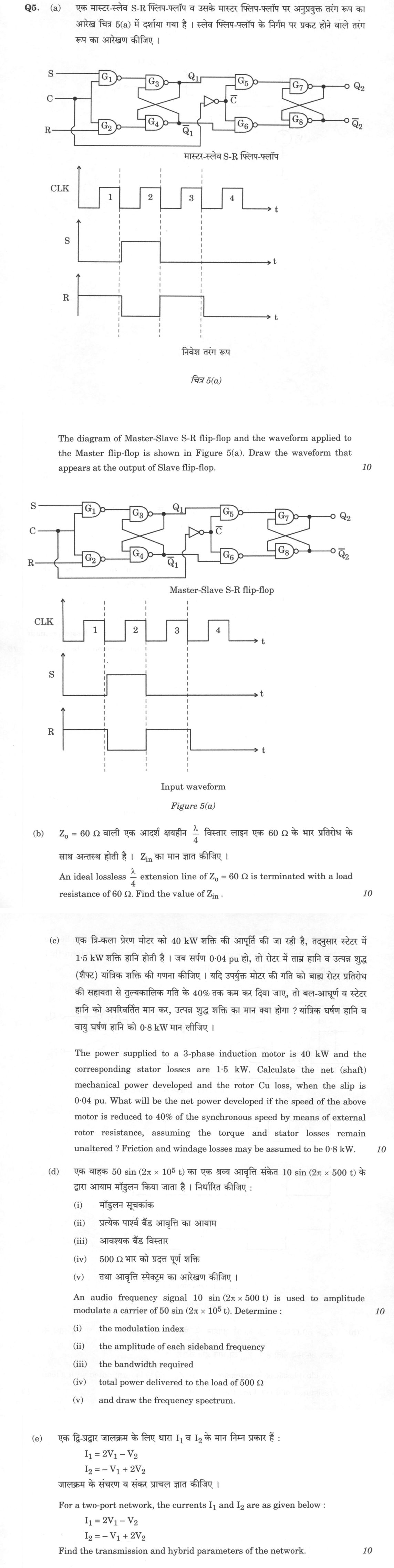
The figure this question refers to, in words
The question paper is a scan and the diagram did not survive as text. This is the figure as read from the original page — every component, value and label — so the question can be worked from the text below.
(a) Figure 5(a) contains two diagrams:
- Logic diagram of 'Master-Slave S-R flip-flop':
- Master stage:
- NAND gate G1 has inputs S and clock C.
- NAND gate G2 has inputs clock C and R.
- Output of G1 connects to one input of NAND gate G3.
- Output of G2 connects to one input of NAND gate G4.
- G3 and G4 form a cross-coupled latch: output of G3 is labelled Q1 and connects to the second input of G4; output of G4 is labelled Q1_bar and connects to the second input of G3.
- Slave stage:
- Clock line C passes through an inverter (NOT gate) to produce inverted clock C_bar.
- NAND gate G5 has inputs Q1 and C_bar.
- NAND gate G6 has inputs C_bar and Q1_bar.
- Output of G5 connects to one input of NAND gate G7.
- Output of G6 connects to one input of NAND gate G8.
- G7 and G8 form a cross-coupled latch: output of G7 is labelled Q2 and connects to the second input of G8; output of G8 is labelled Q2_bar and connects to the second input of G7.
- Timing diagram labelled 'Input waveform' showing three aligned signals versus time t:
- CLK: A series of four positive rectangular pulses numbered 1, 2, 3, and 4. Vertical dashed lines mark the falling edges of pulses 1, 2, and 3.
- S: Starts LOW (0). At the falling edge of CLK pulse 1, it transitions to HIGH (1). At the falling edge of CLK pulse 2, it transitions to LOW (0) and remains LOW through pulses 3 and 4.
- R: Starts HIGH (1). At the falling edge of CLK pulse 1, it transitions to LOW (0). At the falling edge of CLK pulse 2, it transitions to HIGH (1). At the falling edge of CLK pulse 3, it transitions to LOW (0) and remains LOW through pulse 4.
Model answer
Written by UPSC Answer Check against this question's marking rubric, to the expected length. UPSC does not publish answers for Mains — this is one way to score well, not an official key.
(a) In a master-slave S-R flip-flop, the master is enabled when CLK = 1, while the slave is enabled when CLK = 0 because of the inverter. Therefore, the slave output Q₂ changes only at the falling edge of CLK, and it copies the master output Q₁ that existed just before the falling edge.
Reading the given input waveform:
- During CLK pulse 1, S = 0, R = 1. Hence master is reset, Q₁ = 0. At the falling edge of pulse 1, slave copies Q₁ = 0, so Q₂ becomes 0.
- During CLK pulse 2, S = 1, R = 0. Hence master is set, Q₁ = 1. At the falling edge of pulse 2, slave copies Q₁ = 1, so Q₂ becomes 1.
- During CLK pulse 3, S = 0, R = 1. Hence master is reset, Q₁ = 0. At the falling edge of pulse 3, slave copies Q₁ = 0, so Q₂ becomes 0.
- During CLK pulse 4, S = 0, R = 0. Master holds Q₁ = 0. At the falling edge of pulse 4, Q₂ remains 0.
The output waveform is therefore:
`` CLK : 1 2 3 4 |‾| |‾| |‾| |‾| | | | | Q₂ : x x 0 0 1 0 0 ↑ ↑ ↑ ↑ edge1 edge2 edge3 edge4 ``
If the initial state before the first falling edge is not specified, it is indeterminate; from the first falling edge onward, Q₂ = 0, then 1, then 0, then 0.
Final answer: Q₂ changes at falling edges as − 0 after edge 1, 1 from edge 2 to edge 3, and 0 after edge 3.
(b) For a lossless transmission line of length l,
Z_in = Z₀ (Z_L + jZ₀ tan βl) / (Z₀ + jZ_L tan βl).
Here l = λ/4, so
βl = (2π/λ)(λ/4) = π/2.
Thus tan βl → ∞. Taking the limiting value for a λ/4 line,
Z_in = Z₀² / Z_L.
Given Z₀ = 60 Ω and Z_L = 60 Ω,
Z_in = 60² / 60 = 3600 / 60 = 60 Ω.
Final answer: Z_in = 60 Ω.
(c) The air-gap power transferred to the rotor is
P_ag = input power − stator losses = 40 − 1.5 = 38.5 kW.
Rotor Cu loss at slip s = 0.04:
P_cu,rotor = s P_ag = 0.04 × 38.5 = 1.54 kW.
Gross mechanical power developed:
P_m = (1 − s) P_ag = 0.96 × 38.5 = 36.96 kW.
Net shaft mechanical power = gross mechanical power − friction and windage loss:
P_shaft = 36.96 − 0.8 = 36.16 kW.
For the second case, speed is reduced to 40% of synchronous speed. Therefore new slip is
s′ = 1 − 0.40 = 0.60 pu.
The torque is assumed unchanged. At original slip, gross mechanical power was 36.96 kW at speed 0.96 N_s. Hence torque is proportional to
T ∝ 36.96 / 0.96 = 38.5 per unit synchronous speed.
At new speed 0.40 N_s,
P_m′ = (38.5)(0.40) = 15.4 kW.
Net shaft power at new speed:
P_shaft′ = 15.4 − 0.8 = 14.6 kW.
Final answers: Rotor Cu loss = 1.54 kW; net shaft power at original slip = 36.16 kW; net shaft power at 40% synchronous speed = 14.6 kW. The corresponding gross mechanical power in the second case is 15.4 kW.
(d) The modulating signal is
m(t) = 10 sin(2π × 500t), so A_m = 10 V and f_m = 500 Hz.
The carrier is
c(t) = 50 sin(2π × 10⁵t), so A_c = 50 V and f_c = 100 kHz.
(i) Modulation index:
μ = A_m / A_c = 10 / 50 = 0.2.
Final answer: μ = 0.2.
(ii) The amplitude of each sideband is
A_side = μ A_c / 2 = (0.2 × 50) / 2 = 5 V.
The sideband frequencies are
f_c − f_m = 100000 − 500 = 99.5 kHz,
f_c + f_m = 100000 + 500 = 100.5 kHz.
Final answer: Each sideband amplitude = 5 V, at 99.5 kHz and 100.5 kHz.
(iii) Bandwidth required:
BW = 2 f_m = 2 × 500 = 1000 Hz = 1 kHz.
Final answer: Bandwidth = 1 kHz.
(iv) Carrier power in load R = 500 Ω is
P_c = A_c² / (2R) = 50² / (2 × 500) = 2500 / 1000 = 2.5 W.
Total AM power is
P_total = P_c (1 + μ²/2)
= 2.5 (1 + 0.2²/2)
= 2.5 (1 + 0.04/2)
= 2.5 × 1.02 = 2.55 W.
Final answer: Total power delivered to the 500 Ω load = 2.55 W.
(v) The frequency spectrum has three spectral lines:
- Lower sideband at 99.5 kHz with amplitude 5 V.
- Carrier at 100 kHz with amplitude 50 V.
- Upper sideband at 100.5 kHz with amplitude 5 V.
`` Amplitude (V) 50 | 5 | * 0 |_______|________________________|_______ 99.5 100.0 100.5 f (kHz) ``
Final answer: Spectrum lines at 99.5 kHz, 5 V, 100 kHz, 50 V, and 100.5 kHz, 5 V.
(e) The given equations are
I₁ = 2V₁ − V₂,
I₂ = −V₁ + 2V₂.
This is in admittance-parameter form. Writing the matrix,
[ I₁ ; I₂ ] = [ 2 −1 ; −1 2 ] [ V₁ ; V₂ ].
The determinant is
Δ = (2)(2) − (−1)(−1) = 4 − 1 = 3.
Solving for V₁ and V₂:
V₁ = (2I₁ + I₂) / 3,
V₂ = (I₁ + 2I₂) / 3.
Hybrid parameters
Hybrid parameters are defined by
V₁ = h₁₁ I₁ + h₁₂ V₂,
I₂ = h₂₁ I₁ + h₂₂ V₂.
From I₁ = 2V₁ − V₂,
2V₁ = I₁ + V₂,
V₁ = 0.5 I₁ + 0.5 V₂.
So
h₁₁ = 0.5 Ω,
h₁₂ = 0.5.
Now substitute V₁ into the second equation:
I₂ = −V₁ + 2V₂
= −(0.5 I₁ + 0.5 V₂) + 2V₂
= −0.5 I₁ + 1.5 V₂.
Hence
h₂₁ = −0.5,
h₂₂ = 1.5 S.
Final hybrid parameters:
h₁₁ = 0.5 Ω, h₁₂ = 0.5, h₂₁ = −0.5, h₂₂ = 1.5 S.
Transmission parameters
Using the standard form with I₂ entering port 2,
V₁ = A V₂ − B I₂,
I₁ = C V₂ − D I₂.
From V₂ = (I₁ + 2I₂)/3,
I₁ = 3V₂ − 2I₂.
Thus
C = 3 S,
D = 2.
Now substitute I₁ into V₁:
V₁ = (2I₁ + I₂)/3
= [2(3V₂ − 2I₂) + I₂]/3
= (6V₂ − 4I₂ + I₂)/3
= (6V₂ − 3I₂)/3
= 2V₂ − I₂.
Therefore
A = 2,
B = 1 Ω.
Final transmission parameters:
A = 2, B = 1 Ω, C = 3 S, D = 2.
What "Solve" is asking you to do
Choose the method, then carry it through to a final answer. Identifying what kind of problem this is and why that method applies is the first thing marked; a correct figure arrived at invisibly earns almost nothing.
Structure that answers it
Given data and what is required → method chosen, with the reason it applies → set-up (equation, circuit, free body, trial balance) → working, step by step → answer with units and any condition of validity
Where marks are lost
Doing the middle steps mentally and writing only the result. In mathematics papers, a further loss comes from giving a decimal where the exact value in surds or fractions was wanted, or from skipping the justification a part explicitly asks for.
How this answer will be evaluated
Approach
(a) describe: define > structure or process in order > labelled diagram > significance | (b) calculate: given > formula > substitution > result with units > interpretation | (c) calculate: given > formula > substitution > result with units > interpretation | (d) calculate: given > formula > substitution > result with units > interpretation | (e) calculate: given > formula > substitution > result with units > interpretation Full marks: Complete derivations with correct units, labelled diagrams, and clear step-by-step logic.
Key points expected
- Identify master active during CLK high
- Identify slave active during CLK low
- Track Q1 and Q1-bar transitions
- Show Q2 output changing on falling edge
- State quarter-wave transformer formula
- Substitute Z0 = 60 ohm and ZL = 60 ohm
- Calculate final Zin value
- Calculate air-gap power (40 - 1.5 kW)
Evaluation rubric
Each sub-part is marked on its own, against the marks and word limit printed on the paper.
- (a) Draw the output waveform of the slave flip-flop based on the given inputs. 10 marks
describe— define → structure or process in order → labelled diagram → significance
Must cover
- Identify master active during CLK high
- Identify slave active during CLK low
- Track Q1 and Q1-bar transitions
- Show Q2 output changing on falling edge
Loses marks
- Ignoring the inverter on slave clock
- Output changing on rising edge
Earns more
- Label timing intervals 1, 2, 3, 4
- Show intermediate master state Q1
Extra mark
- Annotate gate states G1-G8
- (b) Calculate the input impedance of the quarter-wave line. 10 marks
calculate— given → formula → substitution → result with units → interpretation
Must cover
- State quarter-wave transformer formula
- Substitute Z0 = 60 ohm and ZL = 60 ohm
- Calculate final Zin value
Loses marks
- Using wrong formula for line length
- Arithmetic error in substitution
Earns more
- Mention impedance inversion property
Extra mark
- Draw equivalent transmission line model
- (c) Calculate shaft power, rotor loss, and power at reduced speed. 10 marks
calculate— given → formula → substitution → result with units → interpretation
Must cover
- Calculate air-gap power (40 - 1.5 kW)
- Determine rotor Cu loss using slip 0.04
- Compute initial net shaft power
- Recalculate power for 40% speed reduction
Loses marks
- Ignoring stator losses in air-gap calc
- Forgetting to subtract mechanical losses
Earns more
- Explicitly subtract friction and windage losses
- Show torque-speed relationship logic
Extra mark
- Draw power flow diagram
- (d) Determine modulation parameters and draw the frequency spectrum. 10 marks
calculate— given → formula → substitution → result with units → interpretation
Must cover
- Calculate modulation index m = 0.2
- Determine sideband amplitudes (5 V)
- Calculate total power delivered to 500 ohm
- Draw spectrum with carrier and sidebands
Loses marks
- Incorrect sideband amplitude calculation
- Missing carrier in spectrum diagram
Earns more
- Label carrier frequency 100 kHz
- Label sideband frequencies 99.5 and 100.5 kHz
Extra mark
- Calculate bandwidth explicitly as 1 kHz
- (e) Find the transmission and hybrid parameters of the network. 10 marks
calculate— given → formula → substitution → result with units → interpretation
Must cover
- Derive transmission (ABCD) parameters
- Derive hybrid (h) parameters
- Show matrix form for both
Loses marks
- Confusing current directions in derivation
- Matrix inversion errors
Earns more
- Verify reciprocity condition
Extra mark
- Draw two-port network diagram
Practice this exact question
Write your answer and it is marked point by point against the model answer above — what you covered, what you missed, what you got wrong.
Evaluate my answer →More from Electrical Engineering 2022 Paper I
- Q2 (a) (i) For the circuit shown in Figure 2(a)(i), initial current through the coil is zero…
- Q3 A common-emitter amplifier circuit is shown in Figure 3(a). Neglect r_x and r_o and assum…
- Q4 For the network shown in Figure 4(a)(i) and its excitation function shown in Figure 4(a)(…
- Q5 (a) The diagram of Master-Slave S-R flip-flop and the waveform applied to the Master flip…
- Q6 (a) The plane wave E = 30 cos (ωt – z) aₓ V/m in air normally hits a lossless medium (μ =…
- Q7 (a) A three-phase, 5 kW, 440 V, 6 pole, star connected synchronous motor having negligibl…
- Q8 (a) (i) Differentiate between the functions of Decade counter and BCD counter with exampl…