Paper I — Q7
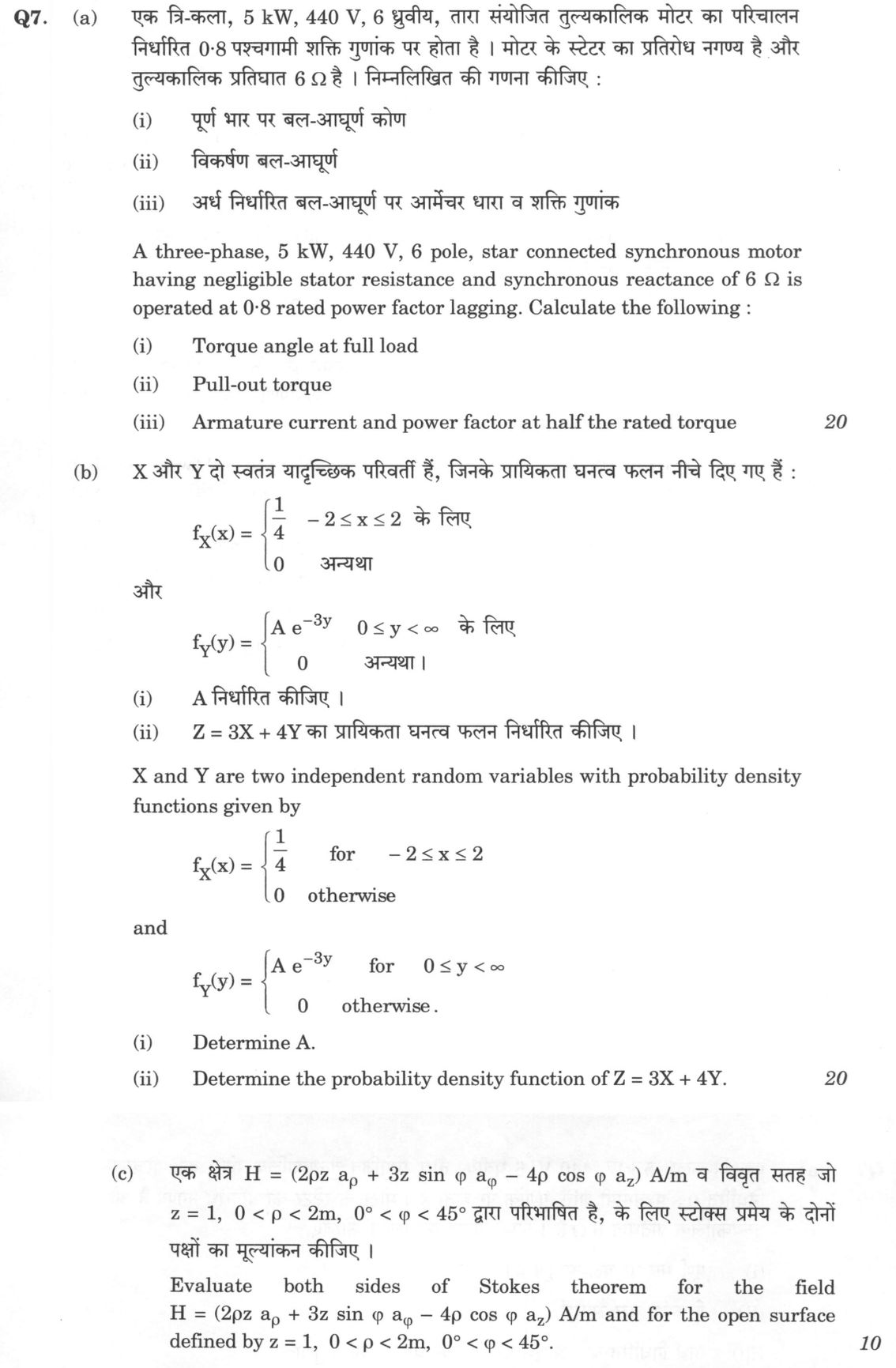
(a) A three-phase, 5 kW, 440 V, 6 pole, star connected synchronous motor having negligible stator resistance and synchronous…
A three-phase, 5 kW, 440 V, 6 pole, star connected synchronous motor having negligible stator resistance and synchronous reactance of 6 Ω is operated at 0·8 rated power factor lagging. Calculate the following :
Torque angle at full load
Pull-out torque
Armature current and power factor at half the rated torque 20 marks
X and Y are two independent random variables with probability density functions given by
f_X(x) = 1/4 for -2 ≤ x ≤ 2 0 otherwise
and
f_Y(y) = A e^-3y for 0 ≤ y < ∞ 0 otherwise .
Determine A.
Determine the probability density function of Z = 3X + 4Y. 20 marks
Evaluate both sides of Stokes theorem for the field H = (2ρz a_ρ + 3z sin φ a_φ − 4ρ cos φ a_z) A/m and for the open surface defined by z = 1, 0 < ρ < 2m, 0° < φ < 45°. 10 marks
हिंदी में प्रश्न पढ़ें
एक त्रि-कला, 5 kW, 440 V, 6 ध्रुवीय, तारा संयोजित तुल्यकालिक मोटर का परिचालन निर्धारित 0·8 पश्चगामी शक्ति गुणांक पर होता है। मोटर के स्टेटर का प्रतिरोध नगण्य है और तुल्यकालिक प्रतिघात 6 Ω है। निम्नलिखित की गणना कीजिए :
पूर्ण भार पर बल-आघूर्ण कोण
विकर्षण बल-आघूर्ण
अर्ध निर्धारित बल-आघूर्ण पर आर्मेचर धारा व शक्ति गुणांक 20 marks
X और Y दो स्वतंत्र यादृच्छिक परिवर्ती हैं, जिनके प्रायिकता घनत्व फलन नीचे दिए गए हैं :
f_X(x) = 1/4 -2 ≤ x ≤ 2 के लिए 0 अन्यथा
और
f_Y(y) = A e^-3y 0 ≤ y < ∞ के लिए 0 अन्यथा |
A निर्धारित कीजिए।
Z = 3X + 4Y का प्रायिकता घनत्व फलन निर्धारित कीजिए। 20 marks
एक क्षेत्र H = (2ρz a_ρ + 3z sin φ a_φ − 4ρ cos φ a_z) A/m व विवृत सतह जो z = 1, 0 < ρ < 2m, 0° < φ < 45° द्वारा परिभाषित है, के लिए स्टोक्स प्रमेय के दोनों पक्षों का मूल्यांकन कीजिए । 10 marks
Model answer
Written by UPSC Answer Check against this question's marking rubric, to the expected length. UPSC does not publish answers for Mains — this is one way to score well, not an official key.
(a) Assume supply frequency f = 50 Hz and neglect rotational losses. Per-phase voltage: Vph = 440/√3 = 254.03 V. At full load, P = 5000 W, cosφ = 0.8, sinφ = 0.6.
Armature current: I = P/(√3 VL cosφ) = 5000/(√3 × 440 × 0.8) = 8.201 A.
For a synchronous motor with Ra = 0: Vph = Ef + jXsIa, so Ef = Vph − jXsIa. Since Ia lags, Ia = I(0.8 − j0.6). Thus jXsIa = j × 6 × 8.201(0.8 − j0.6) = 29.52 + j39.37 V. Hence Ef = (254.03 − 29.52) − j39.37 = 224.51 − j39.37 V. |Ef| = √(224.51² + 39.37²) = 227.94 V.
(i) Torque angle: δ = arctan(39.37/224.51) = 9.94°. The excitation emf Ef lags Vph by δ = 9.94°.
(ii) Pull-out occurs at δ = 90°: Pmax = 3VphEf/Xs = 3 × 254.03 × 227.94/6 = 28.95 kW. Synchronous speed: Ns = 120f/P = 120 × 50/6 = 1000 rpm. ωs = 2πNs/60 = 104.72 rad/s. Pull-out torque: Tpo = 28951.6/104.72 = 276.5 N m.
(iii) At half rated torque, P = 2500 W, assuming Ef remains unchanged. P = 3VphEf sinδh/Xs sinδh = 2500 × 6/(3 × 254.03 × 227.94) = 0.08635. δh = 4.95°, cosδh = 0.9963.
Armature current components: Ia = (Ef sinδh/Xs) − j(Vph − Ef cosδh)/Xs = 3.28 − j4.49 A. |Ia| = √(3.28² + 4.49²) = 5.56 A. Power factor angle φh = arctan(4.49/3.28) = 53.86°. So pf = cos53.86° = 0.590 lagging.
(b)(i) For fY(y) = A e^(−3y), 0 ≤ y < ∞: ∫₀^∞ A e^(−3y) dy = A/3 = 1, hence A = 3.
(ii) Let U = 3X and V = 4Y. Since X is uniform on [−2,2], U is uniform on [−6,6]: fU(u) = 1/12, −6 ≤ u ≤ 6. Since fY(y) = 3e^(−3y), for V = 4Y: fV(v) = (3/4)e^(−3v/4), v ≥ 0.
For Z = U + V, use convolution: fZ(z) = ∫ fU(u) fV(z − u) du. The integrand is nonzero for −6 ≤ u ≤ 6 and z − u ≥ 0, i.e. u ≤ z.
Thus:
- For z < −6, fZ(z) = 0.
- For −6 ≤ z ≤ 6, fZ(z) = ∫₋₆^z (1/12)(3/4)e^(−3(z−u)/4) du = (1/12)(1 − e^(−3(z+6)/4)).
- For z ≥ 6, fZ(z) = ∫₋₆^6 (1/12)(3/4)e^(−3(z−u)/4) du = (1/12)(e^(−3(z−6)/4) − e^(−3(z+6)/4)).
Therefore, fZ(z) = 0, z < −6 fZ(z) = (1/12)(1 − e^(−3(z+6)/4)), −6 ≤ z ≤ 6 fZ(z) = (1/12)(e^(−3(z−6)/4) − e^(−3(z+6)/4)), z ≥ 6.
(c) For cylindrical coordinates, Hρ = 2ρz, Hφ = 3z sinφ, Hz = −4ρ cosφ.
Curl H: (∇×H)ρ = (1/ρ)∂Hz/∂φ − ∂Hφ/∂z = sinφ. (∇×H)φ = ∂Hρ/∂z − ∂Hz/∂ρ = 2ρ + 4cosφ. (∇×H)z = (1/ρ)[∂(ρHφ)/∂ρ − ∂Hρ/∂φ] = 3z sinφ/ρ.
On z = 1, taking normal as az, so dS = ρ dρ dφ az. Surface integral: ∫(∇×H)·dS = ∫₀^(π/4) ∫₀² (3 sinφ/ρ) ρ dρ dφ = 6∫₀^(π/4) sinφ dφ = 6(1 − 1/√2) = 6 − 3√2 A = 1.757 A.
Line integral, taking positive normal az: C1: φ = 0, ρ = 0 → 2. ∫ H·dl = ∫₀² 2ρ dρ = 4 A. C2: ρ = 2, φ = 0 → π/4. ∫ H·dl = ∫₀^(π/4) 6 sinφ dφ = 6 − 3√2 A. C3: φ = π/4, ρ = 2 → 0. ∫ H·dl = ∫₂⁰ 2ρ dρ = −4 A. Contribution at ρ = 0 is zero.
Total: ∮H·dl = 4 + (6 − 3√2) − 4 = 6 − 3√2 A = 1.757 A.
Both sides of Stokes’ theorem are equal: 6 − 3√2 A.
What "Calculate" is asking you to do
Apply the standard formula or schedule to data the question has already supplied — a table of readings, cost records, a balance sheet — and produce the number. The method is rarely in doubt; the marks sit in the named intermediate quantities, each of which has to appear as a labelled line.
Structure that answers it
Data as given → formula or standard treatment, named → substitution → each intermediate, labelled → result with units
Where marks are lost
Omitting an intermediate the marking scheme pays for separately, or rounding at an intermediate line so the final figure drifts. In commerce and accountancy, any figure in a statement that no numbered working note supports is treated as unearned.
How this answer will be evaluated
Approach
(a) calculate: given > formula > substitution > result with units > interpretation | (b) calculate: given > formula > substitution > result with units > interpretation | (c) calculate: given > formula > substitution > result with units > interpretation Full marks: Complete working with correct phasor diagrams, proper convolution setup, and verified Stokes' theorem equality.
Key points expected
- Calculate phase voltage from 440V line voltage
- Determine rated armature current from power and pf
- Calculate back EMF magnitude and phase angle
- Apply torque equation P = 3E_bV_s sin(delta)/X_s
- Integrate f_Y(y) to find A = 3
- Identify X as uniform distribution on [-2,2]
- Identify Y as exponential distribution with lambda=3
- Set up convolution integral for Z = 3X + 4Y
Evaluation rubric
Each sub-part is marked on its own, against the marks and word limit printed on the paper.
- (a) Determine torque angle, pull-out torque, and armature current/power factor for a synchronous motor. 20 marks
calculate— given → formula → substitution → result with units → interpretation
Must cover
- Calculate phase voltage from 440V line voltage
- Determine rated armature current from power and pf
- Calculate back EMF magnitude and phase angle
- Apply torque equation P = 3E_bV_s sin(delta)/X_s
Loses marks
- Using line voltage instead of phase voltage
- Sign errors in torque angle calculation
- Ignoring power factor in current calculation
Earns more
- Draw phasor diagram showing V_s, E_b, I_a
- Calculate pull-out torque using max power condition
- Determine new current and pf for half torque
Extra mark
- Verify power balance at full load
- State assumptions about negligible resistance
- (b) Determine constant A and find PDF of linear combination Z = 3X + 4Y. 20 marks
calculate— given → formula → substitution → result with units → interpretation
Must cover
- Integrate f_Y(y) to find A = 3
- Identify X as uniform distribution on [-2,2]
- Identify Y as exponential distribution with lambda=3
- Set up convolution integral for Z = 3X + 4Y
Loses marks
- Incorrect limits in convolution integral
- Forgetting to scale variables in transformation
- Algebraic errors in exponential integration
Earns more
- Determine range of Z from ranges of X and Y
- Perform piecewise integration for different Z ranges
- Verify PDF integrates to 1
Extra mark
- Sketch the resulting PDF shape
- Calculate mean and variance of Z
- (c) Verify Stokes' theorem by computing line integral and surface integral. 10 marks
calculate— given → formula → substitution → result with units → interpretation
Must cover
- Compute curl H in cylindrical coordinates
- Set up surface integral over z=1 plane
- Define boundary path with 4 segments
- Compute line integral along each segment
Loses marks
- Incorrect curl calculation in cylindrical coords
- Missing boundary segments in line integral
- Wrong surface normal direction
Earns more
- Show both integrals yield same result
- Correctly parameterize boundary path
- Handle limits 0<rho<2, 0<phi<45 degrees
Extra mark
- Sketch the surface and boundary path
- Verify orientation consistency
Practice this exact question
Write your answer and it is marked point by point against the model answer above — what you covered, what you missed, what you got wrong.
Evaluate my answer →More from Electrical Engineering 2022 Paper I
- Q4 For the network shown in Figure 4(a)(i) and its excitation function shown in Figure 4(a)(…
- Q5 (a) The diagram of Master-Slave S-R flip-flop and the waveform applied to the Master flip…
- Q6 (a) The plane wave E = 30 cos (ωt – z) aₓ V/m in air normally hits a lossless medium (μ =…
- Q7 (a) A three-phase, 5 kW, 440 V, 6 pole, star connected synchronous motor having negligibl…
- Q8 (a) (i) Differentiate between the functions of Decade counter and BCD counter with exampl…