Paper I — Q4
For the network shown in Figure 4(a)(i) and its excitation function shown in Figure 4(a)(ii), find the response v(t) using…
For the network shown in Figure 4(a)(i) and its excitation function shown in Figure 4(a)(ii), find the response v(t) using convolution by:
's' domain approach.
time domain analytical approach.
graphical convolution approach.
A 240 V, 50 Hz single phase supply is connected to a full controlled converter to control the speed of a 10 kW, 220 V separately excited dc motor. The rated current of motor at full load is 25 A, armature resistance is 0·4 ohm and machine constant is 0·3 V/rpm. Calculate the speed of motor when converter is operating at an angle α = 50°, assuming continuous armature current.
Describe the performance requirements of a chopper circuit that can perform the chopping functions in any modulation technique.
The amplifier shown in Figure 4(c) is biased to operate at I_D = 1 mA and g_m = 1 mA/V. Neglecting r_o,
determine the midband gain.
determine the value of C_S that places f_L at 10 Hz.
हिंदी में प्रश्न पढ़ें
चित्र 4(a)(i) में दर्शाए गए संजाल और चित्र 4(a)(ii) में दर्शाए गए इसके उत्तेजक फलन के लिए संवलन का प्रयोग करते हुए, निम्नलिखित विधियों से अनुक्रिया v(t) ज्ञात कीजिए :
's' क्षेत्र पद्धति
काल क्षेत्र विश्लेषण पद्धति
चित्रात्मक संवलन पद्धति
एक 240 V, 50 Hz एकल कला आपूर्ति संयोजित एक पूर्ण नियंत्रित परिवर्तक द्वारा एक 10 kW, 220 V, अन्यतः उत्तेजित दिष धारा मोटर की चाल को नियंत्रित किया जाता है । मोटर की पूर्ण भार पर निर्धारित धारा 25 A, आर्मेचर का प्रतिरोध 0·4 Ω व मशीन स्थिरांक 0·3 V/rpm है । जब परिवर्तक का α = 50° कोण पर परिचालन किया जाता है तो मोटर की चाल की गणना, आर्मेचर में सतत धारा प्रवाह मानकर कीजिए ।
एक अंतरायिक (चॉपर) परिपथ की कार्यकरण आवश्यकताओं का वर्णन कीजिए ताकि यह किसी मॉडुलन तकनीक में अंतरायि (चॉपिंग) कार्य कर सके ।
चित्र 4(c) में दर्शाया गया प्रवर्धक, I_D = 1 mA और g_m = 1 mA/V पर कार्य करने हेतु अभिनति (बायस) है । r_o की उपेक्षा करते हुए
मध्य-बैंड लब्धि ज्ञात कीजिए ।
f_L को 10 Hz पर रखने हेतु C_S का मान ज्ञात कीजिए ।
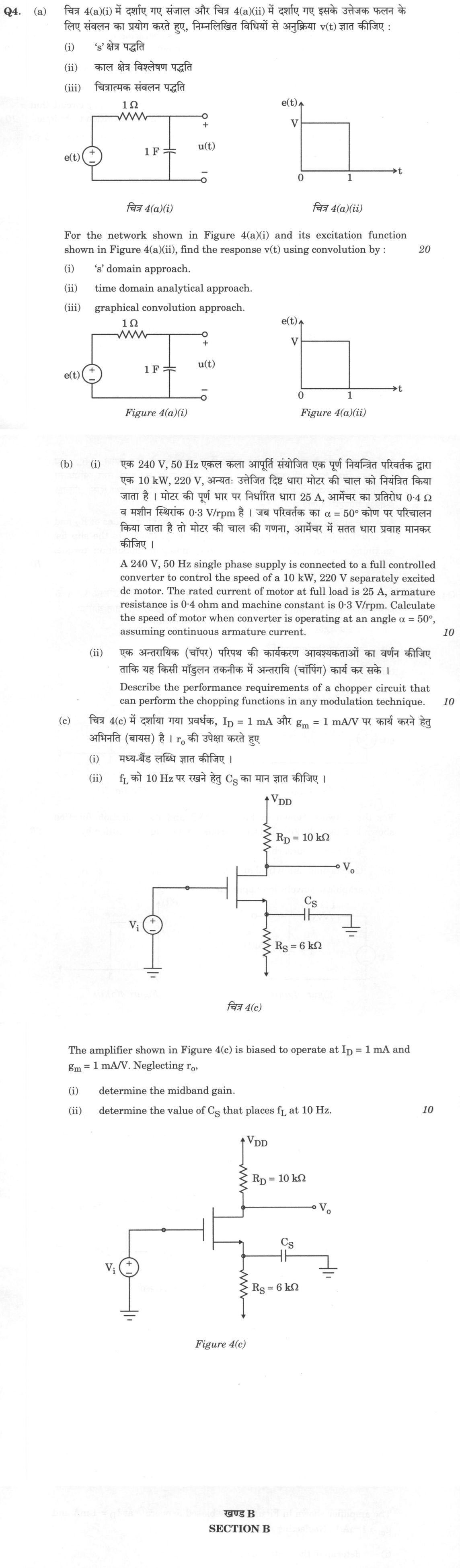
The figure this question refers to, in words
The question paper is a scan and the diagram did not survive as text. This is the figure as read from the original page — every component, value and label — so the question can be worked from the text below.
(a) Figure 4(a)(i): A series RC circuit. A voltage source e(t) is connected in series with a 1 ohm resistor. The resistor is connected to a node which is connected to a 1 Farad capacitor. The other side of the capacitor is connected to the negative terminal of the source. The output voltage u(t) is measured across the capacitor. Figure 4(a)(ii): A graph of the excitation function e(t) versus time t. The vertical axis is e(t) and the horizontal axis is t. The function is a rectangular pulse of height V starting at t=0 and ending at t=1. For t < 0 and t > 1, e(t) is 0.
(c) A circuit diagram of a common-source amplifier. The input signal Vi is connected to the gate of an N-channel MOSFET. The source terminal of the MOSFET is connected to a resistor RS with a value of 6 kΩ, which is connected to ground. A capacitor CS is connected in parallel with the resistor RS. The drain terminal of the MOSFET is connected to a resistor RD with a value of 10 kΩ, which is connected to a DC voltage source VDD. The output voltage Vo is taken from the drain terminal. The text above the figure states the amplifier is biased to operate at ID = 1 mA and gm = 1 mA/V, and to neglect ro.
Model answer
Written by UPSC Answer Check against this question's marking rubric, to the expected length. UPSC does not publish answers for Mains — this is one way to score well, not an official key.
(a)(i) By the s-domain convolution theorem, with zero initial capacitor voltage, v(t)=L⁻¹{H(s)E(s)}. For R=1 Ω and C=1 F, RC=1 s, so H(s)=1/(1+sRC)=1/(1+s). The pulse of height V volts is e(t)=V[u(t)-u(t-1)], with u(t) the unit step, so E(s)=V(1-exp(-s))/s. Hence V_o(s)=V(1-exp(-s))/[s(1+s)]. Since L⁻¹{1/[s(1+s)]}=1-exp(-t), v(t)=V[(1-exp(-t))u(t)-(1-exp(-(t-1)))u(t-1)] volts. Thus v(t)=0 for t<0 s; V(1-exp(-t)) for 0≤t≤1 s; V(exp(-(t-1))-exp(-t))=V(e-1)exp(-t) for t≥1 s. Final: v(t)=V(1-exp(-t))u(t)-V(1-exp(-(t-1)))u(t-1), in volts.
(a)(ii) Time-domain convolution: h(t)=exp(-t)u(t) s⁻¹, with t in seconds. v(t)=∫ h(τ)e(t-τ)dτ. Since e(t-τ)=V for t-1≤τ≤t, the effective limits are max(0,t-1) to t. For 0≤t≤1 s: v(t)=V∫ exp(-τ)dτ from 0 to t = V(1-exp(-t)). For t≥1 s: v(t)=V∫ exp(-τ)dτ from t-1 to t = V(exp(-(t-1))-exp(-t)). For t<0 s, v(t)=0. Final: same piecewise response as (a)(i).
(a)(iii) Graphical convolution: keep h(τ)=exp(-τ)u(τ) s⁻¹ fixed and slide the flipped rectangular pulse. The response is the area under h(τ)e(t-τ). For 0<t<1 s the overlap is 0≤τ≤t, giving V(1-exp(-t)). For t>1 s the overlap is t-1≤τ≤t, giving V(exp(-(t-1))-exp(-t)). At t=1 s, v=V(1-exp(-1)) volts. Final: same piecewise response.
(b)(i) Assume the standard single-phase fully controlled bridge converter, ideal devices, continuous armature current, and motor current equal to rated full-load 25 A. V_m=240√2 V=339.4 V. The average dc output voltage is V_dc=(2V_m/π)cosα=(480√2/π)cos50° V=138.9 V. The back emf is E_b=V_dc-I_aR_a=138.9-25(0.4)=128.9 V. With K=0.3 V/rpm, N=E_b/K=128.9/0.3=429.6 rpm. Final: N≈430 rpm.
(b)(ii) A chopper that can implement any modulation technique must:
- switch over the full duty range 0<D<1 with accurate on/off timing over a wide frequency range;
- use fast devices with low propagation delay, low on-state drop, and adequate voltage/current ratings;
- give high efficiency, low output ripple, low EMI, and good line/load regulation;
- provide freewheeling paths, snubbers, sensing, and protection against overcurrent, overvoltage, short-circuit, and thermal overload;
- have a reliable gate-drive/control interface for PWM, PFM, current-mode, or hysteresis control. Final: these are the required performance characteristics.
(c)(i) From Figure 4(c), RD=10 kΩ and RS=6 kΩ. At midband CS is a short, so the source is at AC ground. Neglecting ro, A_v=V_o/V_i=-gmRD=-(1 mA/V)(10 kΩ)=-10 V/V. Final: A_v=-10 V/V.
(c)(ii) Using the resistance-seen-by-capacitor method, set Vi=0. The source node sees RS in parallel with 1/gm. Since 1/gm=1 kΩ, R_eq=6 kΩ||1 kΩ=6/7 kΩ=857.1 Ω. Source-node KCL gives v_s(1/R_S+sC_S)=gm(V_i-v_s), and V_o=-gmR_D(V_i-v_s), so A(s)=A_mid(s+1/(C_S·R_S))/(s+1/(C_S·R_eq)). Thus f_z=1/(2πC_S·R_S) and f_p=1/(2πC_S·R_eq), with f_z/f_p=1/7. The exact 3-dB condition |A/A_mid|=1/√2 gives f_L=f_p√(1-2/49)=f_p√(47/49). Setting f_L=10 Hz gives C_S=√47/(120000π) F=18.2 μF. The common pole approximation f_L≈f_p gives C_S=7/(120000π) F=18.6 μF. Final: C_S≈18.2 μF exact; 18.6 μF by standard approximation.
What "Solve" is asking you to do
Choose the method, then carry it through to a final answer. Identifying what kind of problem this is and why that method applies is the first thing marked; a correct figure arrived at invisibly earns almost nothing.
Structure that answers it
Given data and what is required → method chosen, with the reason it applies → set-up (equation, circuit, free body, trial balance) → working, step by step → answer with units and any condition of validity
Where marks are lost
Doing the middle steps mentally and writing only the result. In mathematics papers, a further loss comes from giving a decimal where the exact value in surds or fractions was wanted, or from skipping the justification a part explicitly asks for.
How this answer will be evaluated
Approach
(a) calculate: given > formula > substitution > result with units > interpretation | (b(i)) calculate: given > formula > substitution > result with units > interpretation | (b(ii)) describe: define > structure or process in order > labelled diagram > significance | (c(i)) calculate: given > formula > substitution > result with units > interpretation | (c(ii)) calculate: given > formula > substitution > result with units > interpretation Full marks: Complete working with all methods, correct units, and clear circuit diagrams
Key points expected
- Derive transfer function H(s) from circuit parameters
- Perform s-domain convolution and inverse Laplace transform
- Execute time-domain analytical convolution integral
- Sketch graphical convolution result for t < 1 and t > 1
- Calculate average DC output voltage of full converter
- Apply motor voltage equation V = E + IaRa
- Use machine constant to relate back-EMF to speed
- Substitute given values with correct units
Evaluation rubric
Each sub-part is marked on its own, against the marks and word limit printed on the paper.
- (a) Determine v(t) using s-domain, time-domain, and graphical convolution methods. 20 marks
calculate— given → formula → substitution → result with units → interpretation
Must cover
- Derive transfer function H(s) from circuit parameters
- Perform s-domain convolution and inverse Laplace transform
- Execute time-domain analytical convolution integral
- Sketch graphical convolution result for t < 1 and t > 1
Loses marks
- Missing one of the three required methods
- Incorrect limits of integration in time domain
- Sign errors in Laplace transform pairs
Earns more
- Correctly identifies impulse response h(t)
- Shows step-by-step integration limits for time domain
- Labels key points on graphical convolution plot
Extra mark
- Verifies result using initial/final value theorems
- (b(i)) Calculate motor speed at firing angle α = 50° with continuous current. 10 marks
calculate— given → formula → substitution → result with units → interpretation
Must cover
- Calculate average DC output voltage of full converter
- Apply motor voltage equation V = E + IaRa
- Use machine constant to relate back-EMF to speed
- Substitute given values with correct units
Loses marks
- Using peak instead of average voltage
- Ignoring armature resistance drop
- Incorrect unit conversion for machine constant
Earns more
- States assumption of continuous armature current
- Shows formula for full converter output voltage
Extra mark
- Comments on speed regulation at this operating point
- (b(ii)) Describe performance requirements for chopper circuits in modulation techniques. 10 marks
describe— define → structure or process in order → labelled diagram → significance
Must cover
- Define switching frequency requirements
- Specify voltage/current rating requirements
- Discuss efficiency and power loss constraints
- Mention control bandwidth and response time
Loses marks
- Generic description without chopper-specific details
- Missing quantitative performance parameters
- Confusing chopper with inverter requirements
Earns more
- References specific modulation techniques (PWM, PAM)
- Mentions thermal management requirements
Extra mark
- Provides example of specific chopper topology
- (c(i)) Determine midband gain of the amplifier circuit.
calculate— given → formula → substitution → result with units → interpretation
Must cover
- Draw small-signal equivalent circuit
- Apply gain formula for common-source configuration
- Substitute given gm and resistance values
- State final gain with correct sign
Loses marks
- Missing small-signal model
- Incorrect identification of output resistance
- Sign error in gain calculation
Earns more
- Shows AC equivalent circuit with proper grounding
- Identifies load resistance correctly
Extra mark
- Mentions effect of source degeneration on gain
- (c(ii)) Calculate CS value for lower cutoff frequency fL = 10 Hz. 10 marks
calculate— given → formula → substitution → result with units → interpretation
Must cover
- Identify time constant for source bypass capacitor
- Apply fL = 1/(2πRC) relationship
- Determine effective resistance seen by CS
- Solve for CS with proper units
Loses marks
- Using wrong resistance in time constant
- Missing 2π in frequency formula
- Unit errors in capacitance calculation
Earns more
- Shows derivation of equivalent resistance
- States assumption for midband frequency
Extra mark
- Verifies result by calculating actual fL
Practice this exact question
Write your answer and it is marked point by point against the model answer above — what you covered, what you missed, what you got wrong.
Evaluate my answer →More from Electrical Engineering 2022 Paper I
- Q1 (a) For the circuit shown in Figure 1(a), find the V_in, V_S and power supplied by the de…
- Q2 (a) (i) For the circuit shown in Figure 2(a)(i), initial current through the coil is zero…
- Q3 A common-emitter amplifier circuit is shown in Figure 3(a). Neglect r_x and r_o and assum…
- Q4 For the network shown in Figure 4(a)(i) and its excitation function shown in Figure 4(a)(…
- Q5 (a) The diagram of Master-Slave S-R flip-flop and the waveform applied to the Master flip…
- Q6 (a) The plane wave E = 30 cos (ωt – z) aₓ V/m in air normally hits a lossless medium (μ =…
- Q7 (a) A three-phase, 5 kW, 440 V, 6 pole, star connected synchronous motor having negligibl…