Paper II — Q2
(a) A single-phase full bridge inverter is used to produce a 50 Hz voltage across a series R-L load (R = 10 Ω and L = 20 mH)…
A single-phase full bridge inverter is used to produce a 50 Hz voltage across a series R-L load (R = 10 Ω and L = 20 mH) using bipolar PWM. The DC input to the bridge is 380 V, the amplitude modulation ratio mₐ = 0·8 and frequency modulation ratio mƒ = 21. Consider dominant harmonics to be frequency dominant and its nearby side frequencies (both sides). Assume normalized Fourier coefficient for mₐ = 0·8 to be 82% for dominant harmonic frequency and 22% for the nearby side frequencies. Determine— amplitude of 50 Hz component of output voltage and current;
power absorbed by the load resistor;
THD of the load current. Also compare the amplitude of 50 Hz component of output voltage with square wave and quasi-square wave output. 20 marks
A 3-phase, 6-pole, 460 V, 50 Hz induction generator operates at 480 V. The generator has its rated output power of 20 kW. It is driven by a turbine at a speed of 1015 r.p.m. The generator has the following electrical parameters: R₁ = 0·2 Ω, R₂ = 0·15 Ω, Rₛₕ = 320 Ω, X₁ = 1·2 Ω, X₂ = 1·29 Ω, Xₘ = 42 Ω. Find the active power delivered by the generator and reactive power it requires from the system to operate. 20 marks
Under what condition a single line-to-ground fault at the terminals of a generator can be more severe than a 3-phase symmetrical fault at the same location?
A 3-phase power system is represented by one-line diagram as shown in the figure below: The ratings of the equipments are the following: Generator G: 15 MVA, 6·6 kV, X₁ = 15%, X₂ = 10%; Transformers: 15 MVA, 6·6 kV delta/33 kV star, X₁ = X₂ = X₀ = 6%; Line reactance: X₁ = X₂ = 2 Ω and X₀ = 6 Ω. Find the fault current for a ground fault on one of the bus bars at B. 20 marks
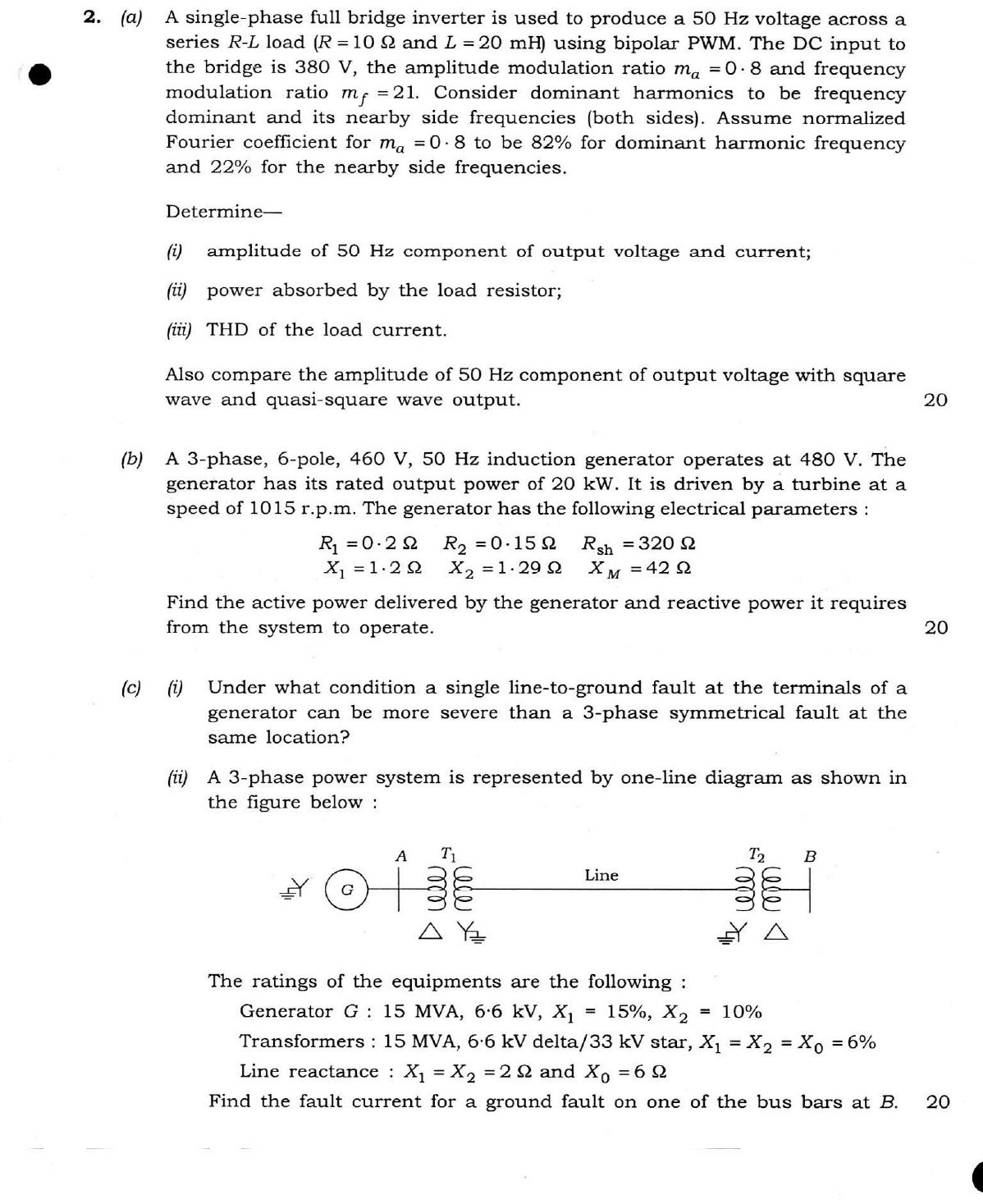
The figure this question refers to, in words
The question paper is a scan and the diagram did not survive as text. This is the figure as read from the original page — every component, value and label — so the question can be worked from the text below.
(c) A one-line diagram of a 3-phase power system. From left to right: A generator labeled 'G' is connected to a bus bar labeled 'A'. The generator symbol is a circle with a 'Y' inside, connected to ground. Connected to bus bar A is a transformer labeled 'T1'. The primary side of T1 is connected to bus A and is shown with a delta symbol. The secondary side of T1 is shown with a star symbol connected to ground. The secondary of T1 is connected to a transmission line labeled 'Line'. The line connects to the primary of a second transformer labeled 'T2'. The primary of T2 is shown with a star symbol connected to ground. The secondary of T2 is shown with a delta symbol and is connected to a bus bar labeled 'B'.
What "Calculate" is asking you to do
Apply the standard formula or schedule to data the question has already supplied — a table of readings, cost records, a balance sheet — and produce the number. The method is rarely in doubt; the marks sit in the named intermediate quantities, each of which has to appear as a labelled line.
Structure that answers it
Data as given → formula or standard treatment, named → substitution → each intermediate, labelled → result with units
Where marks are lost
Omitting an intermediate the marking scheme pays for separately, or rounding at an intermediate line so the final figure drifts. In commerce and accountancy, any figure in a statement that no numbered working note supports is treated as unearned.
How this answer will be evaluated
Approach
(a) calculate: given > formula > substitution > result with units > interpretation | (b) calculate: given > formula > substitution > result with units > interpretation | (c(i)) explain: definition/context > points in order > small example > short close | (c(ii)) calculate: given > formula > substitution > result with units > interpretation Full marks: All calculations are correct with clear steps, equivalent circuits, and phasor diagrams.
Key points expected
- Calculate 50 Hz voltage amplitude using modulation ratio
- Determine load impedance and 50 Hz current amplitude
- Calculate power absorbed by the load resistor
- Compute THD using dominant and side harmonics
- Calculate slip from turbine speed and synchronous speed
- Draw the equivalent circuit for the induction generator
- Determine active power delivered to the load
- Calculate reactive power required from the system
Evaluation rubric
Each sub-part is marked on its own, against the marks and word limit printed on the paper.
- (a) Determine voltage/current amplitudes, power, and THD for a PWM inverter with R-L load. 20 marks
calculate— given → formula → substitution → result with units → interpretation
Must cover
- Calculate 50 Hz voltage amplitude using modulation ratio
- Determine load impedance and 50 Hz current amplitude
- Calculate power absorbed by the load resistor
- Compute THD using dominant and side harmonics
Loses marks
- Ignoring the specified normalized Fourier coefficients
- Calculating THD using only the dominant harmonic
Earns more
- Compare 50 Hz amplitude with square wave output
- Compare 50 Hz amplitude with quasi-square wave output
- Explicitly state harmonic frequencies used for THD
Extra mark
- Provide a phasor diagram for the R-L load
- (b) Find active power delivered and reactive power required for an induction generator. 20 marks
calculate— given → formula → substitution → result with units → interpretation
Must cover
- Calculate slip from turbine speed and synchronous speed
- Draw the equivalent circuit for the induction generator
- Determine active power delivered to the load
- Calculate reactive power required from the system
Loses marks
- Using the wrong sign for slip in the equivalent circuit
- Confusing active power delivered with mechanical input power
Earns more
- Correctly identify synchronous speed for 6-pole, 50 Hz
- Show the power flow diagram for the generator
Extra mark
- Include a detailed phasor diagram of the equivalent circuit
- (c(i)) Explain the condition where a single line-to-ground fault is more severe than a 3-phase fault.
explain— definition/context → points in order → small example → short close
Must cover
- State the relationship between sequence impedances
- Explain the role of zero-sequence impedance
Loses marks
- Stating the condition without explaining the physical reason
Earns more
- Mention the specific condition Z0 < Z1
Extra mark
- Provide a numerical example of such a condition
- (c(ii)) Find the fault current for a ground fault on one of the bus bars at B. 20 marks
calculate— given → formula → substitution → result with units → interpretation
Must cover
- Construct the sequence networks for the system
- Calculate the Thevenin impedances at bus B
- Determine the fault current using the sequence networks
Loses marks
- Ignoring the zero-sequence impedance of the line
- Incorrectly connecting the sequence networks for a ground fault
Earns more
- Correctly account for the transformer connections in sequence networks
- Show the per-unit conversion for all components
Extra mark
- Provide a one-line diagram with sequence network connections
Model answer coming soon
Every evaluation on this site is marked against a verified model answer. This question's answer is still being written; evaluation opens the moment it lands.
More from Electrical Engineering 2022 Paper II
- Q1 (a) A single-phase AC voltage controller is feeding a resistive load of 26·45 Ω from an A…
- Q2 (a) A single-phase full bridge inverter is used to produce a 50 Hz voltage across a serie…
- Q3 (a) For the circuit shown below, calculate the output voltage : R₁ = 1 kΩ R₂ = 2 kΩ R₃ =…
- Q4 (a) (i) What do you mean by grading of cables? What are the methods of grading? (ii) Deri…
- Q5 (a) A DC motor has an armature resistance of 0·5 Ω and Kφ of 3 Vs. The motor is driven by…