Paper II — Q7
(a) A full-controlled full-wave bridge AC/DC converter is fed from a single-phase, 230 V, 50 Hz supply, and is in turn feeding to…
A full-controlled full-wave bridge AC/DC converter is fed from a single-phase, 230 V, 50 Hz supply, and is in turn feeding to an R-L load (R = 10 Ω and L = 100 mH). The firing angle α = 60°. Investigate whether load current remains continuous or not. Compute r.m.s. load current considering only the dominant harmonic, and determine the power absorbed by the load. Also compute voltage ripple factor. 20 marks
For the electromechanical system shown below, the air-gap flux density under steady-state operating condition is given by
B(t) = Bₘ sin ωt
Find the instantaneous coil voltage and current along with force of magnetic field origin : 20 marks
In case of a circuit breaker, define the terms 'restriking voltage' and 'RRRV', and express their maximum values in terms of system voltage.
Which circuit breaker is preferred for voltages 132 kV and above?
In a 132 kV system, the reactance per phase up to the location of circuit breaker is 5 Ω and capacitance to earth is 0·03 µF. Calculate the maximum value of restriking voltage, the maximum value of RRRV and frequency of transient oscillation. 20 marks
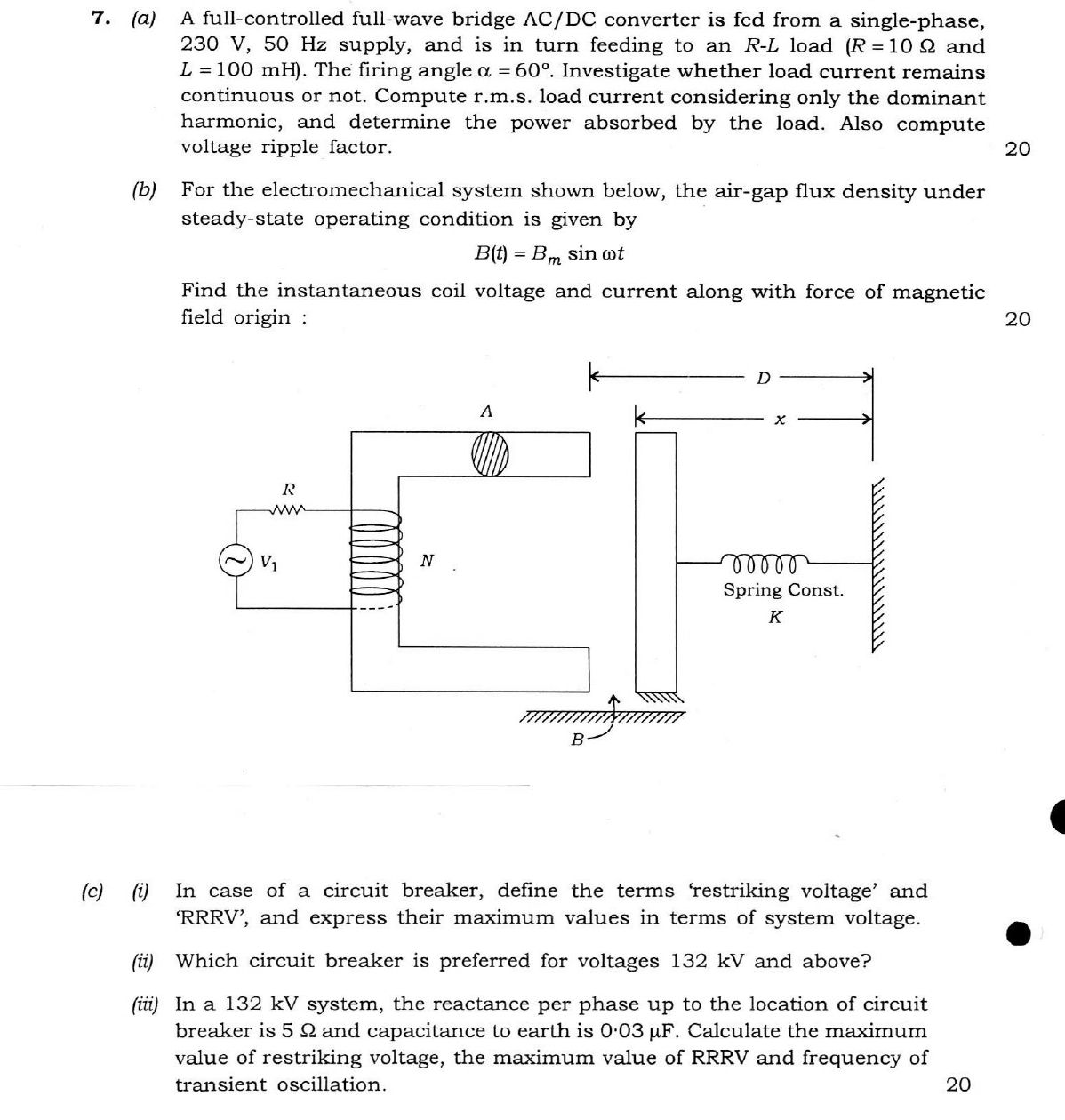
The figure this question refers to, in words
The question paper is a scan and the diagram did not survive as text. This is the figure as read from the original page — every component, value and label — so the question can be worked from the text below.
(b) The question text refers to an 'electromechanical system shown below', but the specific diagram or figure for this system is not present on the provided page. The text only provides the equation for air-gap flux density: B(t) = Bm sin wt.
What "Solve" is asking you to do
Choose the method, then carry it through to a final answer. Identifying what kind of problem this is and why that method applies is the first thing marked; a correct figure arrived at invisibly earns almost nothing.
Structure that answers it
Given data and what is required → method chosen, with the reason it applies → set-up (equation, circuit, free body, trial balance) → working, step by step → answer with units and any condition of validity
Where marks are lost
Doing the middle steps mentally and writing only the result. In mathematics papers, a further loss comes from giving a decimal where the exact value in surds or fractions was wanted, or from skipping the justification a part explicitly asks for.
How this answer will be evaluated
Approach
(a) calculate: given > formula > substitution > result with units > interpretation | (b) calculate: given > formula > substitution > result with units > interpretation | (c(i)) define: precise definition > the distinguishing feature > one example | (c(ii)) describe: define > structure or process in order > labelled diagram > significance | (c(iii)) calculate: given > formula > substitution > result with units > interpretation Full marks: Complete derivations with correct formulas, accurate calculations, and clear physical interpretation of all results.
Key points expected
- Calculate load impedance and critical firing angle for continuity
- Compute RMS load current using dominant harmonic
- Determine power absorbed by the R-L load
- Calculate voltage ripple factor
- Derive coil voltage from flux linkage
- Calculate instantaneous current in the coil
- Determine force of magnetic field origin
- Relate force to air-gap flux density
Evaluation rubric
Each sub-part is marked on its own, against the marks and word limit printed on the paper.
- (a) Determine load current continuity, RMS current, power, and ripple factor for the AC/DC converter. 20 marks
calculate— given → formula → substitution → result with units → interpretation
Must cover
- Calculate load impedance and critical firing angle for continuity
- Compute RMS load current using dominant harmonic
- Determine power absorbed by the R-L load
- Calculate voltage ripple factor
Loses marks
- Assumes continuous current without verification
- Ignores inductive reactance in impedance calculation
- Incorrect harmonic analysis for RMS current
Earns more
- Correctly identifies continuous vs discontinuous mode
- Uses appropriate Fourier series for output voltage
- Considers phase shift in load current
Extra mark
- Includes phasor diagram of load current
- Provides graphical representation of current waveform
- (b) Find instantaneous coil voltage, current, and magnetic force for the electromechanical system. 20 marks
calculate— given → formula → substitution → result with units → interpretation
Must cover
- Derive coil voltage from flux linkage
- Calculate instantaneous current in the coil
- Determine force of magnetic field origin
- Relate force to air-gap flux density
Loses marks
- Confuses flux density with flux linkage
- Ignores spring force in equilibrium
- Incorrect differentiation of flux expression
Earns more
- Correctly applies Faraday's law for voltage
- Considers spring constant in force balance
- Uses energy method for force calculation
Extra mark
- Includes free-body diagram of the armature
- Shows time-domain waveforms of voltage and force
- (c(i)) Define restriking voltage and RRRV, expressing maximum values in terms of system voltage.
define— precise definition → the distinguishing feature → one example
Must cover
- Define restriking voltage in circuit breaker context
- Define RRRV (Rate of Rise of Restriking Voltage)
- Express maximum restriking voltage in terms of system voltage
- Express maximum RRRV in terms of system voltage
Loses marks
- Confuses restriking voltage with recovery voltage
- Fails to express values in terms of system voltage
- Incorrect definition of RRRV
Earns more
- Distinguishes between transient and steady-state voltages
- References standard circuit breaker terminology
Extra mark
- Includes typical values for common voltage levels
- References relevant IEEE or IEC standards
- (c(ii)) Identify the preferred circuit breaker type for voltages 132 kV and above.
describe— define → structure or process in order → labelled diagram → significance
Must cover
- Name the preferred circuit breaker type
- Justify selection for 132 kV and above
- Mention key advantages of this type
Loses marks
- Names incorrect breaker type for high voltage
- Fails to justify the selection
- Confuses low-voltage and high-voltage applications
Earns more
- References specific breaker technology (e.g., SF6, vacuum)
- Consists of reliability and maintenance factors
Extra mark
- Includes comparison with other breaker types
- Mentions specific manufacturers or models
- (c(iii)) Calculate maximum restriking voltage, RRRV, and transient oscillation frequency for the 132 kV system.
calculate— given → formula → substitution → result with units → interpretation
Must cover
- Calculate maximum restriking voltage
- Determine maximum RRRV value
- Compute frequency of transient oscillation
- Use given reactance and capacitance values
Loses marks
- Incorrect use of reactance and capacitance
- Fails to convert units properly
- Wrong formula for oscillation frequency
Earns more
- Correctly applies LC circuit formulas
- Considers system parameters accurately
- Provides units for all calculated values
Extra mark
- Includes phasor diagram of transient response
- Shows step-by-step calculation process
Model answer coming soon
Every evaluation on this site is marked against a verified model answer. This question's answer is still being written; evaluation opens the moment it lands.
More from Electrical Engineering 2022 Paper II
- Q4 (a) (i) What do you mean by grading of cables? What are the methods of grading? (ii) Deri…
- Q5 (a) A DC motor has an armature resistance of 0·5 Ω and Kφ of 3 Vs. The motor is driven by…
- Q6 (a) A 20 kW, 500 V DC shunt motor (having 90% full-load efficiency) has 40% armature copp…
- Q7 (a) A full-controlled full-wave bridge AC/DC converter is fed from a single-phase, 230 V,…
- Q8 (a) A signal is given by x[t] = cos(28πt) + 2cos(40πt) + 3cos(70πt) This signal is sample…